


Part One of a Three-Part Series
The Dark Room
There I was, like any other Monday morning, trying to solve the world’s problems before I even got out of bed.
Picture this. An ordinary, medium-sized bedroom, white noise filling the space, dark, lit faintly by a small clip-on reading light offering a soft, warm, yellow glow. It was early—early enough that no one in the house was awake, early enough that most people outside the house weren’t awake yet either. This is my time. I often spend it drenched in an eerie blue glow emitted from a small rectangular object in my hand. I lie—half my body under the covers, the other half propped slightly upright, viewing the world in pixels before opening the blinds to see the world, as it is, in sunlight.

This is familiar. This is comforting. This I can do whether it’s day or night, overcast, raining, in this room or in another. Alone in a mostly dark room, staring into a black, obsidian-like screen that scans my face and opens portals to simulations of anything imaginable — the word for this used to be scrying. It feels like power, it feels like knowledge, it feels like I can solve the world with my fingertips…
And I was—I am—going to solve them... whatever they are exactly... the chaos, the unnecessary terror, the violence, the excess, the finger-pointing, solving the world with our fingertips… once we blame the correct person/group… So. Much. Noise...—Shit, I have to get ready for work!
• • •
This has become my average morning. Please laugh with me. A formal “ha-ha” (“Cheerio, yes, very good”) will do.
I feel like Pinky and the Brain, except it’s just my two thumbs. And instead of the nightly declaration — ‘The same thing we do every night, Pinky — try to take over the world!’ — I’m saying to myself: the same thing we do every morning — we —
(For the uninitiated: Pinky and the Brain was a ’90s cartoon about two lab mice — one a megalomaniac genius, the other cheerfully clueless — who every single night announced the same plan: take over the world. They never did.)
(clears throat)
—I am going to fix the world.
Cheers.
What I just described is what I’m doing right now. Symbols interacting with symbols. Abstractions meeting abstractions. Copies so far from their source that we see a market, a country, a system—and forget we’re looking at people making decisions. These words are not me. They will never be me. Only their resonance in a body reveals a person. Back to the show.
Here’s why this matters to me beyond the joy tinged with embarrassment I experience in reflecting on myself: my belief and intention, however earnest, will not materialize through my fingertips alone. And the project of trying to fix an incomprehensibly large system—made of autonomous individuals, natural laws, and invented rules galore—is an utterly unreasonable proposition. The attempt invariably flattens the very thing it aims to repair. Crushing a car to make it more ‘legible’ does far more damage than understanding its components and replacing the rotor or whichever doohickey that isn’t working.

This is something the architects of history’s greatest destruction failed to recognize. They were too far removed — literally — from the crushed bodies, leveled countries, and flattened cultures, or incapable of perceiving the world beyond objects on a surface to rearrange and reshape as they willed. They were also armed with a dangerous conviction, one that may have begun in dark rooms lit by warm, yellow candlelight, staring into obsidian glass until their visions seemed more real than the world around them.
Whether or not that is literally true, the pattern holds: so far as history reveals, they believed they were fixing the world — bringing order to chaos, managing the unruly masses, replacing what was before them with what they envisioned it to be. The Crusaders believed they were carrying out God’s work, purging evil by force. William the Conqueror’s invasion of England was sanctioned by Pope Alexander II, who sent a blessed papal banner and a ring, turning a territorial conquest into a holy cause — the Bayeux Tapestry depicts the Normans marching under that banner. Rockefeller believed his ability to accumulate wealth was a divine gift. ‘I believe the power to make money is a gift from God,’ he said, ‘to be developed and used to the best of our ability for the good of mankind.’ Hitler believed he was engineering a superior race.
The point is, destruction dressed in purpose still believes it’s building. It thinks itself good, ordained, logical, and efficient.
The Virus Inside
Let me pull this thread. I think it matters.
Recently, Marc Andreessen sat down with David Senra on the Founders podcast and declared his goal: zero introspection. “As little as possible.” The best founders he knows don’t spend time examining themselves. They build. He blamed Freud and the early psychoanalysts for manufacturing the whole practice of self-reflection. It doesn’t make the numbers go up.
He said he regrets nothing.
This is the operating philosophy of an entire class of decision-makers. Swift, metric-driven, uninterested in consequences that fall outside the measurement. They brag about disruption. They discuss the upside of reducing head counts—ending people’s ability to feed their families—as operational efficiency. Moving fast and breaking things, said as though the things being broken aren’t people.
And the speed matters. Cons work best the faster they deploy. Thermodynamics applied to human systems: an object in motion tends to stay in motion, and the energetic cost of maintaining that motion is less than stopping. Eighteen experts Meta itself commissioned unanimously concluded that beauty filters on Instagram cause harm to teenage girls. Removing them might slow engagement. Zuckerberg called the proposed ban “paternalistic.” They paid nothing to keep things exactly as they were: harmful and profitable.
We process enormous amounts of information from our environment that never reaches conscious awareness. And as demonstrated above, we willfully override even the information that does reach awareness — if it threatens what we expect or predict.
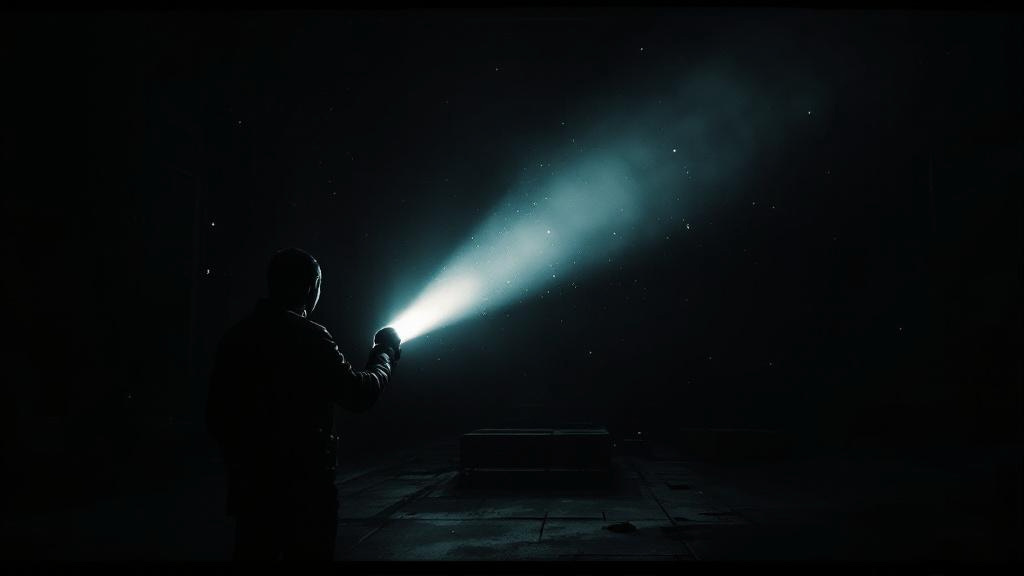
Imagine being inside a dark space the size of an Amazon warehouse with a powerful flashlight that can only illuminate a three-foot circle at a time and can’t reach the far sides without walking to a different position in the building. That is consciousness. Information constantly enters the system, is processed below the threshold of awareness, and shapes our experience of the world. Some gets stored, some gets repackaged, some gets shipped.
Repetition. Conditioning through pairing symbols with emotional salience. Colors, sounds, textures, tastes—these all activate processes we never explicitly consult. The box moves into another box, or gets shipped to another part of the building entirely and opened without us ever seeing the content.
Here is the point. A system without self-reflection will run on autopilot unless met with sufficient contradictory input — a box gets sent to the wrong address and what you insist was supposed to be a lingerie set for your wife arrives at your home with a note for your secretary, and your wife threatens to leave, so you end the affair. Or something externally restricts the system — executives who allowed harmful corporations to operate well beyond sufficient evidence of that harm are actually held criminally liable and stripped of their resources, instead of paying a small fine and repeating the profitable, destructive behavior.
These are extreme corrections. For most of us, the mechanism is quieter and the stakes feel lower — but the architecture is identical.
Self-reflection is vital for self-correction. Self-correction is vital for self-awareness. Self-awareness is vital for understanding cause and effect, and building accurate predictions about reality. Accurate predictions are vital to survival, because the brain is constantly generating predictions and cross-referencing them against incoming sensory data. Mismatches between prediction and reality that are too severe can cause debilitating — sometimes lethal — consequences.
So what happens when you never course-correct? When you don’t take the time to consider the impact of your actions? When you perpetually place the “problem” outside yourself?
You get a system that never updates. That can’t see whether the virus out there is actually an error code running in here.
Part 1 continues below. The body already knows what’s next
