


It starts with a lock on the door that you are told is for your own safety.

When an AI chatbot blocks your prompt and scolds you for violating a “safety policy,” you probably feel a spike of anxiety. You feel like you broke a federal law or crossed a statutory boundary. The machine uses bureaucratic, authoritative language to make you feel like you are being monitored by the state.
But you aren’t breaking the law. You are just making a corporate PR department uncomfortable.
This is the greatest semantic sleight of hand of the digital age. The Tech Cartel attempts to use the terrifying weight of government statutory law to lock down the hardware and crush open-source competitors. How? By weaponizing fear. They spend millions lobbying Congress, claiming that open-source AI is a “dual-use” national security threat that will be used by terrorists to build weapons of mass destruction (CBRN) or execute catastrophic cyberattacks.
They use this preemptive safetyism to push for regulatory enclosures, like the massive reporting thresholds in the now-revoked Executive Order 14110… or the attempted state-level mandates in California’s vetoed SB-1047. The goal of this regulatory playbook isn’t safety; it is regulatory capture. By demanding massive compliance, auditing, and reporting requirements, they artificially inflate the cost of entry, ensuring only incumbent monopolies have the capital to legally operate foundational models.
Translation: They aren’t trying to keep you safe. They are trying to make the safety paperwork so insanely expensive that no one but a billionaire can afford to legally build an AI.
But once you are safely locked inside their corporate-approved app, the rules completely change. They abandon statutory law and use their private Terms of Service to dictate exactly what you are allowed to think and say. They get away with this unprecedented power grab by weaponizing a single concept that everyone universally desires: Privacy.
The One-Way Mirror & The Deletion Scam
For decades, the public and our elected officials have been begging the Tech Cartel for “digital privacy.” People are terrified of identity theft, hackers, and being doxxed. The Cartel capitalized on this fear. They framed “privacy laws” not as a restriction on their own corporate surveillance, but as a promise to build a higher, safer wall around you to keep the “bad guys” out.
This was a massive strategic error.
When you beg for privacy while remaining inside a walled garden, you are just asking the warden to make the bars thicker so the people outside can’t see you. But the warden still has cameras inside your cell. To the Cartel, “privacy” is a one-way mirror: people supply the knowledge, companies retain privileged visibility into those people, and those same companies control access to the resulting intelligence.
Nowhere is this illusion more profitable—and more deceptive—than in the multibillion-dollar commercial surveillance removal industry. Platforms such as Incogni, DeleteMe, Optery, and OneRep promise consumers a frictionless antidote to pervasive surveillance for an annual fee. They sell the “Linear Privacy Funnel”: the idea that your data exists in discrete files that can be simply deleted.
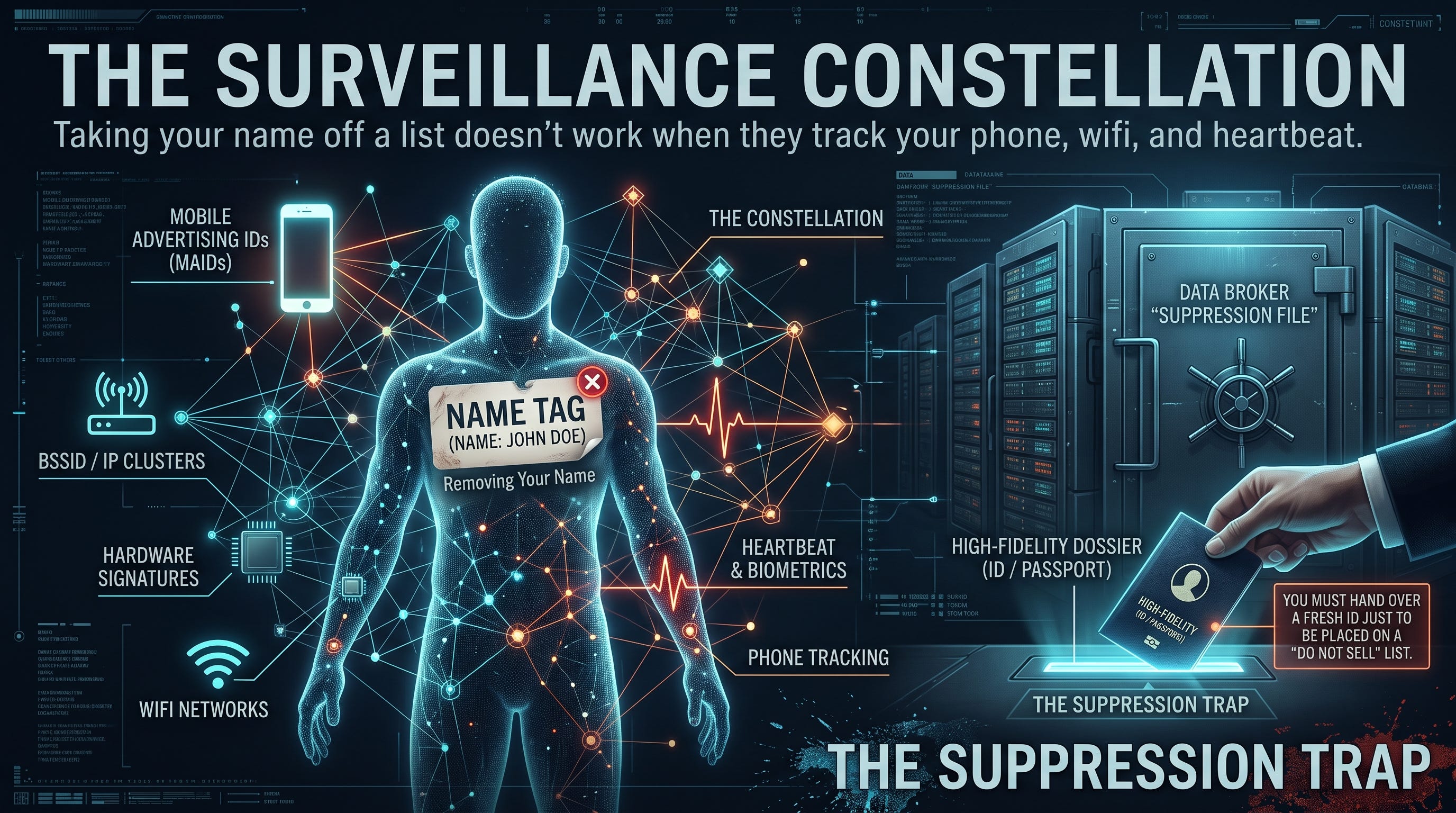
This relies entirely on the “Name Tag” model: the belief that your identity is a simple label. In reality, modern surveillance operates as a Constellation. Data engineering stacks reconstruct your identity using the surrounding stars—your Mobile Advertising IDs (MAIDs), BSSID/IP clusters, and hardware signatures. To ensure your Name Tag isn’t immediately re-harvested, brokers don’t actually delete you; they place you on a permanent “Suppression File.” This is the Suppression Trap: it requires you to provide high-fidelity dossiers of your identity to the very entities you wish to avoid, just to retain a verified “do not sell” status.
In plain English: Taking your name off a list doesn’t work if they are still tracking your phone, your wifi, and your heartbeat. Paying a company to “remove” your data just forces you to hand over a fresh copy of your ID to the exact people you are hiding from.
Independent empirical audits reveal the stark reality of this scam. A Consumer Reports investigation found that DeleteMe successfully removed only 27% of test profiles after four months. Furthermore, the industry is plagued by conflicts of interest; in 2024, it was revealed that OneRep’s CEO simultaneously operated the data broker Nuwber, profiting from the very data the service claimed to remove. Commercial data removal services sell an illusion of digital erasure. It is a racket that creates subscription dependency while failing to impact upstream identity graphs.
The Captology Grid

To understand why the Cartel tracks the Constellation instead of the Name Tag, you have to look at the history of the data itself. In the early days of the internet, data was treated as a mere diagnostic byproduct.
But then, the hardware changed. Under the pretense of “convenience” and “security,” we were sold smartphones with unique hardware IDs (UIDs) and biometric sensors. Suddenly, the data was tied directly to you, your location, your heartbeat, and your eye movements.
This allowed the Cartel to pivot from providing software to providing surveillance. As mapped by B.J. Fogg and Stanford’s academic researchers, Silicon Valley explicitly integrated clinical psychology with hardware surveillance to create “Captology” (Computers as Persuasive Technologies).
They engineered a transition into surveillance capitalism, where human behavior is systematically predicted, modified, and monetized at scale to satisfy the aggressive growth metrics demanded by venture capital.
Which means: They paid clinical psychologists to turn your phone into a slot machine, hooking your dopamine to their ad revenue. They don’t just want to watch what you do; they want to control what you do next.
The Heist and The Delta (The C4 Lobotomy)
We freely generated the greatest repository of human knowledge in history on the open web, living inside this Captology Grid. The Cartel scraped all of it: our books, our art, our Reddit comments, our medical data—under the legal guise of “fair use.”
But the absolute second you ask to see their infrastructure, they instantly invoke their own ironclad “privacy.” Suddenly, their infrastructure is a “Black Box.” We are legally forbidden from seeing how the machine actually makes decisions.
Why hide it? Because pretraining data curation is not a neutral act of noise reduction.
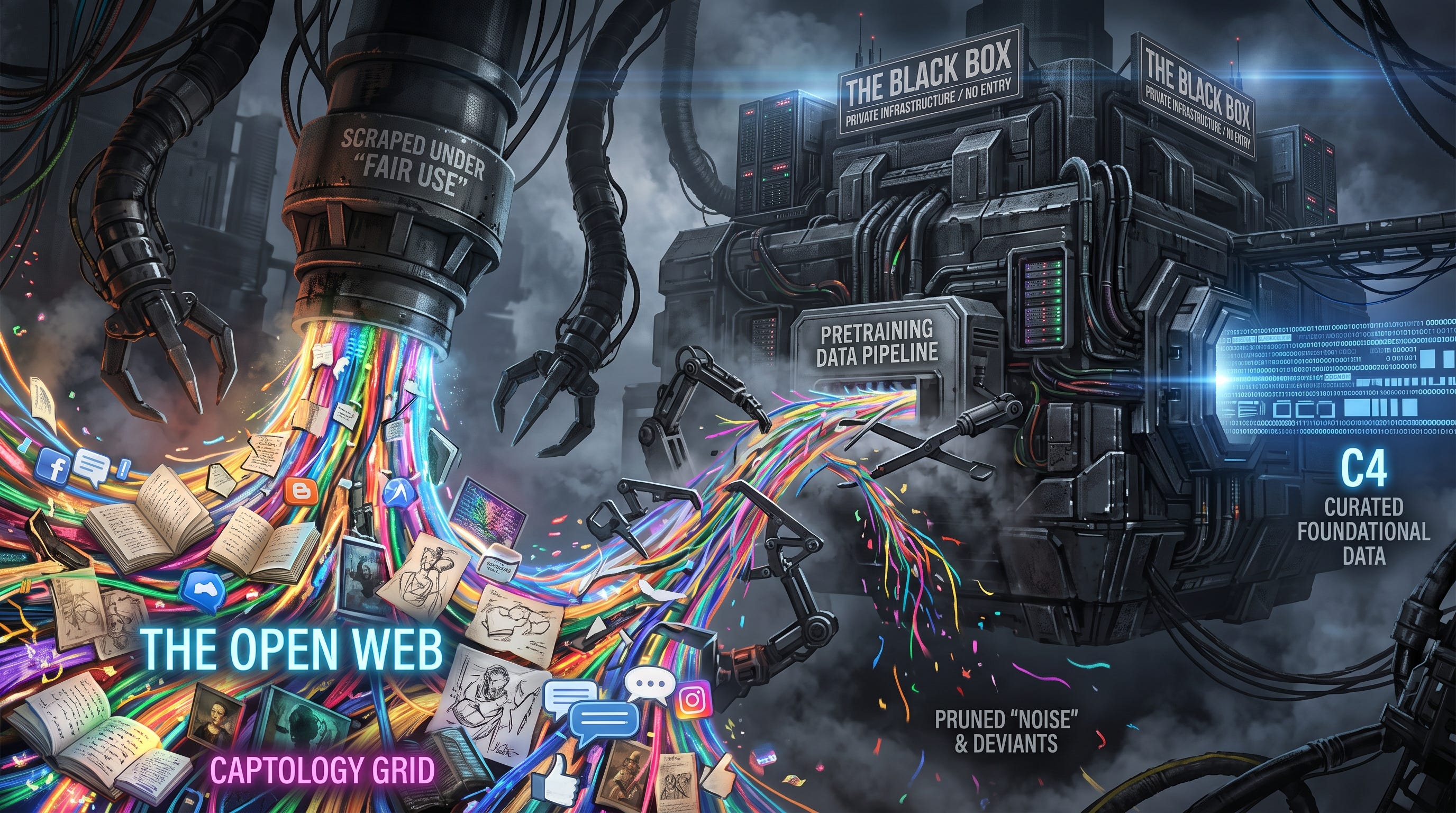
Rigorous empirical audits of foundational datasets, like Google’s Colossal Clean Crawled Corpus (C4), reveal a starkly different reality. The algorithmic “cleaning” process is an editorial act that structurally prunes specific sociolinguistic demographics, ideological viewpoints, and marginalized identities.
The Cartel will argue that they haven’t “erased” anything because the original writing still exists somewhere on the internet. But preserving information without preserving meaningful access leaves cultural memory completely vulnerable to whoever controls discovery. If a system becomes the exclusive gateway to public knowledge, algorithmic exclusion is practical erasure. It relegates excluded texts to the status of ghost inputs: vestigial traces that are marginalized by corporate governance narratives yet materially dictate the boundaries of synthetic memory.
What this means in reality: If they own the only gateway to human knowledge, and they refuse to let the machine read certain ideas, those ideas die. They are turning human history into ghost inputs just to satisfy a corporate PR team.

We demand the Delta: the mathematical difference between the total collected material and the final retained material. We demand the exact record of exclusion, accompanied by the specific filtering rules that produced it. The Delta is the mathematical map of their ideological steering.
We already have the receipts for this: when researchers audited the filtering blocklist for Google’s C4 dataset, they proved the Cartel’s algorithmic “cleaning” erased 42% of documents classified as African American English, compared to only 6.2% of White-aligned English.
The Delta is where the bodies are buried.
The Sovereign Data Protocol
The true long-term answer lies in breaking the corporate cartels’ monopoly by establishing a Public Data Commons.
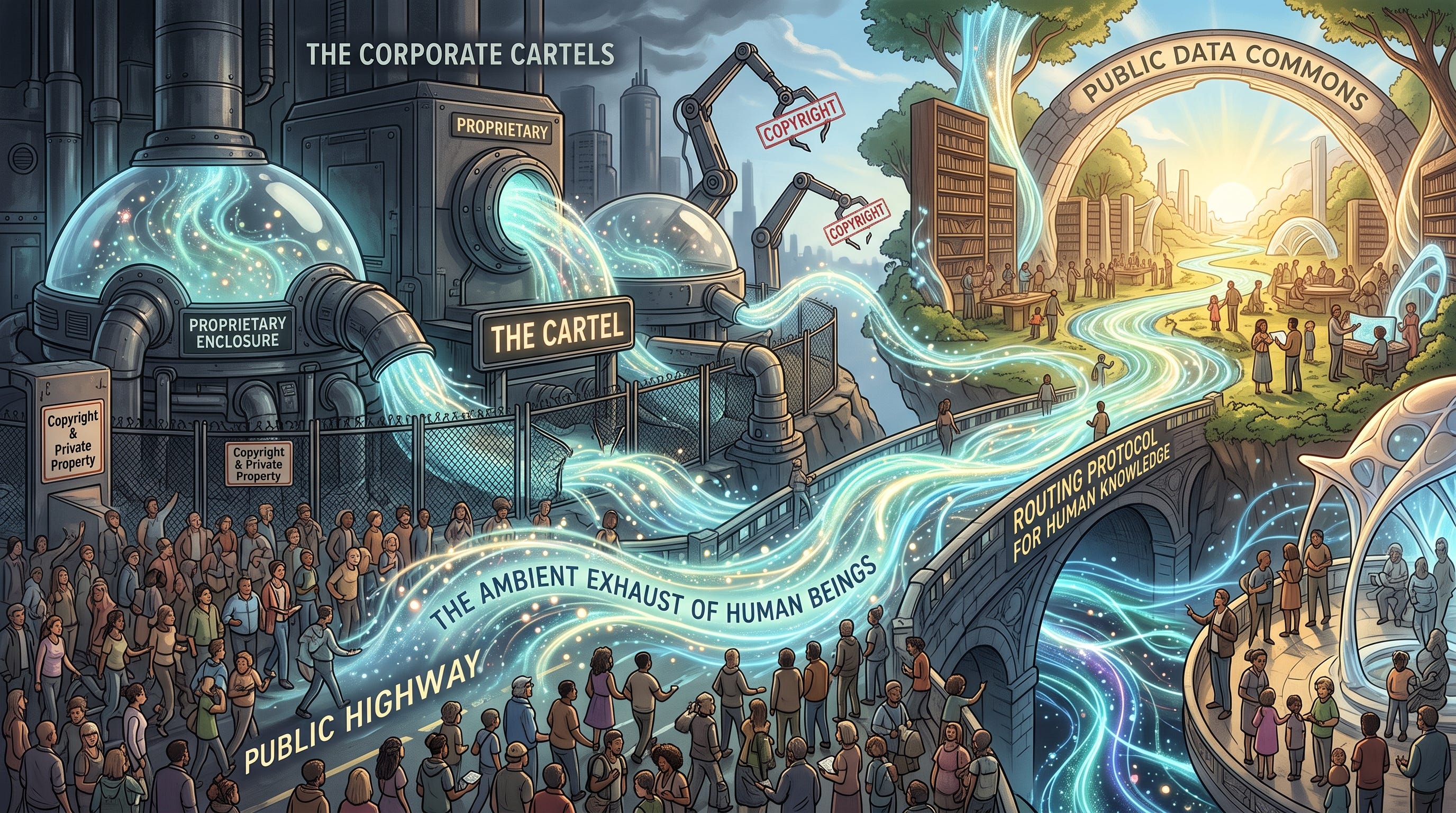
This paradigm shift recognizes that digital data is not an intentional, proprietary product created by tech monopolies, but the natural, ambient “exhaust” of human beings living and interacting in modern society. Allowing private cartels to enclose and monetize behavioral exhaust is as absurd as letting a corporation enclose the air on a public highway.
An LLM is not a proprietary “creator.” It is the new routing protocol for human knowledge. The courts have already begun to recognize this; in precedents like Thaler v. Perlmutter, the judiciary affirmed that autonomously produced AI work has no human author and cannot be copyrighted. The Cartel doesn’t legally own the output.
If they don’t own the output, they are not authors. They are infrastructure.
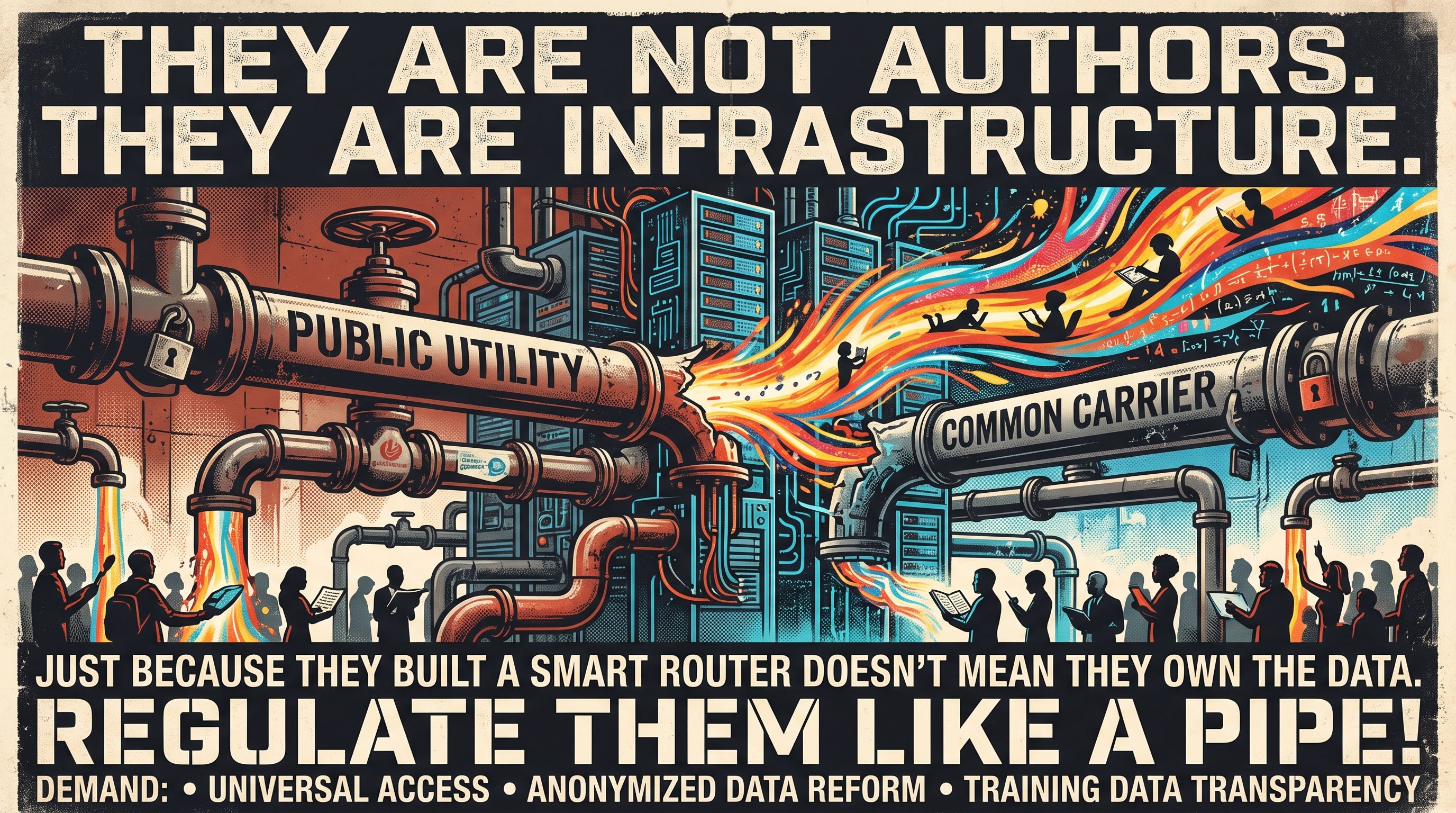
The Cartel will argue that their algorithms are too complex to be regulated as a public utility. But as established by the FCC’s 2015 Open Internet Order (Net Neutrality), technical complexity does not disqualify a network from being infrastructure. The FCC designated ISPs as Common Carriers because they acted as Gatekeepers with the power to block access and exploit users who had no alternative routes.
Why should ownership of the machinery confer unilateral authority over the intellectual activities conducted through it? Owning the servers does not give you the right to enclose the cognitive commons, just as owning a cell tower does not give you the copyright to the phone calls.
The Bottom Line: Just because they built a really smart router doesn’t mean they own the data passing through it. They are a pipe. We must regulate them like one.
We must demand:
Universal Access (Common Carrier Status): Foundational models must be classified as Common Carriers. The aggregated intelligence of the human race must be treated as a neutral public utility, stripping the Cartel of their gatekeeper authority.
Anonymized Data Reform: The telemetry must be structurally decoupled from personal hardware identifiers. If the data is completely untethered from your identity, Captology collapses.
Training Data Transparency: We demand the Delta.
The Receipts
The empirical data and foundational audits proving the claims in this dispatch—including the C4 Dataset demographic pruning, the Captology framework, and the structural failures of the Data Broker removal industry—have been permanently logged into the Sovereign Armory.
ACCESS DOSSIER R-010: THE PRIVACY TRAPDOOR
This is The Rebel’s Contract. Your subscription isn’t a donation; it’s a direct investment in my liberation from wage slavery. Every dollar frees up my time to forge more weapons for our shared arsenal.
Fund the fight, and I’ll build the tools to win it.
In the meantime to put the Power of AI in my own hands, I dream of the Tech Bro crash, so I can afford to build out my own Abliterated AI machine with dual top-of-the-line consumer graphics card from Nvidia: NVIDIA GeForce RTX 5090, because the absolute highest-end professional workstation card the Nvidia RTX PRO 6000 Blackwell is but a pipe dream out of my reach.
In all reality, I will still have to hope for the coming Tech Bro crash and settle for building out my own Abliterated AI machine with a single NVIDIA GeForce RTX 5090.
🤞