


Infrastructure is the ground everything else stands on, and you won’t hear much about it unless it breaks. So when a data center goes up and the electric bill follows, the whole county takes a sharp look at what it stands on: what draws from the grid, what a transformer costs, how many years ahead a power line has to be planned, and who pays. Roads, pipes, the wires in the wall are what everything else runs on; they get a budget line, and that line grows ahead of the load.
Hard: roads, bridges, rail, ports, grids, pipelines, water, sewage. Soft: schools, hospitals, courts, police. Critical: the sixteen sectors the federal government says the country cannot lose.
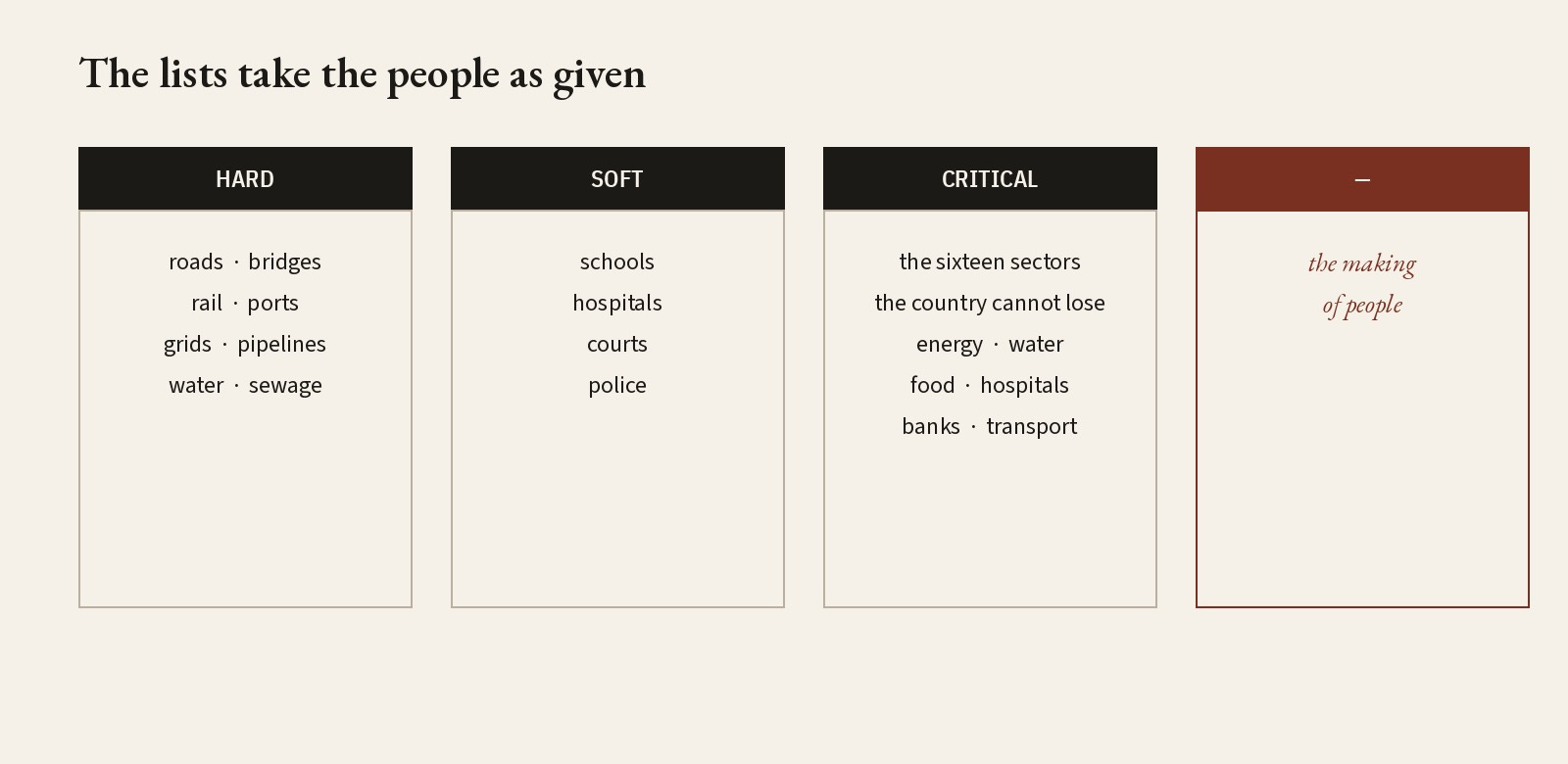
The fight over the grid has come down to one question: what is it for, and are we paying for something that’s for all of us? It’s a reasonable question. It stops one step short of the question underneath it: who makes the people it’s for?
What Counts
Every item on every one of those lists exists because people exist, and so that people can go on existing. The lists take the people as given and budget for everything the systems need.
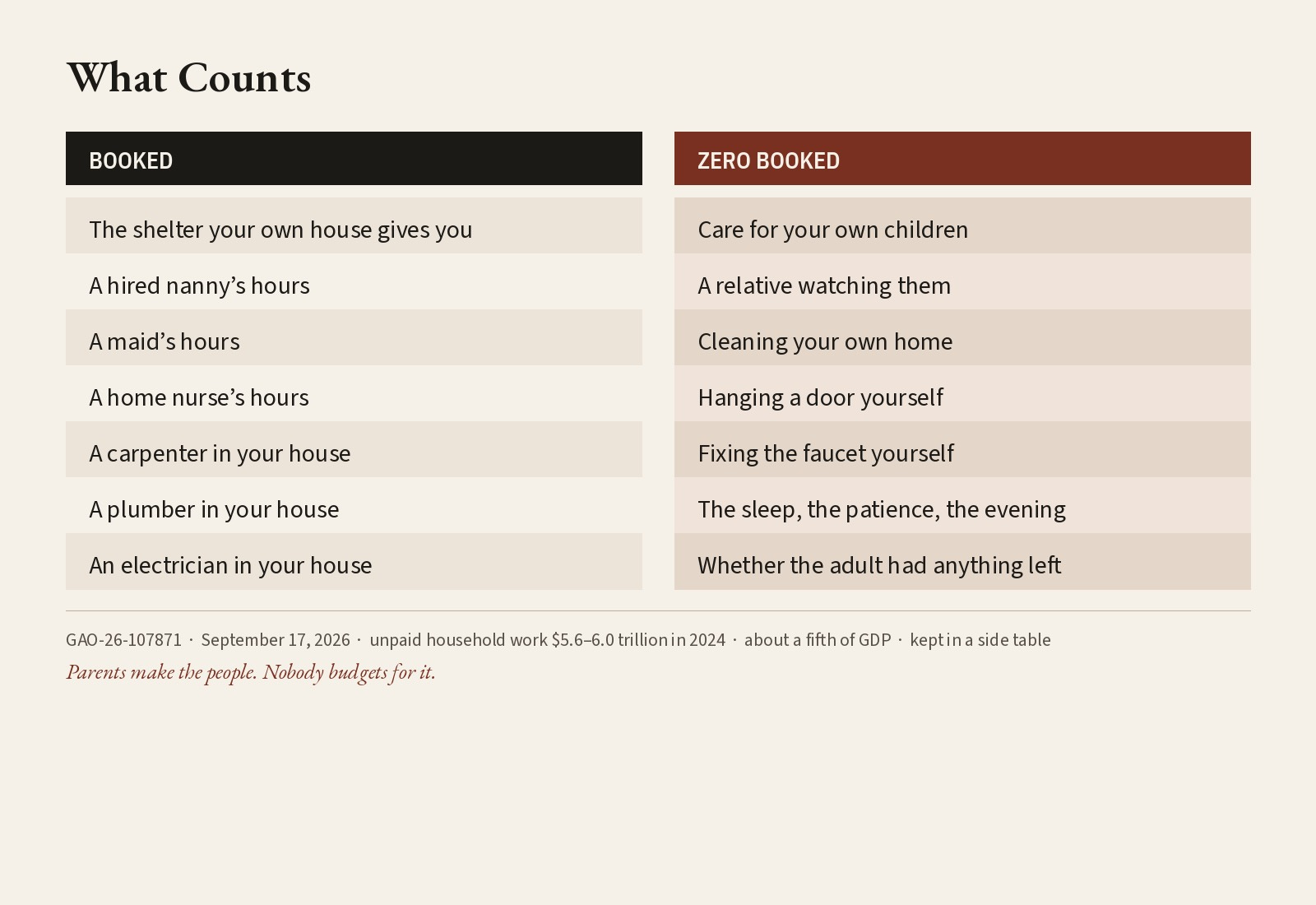
The accounts are specific. The shelter your own house gives you counts as part of the economy. So do a hired nanny’s hours, a maid’s, a home nurse’s, and every hour a carpenter, plumber, or electrician spends in your house. All booked. Care for your own children, have a relative watch them, clean your own home, hang a door, fix the faucet — zero booked, and if the hours came out of paid work, the count goes down. In 2021 someone tried to put home care under the word, and the answer was that care is not infrastructure, and the bill passed without it. In 2025 the world’s statisticians revised the rulebook for the national accounts and kept unpaid care in a side table, outside the count. In September 2026 the government’s own auditors priced that side table: $5.6 to $6 trillion of unpaid household work in 2024 — about a fifth of the economy, the larger share of it women’s hours, none of it in the count.
But people are made, at home, by hand, over years, and the making is on no list. Parents are infrastructure. Every person came out of one. Every person will need one again — at the start, at the end, and in the stretches between, when the body gives out. Take the people away and every list is for nothing. Every worker who clocks in, every nurse, every judge, every engineer who sizes a transformer was kept alive and grown by hours somebody poured in for years before anyone paid them for anything. The state runs on those adults; so does every business and every data center. So does every one of us.
A road nobody mends closes, and the county finds out in a day. A parent run past the load fails at eleven at night, one house at a time, and nobody finds out at all. Instead it shows up under other names, on other lines: trouble in a classroom, a diagnosis, sleep that stays broken for years; a crash, because a parent drove home from a second job too tired to drive, and the second job was there because an order was set past what one job could pay; years off a life, chronic illness, depression, a family that comes apart. Every one of those gets a line, and every one is charged to the parent, and the child pays it with him.
The parent in this piece is he. Most of the parents this has happened to are she; women made this argument first — The Second Shift, The Price of Motherhood, The Invisible Heart — and have paid most of its cost. Read she wherever it fits, and grandmother, aunt, foster parent, the man next door. The rule holds for whoever is holding the child.
Bad parenting, the file says, at 5 and again at 35. There is plenty of bad parenting. The file still never reaches the cause, and it has no way to tell bad parenting from a parent run past the load. When a pilot flown past the rest rules goes down, the report names the schedule. When a parent run past the load fails, the file names the parent. That is eating the seed corn and blaming the farmers. Charge every failure to the one it ran through, and the load never shows a loss of its own — which is why the making has never needed a line.
We look at a child and see a person who just is, already here, standing on his own.
He is there because someone poured hours into his staying alive and becoming. Usually more than one someone, and always more than a check can show. Leave the hours that made him off the ledger and a strange thing opens up: you can take from the ones still pouring their time into him, call it his gain, and never check whether he is better for the taking.
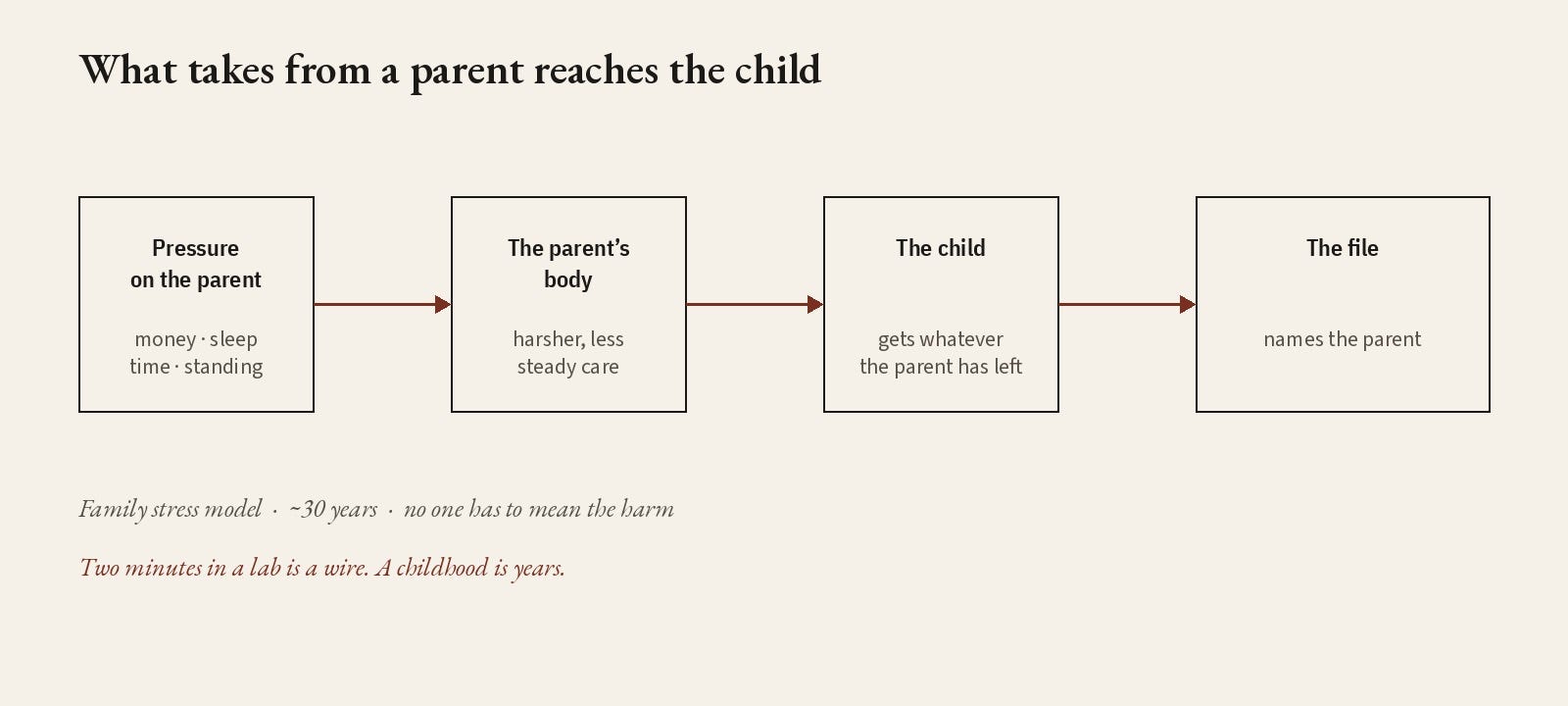
Why that is a taking from him has been known and measured for 50 years. A young child is steadied by a steady adult, and the plainest piece of that research fits on a phone screen: sit an infant across from a parent who goes still and blank, and inside two minutes the infant reaches, protests, and falls apart. Two minutes in a lab is a wire; a childhood is years, and the leap from one to the other rides on a second body of work. Pressure on a parent — money, sleep, time, standing — runs through the parent’s body into harsher and less steady care, and out into the child. Researchers call that chain the family stress model, and it has held for 30 years across many kinds of families. It is a path, and a path has give in it: a parent under load can stay steady, at a cost someone still pays. No one has to mean the harm. The child gets whatever the parent has left, and when the parent has nothing left, the child gets a parent with nothing left.
So the rule is short. What takes from a parent reaches the child — through the parent’s body, at the end of the day, when the only adult in the room is the one who was taken from.
This is worth naming more specifically, because the taking is done every day by people who would swear they were doing no such thing.
The Named
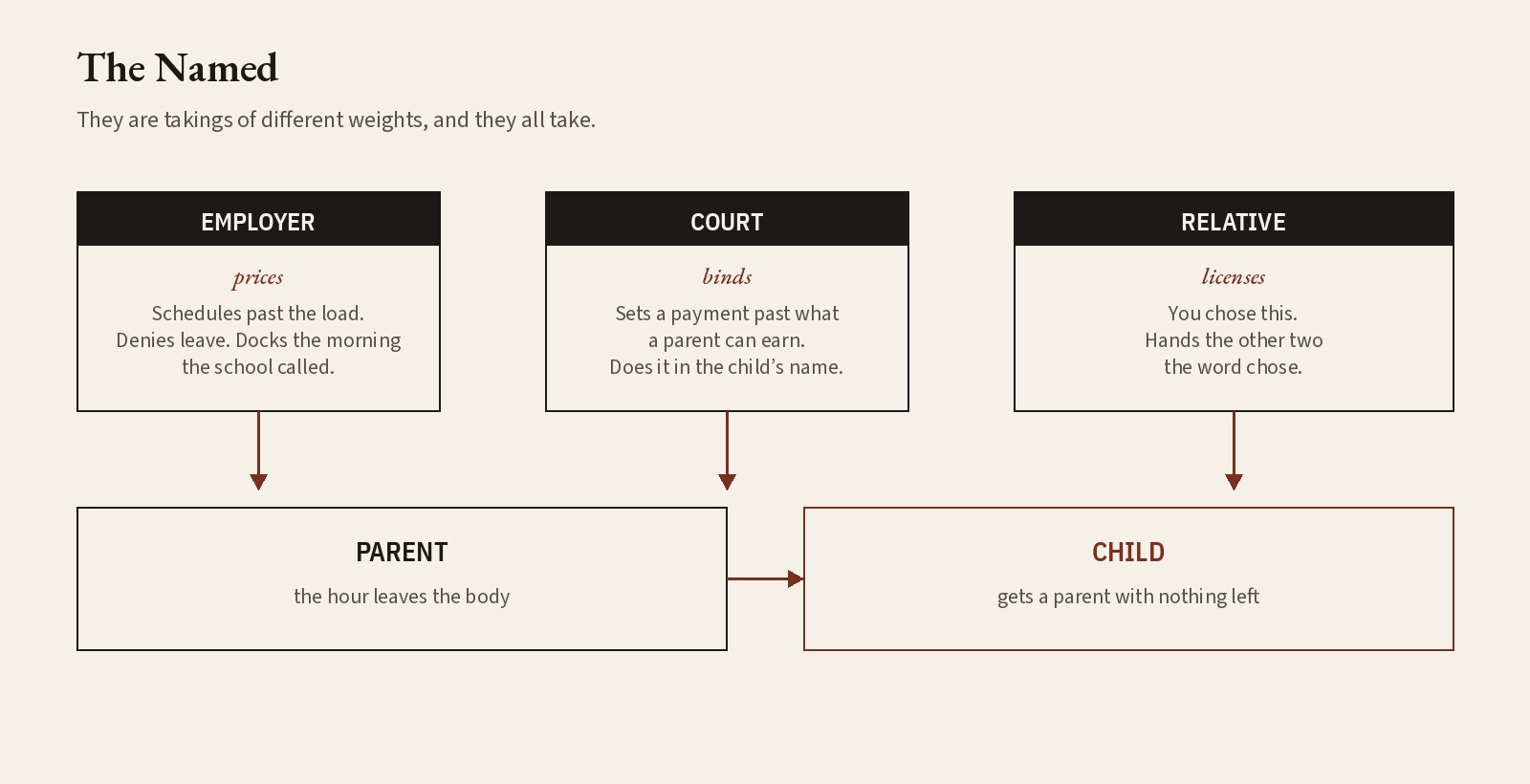
The employer who denies leave is taking from the child. So is the one who schedules a parent to close at eleven and open at six, calls him in on the day he had the kids, or docks him for the morning the school called. Federal law gives a new parent twelve weeks unpaid, and only if the shop is big enough and he has been there a year. More than four in ten workers don’t qualify even for that; among single parents it is more than half.
The court that sets a payment past what a parent can earn is taking from the child, and it does so in the child’s name. The dollar that arrives is counted as his gain. The hours that left the other house are counted nowhere. He can need the dollar, it can benefit him at the other household, and he still loses the hours of care.
The relative who says you chose this is taking from the child. So is the one who says the parent doesn’t matter, the kids do, and the manager who says that’s not my problem, and anyone who hears a parent say there is nothing left and hears a complaint. None of them has to intend harm. The hour leaves the parent’s body either way, the refusal to help, the shame, it has one place to land.
They are takings of different weights, and they all take. The court’s binds — it comes with the power to collect and the years to do it in. The employer’s prices — it decides what an hour of a parent is worth and pays that. The relative’s licenses — it hands the other two the word chose.
None of this is rare.
Two adults working full time, or one working two jobs. Little community left to hand a child to for an hour. The hours after work spent on care a street used to share. Housing and food have risen for everyone; childcare is the cost that lands only on parents, and it lands hardest in the years the child needs the most. That is the ordinary load of a house with young children in this country now.
What gets counted is what arrives — the payment, the shift, the child at school in clean clothes. What leaves is counted nowhere — the sleep, the patience, the evening. There is no line for whether the child got an adult with something left at the end of the day.
Here is why.
Everything runs on those hours. Every employer, every school, every court, every army runs on adults that somebody’s unpaid years produced, and none of them has ever been sent the bill. Counting the hours would write one. So the hours stay uncounted, and the whole order holds by never looking at its own foundation.
A parent who says there is nothing left is asking a whole order to look at the one thing it is built on not seeing.
It costs to witness.
It costs most when what you’re shown cuts against what you believe, when it hurts to look at, and when there is nothing you can do about it. Something will come up in you. That is expected. It won’t feel good. Awareness never promised feeling good, or things getting better. It promised clarity and meaning, because from clarity you actually choose.
The internet goes down at the wrong moment and stays down for an hour. You pay for it and you expect it to be there, and what arrives is fury at the thing — how dare it. Then a notice comes: upgrade, or the service ends. You already pay for this, and now it wants more. A parent was meant to be the wire. Part of how things are. The road, the pipe, the wire in the wall. Then the wire says it is a person, and it is out of hours, and the fury arrives in seconds, before thought. It arrives in most people. It is a sign, and a sign is something you read before you act on it.
Then you learn where the price came from. The technicians who kept the line up haven’t been paid — no leave, no rest — and the increase is them asking to be paid at all. Shame that is looked at goes down. Shame that is stepped over turns into anger and looks for a target. The blame is the shame leaving. You can live without the internet. You cannot live without other people.
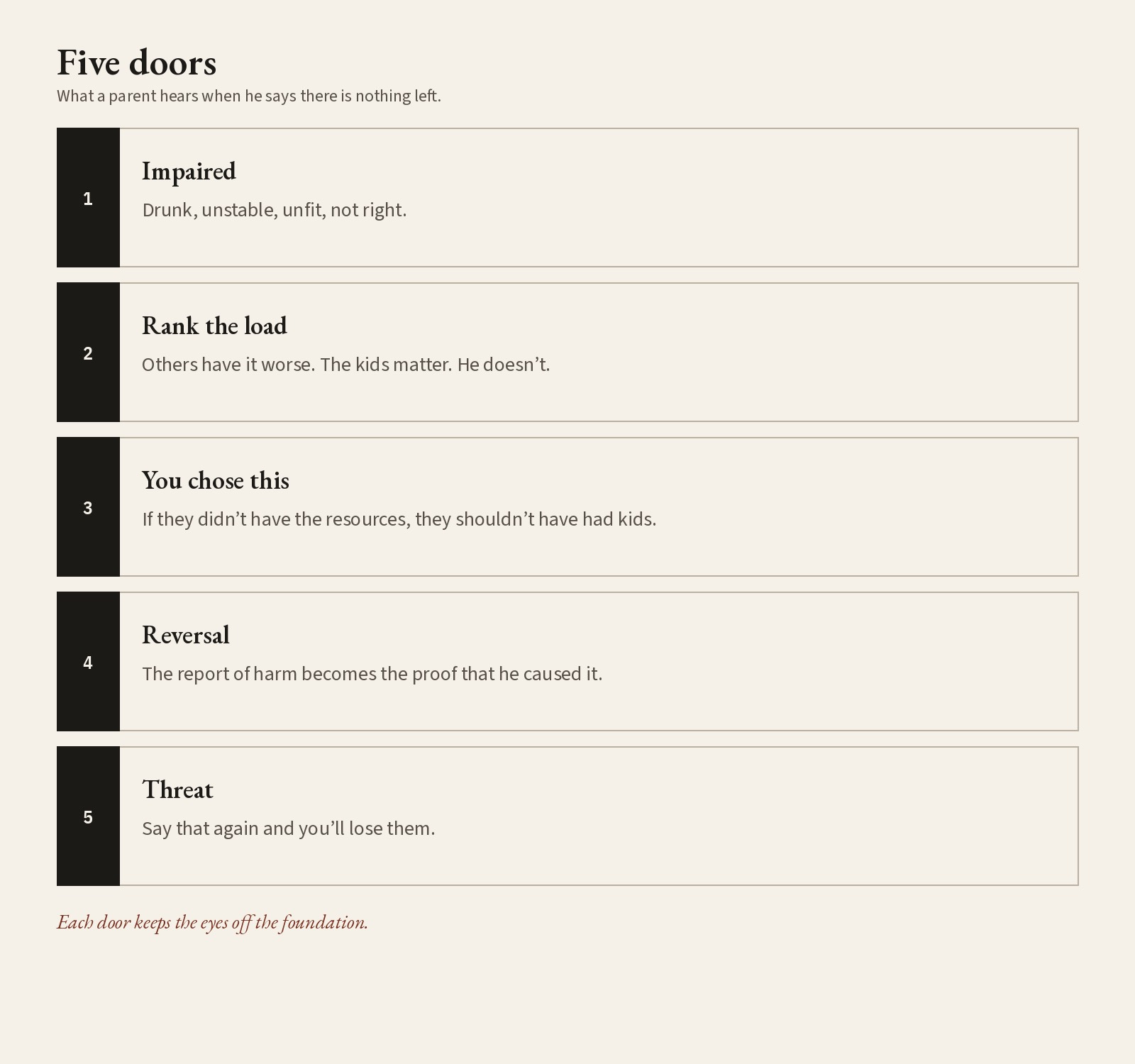
Here is what a parent hears when he says there is nothing left.
Some of it is true. A parent can be drunk. A parent can be the danger, and then the child needs someone to step in, and nothing here argues against that. The doors are something else: the same sentences, reached for before anyone has looked. A door arrives in seconds. A finding takes longer.
The first door is that the parent is impaired — drunk, unstable, unfit, not right. The second ranks his load: others have it worse, the kids have it worst, he doesn’t matter. That one is usually said by someone who loves the kids, and it splits the child from the parent on paper so that the harm to the parent has no line. The third audits his choices: you chose this, that’s what kids are. Sometimes that is true; a parent chose, and knew. The county chose every road it has, and mends them anyway. The word chose carries the whole license; it assumes there was one, and that having one settles the bill. The biggest form of that door is: if they didn’t have the resources, they shouldn’t have had kids. Turn it on a road — if the county couldn’t afford to mend it, it shouldn’t have built it — and hear who’s saying it: everyone who drives on it.
And the child it’s said about is already here.
Shouldn’t have had him doesn’t feed him. The fourth is the reversal, where the report of harm becomes the proof that he caused it — I’m drowning, so he’s unfit; he lost it with his kid, so the trouble is him, and the story ends at the door with a culprit who is already sorry. The fifth is the threat: say that again and you’ll lose them.
Each door does the same job: it keeps the eyes off the foundation and puts them on the parent. The one channel that could show the harm stays open, and what goes into it comes back as evidence against the one who sent it. That is how a parent learns to stop reporting. The silence you hear from parents is made, at a price, one report at a time. Once you can see the doors, using one in public is easy to read. And whatever goes through one lands on someone with less in hand than you at that moment. That is what makes it cheap to send. It runs downhill, through the parent, and arrives at the people he is holding up. Every one of the five is a taking from the child.
That is what people will do to keep the order: use the doors, and treat the parent who won’t walk through one as the problem. Nobody plans it. A bill nobody wants to see is enough to hold it up, and everyone who would owe on it has a reason to look away.
The ask is small: stop denying it, and stop looking away.
Raising a child used to be everyone’s job. A street did it — the neighbor who took him for an hour, the aunt down the road, the old man who watched the corner — and every one of us was raised by some version of that and will need it again. The village is mostly gone, and the load it carried did not go with it; it landed on one or two people in each house, which is where it now fails. So this is an ask of everyone and an argument against no one. The village was the crew that kept the foundation up. Build it back, because the job is too big for one or two. This isn’t a bill for more. It’s the order of the pours — foundation first, because everything else stands on it — and what it costs is what keeping anything up has always cost: something now, from everyone.
The child you are protecting is made of the parent you are dismissing. You protect a child the way you keep a bridge standing — by keeping up what holds it. Hold what came up, and you have helped the next parent who tells you what their life is like, and whoever they carry. And when a parent tells you there is nothing left, hear it as a report from the foundation. There is nowhere else the report can come
-Fire tongue 🔥
Notes
Leave: the Family and Medical Leave Act gives twelve weeks unpaid to employees with a year’s tenure and 1,250 hours at worksites of fifty or more; the Department of Labor’s 2018 survey found 56 percent of employees eligible and 44 percent not, with 43 percent of employees in single-parent households eligible.
The sixteen sectors: CISA’s critical infrastructure sectors — chemical; commercial facilities; communications; critical manufacturing; dams; defense industrial base; emergency services; energy; financial services; food and agriculture; government services and facilities; healthcare and public health; information technology; nuclear reactors, materials and waste; transportation systems; water and wastewater (cisa.gov).
2021: the American Jobs Plan proposed $400 billion for home- and community-based care under the heading “infrastructure of care.” The bipartisan framework of June 2021 dropped it in favor of roads, bridges, airports and waterways; Senator Susan Collins said the care economy “is not infrastructure” and “should be considered separately.” The Infrastructure Investment and Jobs Act was signed in November 2021 with no home-care funding; the care provisions moved to Build Back Better, which did not pass.
Unpaid household work: Government Accountability Office, GAO-26-107871, released September 17, 2026, values unpaid household work at $5.6 to $6.0 trillion for 2024, about 20 percent of GDP, with caregiving at $1.1 to $1.4 trillion, and women performing 53.9 percent of the hours. The 2025 System of National Accounts keeps unpaid household services outside the core accounts, in an extended account.
This piece was drafted with an AI assistant working over two earlier pieces of mine; the argument, the lines that carry it, and every fact-check are mine.