


At the gemologist’s desk, weight is one number recorded. A small tray is placed on the pan and the scale reads 79.5 cts. Press “Tare” and it reads 0.0 cts. Set the stone in the tray and it reads the stone alone. In this case: 15 cts. Lift the stone out and it returns to 0.0 cts. Lift the tray off the pan and the screen now reads −79.5 cts. It reports what it was built to report and negates what it was directed to negate. Everything set on the pan after that reads light by exactly that much, unless the tray is placed on it or “Tare” is pressed again with the tray gone.
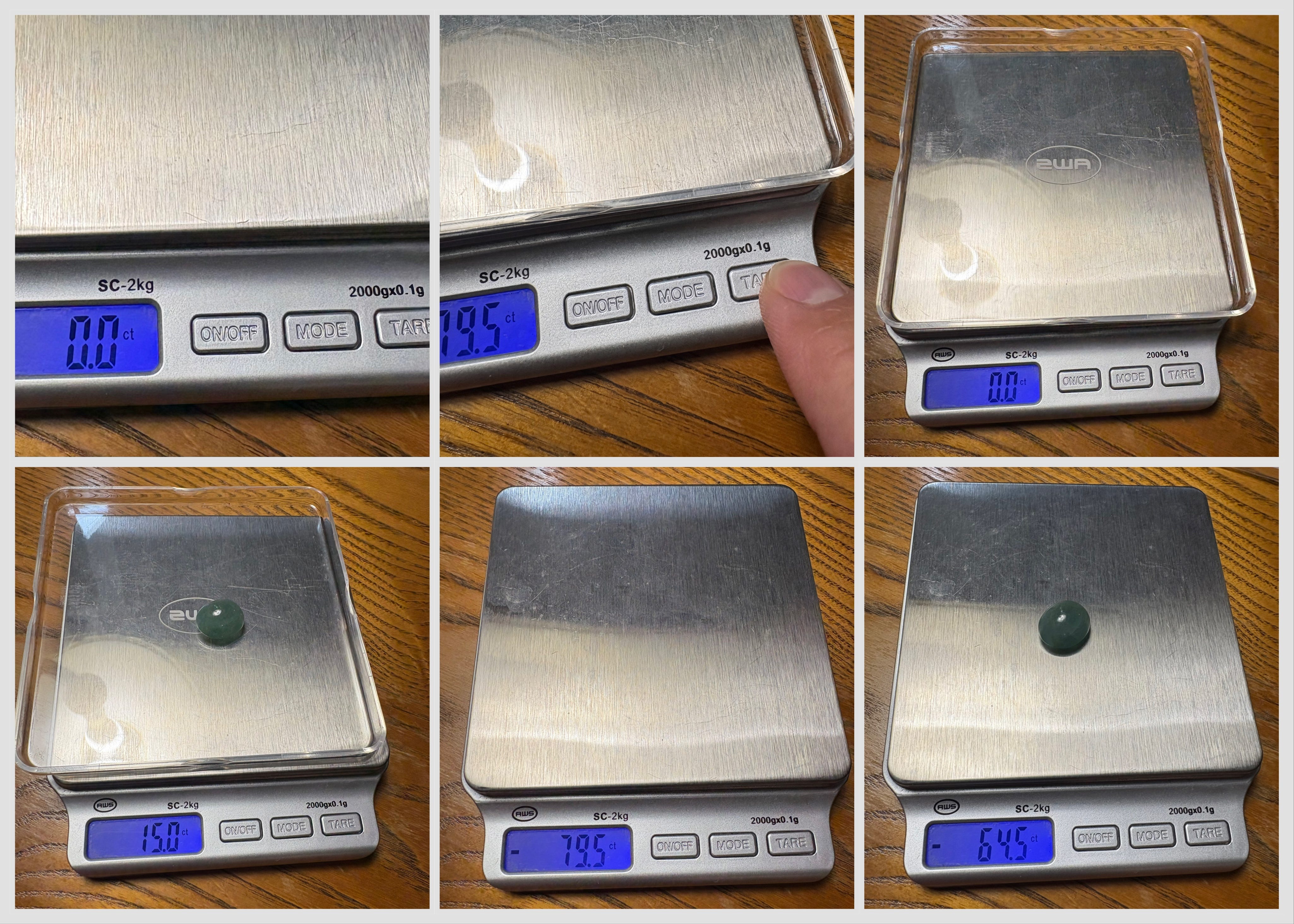
This is one step of many in measuring the value of a gemstone.
A gemologist who stopped at weight wouldn’t be worthy of the title. The scale works regardless of who reads it. Gravel or a Burmese ruby, it measures weight just the same. It can tell you which of two things is heavier, and it can price them by nothing else.
If weight were the only measure, a 100-carat clear quartz would outprice a 2-carat pigeon’s-blood ruby fifty to one. In the gem trade, that quartz brings about $2 a carat and a Burmese ruby of that color and size starts near $10,000 a carat. By what it is, the ruby fetches a hundred times the quartz.
A gemologist who stopped at weight would also process more material, faster. No hours at the microscope, the refractometer, the spectroscope; no color guide, no record of past sales; none of the tests that establish that the stone in hand is what it is called and not a synthetic, a treated stone, or a glass imitation. Lower overhead. Less labor per carat. They’d go through tons while the traditional gemologist moved at the speed of carats.

The gemologist isn’t paid by the stone’s value: the fee buys the record of what the stone is. Skip the test and the ruby is still a ruby. What is lost is the record, and the record is where the price lives. Sold as gravel, it is gone for good, and the mine that made it runs out sooner, because gravel is used by the ton. Unmeasured value lost, with no record of the loss, because the only scale used read weight.
The Hands
The United States set the household on the pan, pressed “Tare”, and read the child as one number. The national account is the scale, and the state is the gemologist who ran the tests and filed them where no price is set.
The household was zeroed, so the measurement that counts in their books was taken without it. The tray is for holding, and the scale treats it as a fixed weight. The child is what gets weighed, and the scale reads a child the way it reads gravel. The tests that would say what a child is, and what it took to make one, exist. The state has run them, in a second set of books, and left the result off the record. The record is where the price lives. Read by the ton, a ruby is gravel, and the mine that made it runs out sooner. The mine is the household.
“The United States” is a tare of its own. Press it and the hands read zero. The word does to accountability what the button does to the tray: everything after is measured without the person who did it. No one has ever touched the United States, which is why the word holds weight so well.
The line that zeroed the household is a boundary in a standards manual, and it has names on it. Simon Kuznets, 1934, in the report that gave the Senate its first national income figure: housewives’ work left out by name, with his note that the item was large enough to change the total, and his warning in the same pages that the welfare of a nation can scarcely be inferred from the number. The exclusion was kept. The warning was dropped. The United Nations has redrawn the line four times since, the last in 2025, and each time it counts the rent an owner is deemed to pay himself for living in his own house and leaves out the care of his own children, for a reason it states: count that work and unemployment is eliminated. The house is counted. The child in it is tared, so the ledger can keep its zero.
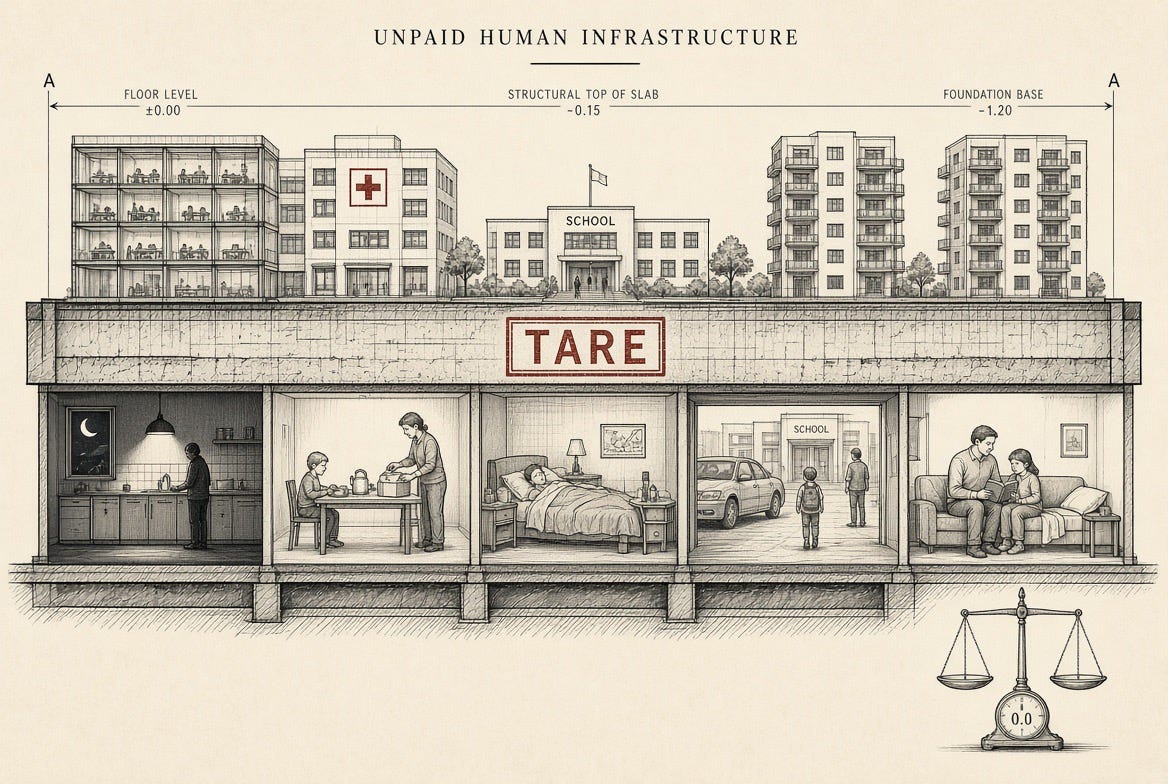
A child is the one input the economy cannot make and does not exist without.
Every industry runs on it: someone to make the thing, someone to sell it, someone to buy it, and each of them was a child first. That is so plain it reads as a given, so it is booked like air. Nobody pays for air. Cleaner air, yes; air enough to breathe, no one prices. Air makes itself. A child is made, by someone, over eighteen years. A firm will carry what it paid to win a customer and nothing for the customer being there. The firm gets a worker, the state a taxpayer, the pension system its next payer, the platform a user, the army a body, the landlord a tenant. Each reads the child as one number, a wage, a return, a headcount, and the number carries none of the years that brought it to the pan.
What forms a person is on the tray.
The sleep that went to a fever.
Three meals a day for eighteen years.
The drives: to school and back, to the pediatrician, to the friend’s house, to practice, and the wait in the parked car.
The hours reading to, singing to, holding.
The teaching that runs before any school opens: the toilet, the shoes, the several thousand words a child walks into kindergarten already carrying.
The scraped knee cleaned.
The hurt feeling sat with until it passed.
The midnight research into what an app is built to do with a child’s attention, what is in the food, and which of the warnings is real.
The people who stayed. The friends, family, and mentors who gave hours no one paid them for.
Nearly every line of that has a number; the state keeps it in the second set of books. In the book that decides what is worth doing, the line reads zero.
Zero it and you have given permission for anything with a price to take its place, because on this scale anything with a price reads heavier than the thing that formed you. That is how a screen outweighs a parent, a shift outweighs a childhood, and a house is counted while the child in it is tared. The zero decides it, with no one in the room.
The tests exist; the second set of books proves it. What makes and maintains and grows a person is measured, and read twice, and never as value.
Read one way it is a resource: the need to belong is what the feed is built on, the need to eat is what the food is engineered to exploit via ultra processed food that hijack a biological system tuned to survival in a natural environment, the need to be held is what the ad sells back.
Read the other way it is a loss: sleep is loss, support is loss, time off is loss, the fever is loss, the parked car is loss. Same need, two readings, and neither is a price paid to the person who has it. So when something arrives that does the work and needs no sleep, no support, no time off, the scale does not have to choose. Whatever needs nothing reads heavier by exactly the weight of the tray.
And you are on a pan somewhere.
To your employer a wage, to the state a taxpayer, to the platform a user, to the landlord a tenant, and the number carries none of the years that brought you to it. Someone sat up with you. Someone drove. Someone packed the lunch and taught you the words you are reading this with, and none of it is on your line either. You are the one input the economy cannot make and does not exist without, and you are still being made: every day you take time, care, energy, patience, fairness, and consideration from people who are here and available to you, and you could name them if you stopped to. They are the tray, and the tray is booked as a fixed weight. Whoever reads you reads with a scale, and the zero on it was set by a hand.
Read a person as inefficiency, as cost, as loss, and the hand is yours. You are here. You are available. Book a human being at zero for being here and available, and you have opted yourself out of the equation. You are being read by the same instrument, at the same zero, and you consented to it.
Everything else you are fighting for is downstream. Every wage is paid to someone who was fed. Every vote is cast by someone who was taught the word. Every machine is trained on the sentences of people who were read to first. Whatever the fight is, it is fought by people and won for people, and every one of them was carried to the pan by someone whose hours read zero.
Put the tray back first.
Fire tongue 🔥
Receipts
- Kuznets, *National Income, 1929–1932*, Senate Document 124, 73rd Congress (1934): households’ services named as an omission large enough to affect the total, and the welfare sentence. King, *Income in the United States* (NBER, 1923), housewives’ services 30.7 percent of national income in 1909, and the 1926 FTC estimate that excluded them, as reported in National Research Council, *Beyond the Market* (2005), ch. 3.
- System of National Accounts 1953, 1968, 1993, 2008; 2025 SNA, ch. 7, endorsed March 2025: the production boundary, owner-occupied housing inside it, “deliberate compromise,” and the unemployment sentence.
- “A second set of books”: BEA household production statistics, 1965–2020 series (*Survey of Current Business*, 2019, 2022) and Working Paper WP2026-15 (June 2026).
I appreciate the thought and rigor here. And I need a Cliff notes version to understand in a way I can effectively share with others. With this understanding do we need a new metric for something we might call “social capital” and new systems and institutions built on that? With missions to nurture and grow those value-based systems? I look forward to proposals here for what transitional steps might look like.
Quick song first. A quick one.