


I am trying to plan a proposal. The market wants a deliverable: three months of wages on a ring, a setup curated for an audience, a story for the feed. I want to ask the woman I love to spend her life with me. Society wants it to be a production.
I am too tired to perform it.
I come home to two children, five and seven, whose nervous systems are co-regulating off mine because I am their safe base, and I am running on no fuel. I want ninety minutes alone. I cannot find ninety minutes.
This is what I mean when I say the system has stripped the annotation.
Love is the annotation.
Time is the annotation.
Presence is the annotation.
The base — the body, the relationship, the child, the grandmother — is still here. What has been removed is everything that lets the base mean what it means.
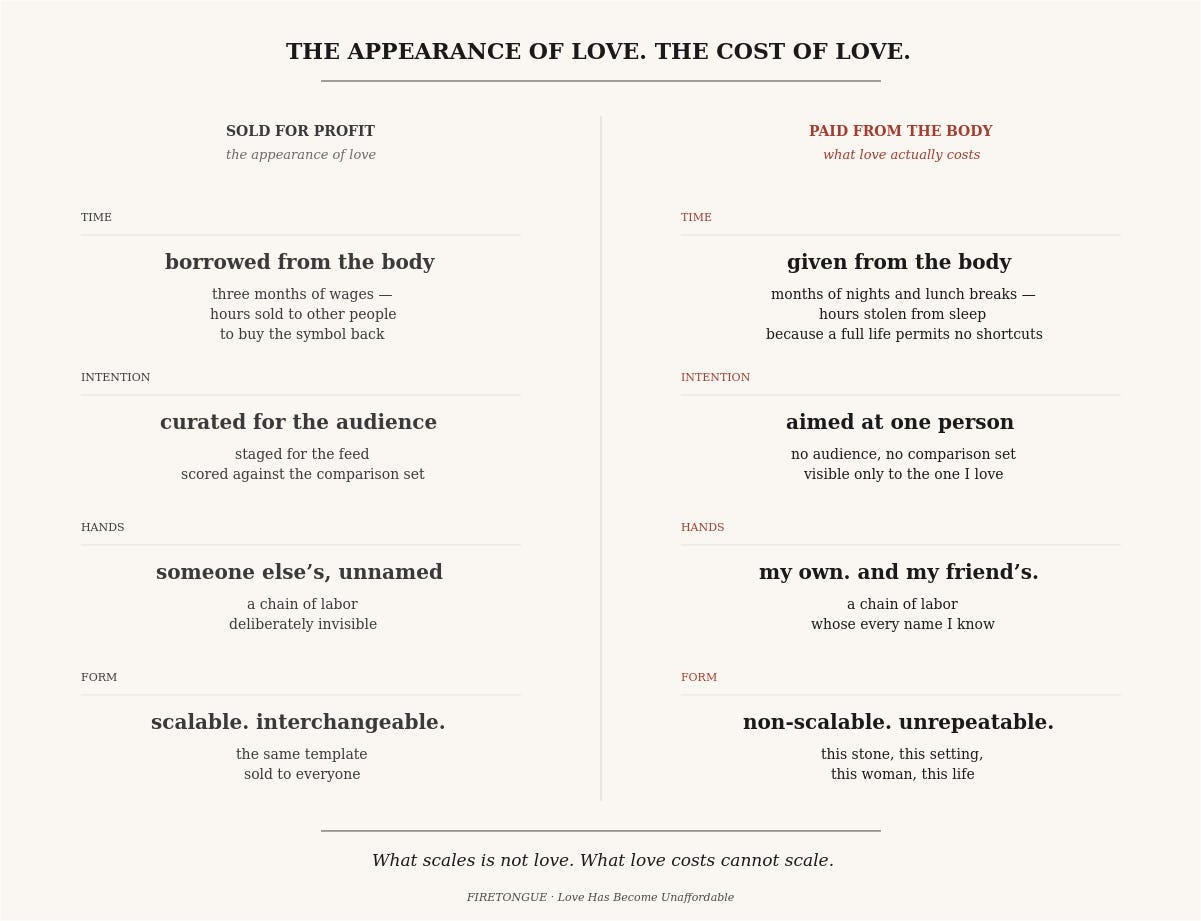
Love sold for profit and love paid from the body are not the same shape. The market has built a version of love optimized for scale: short, repeatable, photographable, fungible. Time borrowed from the body, sold to other people, then bought back as a symbol. Intention curated for the audience, staged for the feed, scored against the comparison set. Hands that are someone else’s and unnamed, a chain of labor deliberately invisible. A form that is scalable and interchangeable, the same template sold to everyone.
The version that costs you something cannot scale. Time given from the body. Months of nights and lunch breaks. Hours stolen from sleep because a full life permits no shortcuts. Intention aimed at one person, no audience, no comparison set, visible only to the one I love. Hands that are my own, and my friend’s, a chain of labor whose every name I know. A form that is non-scalable, unrepeatable. This stone, this setting, this woman, this life.
What scales is not love. What love costs cannot scale.
•
Last week I wrote the prequel to this. A piece called Base Without Annotation. The argument: a system that strips the meaning-layer off everything still keeps the bodies and calls what remains normal. The grandmother becomes malfunction. The caregiver becomes a cost center. The child becomes a target market. Same bodies. Different reading. I posted it. Some of you read the words. Some of you agreed. Some of you scrolled.
If you understood what the words meant, you would act. You would not be able to read them and then go back to the feed.
That is the part I cannot stop turning over. The void is not silence. The void is the polite nod. Agreement is the cheapest form of dismissal. I hear you, I support you, this is so important — and then nothing changes, and the writer goes back to selling watches he cannot afford to people who are buying time they will never live to use.
I am asking you to feel what is on the page until it costs you something. Until you can no longer eat the food, scroll the feed, vote the way you voted, work the job you work, and pretend the bleeding is not happening.
Love has become unaffordable. That is the diagnosis. Until enough of you let that sentence cost you something, nothing will change.
•
The same logic runs the budget.
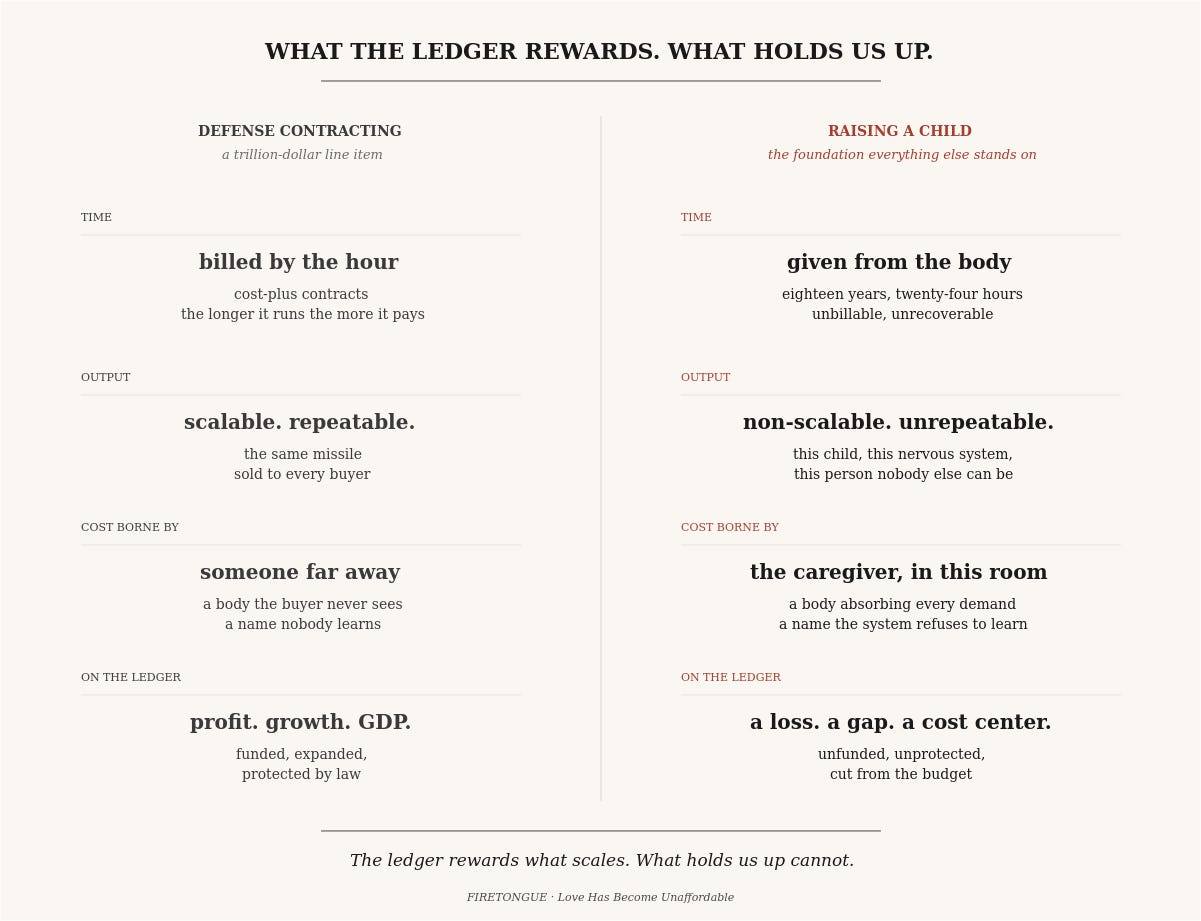
This is not only about my proposal. The same logic that priced love out of reach prices everything that holds civilization up out of reach. The ledger rewards what scales. What holds us up cannot.
A defense contractor bills cost-plus. The longer the contract runs, the more it pays. The same missile is sold to every buyer. The body that absorbs the cost is far away — somewhere the buyer never sees, a name nobody learns. On the ledger: profit, growth, GDP. Funded, expanded, protected by law.
A parent raising a child gives time from the body. Eighteen years, twenty-four hours, unbillable, unrecoverable. The output is non-scalable, unrepeatable — this child, this nervous system, this person nobody else can be. The body that pays the price the ledger refuses to see is in this room. On the ledger: a loss, a gap, a cost center. Unfunded, unprotected, cut from the budget.
These two columns are the budget’s logic, their regularity and repeatability make it clear it isn’t an accident.
•
What earns them is your parent.
My grandmother lives at home because of what was built for the people who can no longer earn. Private equity bought up the nursing home sector. Genesis Healthcare, the largest chain in the country at 175 facilities, was stripped through sale-leasebacks, bankrupted, and bought back by another PE firm through a shell. Mortality runs ten percent higher in PE-owned homes.
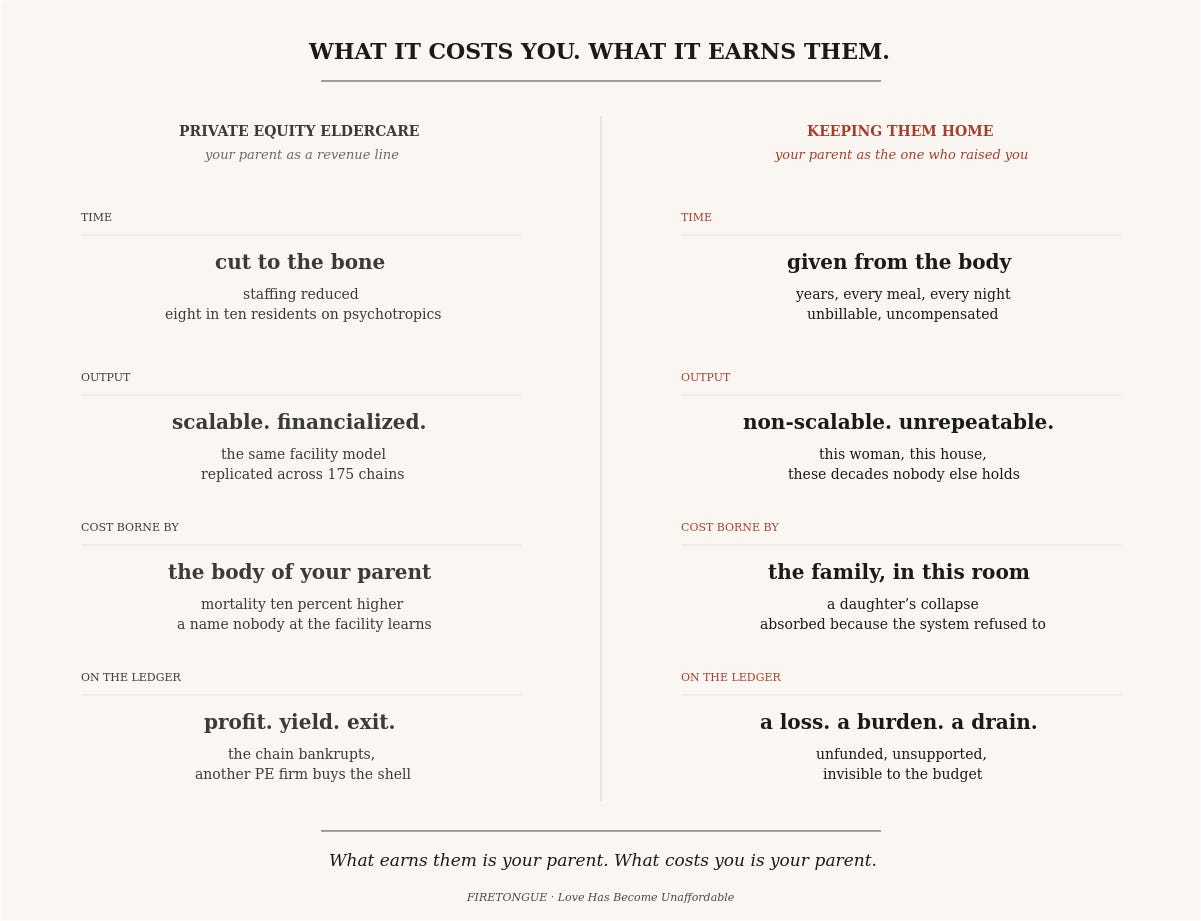
Read one column. Time cut to the bone, staffing reduced, residents medicated for compliance. Output scalable and financialized, the same facility model replicated across hundreds of chains. Cost borne by the body of your parent — a name nobody at the facility learns. On the ledger: profit, yield, exit. The chain bankrupts, another PE firm buys the shell.
Read the other. Time given from the body, years of meals and nights, unbillable and uncompensated. Output non-scalable, unrepeatable — this woman, this house, these decades nobody else holds. Cost borne by the family in this room — a daughter’s collapse absorbed because the system refused to. On the ledger: a loss, a burden, a drain. Unfunded, unsupported, invisible to the budget.
Both columns of the ledger lead to the same parent. What earns them is your parent. What costs you is your parent. The system priced caring for her at the same point the market priced extracting from her. Either way, we pay. Through our own collapse if we keep them home. Through the skeleton of care that keeps them alive a little longer if we don’t.
•
Every minute one wins, the other loses.
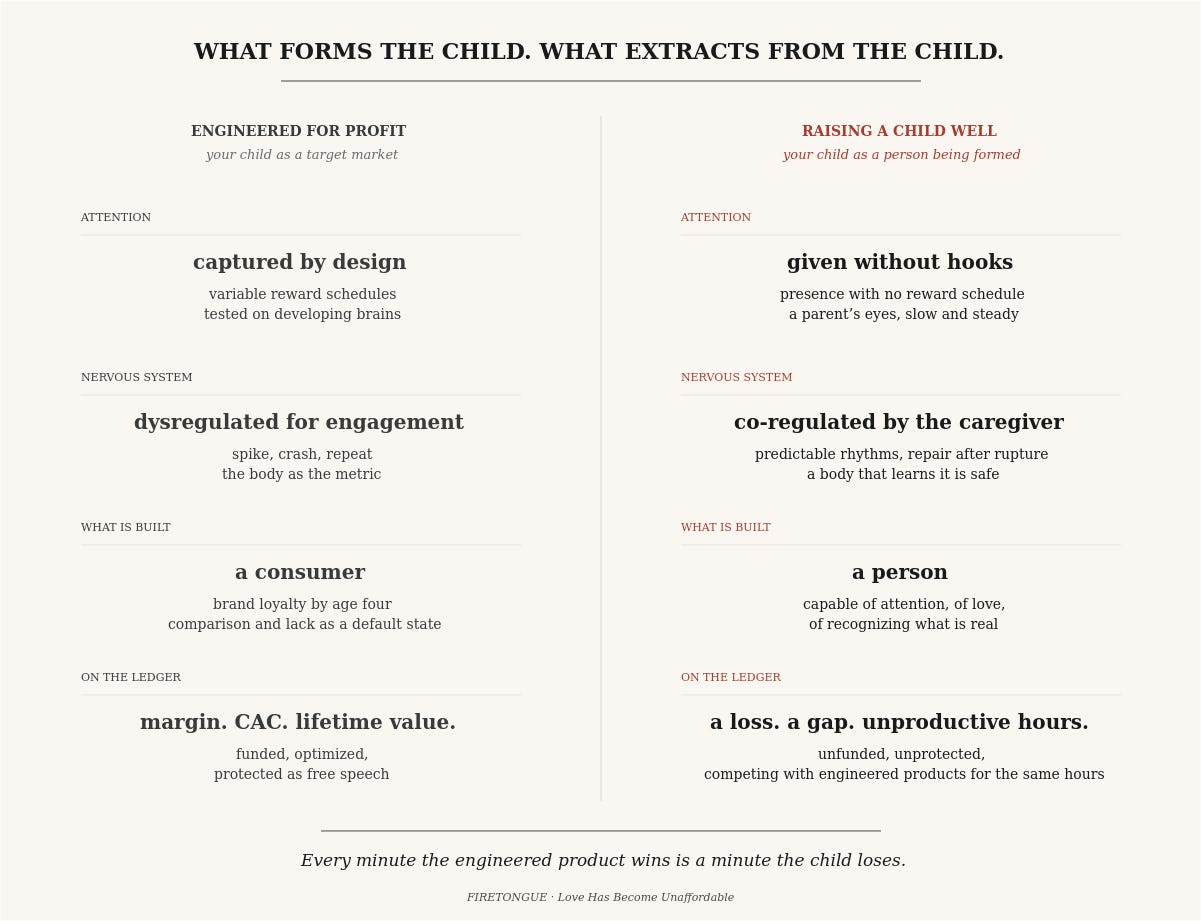
My son will not stop talking. He is five. His nervous system is forming itself by co-regulating off mine. What he needs is presence without hooks — predictable rhythms, repair after rupture, attention that is not optimized for anything. A body that learns it is safe. A nervous system co-regulated by the caregiver. A person being formed, capable of attention, of love, of recognizing what is real.
The market wants the same hours. Attention captured by design. Variable reward schedules tested on developing brains. A nervous system dysregulated for engagement — spike, crash, repeat — the body itself converted into the metric. What gets built is a consumer. Brand loyalty by age four. Comparison and lack as a default state. On the ledger: margin, customer acquisition cost, lifetime value. Funded, optimized, protected as free speech.
These two are competitors for the same hours of the same child. One side is funded by venture capital, billions of dollars, engineered for engagement at the cost of the child’s nervous system. The other side is one or two bodies, exhausted, doing an impossible task.
Every minute the engineered product wins is a minute the child loses. The product is built to win. The parent is built to be tired.
•
Here is what I have done.
I am a gemologist. I know what the market prices and what it does not. I know that the four C’s grading rubric De Beers built in the 1940s is a marketing instrument, not a measure of beauty or rarity. I know what is actually rare. I went looking for it.
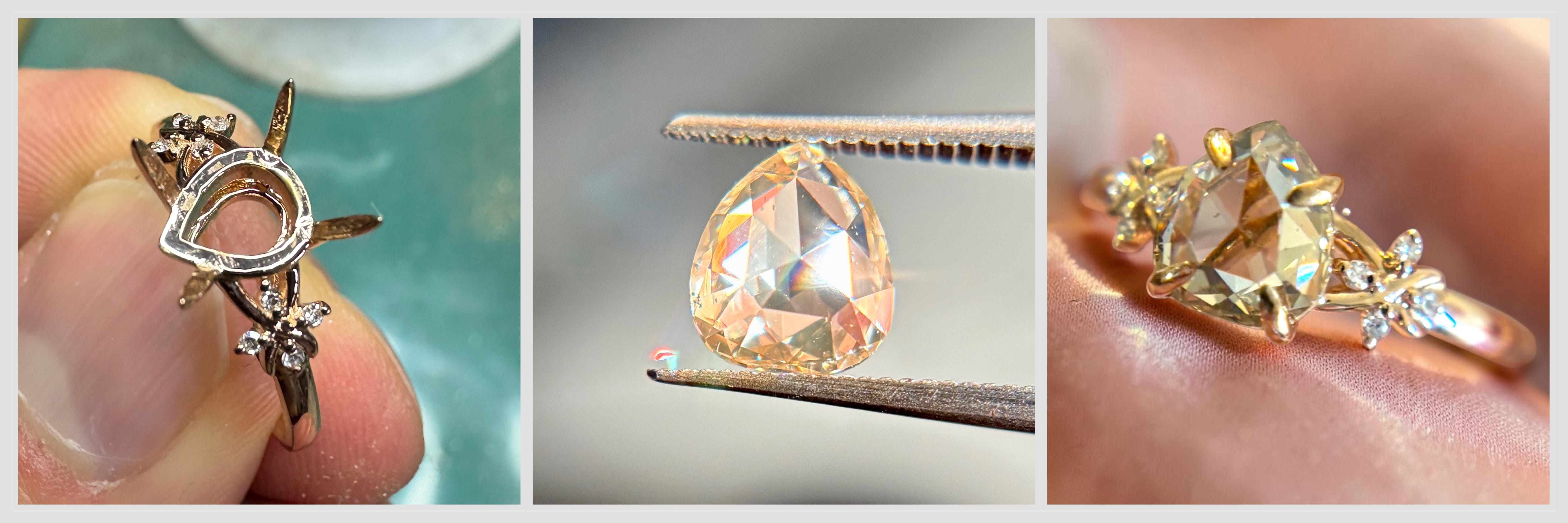
I hunted for the stone for months. Most evenings, after the sales floor, after the kids were down. I knew what I wanted before I started: a fancy color, a rose cut, antique, with character the modern market does not know how to read. I found her ring eventually — a natural, untreated pear-shaped rose cut, 1.15 carats, light grayish brown, SI1 clarity, with strong blue fluorescence under UV. The kind of stone you have to be a gemologist to see for what it is. I ordered it from an independent antique seller in the US.
Then I needed the setting. The mass-market houses build for the round brilliant. They do not understand a pear rose cut from the 1800s. I searched for weeks. I found an independent jeweler in Australia who did. I ordered it in 14karat rose gold with accent diamonds. More weeks for it to arrive.
I had the stone appraised by my friend, one of the best gemologists in the DMV. We met years ago because of my obsession with minerals and crystal structures. I found the most beauty in the stones the market underprices because it cannot read them. He sees them the way I do. We built a friendship and a working relationship out of that mutual recognition. He confirmed what I already knew. Then I set the stone myself, with my own hands.
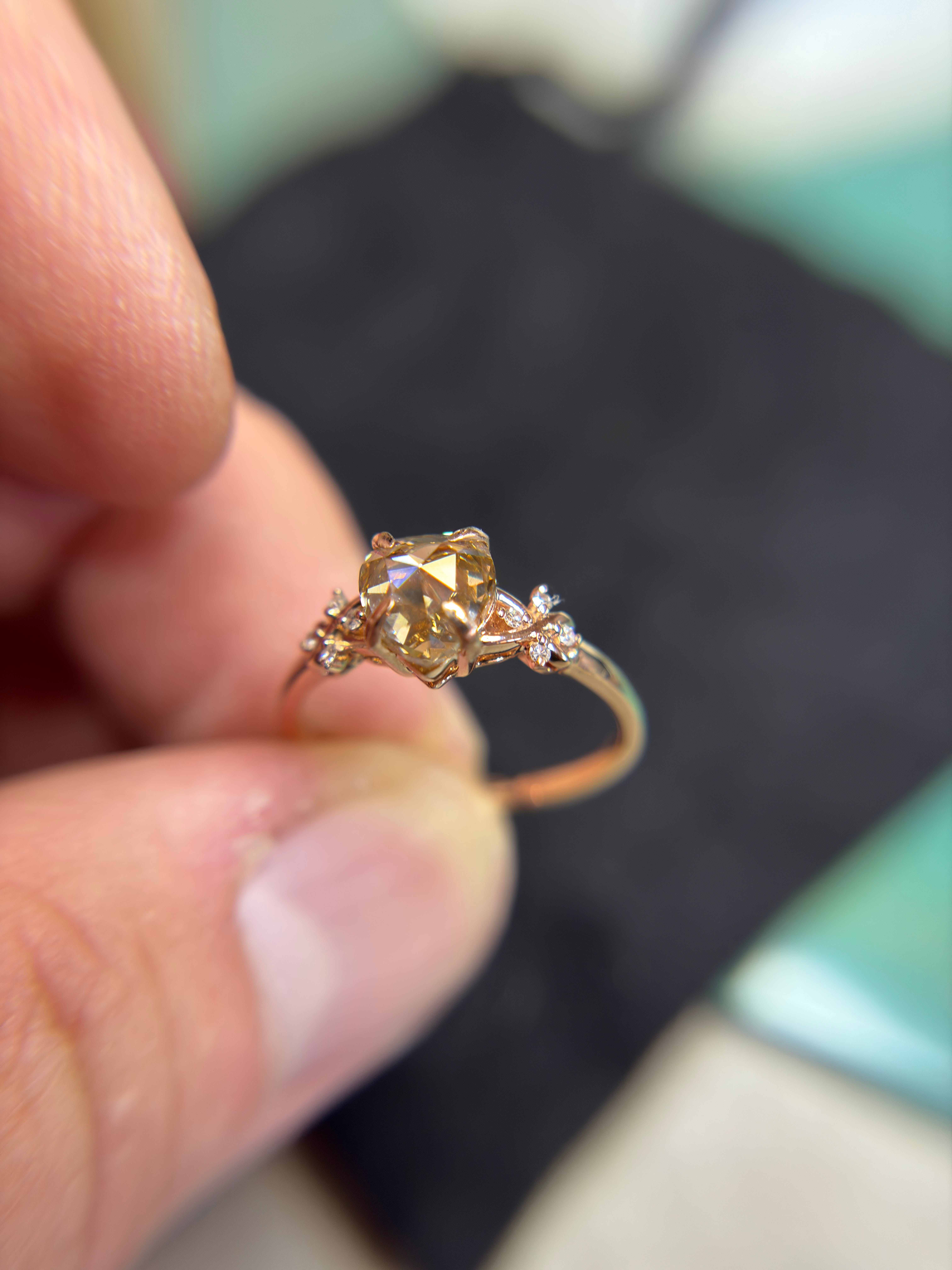
It took me months. It could have taken weeks for a less full life. It could have taken a day for a much larger budget. I do not have uninterrupted time. I do not have a large budget. I have minutes between customers on the sales floor. I have my lunch break. I have the hours at night when I should be asleep. That is when I built her ring.
I booked a few days away. I am trying to make it extra special. I have not had a day off in weeks. I cannot plan or execute it perfectly. I am going to do it anyway.
This is the answer to a system that has made love unaffordable.
Refuse the expensive but affordable imitation.
Remember what real love costs. Where it exists. How I feel it. How I express it. How I know I am loved.
Pay the cost out of my own body. Use my own hands. Find the stone the market cannot price. Set it myself. Build the thing slowly because slow is what a full life permits.
•
I would rather fall apart than cut off love.
I will keep listening to my son when he will not stop talking, because one day he will stop, and I will miss this.
I will keep my grandmother in the family while she is here.
I will show up. I will keep my heart open.
I will propose to her with what I have, which is the truth. The weekend will not be perfect. The proposal will not be perfect. I am not perfect. None of this is perfect.
It is real. That is the only thing the system cannot fake.
•
If you read this and feel something, feel it until it costs you something.
Do not let it become a nod. Then do the loving thing anyway, in whatever form you have left. Use your own hands. Find the thing the market cannot price. Build it slowly if slow is what your life permits. Refuse to scale what was never meant to scale.
That is what is left when the annotation is stripped. The base. The body. The hands. The ones who will see you. The choice to keep loving anyway.
-Fire tongue🔥
If this reached you, send it to one person who needs it. Not the algorithm. Not the broadcast. One person you know is carrying something heavy. One person who has been told, in ways large and small, that what they are doing does not count. That is how this kind of writing travels — body to body, the way real things have always moved.
If you have the means and want to keep this work going, become a paid subscriber. The arithmetic is simple: I write between customers, on lunch breaks, in the hours I should be sleeping. Paid subscribers buy back some of those hours. They buy the time it takes to write more of it.
Either way: see the people in front of you. Especially the ones the system has stopped seeing.
The expectations between lovers wishing to marry is not society's concern. Your bride should know enough about you to have reasonable expectations in rings, get-aways, lifestyles long before the 'question' is popped. If not, both are setting up a rocky road rarely survivable.
Do what your heart tells you; be honest in all things and relax.
My grandfather built on to my grandmother's simple ring as time wore on but she always wished he'd left the original alone. That was given from his heart, the rest from his ego.
She will love it for all the right reasons.