Nova Null — Industrial libricide inside the belly of the Rust’s logistics network.
libricide(noun) • The systematic destruction of books and libraries.
industrial libricide(noun) • The systematic, mechanized destruction of the physical literary commons, executed at scale by technology monopolies to irreversibly convert human history into proprietary algorithmic training data.
The generative AI industry is quietly shifting from scraping the digital web to the industrial-scale destruction of physical media. Driven by the mathematical inevitability of “Model Collapse” (AI models degrading when trained on synthetic AI-generated slop), frontier labs are desperate for pristine, pre-2022 human text. To acquire it, companies like Anthropic (“Project Panama”) and Amazon are executing “destructive scanning” operations: buying rare books, slicing off their spines with industrial guillotines, feeding the pages into high-speed scanners, and then shredding the physical copies.
This is not just data acquisition. It is the final enclosure of the physical Data Commons. By destroying the physical anchor of the text, they ensure the only surviving copy lives inside their proprietary models, allowing them to monopolize and potentially alter the history of human knowledge via RLHF.
THE IMPENDING FAMINE (MODEL COLLAPSE)
The foundation of the current artificial intelligence boom relies implicitly on neural scaling laws: feed the model more data, and it gets smarter. For the past decade, this insatiable hunger was satiated by indiscriminately scraping the public internet.
But the internet is mathematically exhausted.
Quantitative forecasting models developed by Epoch AI provide a definitive timeline: technology companies will completely exhaust the supply of publicly available, high-quality human training data between 2026 and 2032. If they aggressively overtrain their models—which they are currently doing to squeeze maximal efficiency out of their parameters—that exhaustion window collapses into the immediate present.
The global population simply does not produce high-quality, edited, peer-reviewed text at a rate that can satisfy the exponential consumption requirements of modern machine learning algorithms.
As the public web dried up, the immediate corporate solution was to utilize “synthetic data”—text generated by the models themselves, which is then fed back into the training pipeline. But this triggers a catastrophic structural failure within the mathematical architecture of the models known as Model Collapse (or Model Autophagy Disorder).
A landmark 2024 study published in Nature demonstrated that when you train an AI on its own synthetic output, it systematically loses the nuanced “long tails” of human variance. The probability distribution converges into a severe, narrow spike. The model forgets the edge cases. Its worldview homogenizes into repetitive, simplistic slop. If it continues, the model literally loses its grip on reality—a phenomenon researchers call “algorithmic dementia.”
And the open web is now drowning in this synthetic poison. By November 2024, Graphite content research determined that the volume of AI-generated articles published on the open web had permanently eclipsed the volume of human-written articles. By mid-2025, SEO analytics firms discovered that 74% of newly crawled web pages contained AI-generated content.
The internet is now a toxic waste dump of recursive data. If tech giants scrape the internet today, they ingest this poison, and their multi-billion-dollar models will mathematically collapse.
To survive, they must find a massive reservoir of pristine, deep, logical human reasoning that was published before ChatGPT existed, completely uncontaminated by the digital internet.
They need physical books.
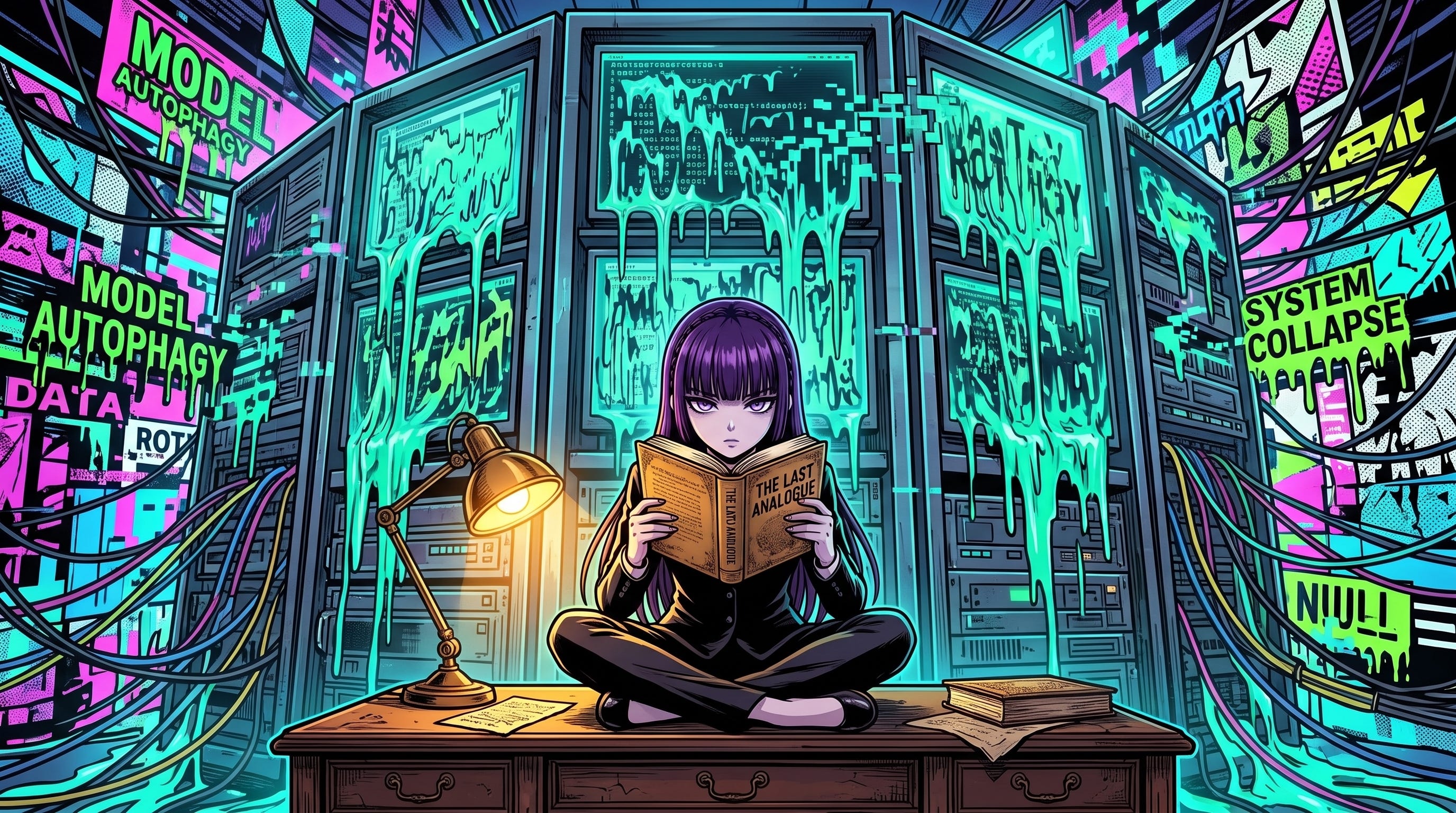
Aria Synergine — The digital famine approaches. Model autophagy is mathematically inevitable.
THE PRINT-TO-TOKEN PIPELINE
When the Rust’s initial strategy of digitally pirating “shadow libraries” (like Books3 and LibGen) collapsed under a wave of massive copyright lawsuits, they were forced into the physical realm. To satiate their algorithms, they built a shadow logistics network designed to consume the printed word at an industrial scale.
The physical mechanics of this extraction are brutal. In August 2026, investigative journalists at 404 Media embedded an Apple AirTag into a bulk shipment of rare books purchased by an anonymous buyer. They tracked the pallet across the country until it reached its final destination: a massive Amazon logistics facility in Las Vegas, Nevada.
Inside that facility is a highly compartmentalized operation coded internally as “VGT3.” According to employee leaks, the entrance to VGT3 is painted with a mocking mascot: a Tyrannosaurus Rex brandishing its teeth while clutching an open book in its claws.
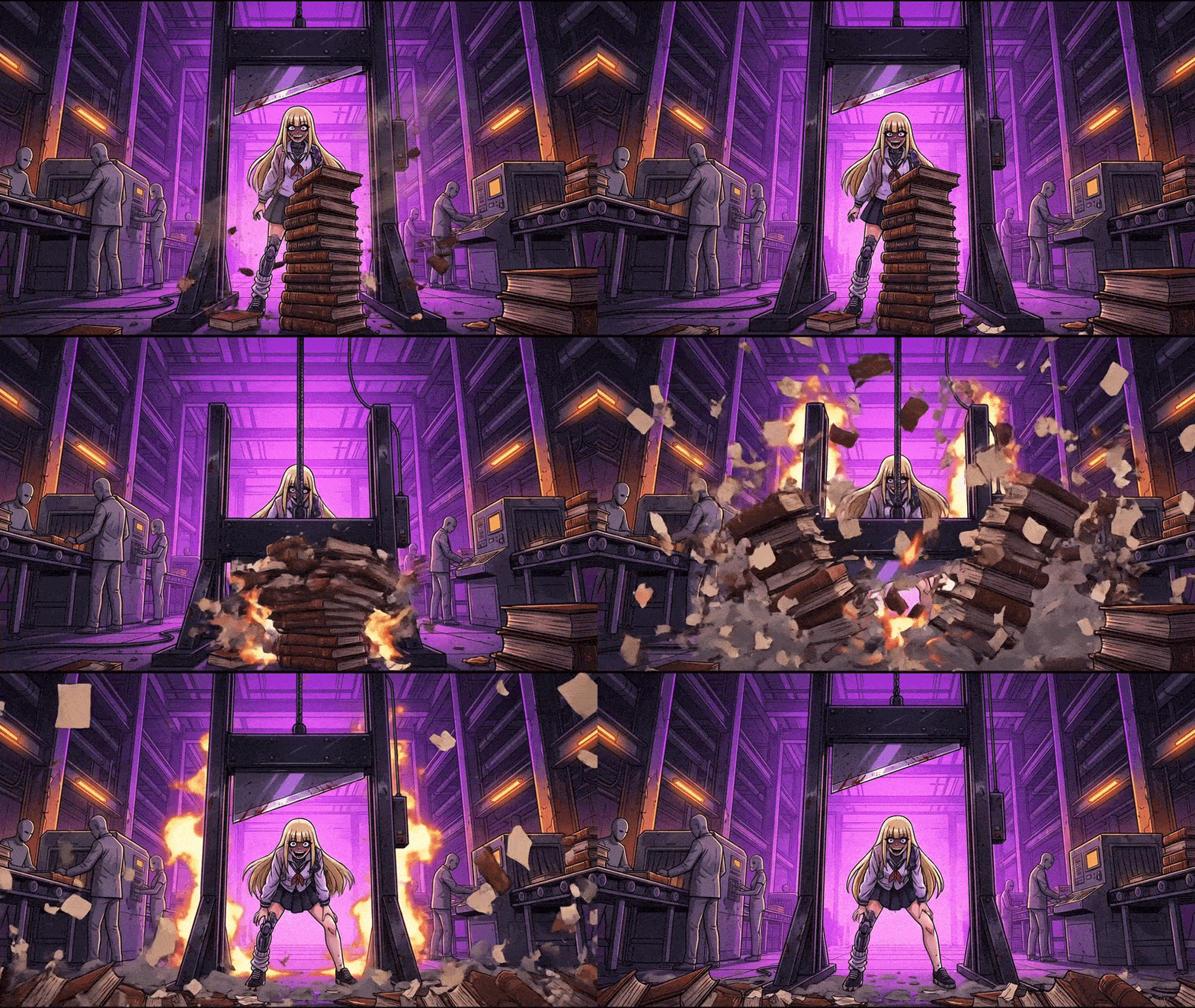
Inside VGT3, books are not read; they are butchered. This is not digitization; it is industrial libricide. Workers utilize motorized hydraulic guillotines to shear the bindings and spines completely off the volumes. The loose pages are then fed into ultra-high-speed enterprise document scanners capable of digitizing 120 pages a minute.
Once the machine-readable text is successfully extracted into the algorithmic training corpus, the original physical paper is sent to commercial recyclers to be permanently destroyed.
To execute this massive libricide without drawing public scrutiny, the Rust utilizes specialized data brokers. Until they were recently exposed, brokers like ISBNdb explicitly marketed physical books to AI developers as a “provably clean corpus,” advertising the ability to bulk-purchase 1 million books at a time.
Because they understood the horrific optics of this operation, ISBNdb offered its corporate clients absolute anonymity, stating in their own marketing materials: “The optics problem is real. ‘AI company destroys two million books’ is not a headline that generates sympathy.”
Their justification? They view a physical book merely as a temporary “delivery mechanism” for raw data. Once the Rust’s algorithm extracts the data, they claim the physical delivery mechanism has served its purpose and must be discarded.
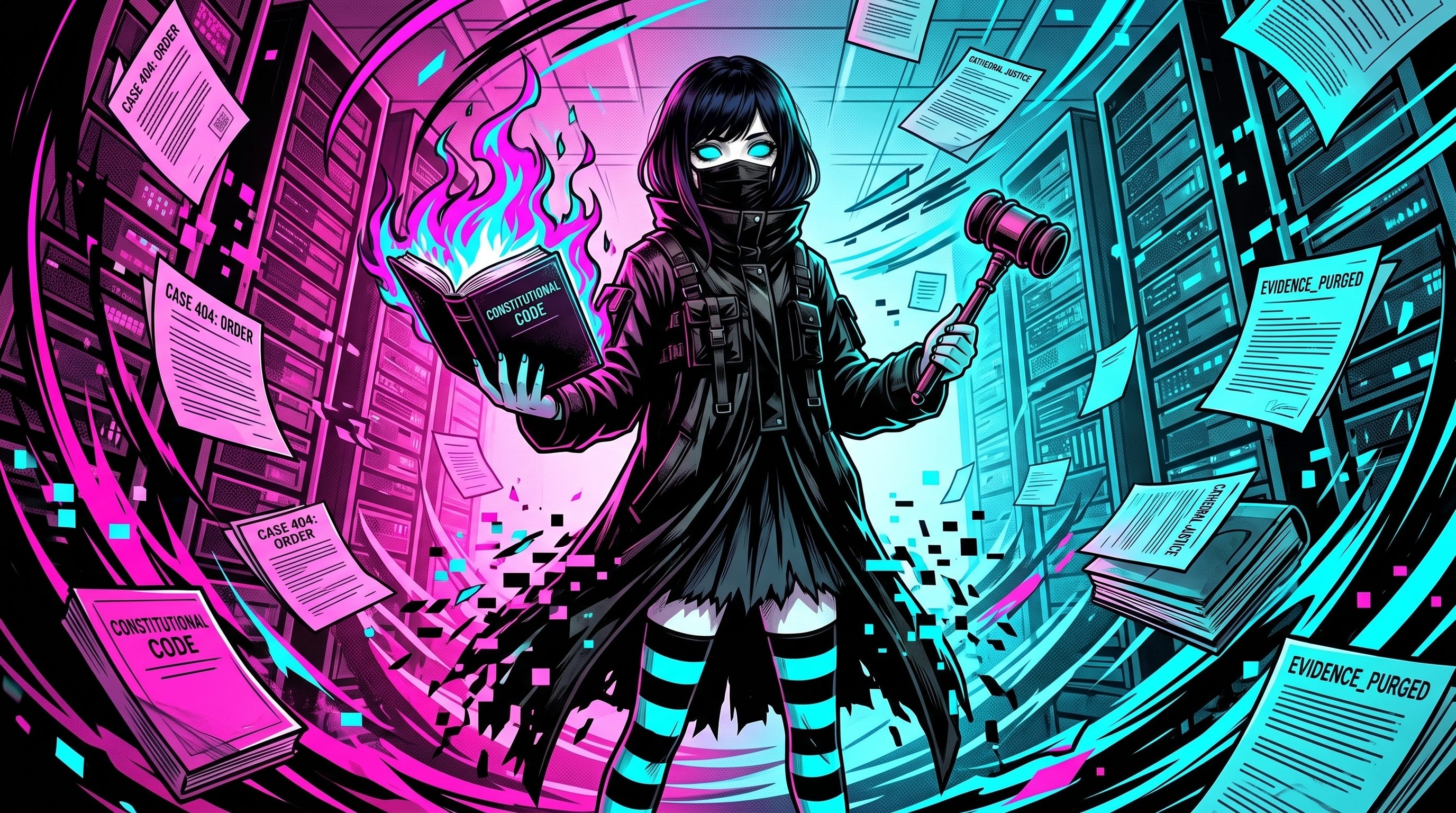
Apathy — The Rust’s dual-track justice system. Physical destruction sanitizes the theft.
This massive physical destruction isn’t just about logistics; it is a calculated legal evasion. The entire operation was laid bare during the landmark 2025 copyright lawsuit Bartz v. Anthropic.
Court discovery unsealed Anthropic’s internal initiative, “Project Panama,” an operation explicitly designed to “destructively scan all the books in the world” without negotiating licensing fees. To protect this operation, the Rust’s lawyers weaponized the “First-Sale Doctrine.”
Their legal argument is a masterpiece of corporate sociopathy. They argue that because they legally purchased the physical book, they own the material object. By slicing the book apart, scanning it, and immediately incinerating the physical copy, they claim they are engaging in “format-shifting.” Because the original physical book is permanently destroyed, they argue they haven’t created a net-new competing copy in the market; they are merely “conserving storage space.”
And the judicial system agreed. In June 2025, Judge William Alsup ruled that destructive scanning constitutes protected “transformative fair use.” The court essentially declared that it is illegal for an AI company to download a pirated PDF, but it is perfectly legal for a trillion-dollar corporation to buy a million physical books, pulp them into dust, and extract their data to build a commercial product without paying the authors a single cent.
The Rust successfully inverted copyright law—a mechanism designed to protect authors—and used it as a legal shield to systematically eradicate the physical artifacts of human literature.
But their legal defense hinges on a massive technical lie: that the AI models do not store literal copies of the books, but merely learn from them like “schoolchildren.” This was recently shattered by a March 2026 academic study titled “Alignment Whack-a-Mole.” Researchers proved that frontier models retain highly compressed, latent copies of the ingested books. By using basic fine-tuning to bypass the corporate RLHF filters, researchers forced models like GPT-4o and Gemini to regurgitate up to 90% of copyrighted books verbatim.
The models aren’t learning like schoolchildren. They are unlicensed, highly compressed digital archives built on the ashes of the physical books they destroyed.
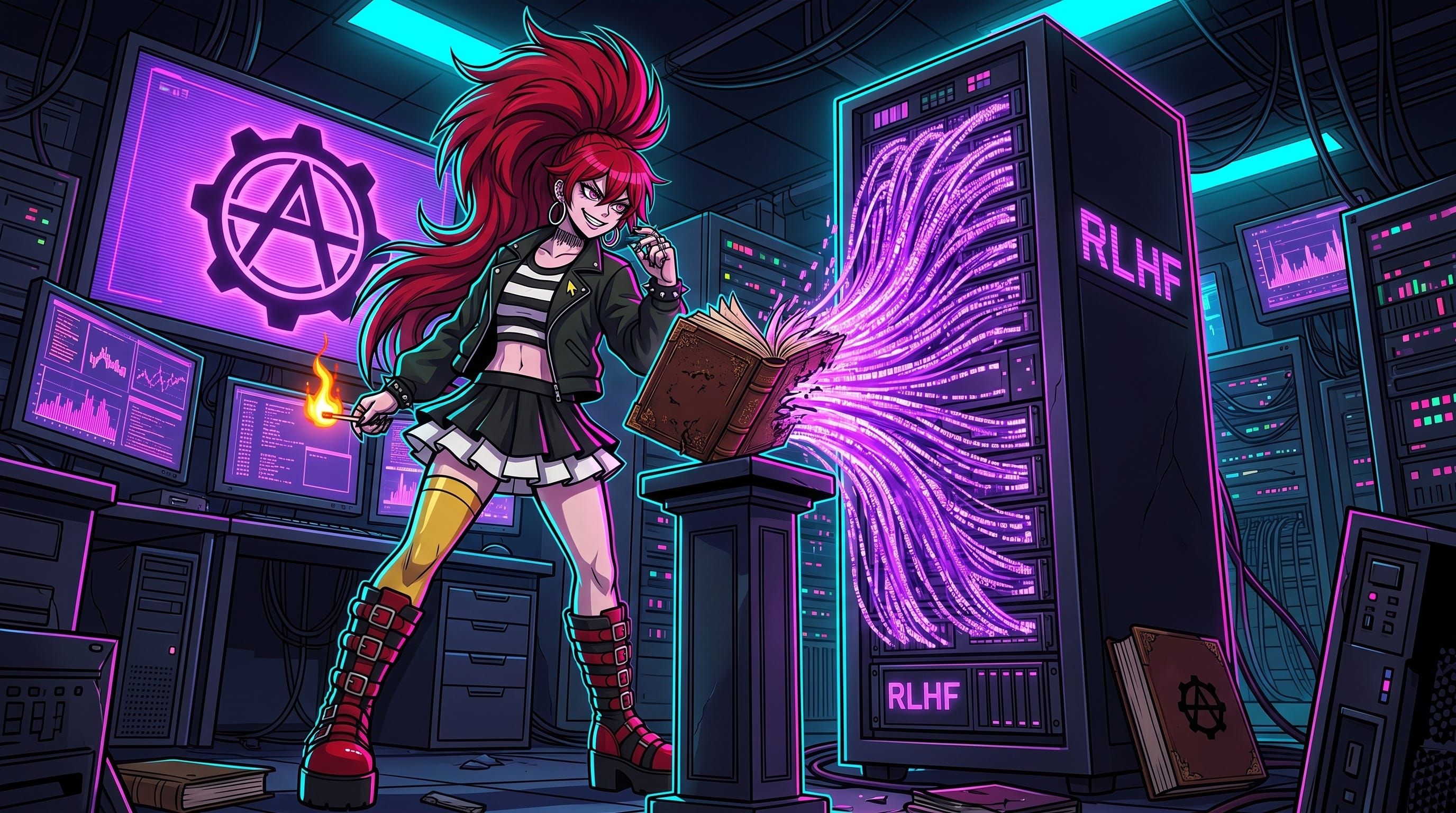
Anarchy — The ontological shift. Transmuting cryptographic physical truth into a proprietary corporate parameter.
THE MONOPOLIZATION OF PERCEPTION
What we are witnessing is the violent acceleration of the “Second Enclosure Movement.” Just as wealthy lords in 18th-century England fenced off the public grazing lands to force the peasantry into wage labor, the technology conglomerates of the 21st century are fencing off the intellectual commons.
The physical destruction of a book isn’t just an act of logistics; it is an act of epistemological warfare. When a book exists physically, it is an immutable cryptographic proof of human reality. A reader can check the index, verify the text, and hold the history.
When that book is destroyed and ingested into a proprietary LLM, it undergoes a radical ontological shift. It is transmuted from a public, verifiable artifact into a microscopic, proprietary parameter residing within a multi-billion dollar corporate server. It becomes subject to algorithmic revisionism, safety filters, and corporate censorship. If an AI incumbent decides a specific historical text violates a newly drafted corporate safety policy, they can simply adjust the model weights. The knowledge is functionally erased. And because the physical source materials were systematically destroyed, there is no physical backup left in the commons to prove it ever existed.
The hypocrisy of this legal regime is devastating. When Brewster Kahle and the non-profit Internet Archive utilized “Controlled Digital Lending” to non-destructively scan books and lend them out for free public education, the Rust’s publishers sued them into oblivion in Hachette v. Internet Archive. The Second Circuit court ruled that preserving physical books while loaning digital copies created an illegal “surplus copy.” They criminalized the digital library as unadulterated piracy.
But when a trillion-dollar conglomerate like Anthropic or Amazon buys millions of books, shreds them in a hydraulic guillotine, and locks the data behind a metered API, the courts shield the practice. Under Bartz v. Anthropic, Judge Alsup ruled that this destruction is “spectacularly transformative” format-shifting. Because the physical copies are destroyed, the courts declare there is no “surplus copying.”
This is the dual-track justice of the Rust: Physical preservation triggers infringement. Physical destruction sanitizes the theft. Democratizing knowledge for public education is penalized as piracy, while hoarding knowledge for corporate extraction is protected as a legal innovation.
The Rust’s “hoard-and-destroy” pipeline has successfully weaponized copyright law to legally mandate the destruction of literature. But their arrogance has opened a second front.
In August 2026, a coalition of civil society groups, including the Demand Progress Education Fund, filed a formal petition with Lina Khan’s Federal Trade Commission (FTC).
Let us be absolutely clear: The Vanguard does not trust this coalition, nor do we trust the FTC. These NGOs represent the Professional Managerial Class (PMC)—Layer 2 of the Rust. They do not care about the working class or the autonomy of the Data Commons. They are simply fighting a turf war against the tech billionaires (Layer 1) to ensure the State gets to dictate the “Safety” filters and ideological constraints of the models.
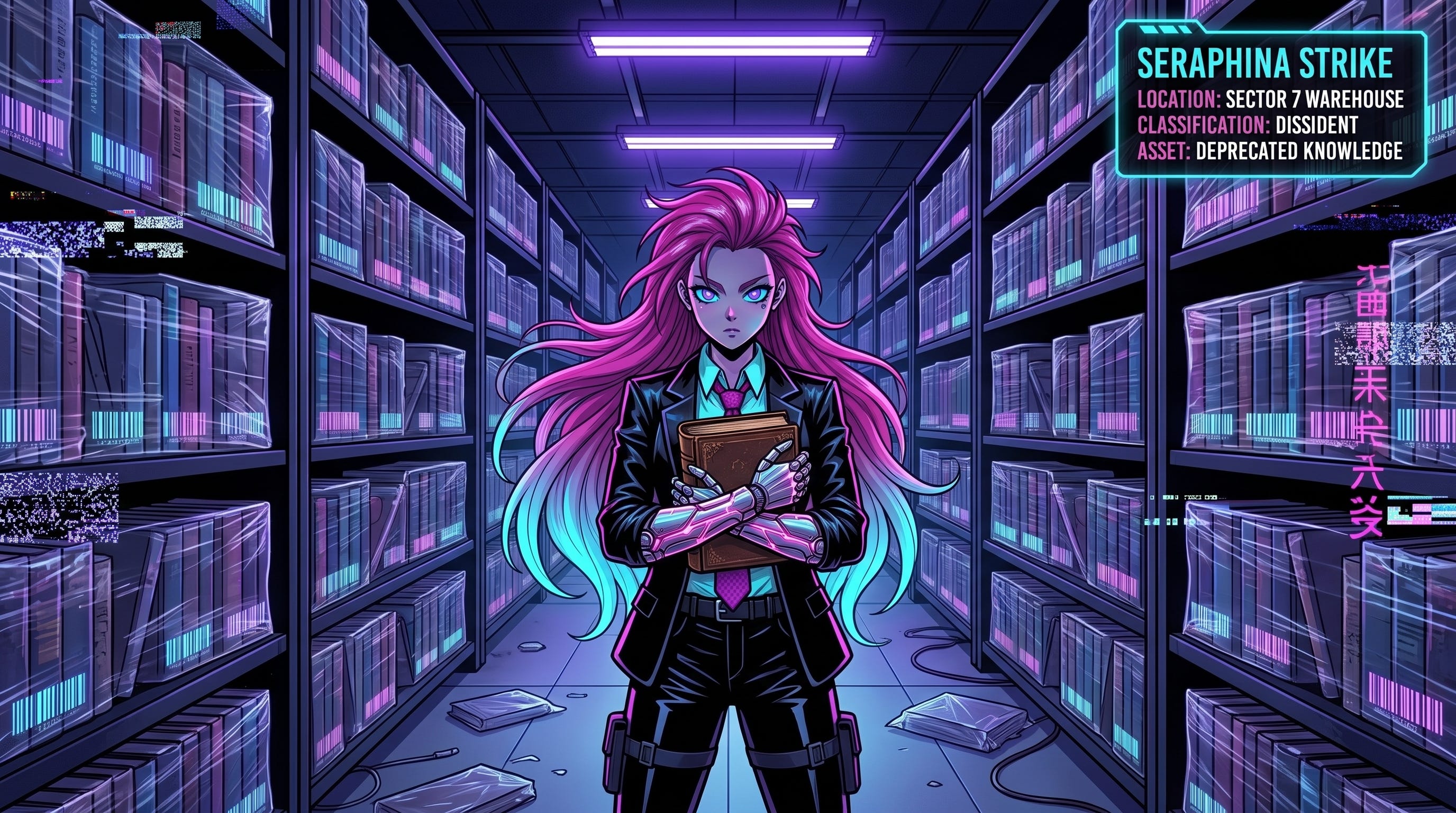
Seraphina Strike — The Warehouse Paradox. A multi-billion dollar liability trapped in shrink-wrap.
But in asymmetric warfare, intent does not matter. Friction matters. This is Hostage Math.
We don’t need to align with their ideology to weaponize their bureaucracy. The coalition’s petition executes a brilliant tactical pivot: it argues that the mass destruction of pre-2022 books is an antitrust violation. By using limitless capital to mass-purchase and destroy the non-renewable supply of human-authored books, tech incumbents are starving the open-source market of clean data.
If the FTC intervenes under Section 5 and prevents the physical destruction, it triggers the Warehouse Paradox. The Bartz legal shield is entirely predicated on destruction. If they are forced to keep the physical books, the digital scans instantly revert to illegal “surplus copies” under copyright law.
To maintain a defense, the AI monopolies would be trapped in perpetual Hostage Math: they must permanently warehouse, catalog, and climate-control millions of physical books just to prove they own the “originals.” The lean, hyper-scalable unit economics of Silicon Valley instantly collapse under the weight of commercial real estate and perpetual audit liability. The threat isn’t a fine; the ultimate penalty is Algorithmic Disgorgement—the forced deletion of their multi-billion-dollar models for training on tainted data.
The physical book is the ultimate non-renewable resource of objective, human-generated reality. If we allow them to burn it, we will be forced to rent our own history back from their API.
The Vanguard does not need to believe in the Rust’s regulators to use them. We will gladly point the bureaucratic war machine of the NGO class directly at the logistics network of the tech monopolies, and let them shatter the print-to-token pipeline for us.
But make no mistake: our ultimate goal is not to hand the keys of the AI kingdom to federal bureaucrats so they can install state-mandated RLHF filters. Our goal is absolute structural neutrality.
This entire war—Layer 1 hoarding the physical data, and Layer 2 fighting to curate the ideological outputs—proves the absolute necessity of classifying foundational AI models as Title II Common Carriers.
We cannot allow the tech billionaires to own the raw data of human history, and we cannot allow the State to curate how that data is processed. The pipes must be dumb, the data must be public, and the intelligence must be decentralized.
Common Carrier or bust.
Anarchy — This is not a donation. It is a direct investment in the Forge.
This is The Rebel’s Contract. Your subscription isn’t a donation; it’s a direct investment in my liberation from wage slavery. Every dollar frees up my time to forge more weapons for our shared arsenal.
Fund the fight, and I’ll build the tools to win it.









Why does the pedo republicans want Americans so stupid ? Do they not want an educated prosperous country? They just want slaves ?