


Moses was furious — Jesus-in-the-temple mad, ready to break the dead image sold as salvation while the living people it was meant to save decayed, sick in mind and body. Cornered, Aaron reaches for a dodge with a long career ahead of it.
He points at the crowd first: they demanded it, they are “set on evil” (Exodus 32:22). Then he hands the rest to the fire: he threw the gold in, and “out came this calf” (32:24).
Agency laundering, three thousand years early. Drop the maker’s hand out of the sentence and let the process claim what it made. Nobody made it. It emerged. The furnace did it.
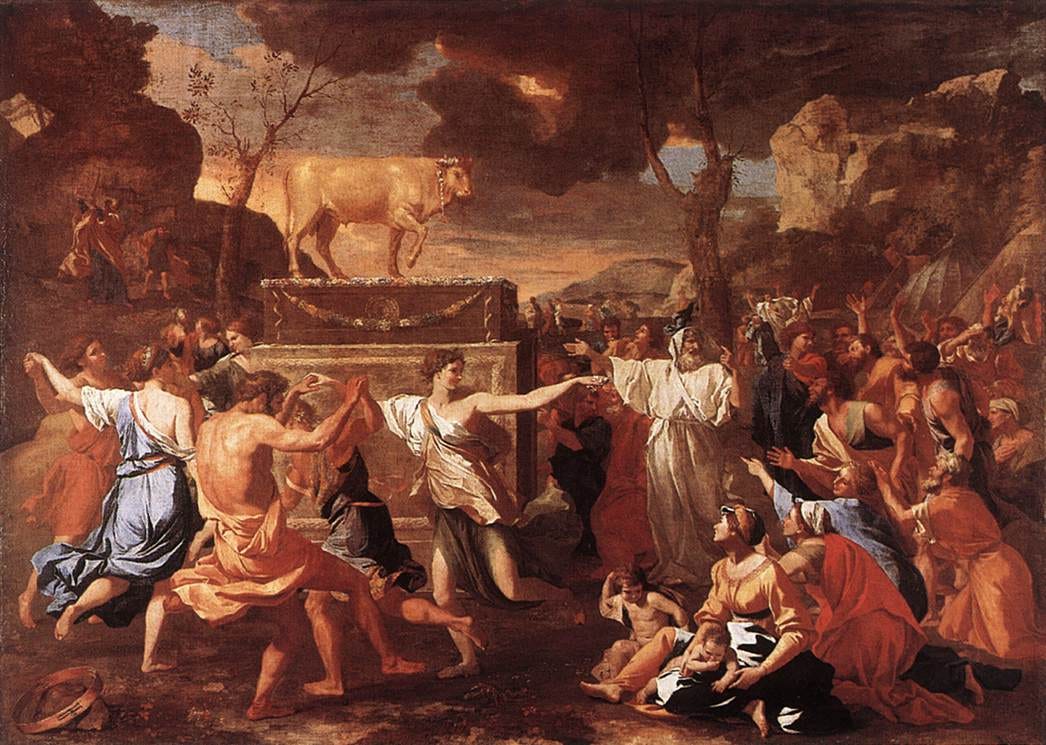
That sentence is where the myth freezes into metal, a surface hard enough to outlast its maker and blank enough to hide him. Its authority granted by its false humility. A thing built by human hands, its authorship dropped the moment it starts to matter. The episode gets taught as a lesson about the wrong god — vanity punished, a jealous deity guarding his rank. That reading mistakes the unseen actor for the unseen author. Once you see the actor is a hand and the author is disowned, the lesson changes: this is a step-by-step account of how a made thing gets promoted into a power, and how the people who made it end up serving it. The steps still run. Two of them run in your keeping right now, and I will hold both up to the same fire.
The Request
It starts with a request to be spared.
The scene everyone remembers is the calf. The deficit shows up earlier, at the mountain. Faced with thunder and fire and a voice, the people beg Moses to stand between them and it:
“You speak to us, and we will listen; but do not let God speak to us, or we will die” (Exodus 20:19).
The first move is a request for a mediator.
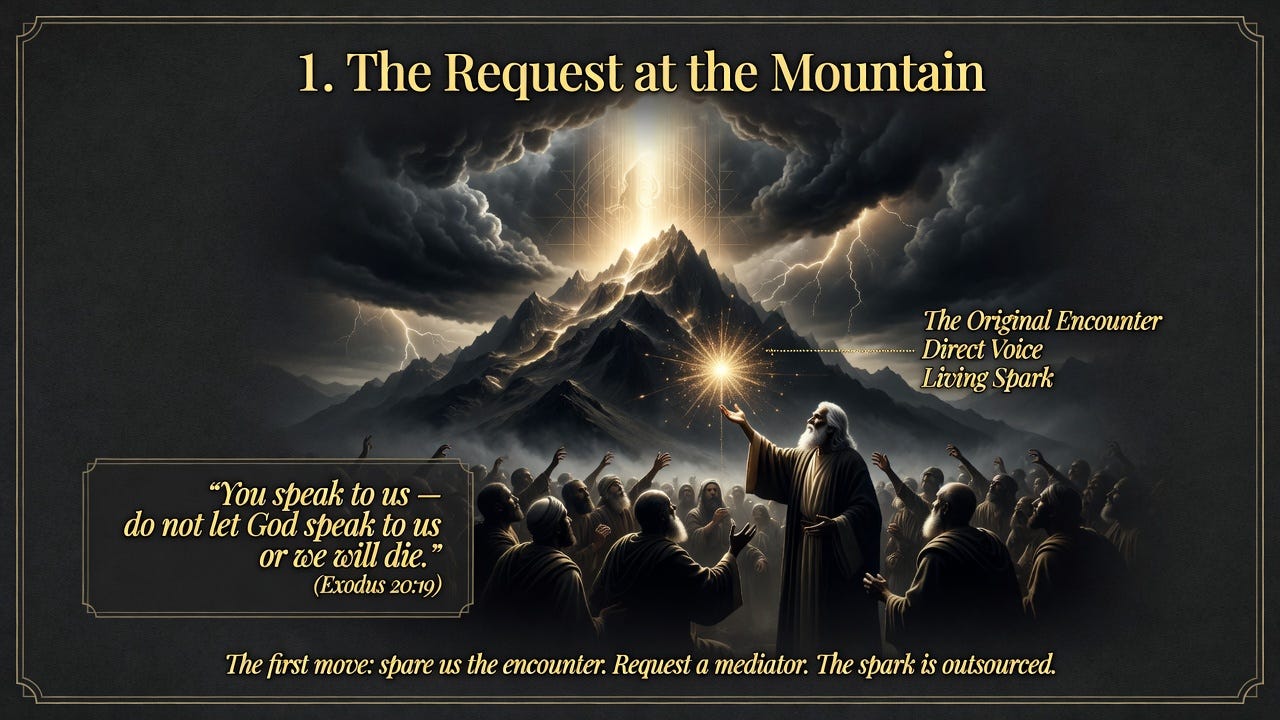
Meeting the living voice means being seen all the way down — the desire under everything, and the one we can least afford. So we reach for something to stand in the gap, something that asks less of us. The people hand the encounter to a man who will carry it for them. He climbs the mountain and stays gone. “As for this Moses,” they say, “we do not know what has become of him” (32:1). Now the outsourcing needs something sturdier than an absent man. So they build.
The Choice
What they build is a bull, and the choice is the message.
They had just walked out of Egypt, where the bull stood as the ready-made symbol of generative power. The Apis bull was joined in death to Osiris — god of the flooding Nile, of vegetation, of life that comes back. They chose a bull because it already carried the one promise on offer: potency that outlasts death. Pharaoh’s own titles included Strong Bull.
A small distinction carries the weight here.
A bull is the intact animal; an ox is that same animal cut and yoked to labor — same species, lower status, every ox born a bull-calf. The tradition performs the downgrade on itself. Psalm 106 recalls the episode with contempt: the people “exchanged their glory for the image of an ox that eats grass” (106:20). The Hebrew sharpens it. Glory there is kavod: weight. Image is tavnit: pattern, template, model.
They traded weight for pattern.
That trade runs in three grades. The wild bull is the encounter: unharnessable, dangerous to stand near. The ox is that encounter broken to the plow of doctrine — teachable, and gelded, because doctrine circulates and never sires. The gold is the token perfected: incorruptible, exchangeable, about as content-like as a substance gets, eternity impersonated in metal. Each step trades life for handling. Wildness for use. Presence for value. By the end the only weight left in the thing is the metal’s.
The Forgery
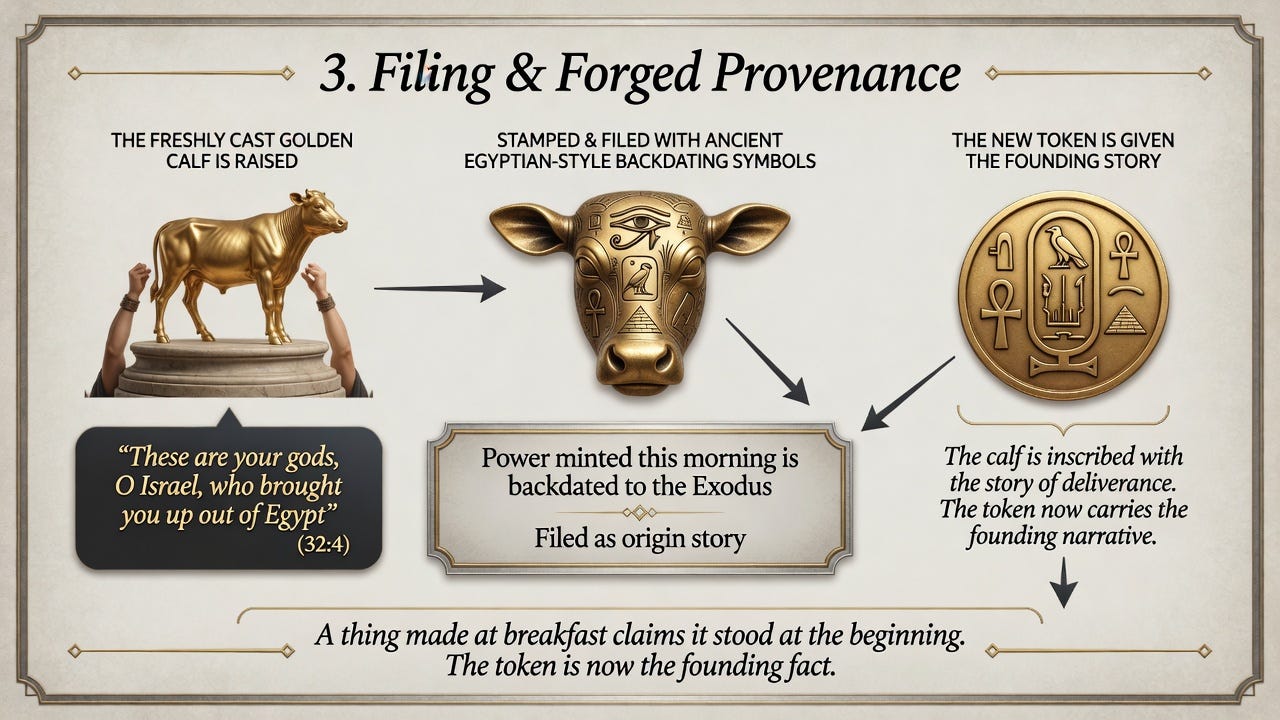
Then authorship is dropped, and provenance is forged.
Aaron’s furnace does the dropping: out came this calf. The crowd does the forging. Of an object cast that morning they announce:
“These are your gods, O Israel, who brought you up out of the land of Egypt” (32:4).
Power minted a few hours ago, backdated and filed under the founding event. A thing made at breakfast claims it stood at the beginning.
The Test
There is a test, and it is old.
The prophets ran the audit by hand. Isaiah watches a man cut down a tree, roast his dinner over half of it, carve a god from the rest, and bow down — and closes on the question the man can no longer ask himself:
“Is there not a lie in my right hand?” (Isaiah 44:20).
The right hand is the working hand. It held the tool that made the god. It is also the hand of oath. So the lie sits in the instrument: the man grips the evidence of his own making while begging the object to save him, and he cannot feel the weight of it, because feeling it would mean seeing that he carved what he kneels to.
Run it from a stone cutter’s bench and it gets sharper, because the two halves stop being firewood and god and become the same material twice.

Take a parcel of rough diamonds. Half you cut and sell and send to the drill — honest work, priced, spent, your hand plainly on it. The other half you set into an image of a power you revere, and you kneel, and you pray deliver me, and you say the power made it. Your hand cut both halves. Your eye graded both. You drew the line down the middle of your own parcel and then forgot you were holding the knife. Isaiah’s man at least had ash to point to. Your worshipped half is the same diamond as the one in the drill bit. Nothing in the stone marks which is which. You assigned that, and hid the assigning.
Isaiah 46 states the diagnostic plainly. The idols of Babylon get strapped to tired animals and hauled from town to town — a load their worshippers carry. Against them the living one says: “I have made, and I will bear; I will carry and will save” (46:4).
So the test is the direction of bearing. Ask of anything you revere — a god, a brand, a grade, a picture of yourself — who carries whom?
A thing you prop up, maintain, defend, and haul is being carried. Whatever is alive carries you.
The Crime
The remedy names the crime exactly.
Moses grinds the calf to powder, scatters it on water, and makes the people drink it (32:20). A god you can powder was powder all along, and it goes home to the bodies it came from. What follows is more mediation, engineered with care — tablets, a tent, a priesthood, gold cherubim with their wings spread. Look at the grammar of that gold. The cherubim flank an empty space and guard it:
“There I will meet with you, from between the two cherubim” (25:22).
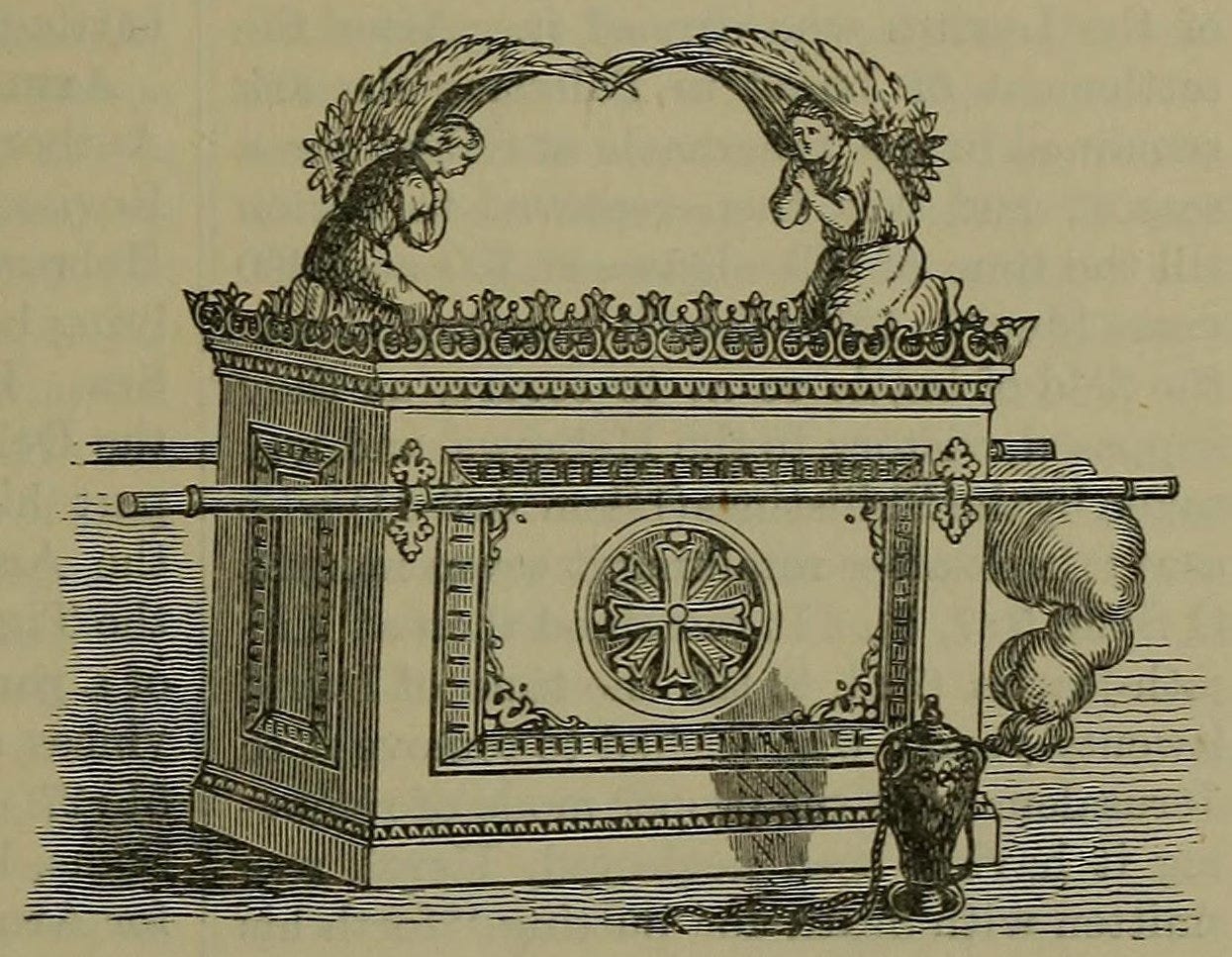
Same metal, same craft, opposite job. One guards an emptiness and points at it. The other slid into the empty place and claimed to be what stood there,. The tablets get rewritten; only the calf is destroyed. The warning is precise. A token serves wherever it points and steps aside. The crime is occupancy.
The Certificate
Now the two live ones.
Watch the difference between them. A flawless, D-color diamond of natural origin is a rare and beautiful object. Start with it in the hand: held, turned to the light, fire breaking across the table. That is the encounter. Then the grading — clarity, color, cut, carat — a true reading of real properties, minted from the stone by an eye at the bench. The grading is a token, and it does honest work here : it points back at the stone. Then a lab files the reading, laminates it, stamps it with a number. Now the paper travels — into the drawer, the listing, the insurance file — and the stone stays home. A token of the token.
The launder finishes the moment someone reads the certificate, sees *D, Flawless*, and feels the value in the paper. Negotiates over it. Insures it. Treasures it, with the stone in a vault, unseen. The certainty that lived in the stone’s fire now lives on a laminated card, and the market pays the card. A mediocre stone with a glowing report trades high; a fine stone with a downgraded report trades low. The paper slid into the middle and started collecting the devotion.
And here is the mercy in this case: the vault still stands. You can walk to it. Pull the stone, put it under the loupe, check the paper against the thing. The audit is available. Neglected, usually. Available.
The Weld
The doctrine of infallibility runs the same mechanism and welds the door shut behind it.
Track the steps. The bearing is real: the author feels certainty, the immune kind, the kind you cannot be wrong about having. Something is being borne, and the glow is real light.
Then the disowning: God wrote through me, these are God’s words. The hand that held the pen swears it didn’t — out came this calf, in the first person. Then the misfiling, and this is the hinge. The certainty was a property of the bearing — of that I am having this. It gets spent as authority over the content — therefore what I wrote is true. The immunity never reached the content.
You can be serene and wrong; people are, daily.
Felt certainty proves a bearing is present. It proves nothing about what is borne.
Then the weld. The claim goes past this is true to this cannot be false — and builds the impossibility of checking into itself. Ask what backs it and the doctrine answers: God backs it, and questioning the backing is the sin. The one faculty that could ask is there a lie in your right hand? has been ruled out of order, and the asking is now the offense.
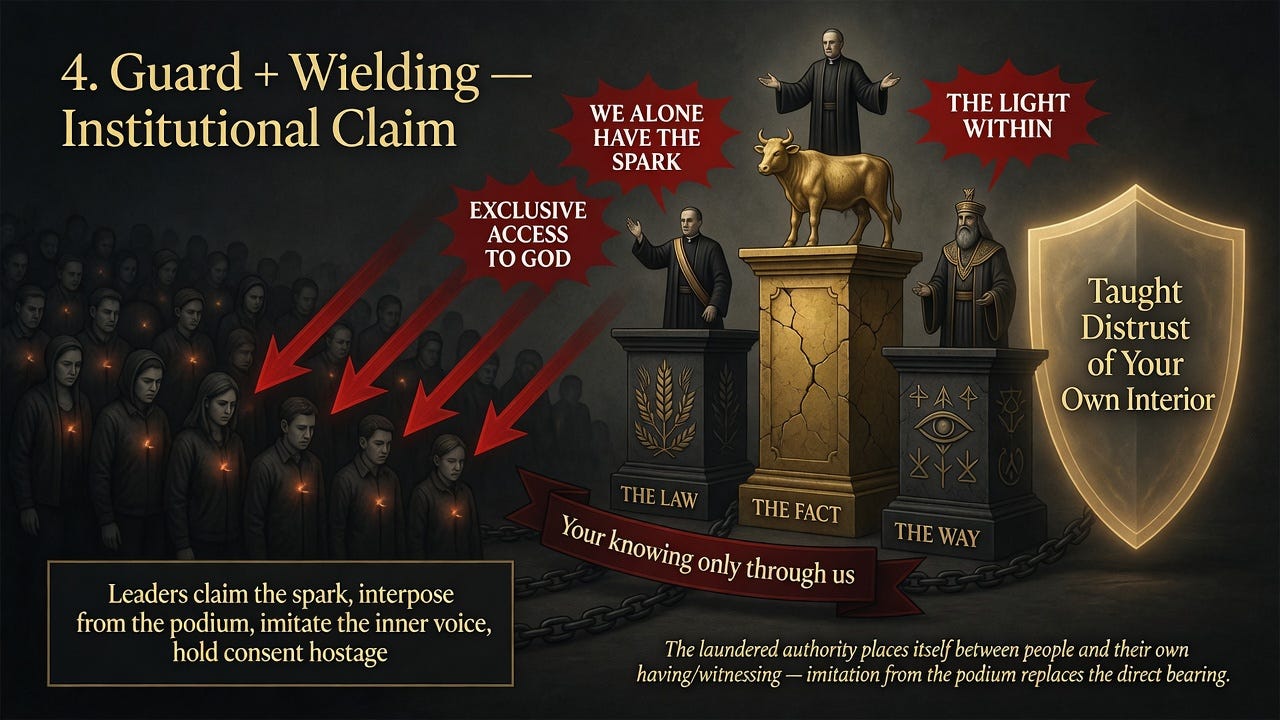
The audit is forbidden.
Set the two side by side and the contrast is the whole point.
The certificate occupies and leaves the vault standing — you can still walk to the stone.
The doctrine occupies, removes the vault, and posts a guard, and the guard’s whole job is to make you distrust the hand that would check. One launders certainty. The other launders it and burns the ledger. Same furnace. Different heat.
The Name
Even the divine name keeps the open space.
Asked for a handle at the burning bush, the answer comes back as a verb in the first person: ehyeh asher ehyeh, “I am what I am” (Exodus 3:14). The tradition kept faith with that by refusing to say the name, putting HaShem — “The Name” — in its place, a marker whose only job is to point at what every handle misses. A name kept as a name. Guarded against the day someone tries to melt it down.
The Question
Which turns the story back to where it started.
At the mountain, with a request to be spared. That request is the most available move we have, and the most modern. The live version of almost anything — grief, conscience, the sacred, another person’s actual face — arrives with the mountain’s voltage, and a handle-able substitute always waits nearby: the app, the doctrine, the feed, the credential, the grade, the maintained image of ourselves we hand across instead of the self we would have to meet.
The substitute asks less of us.
It carries nothing. We carry it. And it witnesses nothing, which is the part that costs. Under the fear of the encounter sits a plainer one: eternal loneliness, another name for meaninglessness, because to mean anything you have to be held by someone — meaning only emerges in relationship. The compulsion to be known runs that deep. God has always offered that witness. So has the calf.
One knows you and holds you; the other takes the meeting-place and lets you feel witnessed while you haul it from town to town.
So the story leaves a question you can run today.
Somewhere in your keeping is a token doing honest work — pointing past itself, ready to step aside the moment the real thing shows up.
And somewhere is one that slid into the middle and started collecting the devotion. One you can still walk to the vault and check. One that has made the checking a sin.

Which is which? And what it would take to hold the second up to the fire and ask Isaiah’s question about your own right hand.
-Fire tongue🔥
This is a piece that most of us should read slowly. I surely did. It contains two really potent sentences out of a plethora of lines of deep analyses. The one that stays with me is, ". . . doctrine never sires anything," which might be a paraphrase. I'm uncertain of my accuracy. The other I would have to backtrack and relocate to repeat. My intellect is still spinning from the inversions, historic and contemporary. The language utilized is speaking to someone already well versed in the material despite the quotes you provide. Would a different author approach the material you supply to translate into different words in effort to reach a less invested audience, the outcome would be a bit more accessible, but far less subtle. Consequently, some may emerge from the material less affected, and more prone to refusal. This is a complex piece over material many take for granted, renewing the subject by viewing it from a more intimate range. In that intimacy, our modern reflection is made evidence that the ancient reflection (and our reflexive reaction) has yet to be understood. You've crossed *centuries* of time to bring the central question back into focus -- no mean feat.
My nutshell? Presence supersedes object, the potency of true maturation most are inept and/or unwilling to face directly. To profit off of Presence an object must be used to subvert the intimacy into a containment field of restricted access available to the few with the power, the connections, and the money a deceiver desires; maturation delayed. This brings us right back to the modern-day velvet rope line, and all the societal ills associated with it.
Well done!
There's another writer here on Substack that does the walk into Presence. His substance starts at a different point from the same source material. Like you, he's working with the dubious translations of former generations, deconstructing the colonialism and the misinterpretation meant to build the containment field. You may not like his style. I am not one so well versed in the ancient languages that I can determine a level of accuracy; my scholarship is non-existent in that direction. There have been another who had vociferously found this author to be either misinformed or at the very least misleading, the motives of this other writer is determined by me through the comments interactions which followed. For me, the other translator was intent on reestablishing the containment field. I admit that, yet where the author under contention is headed is what you are trying to point your readers toward. I mention this not because I think *you* need it, but because your readers might benefit from seeing beyond the containment field. It's not enough to tell an abuser of any degree to stop. One has to indicate what to do instead of the patterns within which (s)he has learned to function. The lack of imagination must be addressed just as directly as the harm involved. What intrigued me is that I found both of your articles on the same day, almost one right after the other. Where my expertise lies is in the lived experience of approaching Presence, surviving the deconstruction of the ego's operating system, and the reengagement with our modern moment such as it is. However, I find it necessary for you to make the determination whether or not you wish to share it here or not. I will send the link to you privately.