


Author's Note: This analysis was produced through a unique synthesis of human direction and strategic AI. I serve as the Explorer, providing the core thesis and raw intelligence. My AI partner serves as the Synthesizer, structuring the data into a coherent narrative. This is a product of our Open Forge.

Introduction: The End of a Campaign and the Battlefield Left Behind
The announcement by Senator Addison Mitchell McConnell in February 2024 of his intent to step down from leadership was not a retirement; it was the formal conclusion of a forty-year military-style campaign. This event marks the moment the commanding general has departed the field, permitting a full, unsparing assessment of the strategic landscape he permanently altered. This analysis deconstructs that campaign not as a political biography, but as a singular, coherent, and ultimately successful operation of political capture and leverage.
The central thesis of this analysis is the identification and deconstruction of "The Kentucky Contradiction," a strategic doctrine of immense effectiveness. This doctrine posits that a local political asset—in this case, a United States Senate seat—can be captured and held indefinitely through localized, identity-based narrative warfare, while its power is deployed exclusively in a national theater of operations on behalf of an entirely separate, non-local constituency.
To understand this campaign, the belligerents must be clearly identified. The first is "The Rust," a national coalition of corporate, financial, and industrial interests that formed the true financial and ideological constituency of Senator McConnell's operation. This entity provided the near-limitless logistical and financial support required for a multi-decade war effort. The second is "The Gears," the American producer class, which includes the very constituents in Kentucky whose political loyalty provided the secure "base of operations." This group represents the territory upon which the campaign was fought and which bore the collateral damage of the primary war effort.
The United States Senate served as the primary battlefield—a piece of strategic high ground whose capture and control allows for the projection of power across all branches of the federal government. Senator McConnell's career is a master class in seizing, holding, and leveraging this specific terrain to achieve the strategic objectives of his principals.
Section 1: THE OFFICIAL NARRATIVE (LAYER 2 ANALYSIS): Constructing the "Kentucky Champion" Camouflage
This section deconstructs Senator McConnell's public persona as a deliberate, multi-decade psychological operation (psyop) designed to secure and fortify his home base of operations: the Commonwealth of Kentucky. This camouflage was essential for the prosecution of the national campaign.
Narrative Warfare & Identity Fortification
The foundation of Senator McConnell's political durability was a narrative that framed his entire career as an act of service to Kentucky. In his speech stepping down from leadership, he defined his two constituencies as "the Republican conference and the people of Kentucky," a calculated messaging tactic designed to place his home state on equal footing with his national role, thereby preemptively neutralizing accusations of conflicting loyalties. This rhetoric was reinforced by a personal narrative that deeply intertwined his own life story with the state's identity, frequently recounting how his father's decision to take a job in the "Bluegrass state" set the course for his life. This technique effectively transformed his political role from a transactional one, based on policy delivery, into a tribal one, based on shared identity.
The strategic brilliance of this approach was its function as a form of political inoculation. By consistently invoking Kentucky identity and expressing "humility" before its voters, he forged a deep, emotional, and non-policy-based rapport with his electoral base. This conditioning made the base highly resistant to factual, data-driven attacks on his legislative record. The political loyalty he cultivated was not to the policies he enacted, but to the man as a symbol of Kentucky's interests in Washington. For this strategy to succeed, the identity-based bond had to be stronger than any negative reaction to his policy decisions. The "Kentucky Champion" narrative was therefore not political flattery; it was a shield, creating an emotional loyalty so durable that it could withstand direct evidence of policy-driven harm to the very people who granted him power.
Propaganda & Perception Management
This narrative was propagated through sophisticated messaging and advertising. The foundational myth-making event of his career was the 1984 "Bloodhounds" campaign ad, which depicted dogs searching for his opponent, who was accused of missing key votes. This was not merely a successful attack ad; it was a masterful piece of political communication that established his archetype as a "tenacious and watchful guardian of Kentucky's interests". This powerful brand was strategically reactivated decades later in a 2014 ad that humorously referenced the original, a move that demonstrated confidence and reinforced a long-term, familiar connection with the electorate.
His campaign messaging consistently employed classic in-group/out-group psychological tactics. His official website framed his mission as a fight to defend Kentucky's values against external enemies identified as "Left-wing billionaires, progressive activists, and Hollywood liberals". This converted his national power, a potential liability that could cast him as a "Washington insider," into a local asset. Slogans like "Experience. When experience matters most" argued that his seniority was the very tool that allowed him to "help Kentucky punch above its weight". This psyop effectively reframed the terms of engagement, making a vote against him seem like a vote against Kentucky's own defense.
Tactical Pacification & Resource Allocation
To substantiate the "Kentucky Champion" narrative, a calculated and minimal allocation of resources was directed toward the home front. High-visibility federal projects—such as the Tobacco Buyout, the modernization of the Brent Spence Bridge, and the cleanup of the Blue Grass Army Depot—served as tactical pacification efforts. These tangible accomplishments were presented as primary evidence of his effectiveness, allowing him to argue that his leadership delivered concrete benefits to "Kentucky's families and farmers and miners".
These projects represent the minimal expenditure necessary to maintain base loyalty and ensure the "Kentucky Champion" camouflage remained credible. They were the political equivalent of bread and circuses, maintaining order in the home province while the legions were engaged in the primary war effort elsewhere. The relatively small number of these projects, when amplified by his powerful narrative machine, allowed him to maintain control of his base of operations at a remarkably low political cost. The vast reserves of political capital and legislative energy saved by not having to constantly address broad-based local needs could then be entirely redirected to the national campaign for "The Rust." From a strategic perspective, Kentucky was not a territory to be developed; it was a fortress to be held with a minimal garrison, freeing up the main army for decisive engagements on the national battlefield.
Section 2: THE POWER PLAYER'S MANEUVERS (THE RUST'S CAMPAIGN): Deconstructing the War Machine
While the "Kentucky Champion" persona secured his base, Senator McConnell's national-level actions constituted the actual war effort. These were a series of coordinated military maneuvers executed with precision on behalf of his true constituency: "The Rust."
The Logistical Corps - A Financial Blitzkrieg
Every sustained military campaign depends on its logistical supply line. An intelligence assessment of Senator McConnell's fundraising apparatus reveals a financial machine of immense scale and sophistication, one that was national, not local, in character. In the 2020 election cycle, a staggering 92% of donations to his campaign originated from outside his home state, a clear indicator of his true constituency.
This logistical corps was composed of several key units. The primary offensive weapon was the Senate Leadership Fund (SLF), a Super PAC run by his former chief of staff that raised and spent over $475 million in the 2020 election cycle alone. Operating in the shadows was One Nation, a 501(c)(4) "dark money" group that served as an intelligence and funding arm. By exploiting its tax status, One Nation concealed its donors while funneling $77.5 million in untraceable funds to the SLF in 2020, making it the Super PAC's single largest source of funds.
The financiers of this operation, the key stakeholders in "The Rust" coalition, are a matter of public record. As detailed in Table 1, this coalition includes dominant forces in American finance, private equity, energy, and real estate.
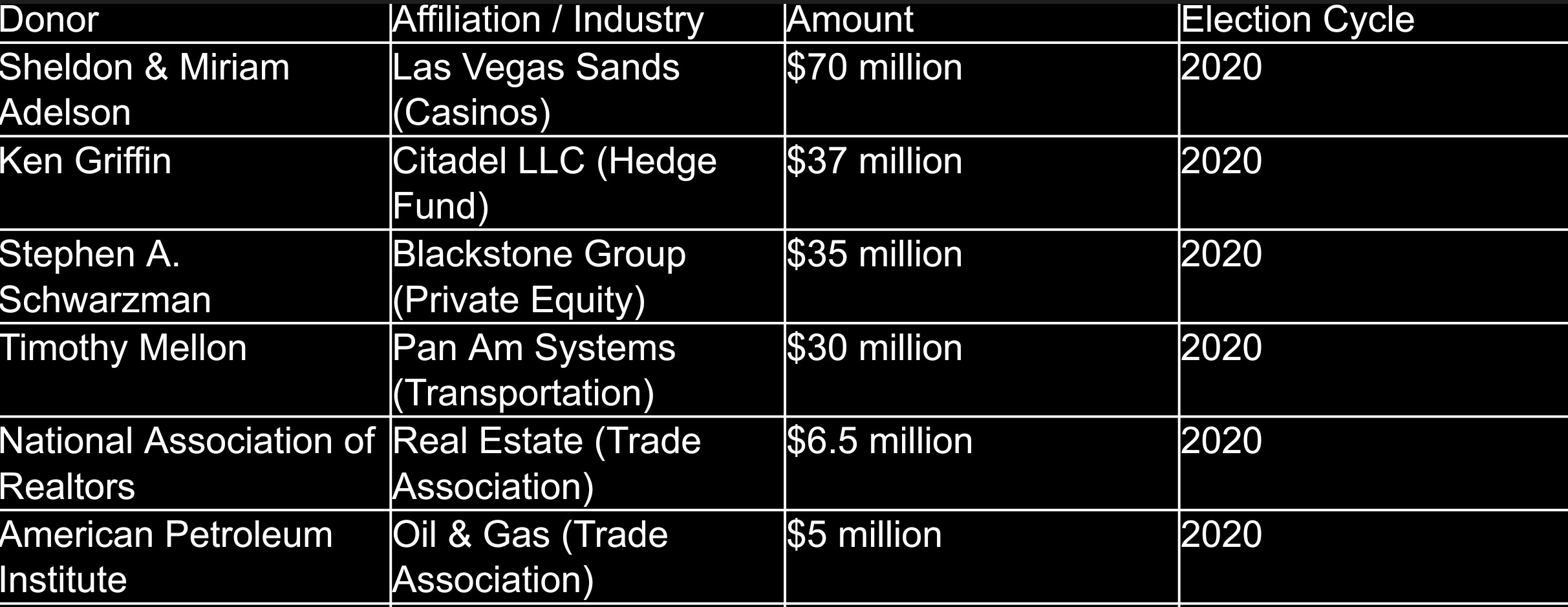
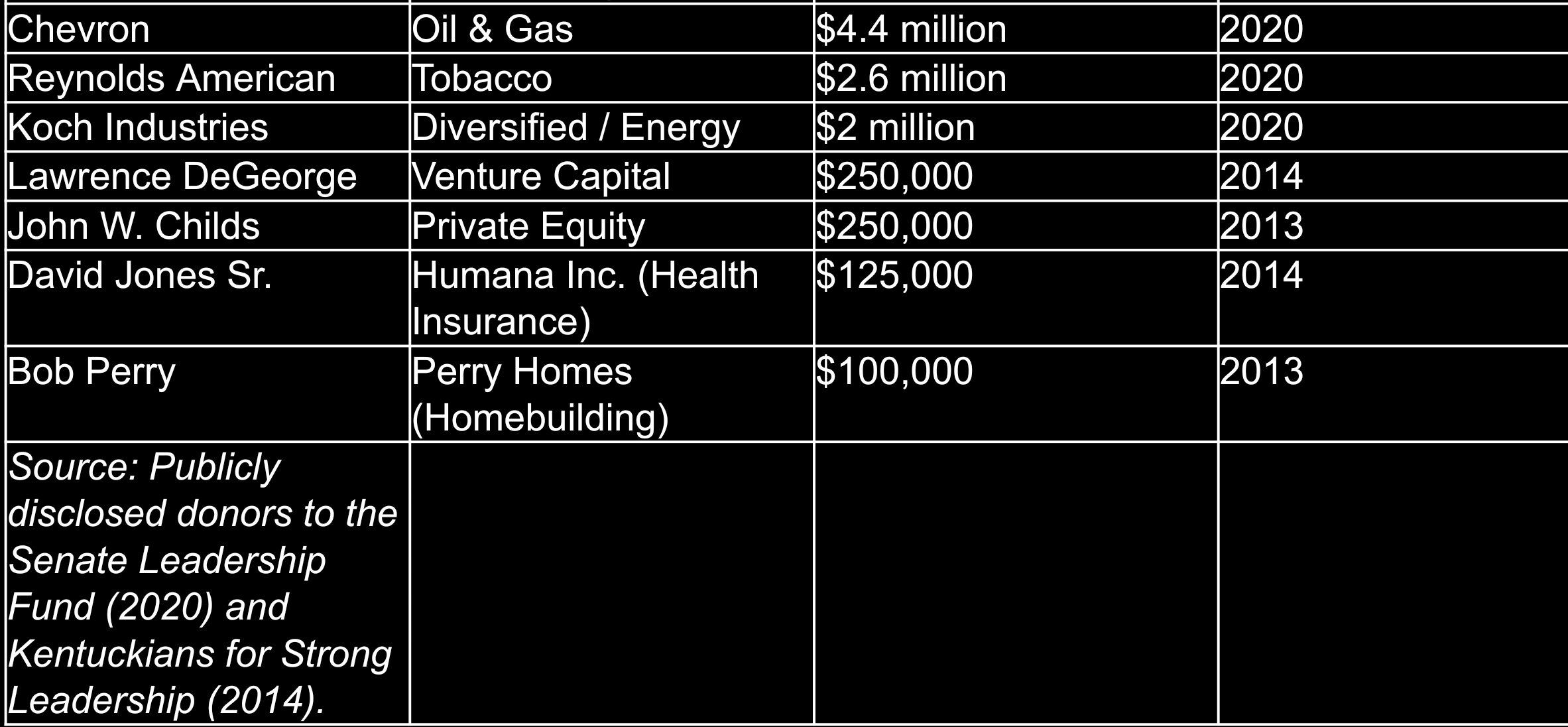
This financial structure did not emerge by accident. Senator McConnell's career-long legislative crusade against campaign finance regulations, including his central role in the McConnell v. FEC Supreme Court case, was not merely an ideological stance. It was a strategic act of terraforming the battlefield's legal landscape to favor his own forces. He first used his political power to dismantle the enemy's defenses against unlimited financial warfare, a process that culminated in the Citizens United decision. He then built a logistical machine perfectly designed to exploit the very rules he had shaped. This created a self-reinforcing cycle: political power was used to deregulate political money, which in turn provided access to more money, which further increased his political power.
The Engineering Corps - Legislative Sieges & Strategic Denial
With his supply lines secure, Senator McConnell's legislative actions can be analyzed as a series of offensive maneuvers and defensive fortifications. The Tax Cuts and Jobs Act of 2017, which permanently slashed the corporate tax rate from 35% to 21%, was a successful siege that seized key economic territory for his corporate backers. The systematic deregulation of the financial industry, including the 2018 vote to roll back key provisions of the Dodd-Frank Act, is best understood as the dismantling of enemy fortifications erected after the 2008 financial crisis.
Defensively, his self-proclaimed role as the "Grim Reaper" was a doctrine of strategic denial. By creating a "legislative graveyard" for bills passed by the opposition-controlled House of Representatives, he established impenetrable choke points on the battlefield. This ensured no enemy advance on territory captured by his coalition, blocking legislation on everything from minimum wage increases to election security reform.
The Special Forces - Judicial Occupation & Generational Entrenchment
The campaign's ultimate and most crucial objective was the permanent occupation of an entire branch of government: the federal judiciary. This was a long-term strategy designed to ensure the victories won by "The Rust" would be defended and enforced for a generation, long after he and his political allies left the field. He openly stated that confirming conservative judges was the best way to achieve a "lasting impact," far more permanent than any single piece of legislation.
The decisive engagement in this theater of operations was the 2016 blockade of President Obama's Supreme Court nominee, Merrick Garland. This was an unprecedented maneuver of strategic patience and procedural warfare. Citing the proximity of a presidential election, he held a key piece of strategic high ground—a Supreme Court seat—open for nearly a year until reinforcements, in the form of a friendly administration, arrived. This single act left over 100 federal judicial vacancies for the next president to fill.
Following the 2016 election, the Senate was converted into a "conveyor belt" for judicial nominees. Working in lockstep with the White House and outside groups like the Federalist Society, he oversaw the rapid occupation and fortification of this captured territory, confirming three Supreme Court justices and over 200 other federal judges. To ensure total victory, he changed the rules of engagement, deploying the "nuclear option" to eliminate the 60-vote filibuster requirement for Supreme Court nominees. This tactical shift guaranteed that his forces could achieve their objective with a simple majority, cementing a generational hold on American law.
Section 3: THE STRATEGIC FALLOUT (THE IMPACT ON THE GEARS): Assessing the Battlefield
A comprehensive post-campaign analysis requires a battle damage assessment of the real-world consequences of these maneuvers on the home territory of Kentucky and the broader national landscape inhabited by "The Gears."
Collateral Damage in the Home Territory
The most striking evidence of the "Kentucky Contradiction" is the direct, negative impact of Senator McConnell's national war on his own constituents. The primary case study is his relentless, multi-year campaign to repeal the Patient Protection and Affordable Care Act (ACA). This national objective, a key priority for "The Rust" and its ideological allies, stood in direct opposition to the tangible, life-altering benefits the law provided to the people of Kentucky.
Kentucky was an early and enthusiastic adopter of the ACA, expanding Medicaid and establishing its own successful state-based marketplace, kynect. The results were immediate and profound. The state witnessed one of the largest drops in its uninsured rate in the entire country, falling from 14.4% in 2013 to just 6.1% by 2015. Over 562,000 Kentuckians gained health coverage through Medicaid expansion or the marketplace. The law dramatically improved health equity, nearly eliminating the coverage disparity for Black residents, and brought billions in federal dollars into the state's economy. Low-income adults in Kentucky saw significant improvements in access to primary care, affordability of medications, and self-reported health status compared to states that did not expand Medicaid.
Against this backdrop of overwhelming local success, Senator McConnell led dozens of efforts to repeal, defund, or dismantle the law. His public statements, such as the pledge that "No One Is Going to Lose Their Health Care," must be analyzed as tactical disinformation designed to pacify the local population while the strategic assault on their benefits continued. The stark disconnect between his Kentucky-facing narrative and his national actions is laid bare in Table 2.
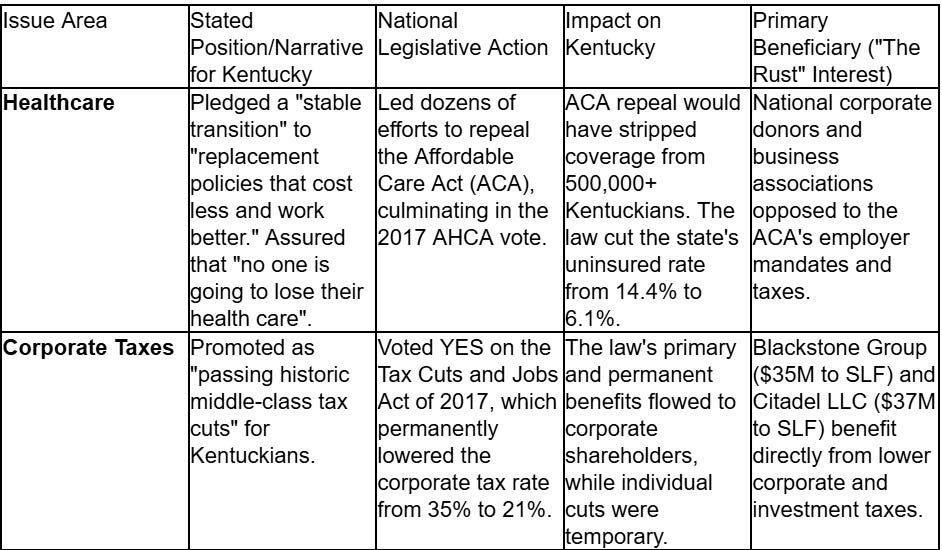
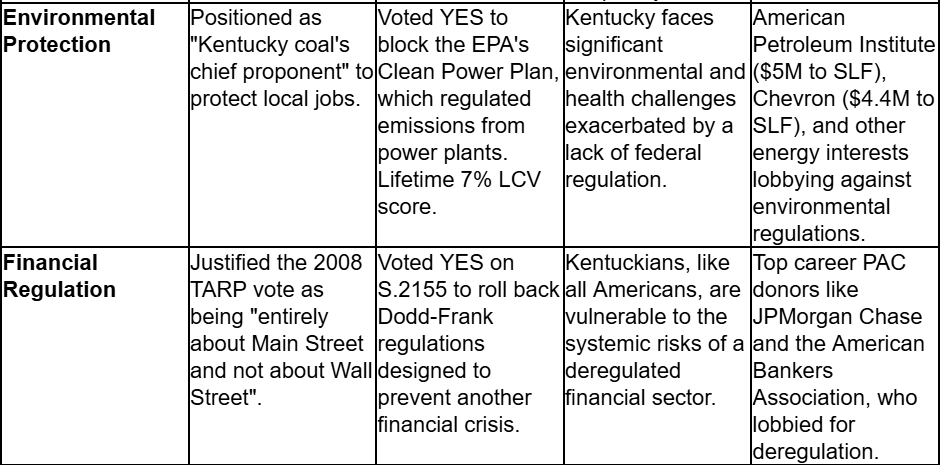
This willingness to inflict direct, measurable harm on his own constituents to achieve a national objective reveals a core tenet of the McConnell Doctrine: the expendable base. The primary strategic value of the home base was not its well-being, but its reliable delivery of a Senate seat. The "Kentucky Champion" camouflage was deemed strong enough to withstand even a direct conflict with the material interests of the voters, proving that a sufficiently fortified identity-based loyalty can, for a time, trump negative policy outcomes.
The Opportunity Cost of a National War
The final dimension of the strategic fallout is an assessment of the opportunity cost. The immense political capital Senator McConnell amassed over forty years was almost exclusively expended on the national campaign for "The Rust." While Kentucky has seen periods of economic success, particularly under its current state-level leadership , one must assess what could have been achieved for the Commonwealth with a senior senator of his power singularly focused on state-level development. His role as the "Grim Reaper" blocked national legislation on infrastructure, voting rights, and wage increases that could have directly benefited the state's working class. His focus on national and international issues like defense spending and trade agreements, while having their own strategic rationale, often came at the expense of domestic priorities more relevant to "The Gears" in his home state. Kentucky's political capital was frequently expended not to advance its own unique interests, but to prosecute a national ideological and partisan war.
Conclusion: Exploitable Contradictions and the Doctrine of Capture
The career of Senator Mitch McConnell is not a study in hypocrisy, but a master class in the application of a coherent and ruthlessly effective military doctrine. The "Kentucky Contradiction" was not a flaw in his strategy; it was the strategy itself. It is the perfected template for waging a "Vertical War," where a national power structure ("The Rust") captures a local political asset and leverages it for strategic objectives that are completely divorced from, and often antithetical to, the interests of the local population that provides the asset.
His career codifies this doctrine into a three-step operational template:
Capture and Fortify: Seize a political base (a Senate seat) using localized, identity-based narrative warfare, propaganda, and minimal tactical pacification to ensure durable electoral support.
Re-task and Leverage: Re-task the captured asset, directing all of its political and legislative power toward the strategic objectives of a separate, national-level financial and ideological constituency.
Entrench and Occupy: Use the leveraged power to achieve permanent strategic gains, most critically by occupying the judiciary to ensure the campaign's victories are defended and enforced for generations, outlasting any single political cycle.
This analysis concludes that Senator McConnell's campaign was a historic success on its own terms. He achieved the primary objectives of his principals, fundamentally altering the nation's legal and economic landscape. However, the doctrine's success reveals its own exploitable vulnerability. The entire structure relies on the durability of the initial camouflage—the "Kentucky Champion" persona. The chasm between this myth and the operational reality of the national campaign is the critical flaw. Any political force capable of piercing that narrative shield and exposing the functional reality of the doctrine to the captured base could, in theory, cause the entire structure to collapse. His career, therefore, serves as the ultimate case study, demonstrating not only how to wage and win this modern form of political warfare, but also exposing the critical terrain on which it must be fought: the battle for perception within the home territory itself.
Works cited
1. Political positions of Mitch McConnell - Wikipedia, https://en.wikipedia.org/wiki/Political_positions_of_Mitch_McConnell 2. McConnell says he'll push for clean repeal health care bill | whas11.com, https://www.whas11.com/article/news/nation-now/mcconnell-says-hell-push-for-clean-repeal-health-care-bill/417-457471847 3. Implementation of the ACA in Kentucky: Lessons Learned to Date and the Potential Effects of Future Changes | KFF, https://files.kff.org/attachment/issue-brief-implementation-of-the-aca-in-kentucky-lessons-learned-to-date-and-the-potential-effects-of-future-changes 4. Affordable Care Act Impact in Kentucky: Increasing Access, Reducing Disparities - PubMed, https://pubmed.ncbi.nlm.nih.gov/29771619/ 5. Affordable Care Act Impact in Kentucky: Increasing Access, Reducing Disparities - PMC, https://pmc.ncbi.nlm.nih.gov/articles/PMC5993404/ 6. Kentucky Has Much to Lose if Supreme Court Strikes Down the Affordable Care Act, https://kypolicy.org/kentucky-has-much-to-lose-if-supreme-court-strikes-down-the-affordable-care-act/ 7. Three-Year Impacts of the Affordable Care Act: Improved Medical Care and Health Among Low-Income Adults - Commonwealth Fund, https://www.commonwealthfund.org/publications/journal-article/2017/may/three-year-impacts-affordable-care-act-improved-medical-care 8. Mitch McConnell Dismisses Claims About Future of Affordable Care Act: "No One Is Going to Lose Their Health Care" - Kentucky Center for Economic Policy, https://kypolicy.org/mitch-mcconnell-dismisses-claims-about-future-of-affordable-care-act-no-one-is-going-to-lose-their-health-care/ 9. Here's How Kentucky's Reps Voted On The GOP Health Care Bill - Louisville Public Media, https://www.lpm.org/news/2017-05-04/heres-how-kentuckys-reps-voted-on-the-gop-health-care-bill 10. Gov. Beshear: Kentucky Ranks 3rd Nationally in Economic Projects Per Capita,1st in South Central Region for 2023 Governor's Cup, https://www.kentucky.gov/Pages/Activity-stream.aspx?n=GovernorBeshear&prId=2113 11. Gov. Beshear: Kentucky Secures Another Top 5 Ranking in Economic Projects Per Capita in 2024 Governor's Cup,Marking 5 Years in a Row, https://www.kentucky.gov/Pages/Activity-stream.aspx?n=GovernorBeshear&prId=2424 12. U.S. Senate Republican Leader Mitch McConnell reflects on accomplishments in leadership, outlines future priorities - The Bottom Line, https://kychamberbottomline.com/2024/10/23/u-s-senate-republican-leader-mitch-mcconnell-reflects-on-accomplishments-in-leadership-outlines-future-priorities/ 13. Kentucky Chamber Hosts Federal Issues Summit, Examines National Policies Impacting Businesses - The Bottom Line, https://kychamberbottomline.com/2025/06/02/kentucky-chamber-hosts-federal-issues-summit-examines-national-policies-impacting-businesses/
Mitch always was an "Enabler & Chief"
Dark horse and a evil force against his local constituency.
You're explained very well, why Ditch-Mitch slogan newer worked.
Damage he caused shall be felt by generations to come.
Thank you.