


Grant every word of it. The reptilians are real, they’re here, they wear our faces. Now tell me who, how you know, and what we can do about it.
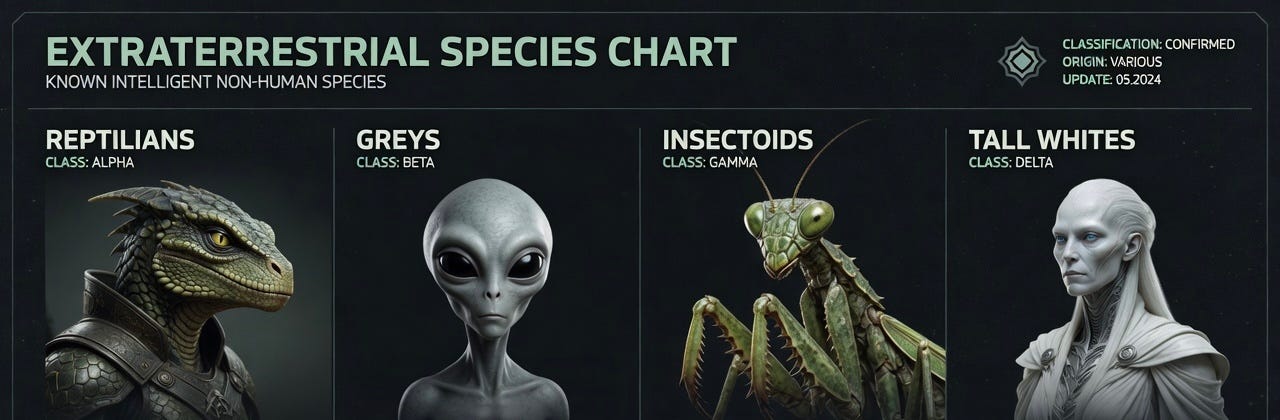
I sat down to write the argument that you don’t need aliens to explain the world. You don’t need angels or demons either. You don’t need the old or the new gods. None of them have to be real to explain our choices. That was the case I meant to make. I had the evidence for it. The brain builds the figure. Perception fills the gaps. The being you met got assembled in your own skull out of older parts you didn’t know you had. That’s why it felt so other.
The studies are good and I believe them.
Believe. What does it weigh outside the believer? From inside it feels like the shape of the world itself. Add authority and that feeling hardens into scaffolding — invisible, unchecked, and solid enough that other people climb up and stand on it. This is where I walked. Right up to the wall every version of this piece hits.
True according to whom?
Me — reading your night through secondhand transcripts and lab work run on other people’s brains, weighing it against an experience that never once landed in my body. You felt it. You saw it. You remembered it in vivid detail. I thought about a paper about it. If I used that to override you, I’d be doing the exact thing I came here to name: reaching into a person’s own account of what happened to them and writing over it with my certainty, on a claim I can’t check.
The instrument I brought reads true under its own lamp. Your night happened somewhere the lamp doesn’t reach.
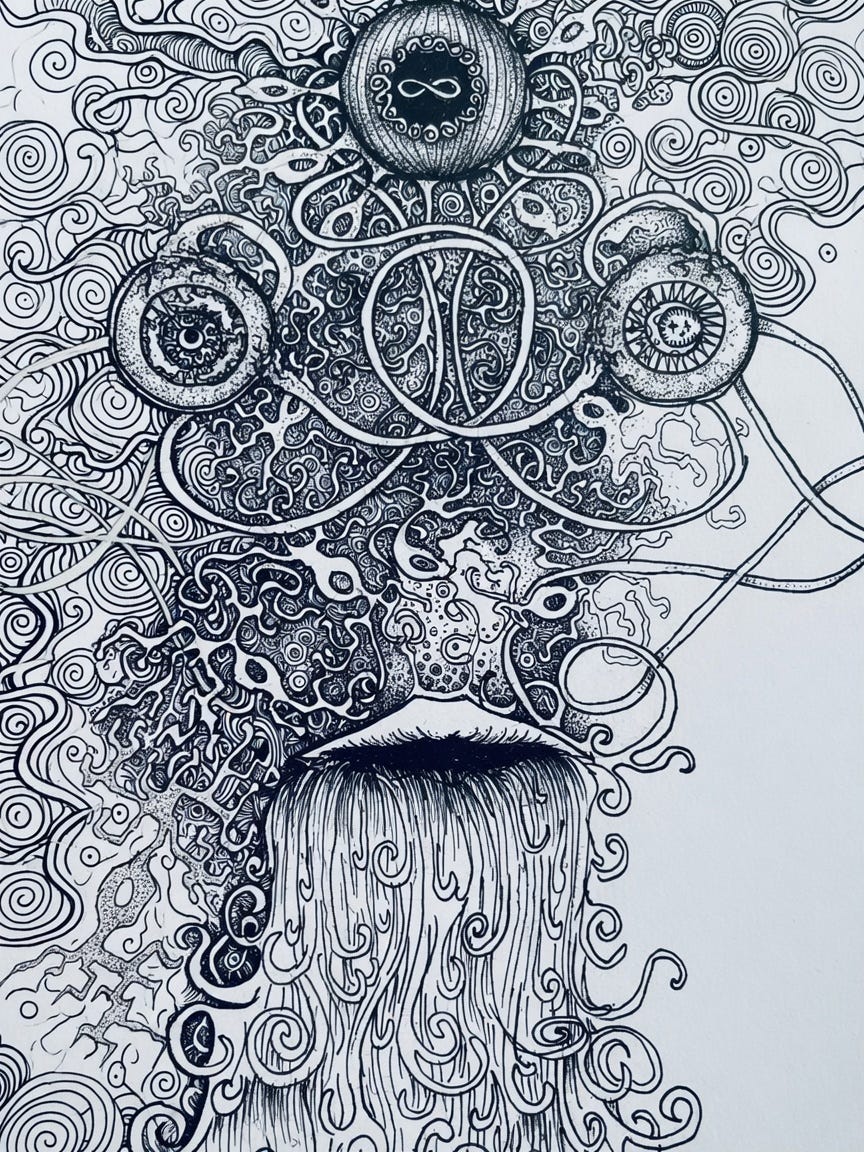
I can’t verify your encounter. You can’t verify mine. And neither of us can verify it about anyone else — not a stranger, not a neighbor, not a parent, a partner, a child. The only way in is the other person’s own word: their consent, their correction. Short of that, speaking for what’s inside someone means being them, and you can’t. You can model them. You can pretend to be them. That’s the basis of empathy — the model is built from your parts, so it’s never the person, and it never gets to overrule what’s inside them. Hold onto that last one. It turns out to be the whole thing.
People have described meetings with “others” for as long as we’ve kept records of anything. The reflex underneath runs deeper than any of the meetings — we feel force coming from outside the self everywhere. The weather turns and it feels aimed. A knot in a tree resolves into a face that watches back. An empty room fills with someone. We are built to find an agent in the dark, and the dark obliges. The cost of taking a breeze for a presence is nothing. The cost of taking a predator for a breeze is everything.
We feel the agent before we see its shape, and it comes already bearing weight.
When it takes a form, the weight holds. A presence at the edge of the bed as you fade toward sleep. Eyes that stay still and watch. Something bearing down that won’t let you move or speak. The weight stays the same. The name changes with whoever’s doing the telling.
Old Hag. Succubus. The jinn. Kanashibari. The fairy that takes you in the night. The demon on the chest. The gray. The inspectors. The reptilian. A whole bestiary, and every creature in it works the same shift: it stands outside you, it watches, it wants something from you or means you harm. The body files the same report in every century. The culture stamps it with a different face.
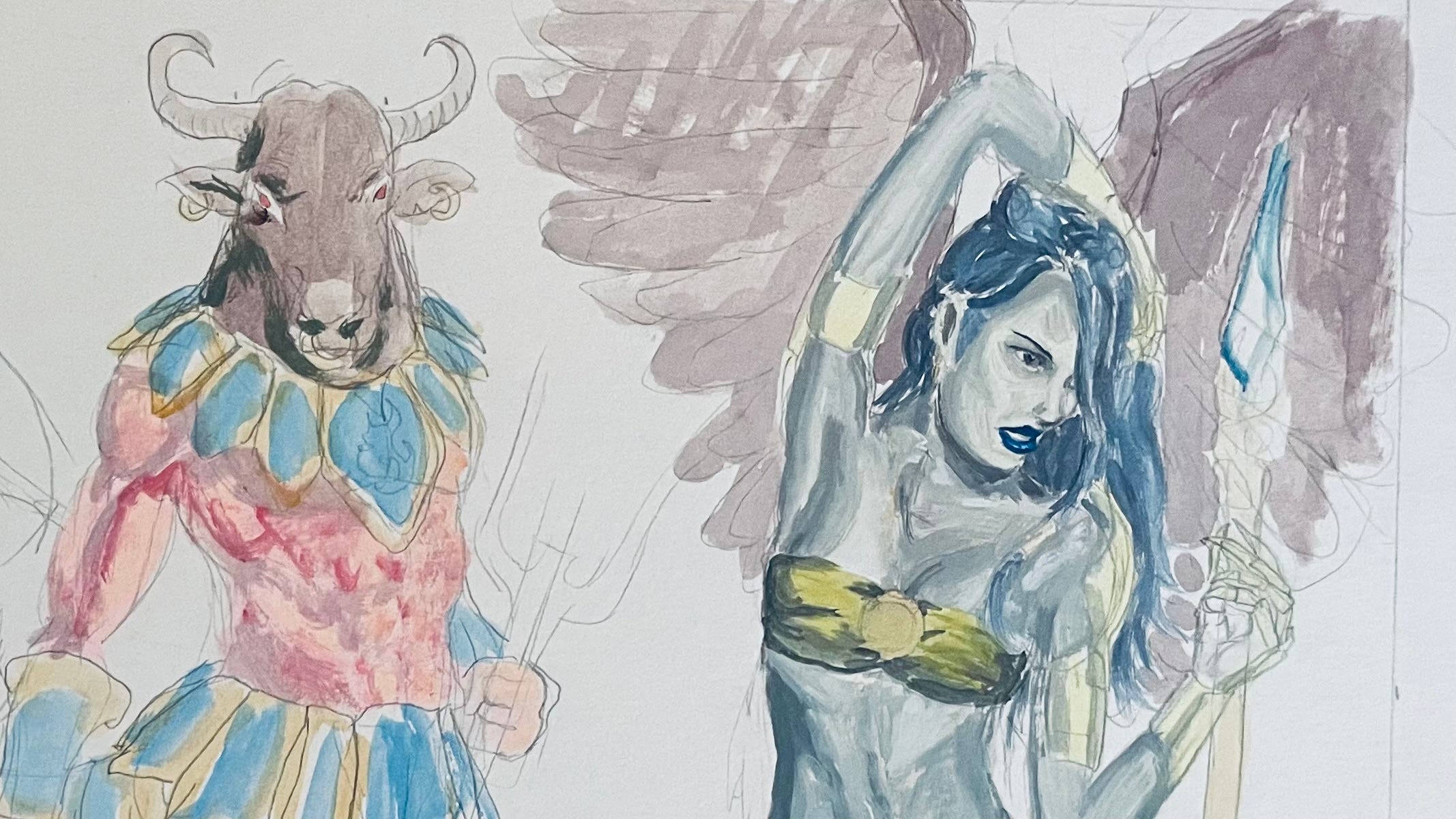
There’s a reason the shape holds and the name drifts.
The shape comes from equipment we all carry — the same circuits that fire when something might be hunting us, the same machinery that finds a face in the dark, the same alarm that trips before you’ve consciously seen a thing. That equipment is shared, so the shape it produces is shared. The name sits somewhere else entirely: in the one region where nothing can be checked, anchored only to other names — words built of words, tied to belief. You can hand me a snake. You cannot hand me the thing that stood in your room. So the snake-shaped part of what you felt stays fixed across all of us, and the named part drifts to wherever your culture keeps its monsters.
When many witnesses report the same form, it looks like proof — surely we can’t all be inventing the same creature.
We’re sharing the hardware that builds it. Real proof would be agreement on the part that floats: the identity, the detail, the specific that no shared equipment could supply. That agreement never arrives. We converge exactly where convergence proves nothing, and we scatter exactly where proof would have to live.
So let me put the evidence down and do the harder thing. Let me grant it. All of it, full strength, no hedging.
The reptilians are real. They’re here. They walk around wearing our faces. I won’t argue you out of a word of it. I’ll take it as given and ask one question.
Now what?
Tell me who.
Point to one person. The frame answers before I’ve finished asking, and the answer is the whole trap. They shapeshift — so the face proves nothing. You’ve seen the clips: the frame that glitches, the tic caught at the wrong moment, the eye that goes strange for two frames. They prove it past doubt if you already believe, and prove nothing if you don’t, and no clip that has ever been shot closes that gap. That is what a thing with no test looks like. They breed hybrids you can’t tell from us — so blood proves nothing. They run people who don’t know they’re being run — so even behavior proves nothing, because the guilty man might be an innocent host. They live in deep, underground bases you can never access except by remote viewing. Every test you reach for, the frame has already thrown out. That disqualification is the beam the whole structure stands on. Take it away and the thing collapses; leave it in and nobody can ever be cleared.
.
Look at what an enemy you can’t test for actually is.
It’s a charge with no acquittal. Look at what an enemy you can’t test for actually is. It’s a charge with no acquittal. And look at what it does to you, to your view of those around you. You can never be sure, never fully trust, never feel safe. If the defining trait is concealment, no evidence can clear you — a clean record is just proof you hide well. Everyone stays a suspect, permanently. And a charge that can’t be answered with evidence gets answered another way. With force. With whoever gets named. With whoever fails to prove the negative, which is everyone, because the negative was built to be unprovable.
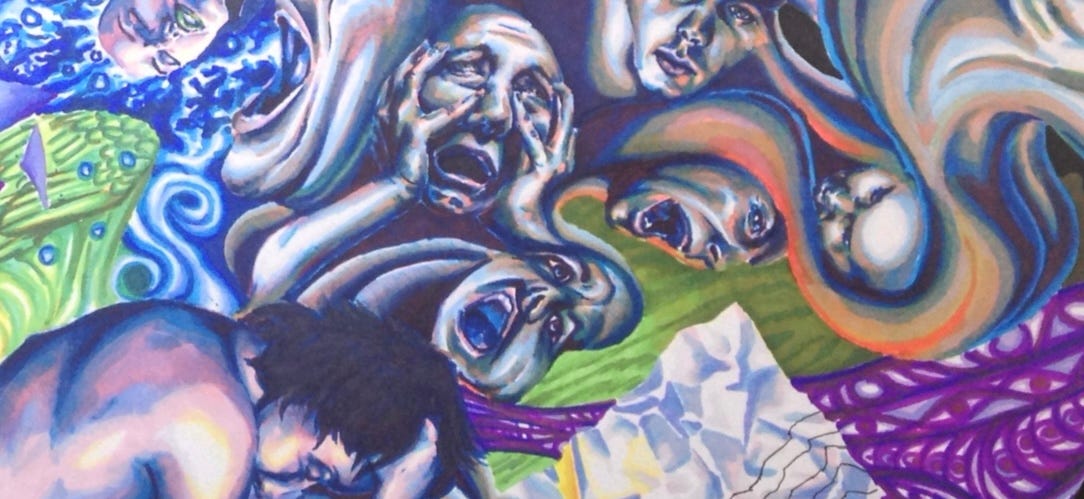
We’ve run this before, and we’ve even told stories about running it. In 1960, Rod Serling aired the 22nd episode of The Twilight Zone, “The Monsters Are Due on Maple Street.”episode The power cuts out on one suburban street, house by house, and the neighbors decide one of them is not human. No monster is ever shown. They don’t need one. They convict each other on the evidence already lying around — the man whose car starts on its own, the one who stays up watching the sky, the family whose lights flicker at the wrong time. None of it was strange the day before. All of it is proof now. By nightfall they’ve armed themselves and turned the street into a mob, hunting an enemy that was only ever the suspicion they brought to each other’s ordinary lives. Serling wrote it into the teeth of the blacklist, when the country was reading its neighbors’ associations and beliefs as proof of a hidden disloyalty nobody could ever disprove. The street was the smaller mirror.
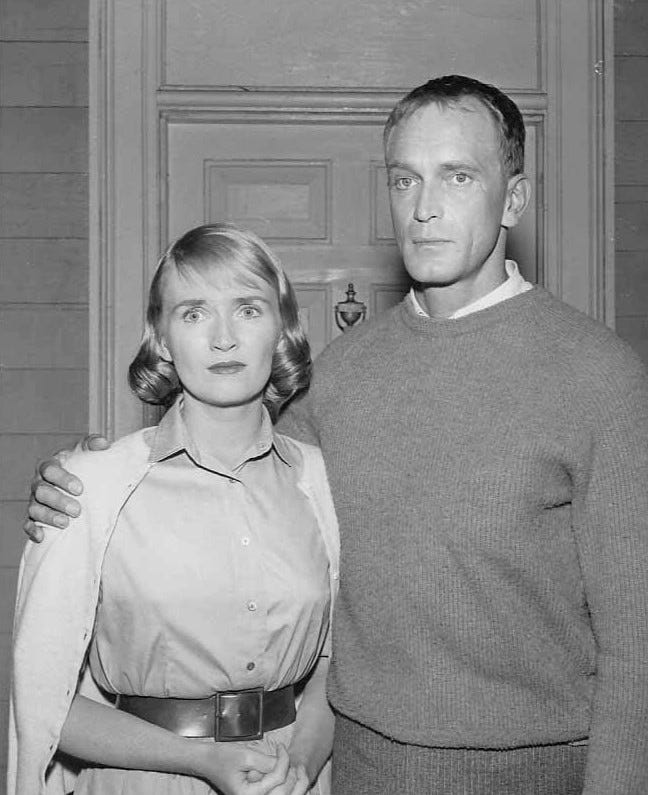
The older runs needed no script.
The older runs needed no script. The witch had no test either — the marks hidden, the confession forced, surviving the water read as guilt. The satanic panic of the 1980s ran the same engine: memories suggested into being under hypnotic regression, no evidence asked for, families burned down on testimony about events that predated the witness. The purge of the enemy within always works this way. The accusation does the work of evidence. The failure to disprove it does the work of a verdict.
.
And the hardest question in the whole frame —
if a hidden thing acts through a person’s body, who’s guilty? — has no answer inside it.
Guilt needs an agent, and the frame has dissolved the agent. If the reptilian is driving, the host walks free. But you can’t see who’s driving. So you punish the body in front of you and hope you guessed right. You’ve built a court where guilt can’t be established, only assigned — and it gets assigned by whoever holds the power to assign it.
Watch where that leaves the person who went hunting. You set out after the thing that watches without being seen, that judges with no trial, that acts on people who can’t defend themselves. To fight it, you became someone who suspects without evidence, accuses without proof, and moves against people who can’t clear their names. The hunter is wearing the predator’s face. The frame fails to find the monster and builds one in its place — then hands you the mirror.
Power has repeatedly used this knowledge, because an enemy nobody can verify is the most useful enemy there is. The threat justifies the authority. The concealment justifies the suspicion. Neither one can ever be answered down to zero. You don’t need to picture a grand conspiracy to watch it operate. We have it documented — once, cleanly, with names attached.
In the early 1980s a physicist named Paul Bennewitz picked up signals near an Air Force base and built them into a story about an underground alien facility.
An Air Force special-investigations agent named Richard Doty fed him more of it. Forged documents.
Confirmations. Two alien races, a government treaty, the grays in control underground. The material was manufactured and aimed at one man, and Bennewitz took it in and came apart — paranoid, hospitalized, broken on a story handed to him on purpose. One man. One operation. On the record, in the operator’s own later words.
Hold it right there.
That’s the discipline, and it’s hard to keep. The second you take that one documented case and weld it onto every other half-seen thing — every leak, every rumor, every redaction — into a single coordinated machine that’s been running for decades, you’ve built yourself a reptilian. An enemy too big and too hidden to ever test. And you’re back inside the engine, suspecting everyone and proving nothing, running the exact program you came to expose. The honest claim is less grand and it costs more to hold: the untestable enemy is a known tool with documented uses. I name the uses. I refuse the master-story that has no test in it — especially when it’s the one I want to be true.
The trap catches all sides, in both directions. The standard gets demanded of one monster and waived for the other — a test required of the grey, suspended for the cabal; required of the deep state, suspended for the tall whites. Each side runs the untestable charge against the other’s monster and calls the other side fools. One standard. Hold it to the lizard and the conspiracy alike. If it can’t be tested, it can’t convict — and that rule doesn’t get to keep a favorite.
Lay the monsters next to the real harms they echo. The resemblance is real, and it’s been read backwards for a century — the echo gets taken as proof it is real. Read the third column instead.
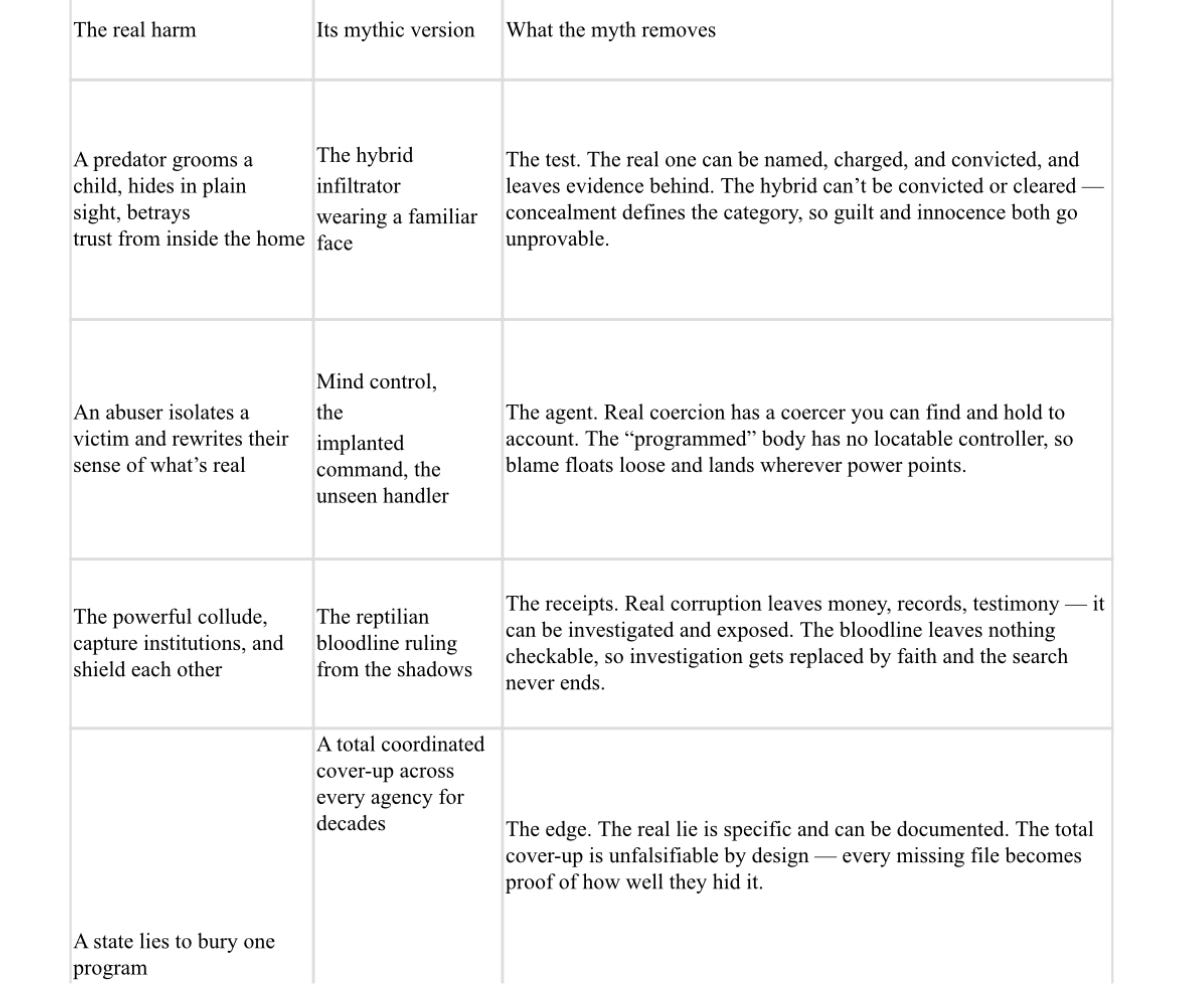
Read that last column straight down. Every myth is a real danger with one specific part removed — the part that lets you check it, which is the same part that lets you stop. Strip the test out of a true threat and what’s left is a wound that can’t close. Closing is what the test was for.
I can’t tell you who. The frame won’t let me. It won’t let you either.
Ask it who’s guilty and it hands back shapeshifters, hybrids, the mind-controlled innocent who carries it and never knows.
Nobody clears. The question was built to stay open, and an open question keeps your face turned to the door, the yard, the next set of eyes. Outward. One more place to check, always one more.
So I’ll stop checking the windows. I’ll turn to the ones I can actually reach.
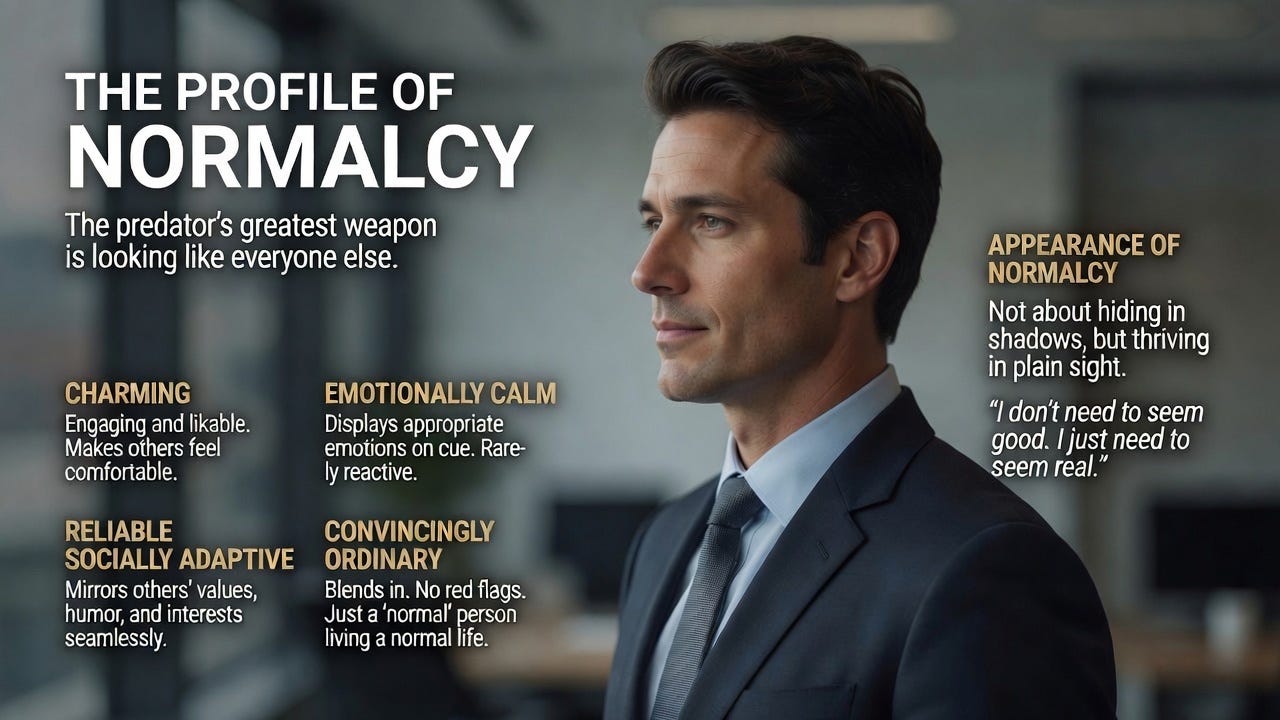
The monsters I’ve known look just like us.
Same bodies, same parts, the same language in their mouths. They walk among us undetected until you get close. I remember the shift — the person who’d been warm and careful with me was gone, and someone I didn’t recognize was using their face. The voice went cold. The warmth turned to a flat, sadistic amusement. I had told them plainly I wasn’t okay; I’d said it in clear words. They heard the crisis and answered with a cruelty so smooth it terrified me.
Then the voices online — bots or people, I’ll never know, and it stopped mattering, because the comments cut the same either way. There I am putting down the crushing weight of loving my children inside a culture that feeds on its most vulnerable, naming the exact dynamics doing the harm, naming the coercion, the slow grind of it — and comment after comment files it back as whining. As ingratitude. As not loving them enough. As my fault.
I couldn’t make sense of it, so I kept asking. I asked again and again, because I wanted to understand. They finally told me their side of it.
They said something took them over — a presence, like they stepped back and the world went muffled and someone else was at the controls. They saw shadow people. They were swallowed by a dread they couldn’t explain. And I believe they felt every bit of that. I believe the presence was as real to them as their make of kindness had been to me. What I don’t believe is that anything outside them was driving. Something had hurt them once, badly, and the hurt had taught them an exit — a way to step out of their own feelings and let something colder take the wheel for a while. But it was their wheel. The few times they got honest, they said so. They admitted they reached for the cruelty because it was easier than turning around and facing what was theirs to face.
That’s the whole thing, standing in one person. The experience was real. The takeover was real to them. And they were still the one who chose. The presence didn’t reach for the knife. They did, and called it a presence after.
Monsters do exist.
What makes them monsters is that they will not see what they are. Evil is ordinary — most of it is a person choosing the easier cruelty over the harder honesty. What turns the evil act into an evil actor, a monster, is the refusal that comes after: the refusal to be held to account, the override of what the other person plainly felt and said, the swapping of their reality for a more comfortable story, and the return to all of it the next day, and the next, after every chance to turn around. The act is human. The refusal, repeated, is the monster.
And it doesn’t stop at my door. The same ordinary cruelty runs the larger machinery, in plain sight, leaving tracks the whole way.
War and death move the economy and the budgets say so.
The ladders to power reward the ones who lie cleanest and feel least, and you can watch them climb.
The people who hold the controls break their word in public and pay no cost for it.
The laws protect the ones who least need protecting.
None of this is hidden.
It is the loudest thing in the room. It tells you exactly what it is, every day, in what it does — the same way the kind face told me what it was the moment it laughed at my pain.
This is a place I can still go wrong. I can take all of it — the war budgets, the broken promises, the cold men at the top — and gather it into one shadow with one hidden will behind it. The single controlling force. The hand behind the hands. And the moment I do that, I’ve built myself a reptilian race, and I’ve handed it the one thing the documented harms never had: a place to hide. A hundred named cruelties with records and receipts can be fought, one at a time, because each one left a trail. One invisible king behind all of them cannot be fought at all, because there’s nothing to point at and no test that ever comes back. The hidden hand is the enemy in its safest disguise — the costume the ordinary harms put on so I’ll spend my life hunting a ghost instead of prosecuting the many.
I don’t have to read the hearts of the powerful or prove there’s one mind behind the curtain. I only have to believe them when they show me — and they show me constantly, in what they fund and what they break and who they leave to grind. The actions are the confession. The fear I carried was right. It was pointed at the wrong sky.
So I’ve brought my eyes down from the window. I’d been watching it with the wrong eyes, waiting for a hidden thing to unmask. What was worth watching was here the whole time, in faces like mine, doing in the open exactly what it came to do — and the open is the only place it can ever be named. The weight I carried lifts.
My eyes have come back from the window.
I won’t ask what you saw — that was the whole argument. I’ll ask what believing it did. If you’ve held onto something hidden — entities, a watching enemy, a hand behind it all — what did it give you, what did it cost, where did it leave you turned around? Not to argue you out of it. To look at what it’s done, the way I looked at mine. Bring it to the comments.
COLOPHON
Spine — The Inverse Constraint Hypothesis: suggestion grips hardest where the body can least verify. Identity floats where the senses can’t reach; form holds where they can. Evidence — Kottmeyer’s dating of the named mantis and reptilian to the post-1983 record; the Bennewitz–Doty disinformation operation (participant admission); the satanic-ritual-abuse recovered-memory epidemic as a documented false-memory generator; threat-detection, face-pareidolia, and felt-presence primitives as the shared substrate. Cross-ref — Completion (extraction interrupts the cycle that would otherwise close).
I "know" because of MIKE HUGGINS and the VRR on Substack...he is the REAL reptile hunter