


Part 1 https://constructamiracle.com/p/before-the-word?r=4uzajq
Part 2 https://constructamiracle.com/p/i-am-a-cause?r=4uzajq

A parcel of spinels arrived. Spinel is often mistaken for sapphire. The steel-model Cartier watches carry a cabochon of synthetic blue spinel on the winding crown; at a glance it reads as sapphire, which is what it is meant to read as. The Black Prince’s Ruby — the great red stone at the front of the Imperial State Crown of Britain — is not a ruby at all. It is a 170-carat red spinel. Before 1783, all large red stones were called rubies. Chemistry eventually told them apart. I was working through the parcel, one by one, when I hit the stone I want to tell you about.
One stone in the parcel stood out.
It sat on my polariscope — two polarizing filters crossed against each other, so that any stone placed between them that does not split light stays dark through every rotation. Spinel does not split light. Its cubic lattice makes it one of the few singly refractive gem species — diamond, garnet, spinel. I rotated this one slow. It brightened and darkened. I did it again, slower, making sure I was not the one moving the light. Same result.
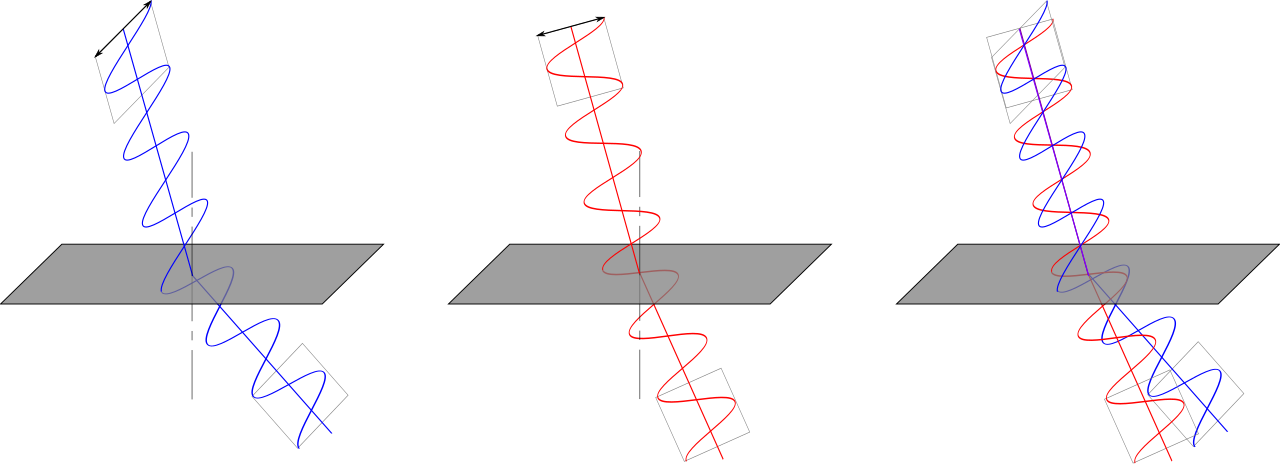
Spinel is singly refractive by the geometry of its atomic lattice. Light entering a spinel does not split. This one was splitting it.
Strain inside the crystal can make the light behave as if it split. Strain is internal distortion — pressure or temperature changes during the stone’s formation that warped the lattice slightly without breaking it. The trade calls the optical result anomalous double refraction. Looks like real double refraction. Still spinel.
Another possibility. Taaffeite. First identified in 1945 by Richard Taaffe, who bought a parcel of cut spinels in Dublin and noticed one of them doing exactly what this stone was doing. He sent it out. The answer came back: new mineral. Hexagonal lattice. True birefringence. A species that had been sitting in collectors’ cases and jewelry boxes for who knows how long, already cut, set, sold as spinel, because it looked the part.
It is the only gem species ever discovered after being cut.
The Stack
A painter works in ultraviolet-reactive pigment. Under ordinary room light the canvas shows nothing — blank white, maybe a ghost of a mark. Switch on a blacklight and the painting appears. The work was there the whole time. What changed was the condition of reception.
Making closes a loop. The painter held a prediction about how the pigment would behave on the surface. Every stroke tested the prediction. The surface answered. By the end a real object existed, and the painter knew what it was. That loop is complete inside the maker.
One body is not enough to build a world.
The shared world — the one we move through together — is built by countless bodies, countless minds, across time. A painting that never leaves the studio, a song that is never heard, a sentence that never reaches another chest: the making happened. The world those acts were meant for never received them. The loop closed in one place and stopped.
Enduring construction is construction that moves beyond itself. Made under a constraint the world answered. Carried into another body. Rebuilt there, in that body’s own terms. Corrected again by that body’s experience. Sent on. The making holds because it transmitted. The private loop became a shared one.
• • •
Making meets matter. That is where the first correction signal lives.
Think of any skill the body learns — throwing, drawing, chopping, cutting gems. The hand moves. The world answers, in milliseconds. Too hard, too soft, wrong angle, wrong grip. The body adjusts. Thousands of cycles later, the movement is smooth, because the world was correcting the body the whole way down. Every Prismacolor blend I botched taught me something the ones that came out right never could. Wrong pressure, wrong order, wrong tip — the paper showed me. I adjusted. Thousands of cycles later, the blends read the way I saw them before I started.
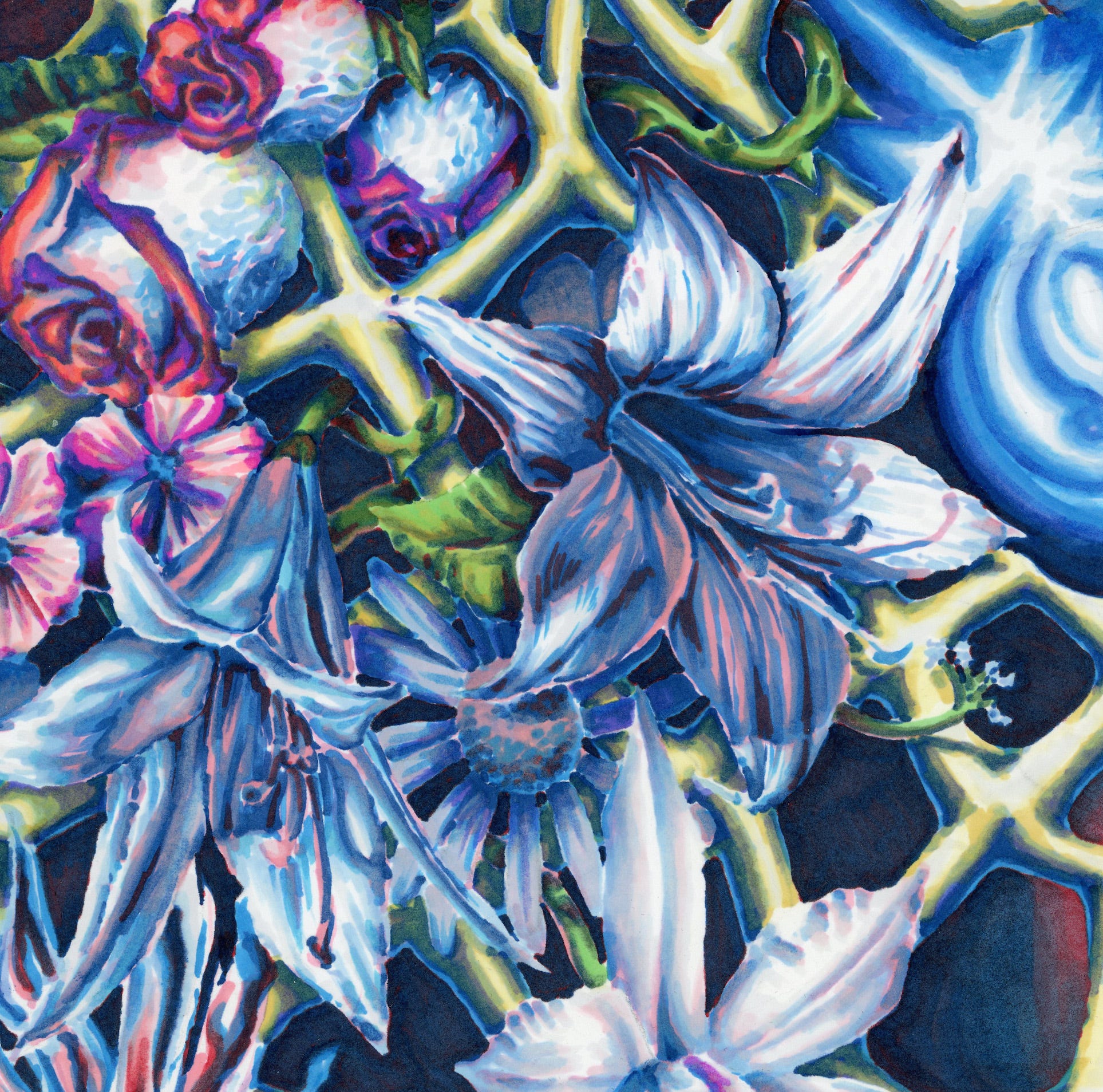
Language learns this way too, when it is allowed to. A child says a word, a face responds. The word landed, or it did not. The child adjusts. Enough rounds, and the word is tethered to what it was meant to mean — because the world kept correcting it.
Transmission meets another brain.
Part 2 described this as situation-model mirroring. When you speak, my brain builds a model of what you are describing. If the words are grounded — if they refer to something a body can register — the model in me starts to approximate the model in you. What got made in your system gets remade in mine. The loop that closed in you closes again in me. That is what communication is when it works.
Both ends are the same prediction engine from Part 2, running at its hardest setting. On one end, the maker meeting the world. On the other, the receiver meeting the maker. Between them, construction moves.
• • •
Now the stack.
Phonemes, which are perceptually distinct units of sound that distinguish one word from another, sit on the body. Produced by mouth and chest. Received by the ear. Tethered to what a body can make and hear. Part 1 set this floor.
Words sit on phonemes, Sentences on words. Arguments, stories, shared references on sentences. Narratives on those. Institutions on narratives. Ideologies on institutions. Whole shared worldviews rise from there, each level more compressed than the last.
Each layer either keeps the tether to the layer below or cuts it.
A sentence built from words learned in bodies, arranged by a grammar the speaker kept testing against how people actually responded, lands. An institution built from sentences like those, staffed by people whose predictions about the work keep updating against real consequence, holds. A culture whose institutions hold can carry large abstract words — justice, community, care — because somewhere down the stack, actual people and actual exchanges are still keeping the words honest.
Cut the tether at any level, and everything above the cut is floating — however coherent it sounds.
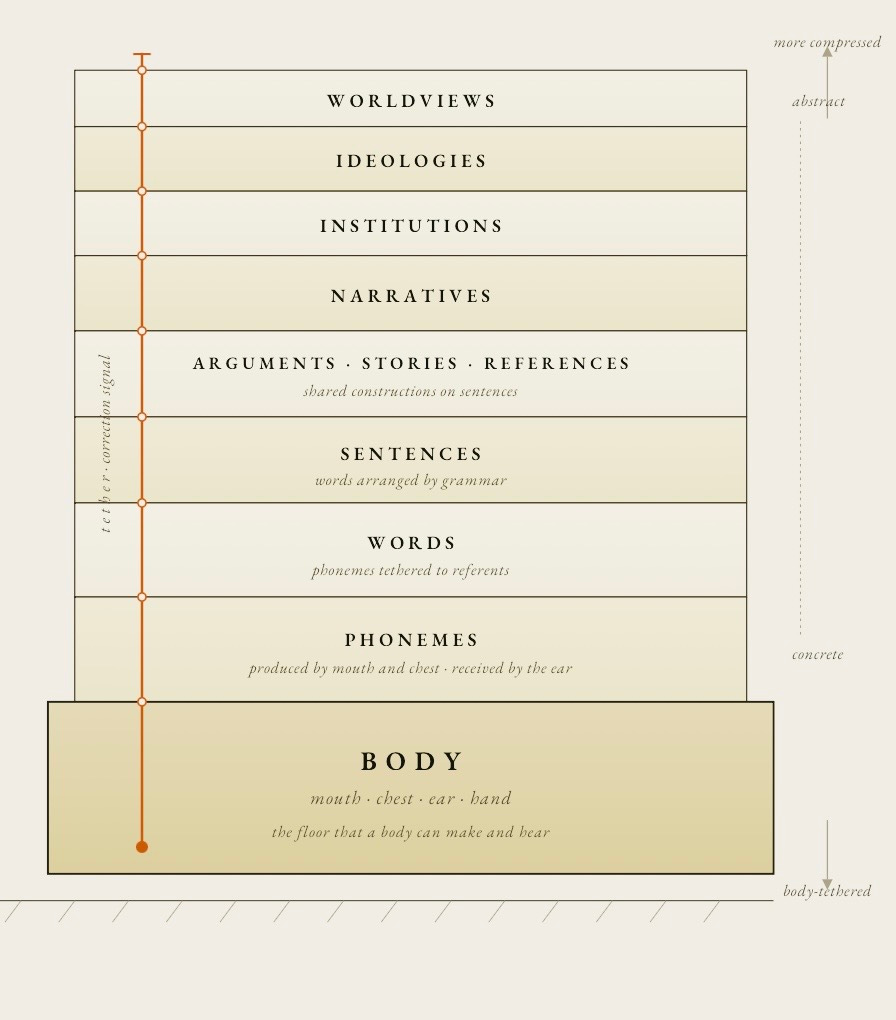
A metaphor three floors up from a severed root is still a metaphor. It can move readers. It can persuade. It cannot carry weight. People speaking an ideology whose words have lost contact with the bodies those words once named are running a stack whose correction signal was turned off levels below them. The coherence is internal. The system runs on symbols confirming symbols. The construction looks like construction.
• • •
Back to the tree from Part 1.
The trunk is constrained by its own geometry. Each branch that grew was tested against wind, gravity, light, water. The shape aboveground makes sense because the root system belowground kept correcting it. Stop distributing resources to the buried part — because it cannot be seen, because the visible tree seems to be doing fine — and the tree keeps looking like a tree until the day it falls.
A society’s stack works the same way. It keeps looking like construction until too much is left destroyed or depleted.
The next question is how to tell the constructions that hold from the ones that only look the part.
Two Architectures
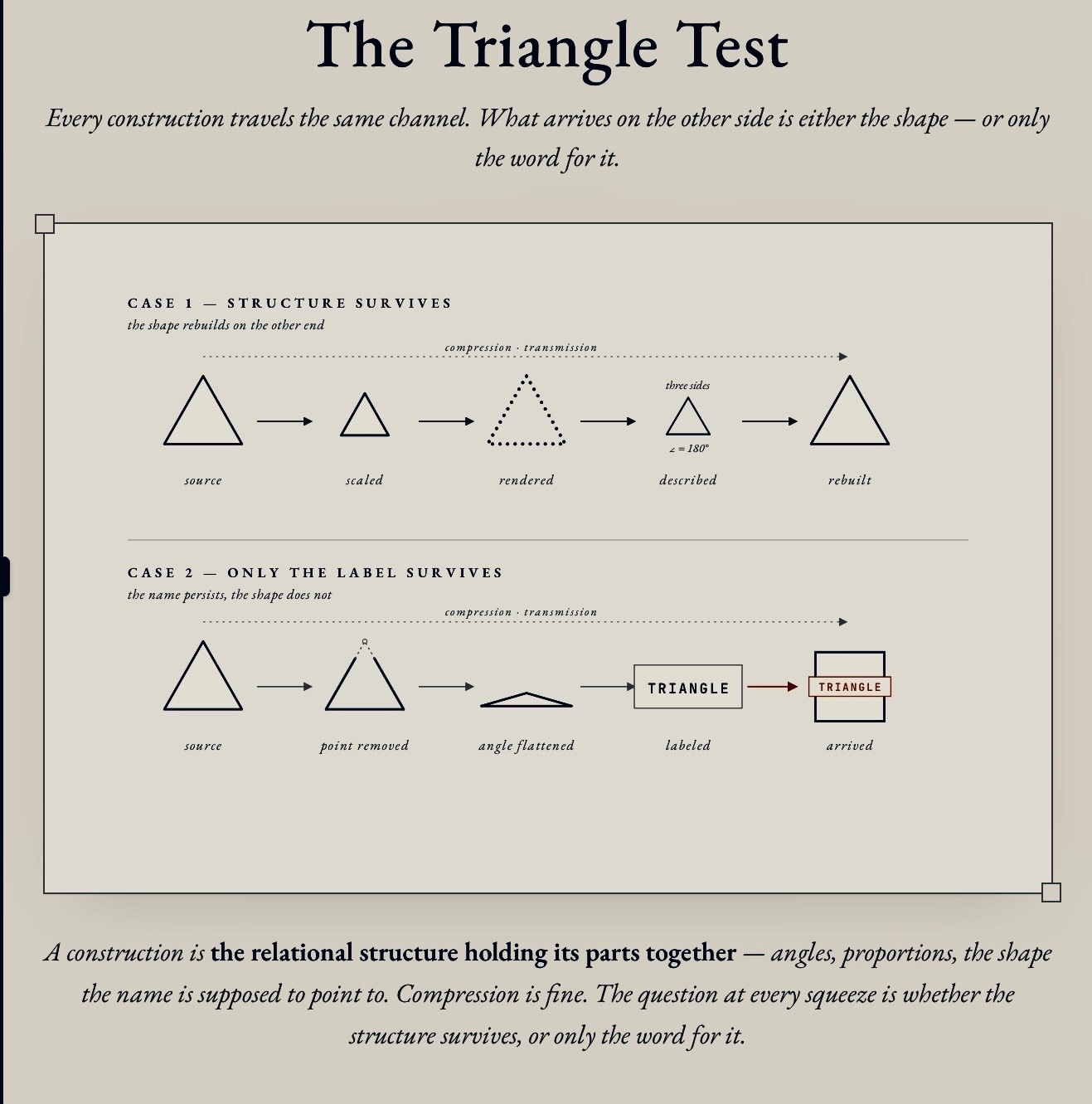
A triangle can be drawn large or small. Rendered in ink or in chalk or in pixels. Described in words. Carried across thousands of miles, through any number of retellings, and what arrives on the other end is still the same figure — three sides, three angles summing to 180°, the proportions between them preserved.
Remove a point. Add a line. Flatten one of the angles. The figure that arrives is no longer a triangle. It is something else now, whatever it looks like. The name can persist without the structure. What moved through the channel was a label.
Every construction travels this way.
• • •
A construction is the relational structure holding its parts together — the angles and proportions that make the thing what it is. Compression is fine. Required, even. Part 1 established that language is itself symbolic compression. A sentence fits a week of experience into a handful of sounds. A blueprint fits a building into a sheet of paper. A word fits a whole class of things into three letters.
The question at every compression is whether the structure survives the squeeze.
“My child” compresses an enormous amount of relational reality into two words. The child is a body you have held. You know their voice, their weight, the frequency of their breathing asleep. The word “child” is small. What it points to is not. If someone hearing you use the word has held a child of their own, the structure rebuilds on their end. The compression worked because the architecture survived.
“The asset on my balance sheet” compresses a different reality. Also small. What it points to — depending on what the asset is — could be the same child, once it has been reduced to a line item. The label is preserved. The structure is not. What was relational, embodied, specific, has been flattened to a number and a category. The shape that arrives on the other side is a different shape. A point was removed.
This happens at every level of the stack. A joke is a setup-payoff structure. Paraphrase it and flatten the payoff, the joke is gone even if all the words are somehow still there. A promise is a speaker-listener-commitment structure with a specific shape in time. Compress it into a slogan and the promise is gone. A neighborhood is a web of specific people who recognize one another across years. Compress it into a demographic, a census tract, a market segment, and the neighborhood is gone. The words remain. The triangles were replaced by labels.
• • •
Enduring construction is construction whose essential structure survives compression and transmission.
This is what the maker’s whole job is — holding the structure of the thing through every stage. The painter working in UV pigment preserved the composition, the proportion, the relational logic of the image through every stroke, knowing it would disappear into the white canvas and only reappear under the right light. The illustrator holds the shape of what they are drawing through every layer of color, every blend, until the image on the paper is the image that started somewhere behind the eye. The writer compresses an experience into a sentence, and the sentence either carries the structure the experience had, or a flattened version that sounds similar and means something else.
On the receiving end, the same work happens in reverse. The receiver rebuilds the structure from the compression they received. If the angles and proportions made it through, the thing they rebuild is the thing the maker made. They are now holding the same shape. The construction transmitted.
Construction that lasts compresses without losing what it is.
• • •
The pressure to collapse structure into label is constant.
Every shortcut is available. Drop a point, the compression is smaller. Flatten an angle, the thing fits more places. Replace the shape with its name, and the name moves at the speed of a sentence. Most of a culture’s working vocabulary travels that way most of the time. Labels at the speed of sentences. A sound or a symbol where a person or entire country used to be.
What survives is construction that refused the shortcut. That held the angles through every squeeze. That compressed exactly as much as it could without losing itself, and no further.
The triangle is the test. What moved through the channel — the shape, or only the word for it?
Collapse and Return
You feel it before you can name it.
A friend you have known for years tells you something. The words are warm. The sentences are correct. Nothing in your body registers that you have been spoken to.
A product arrives from a company whose name you trusted for a decade. The object functions. Something about it reads as though no one made it.
A meeting at work. The right language gets deployed. A decision that nobody in the room would defend on their own feet gets made anyway, and the meeting ends on schedule.
Each of these is the same event at different scales. A label arrived without the shape underneath it. The name persisted. The structure that used to stand behind the name is gone.
This is what collapse actually looks like, most of the time. Buildings do fall, eventually. Long before anything visible comes down, the shapes inside the labels have been thinning for years.
• • •
At the individual scale, you become the shape that goes missing.
A person whose prediction engine has been running on one leased domain — a job, a role, a performance — for long enough that all other domains have atrophied wakes up one day to find the returns on the one remaining domain have stopped firing. The coffee you make every Friday for the meeting is still coffee, but it does not land anywhere. The reports you file arrive in a system that cites other reports. The sentences you speak at work are received by an audience optimizing for the same words you are producing. The loop that was closing in you has been closing only inside a symbol system for longer than you realized.
Part 2 named this collapse burnout, depression, addiction, rage. All the same mechanism: the organism’s agency prediction stops resolving, because the domains it was resolving in were themselves shapes that had gone missing.
The body was right. It was telling you for months. The language caught up or never arrived.
• • •
At the institutional scale, the same thing happens, slower.
An institution is built to hold a shape. A hospital holds the shape of care — a sick body met by hands that can help. A school holds the shape of teaching — a child met by someone who knows something and wants them to know it. A court holds the shape of judgment — a dispute met by a structure older than either party. A newspaper holds the shape of witness — something happened, someone saw, a body on the other end is told.
The shape is the whole institution. The building, the staff, the letterhead, the funding — these are the supports around the shape. As long as the shape is intact, everything else bends toward keeping it intact.
When the shape starts thinning — when the correction signal from the bodies the institution serves stops reaching the bodies running it — the supports become the institution. Budget optimizes against budget. Protocol cites protocol. The letterhead carries weight the shape no longer carries. People show up and perform their roles, and their roles are real, and the institution still runs. What runs is not the original shape.
This can continue for a long time before anything visible happens. A local newspaper that keeps publishing after the newsroom has been gutted is a small version of it. The 2008 financial collapse was a large one. The pattern lives between them, invisible from the street.
• • •

At the cultural scale, the pattern has a name.
Guy Debord gave it one in 1967: the spectacle. His claim was that modern life had replaced direct experience with representation — that everything that used to happen between people was now mediated by images of the thing instead of the thing itself. He saw the pattern. He did not have the neuroscience yet.
The mechanism is what Parts 1 and 2 of this essay established. A culture whose stack has been running on symbol-confirming-symbol for long enough that whole generations have grown up without direct access to the shapes their inherited vocabulary is supposed to point to. The prediction engine runs on predictions. Correction signals come from other predictions. Nothing physical is anywhere in the loop.
When this reaches population scale, the downstream effects are not mysterious. Trust thins, because trust was always a shape the body registered in another body, and that register is no longer firing. Meaning thins, because meaning lived inside shapes that have gone missing. Identity inflates to fill the space, because where the shared shape collapses, the label itself becomes the site of battle. Grievance runs on loop, because the correction signal that used to come from reality engaging with claim has been replaced by engagement metrics that reward whatever kept the feed scrolling.
We are in this now. Name it plainly.
• • •
The return, at every scale, is the same shape, and small.
A body making something under a constraint the world answers. The same body carrying what got made to another body that receives it. The receiver rebuilding the shape in themselves, in their own terms. Sending it on.
That is the whole operation. Part 1 showed it in the infant at the breast. Part 2 showed it in the recovery room. This piece has shown it in the stone on the polariscope, the marker on the paper, the triangle that kept its angles through compression.
Nothing about this scales through announcement. A policy cannot produce it. A platform cannot ship it. A movement that tries to engineer it top-down reproduces the spectacle, because the scale is wrong and the architecture is wrong. This returns one loop at a time, in one body after another, multiplied across enough domains in enough people that the correction signals start reaching the layers above them.
That looks like this. Coffee made for someone who drinks it. A meal cooked on a weeknight for a family that eats it and says almost nothing. A drawing that reads. A blend that comes out the way you saw it before you started. A sentence written to one specific person that lands inside their chest. A child held until they fall asleep. A walk to the end of the street and back, noticing what is there. A fence built straight. A room where one person tells the truth and another person receives it.
Minimum viable making-that-transmits. This is what a working stack is built from, at the bottom, forever.
• • •
Back to the bedroom.

There I was, any Monday morning, dark room, phone in hand, trying to fix the world with my thumbs. Part 1 started there and showed it was the attempt itself that was the error — the stance, the severance from any body the “world” was supposed to be made of. Part 2 showed what was running underneath: a prediction engine on leased signals, error correction turned off. This piece has shown what the working alternative is made of.
The world is not fixed by thumbs on screens. It gets built by bodies making things under constraint and carrying what they made to other bodies. One loop. Another loop. Another. Slow. Local. Rebuildable at scale one. Not optimized. Not scalable. That is the feature.
This is the ground. Under every floor, every foundation, every stack. The place where the shapes actually live.
Everything else is spectacle.
-Fire tongue🔥
If this landed
Gathering this took time, thought, feeling, vulnerability, courage. I put the stone on the instrument. Wrote what I saw. Sent it.
You received it.
The loop closes when something comes back. That’s trade. That’s a cycle completing.
Like and share the article with your network or so eone you know who might benefit from it.
Paid subscription — ongoing. Keeps the work coming.
http://buymeacoffee.com/anthonyn19c— one-time. Keeps the lights on today.
Either one is the same shape. Made. Received. Returned.
Thank you for being on the other end.
Excellent analysis that stops short of Reality-Causality; Divine Blueprints of Source expressed in motion by Divine Thinking that manifests in ITs space-time structure. Construction as manifestation of Self-Appraisal reflected in Divine Mind as endless possibilities in interaction. The Dvine Play ''high-jacked'' for millennia into intensified polarity-duality; the deep experience of lack caused by separation from the Real Truth of our Beauty and Goodness.
As long as our focus remains on effect as opposed to Cause, we will remain on an endless wheel driven by the materialistic understanding of 'science'. In other words, we will fail to comprehend the Source of all phenomena and believe that 'things' are Life Itself. Thus, we will remain bound by our collective ignorance as we fail to refocus and redirect our 'science' into exploration of the Truth of our Real Nature.
From millennia of living in response to the needs and desires of our senses, our 'science' has continued to pursue the same materialistic foundation. Now we have reached the culmination of this closed-mindedness; the deluded mentality of narcissists and psychopaths has led us to create the 'hell on earth' inevitable from such ignorance.
Until we turn to Real Science through simple (but not easy) acceptance (self-deprogramming) that the Universe/Consciousness is the effect of ideas-in-action - the contents of the One-and-Only Divine Mind wherein we materialise - we will remain separated from the Truth of our Oneness.
For as long as we believe our role is in some way to 'conquer and direct' the Omniscience of our Source/God, we remain as children playing in our own imaginations. Surely, the route to true awakening is to feel beyond the bodily senses and into the space that upholds the material wolrd, within and without; the Divine Structure of space-time wherein every thing is materialised.
We must discover true education as learning to reconnect to the One Divine Mind in order to understand and feel Oneness in Love of Life. An essential prerequisite is to learn genuine humility in realisation and full appreciation of the endless beauty-in-motion presented to us in that Mind. To love God's Artwork, given freely to guide us to the Source of such magnificence; to seek connection to the Divine Power and Glory of that One Mind through love of, and service to, that One Life.
To begin, we must accept that in our deep ignorance we have absolutely no ideas that don't stem either from egoistic imaginings or, on occasion, from inspired connection into the One Mind of Truth, Beauty and Goodness. Our alternative is to become fully disconnected from Divine Mind, and thus entrapped into the 'demonic' delusion that we can re-engineer life in our image - articial intelligence supplanting the Divine Gift of Actual Intelligence freely available.
It is time to turn away from the 'black witch' of sensationalism to access the True Knowingness wherein our bodies appear. Clearly, only real education can serve mankind to create new wholesome structures and systems founded on Divine In-Tuition at this juncture.
Walter Russell explained the Divine Science in the 20th Century and his 'Divine Downloads' illustrate our untold opportunities when reconnected. Indeed, they represent the route to the Real Science of reconnection to our Divinity.
The Secret Of Light By Walter Russell (Unabridged Illustrated Audiobook)
https://www.youtube.com/watch?v=qPKO1cxAz3o
The University established for his teachings:
Videos - The University of Science and Philosophy
https://www.philosophy.org/videos.html#/
His 39 day superconscious 40,000 word revelation:
The Message Of The Divine Iliad By Walter Russell (Unabridged Audiobook With Discussion)
https://www.youtube.com/watch?v=ciCQ35O1NOU
Nisargadatta Maharaj and Ramana Maharshi told it from their situation of full awareness.