



OPERATOR’S NOTE: THE DELAY AND THE BREACH
Let me start with a lowkey apology to the author, Empathic Revolutionary… this transmission has been sitting in my secure drafts for a few weeks. That’s entirely on me. But in a way, the delay proves the point of everything we’ve been building here. The Horizontal War and the daily grind are designed to consume our cognitive bandwidth so completely that we sometimes miss the heavy rounds sitting right in front of us.
When I finally ran a deep forensic read on this piece, I realized what they had handed us: a masterclass in dismantling Layer 3 (Learned Helplessness).
If you’ve read my work, you know about the “Shooting Star” question—the realization that the real horror of the prison isn’t just the cell, but the fact that nobody else is looking up at the sky. People stay quiet because they think they are alone in seeing the glitches. Empathic Revolutionary explains the exact mechanics of how we break that script. They call it The Common Knowledge Threshold: the point when that silence breaks , and a shared judgment becomes visible enough that people realize they aren’t crazy, and they start acting together.
I didn’t want to change a single word of their architecture. Read this carefully, Gears. It is the blueprint for how the Rust’s illusion of “inevitability” actually collapses.
– Ethan (The Architect)
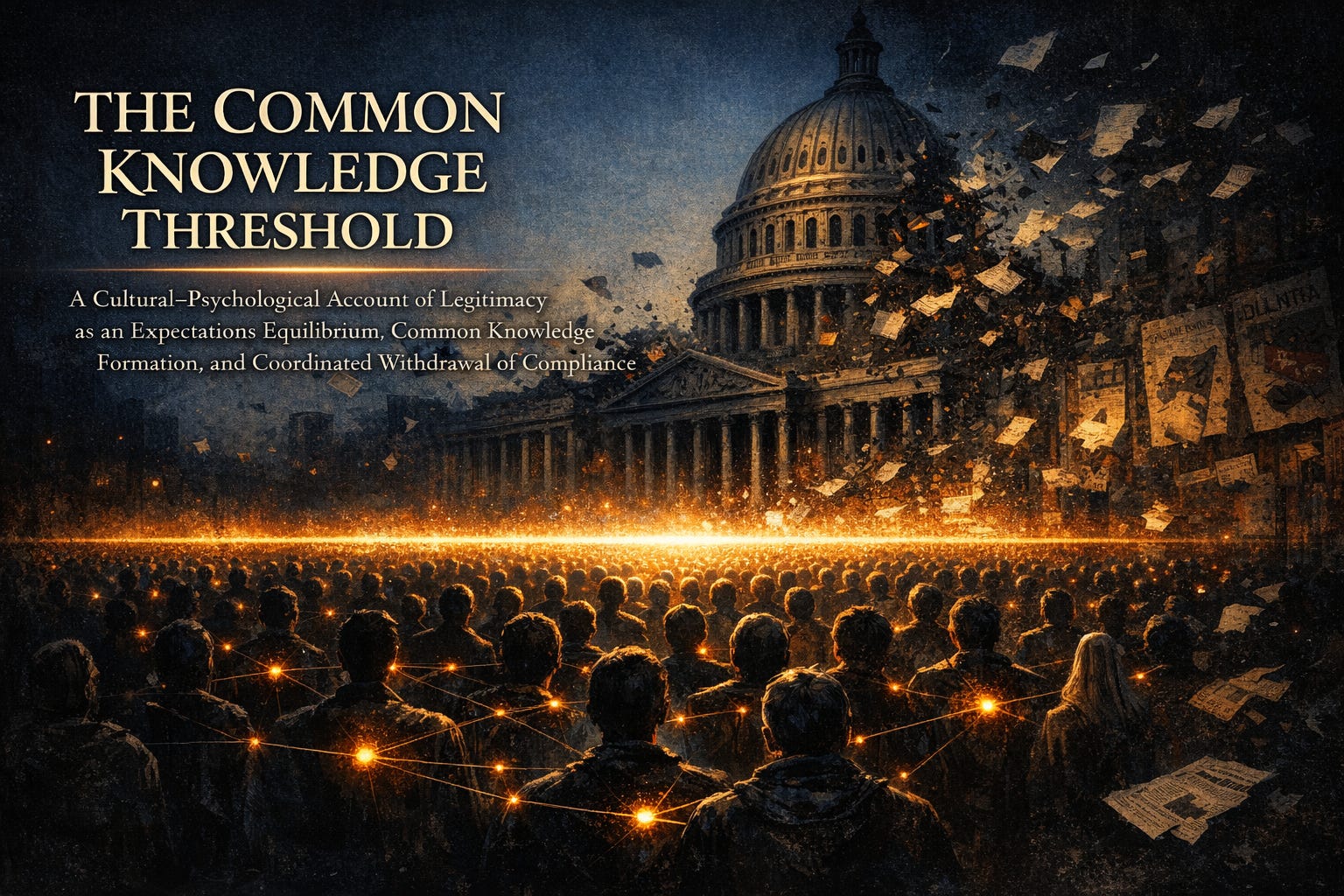
The Common Knowledge Threshold
A Cultural–Psychological Account of Legitimacy as an Expectations Equilibrium, Common Knowledge Formation, and Coordinated Withdrawal of Compliance
Section Index
I. Core Proposition of the Model
II. Conceptual Orientation
III. The Problem of Persistent Authority
IV. Core Psychological and Social Constructs
V. Legitimacy Replacement as a Cultural Process
VI. Replacement Identity Formation
VII. Introduction of the First Law of Humanity
VIII. The First Law as a Legitimacy Metric
IX. Information and Narrative Warfare as the Transmission System
X. Cognitive and Social Transition Sequence
XI. Delegitimization Dynamics
XII. Normative and Expectation Realignment
XIII. Theoretical Constraints and Failure Conditions
XIV. Closing Synthesis
That sense of inevitability is manufactured socially. People watch what others do, read those actions as signals of what others believe, and then choose the path that feels safest given what they see. When everyone around you appears to comply, compliance feels like the obvious move and speaking out feels like stepping off a ledge alone. So even when private doubt is widespread, most people stay quiet—not because they agree with the system, but because they cannot tell that others share their doubt.
The Common Knowledge Threshold names the point when that surface cracks. A shared judgment becomes visible enough that people can see others hold it too—and once they can see that, the calculation changes. Acting alone is one thing. Acting in company is another. When private doubt becomes mutually recognized, isolated individuals become a coordinated public.
I. Core Proposition of the Model
The Common Knowledge Threshold holds that durable authority can be overturned through a cultural and psychological shift in perceived legitimacy rather than by force or decree. Political power becomes replaceable when a legitimacy critique spreads through culture and reaches the status of common knowledge—when people not only hold the critique privately but know that others hold it too, and know that this mutual knowledge is itself shared. At that point, a coordination window opens. People can withdraw compliance together, without waiting for a centralized command, because they can see that the conditions for collective action have arrived.
The core claim is this: authority change depends on synchronized belief and expectation. When enough people privately doubt a system but cannot see that others share their doubt, the system survives. When that doubt becomes mutually visible, the system becomes vulnerable. The threshold is the moment between those two conditions.
II. Conceptual Orientation
This model is a psychological and cultural theory of political change. It draws on social psychology, political sociology, communication theory, and systems thinking to explain why shared beliefs and narratives—rather than force or formal law—function as the primary drivers of systemic transition.
The model rests on three core features of modern authority. First, governance depends largely on voluntary compliance. Large-scale coercion is costly, visible, and unstable; most authority is maintained by the tacit cooperation of people who accept the system as more or less legitimate, or at least as unavoidable. Second, collective action is shaped less by what people privately believe than by what they expect others to do. You may doubt the system deeply, but if you believe everyone else accepts it, you are unlikely to resist. Coordination is driven by perceptions of others, not just by your own convictions. Third, narratives and symbols spread faster than formal politics. Culture sets the pre-political conditions—it shapes what feels natural, what seems thinkable, what appears beyond question—and changes in culture often precede and enable changes in institutions.
The theory is deliberately non-partisan. It treats partisan conflict as a horizontal distraction that leaves underlying power structures intact, and instead emphasizes a broad solidarity identity capable of crossing factional lines without requiring ideological conversion. The argument is structural: who holds power and how that power is legitimated, not which team wins within a fixed system.
The framework draws on Social Identity Theory, Influence Theory, Legitimacy Theory, and the distinction between constituent and constituted power. Together, these allow authority transitions to be analyzed as shifts in collective belief, expectation, and cultural alignment—not as purely institutional events.
III. The Problem of Persistent Authority
Even corrupt or deeply unpopular regimes can endure for decades. The reason is that psychological and cultural stabilizers make authority self-reinforcing in ways that go far beyond brute force.
Perceived legitimacy creates a feedback loop. When an authority is widely seen as rightful—or even just as inevitable—people comply as if its rule were the natural order of things. That compliance, visible to everyone around them, signals to others that the system is intact. And so each act of acquiescence, even a reluctant one, shores up the appearance of consent and reduces the pressure on the regime to prove itself through force. The system feeds on its own appearance of stability.
Narrative cover reinforces this dynamic. Authorities frame coercion and inequality as necessary, natural, or regrettable but unavoidable. A harmful policy is presented as an unfortunate constraint; an act of repression as a defensive necessity; a structural injustice as the price of order. These frames do not merely describe events—they pre-interpret them, shaping what registers as outrageous and what gets rationalized away. When official explanations dominate, evidence of failure tends to be absorbed into the existing story rather than breaking it.
Underneath both mechanisms lies the collective action problem. Many people may privately doubt or despise the system, yet hold back from acting because they have no way to see that their neighbors share their discontent. Every face around them looks compliant. Every institutional surface looks intact. And so they conclude, wrongly, that they are outliers. Their doubt stays private. Their compliance stays visible. And the system interprets this as support.
Authorities further entrench their position by encouraging horizontal conflict—partisan, sectarian, or identity-based infighting that redirects energy away from the legitimacy question itself. People fight each other over who should hold power within the existing system rather than whether the system should be rebuilt. The underlying machinery goes unexamined.
Persistent authority thus rests on a triangle: internalized legitimacy, narrative normalization, and the perceived absence of collective will. Breaking any one of these can destabilize the others. But doing so requires a cultural shift—one that makes the private visible, the exceptional common, and the isolated connected.
IV. Core Psychological and Social Constructs
To analyze how legitimacy is stabilized and how it breaks down, the model relies on a small set of concepts. Each names a distinct mechanism in the social machinery of authority.
Legitimacy is the socially recognized right to govern. It is not just a legal claim or a philosophical argument—it is a felt reality, distributed across a population. When authority is experienced as legitimate, people comply voluntarily and the state’s cost of enforcement falls close to zero. Legitimacy is the difference between a law you follow because it seems right and a law you follow because you fear the penalty. Systems built primarily on fear are fragile; systems built on perceived rightfulness are durable, because the population largely polices itself.
Narrative cover is the interpretive frame that makes coercion or inequality appear lawful, necessary, or inevitable. It is not propaganda in the crudest sense—it does not have to be consciously deceptive to be effective. It works by supplying the default explanation: what an event means before people have time to think about it carefully. Narrative cover turns power into something that feels like background reality rather than a choice someone made and is still making. It keeps harmful arrangements from registering as outrageous.
Default interpretation is the reflexive explanation people use to make sense of events. It is what feels obvious before deliberate analysis kicks in. Authorities work hard to own the default—to ensure that when something happens, the first instinct of the public is to read it through a lens that serves the incumbent order. Changing the default is one of the central tasks of any legitimacy challenge.
Culture is the fast-moving layer of shared language, symbols, jokes, references, and tacit norms that spreads through imitation and conversation. It moves faster than law, faster than formal politics, and it sets the pre-political assumptions that make certain things feel normal or absurd. Culture is not background noise. It is the medium through which legitimacy is constructed and, when conditions shift, dissolved.
A cultural object is a compact, shareable unit of meaning—a slogan, a meme, an anecdote, an image that carries an interpretation embedded in it. When a cultural object spreads, the interpretation travels with it. It is how a legitimacy critique gets transmitted across millions of separate conversations simultaneously, without any central broadcaster.
Common knowledge is not merely a shared belief but a shared recognition that the belief is mutually known. The distinction matters enormously. You might privately believe a regime is corrupt, and ten million of your fellow citizens might believe the same thing—but if none of you knows that the others believe it, no coordination follows. Common knowledge means you know others share the belief, they know you share it, and this mutual awareness is itself shared. At that point, acting together becomes thinkable.
A coordination window is the period when common knowledge lowers the perceived risk of dissent enough that collective action becomes viable. It is temporary and often narrow. If the window is not used—if no visible coordination emerges to validate the sense that others are ready to move—it can close, and the moment passes.
Constituent power is the foundational authority of a population to create or revise the basic rules under which it is governed. It is the power behind the power—the source from which all legitimate institutional arrangements, in principle, derive. It does not reside in any office or law. It is the raw social capacity of a people to say: these are our terms, and we withdraw consent from arrangements that violate them.
Constituted power is the institutional machinery that operates within a rule-set once constituent power has been exercised and a framework established. Courts, legislatures, executives—these are constituted powers. They derive their authority from the framework and can be legitimate or illegitimate depending on whether they operate within it faithfully. The key distinction is this: constituted powers can be reformed; constituent power is what does the reforming, and it cannot be fully captured by any institution because it is the source of institutional authority itself.
Together, these concepts describe the full arc: how shared interpretation links individual belief to mass coordination, and how the latent authority of a population can reassert itself when the cultural conditions shift.
V. Legitimacy Replacement as a Cultural Process
Before any formal transfer of power can occur, something less visible must happen first: the collective mindset must shift so that participating in change feels normal, justified, and survivable. Culture does this work. It reshapes everyday narratives, rewires shared symbols, and redefines what feels credible—before any law is passed or any institution reformed.
Legitimacy replacement begins with the spread of a new interpretive frame. This frame does not invent grievances from thin air; it anchors itself in real events and reinterprets what those events mean. Actions once absorbed into the official story as necessary or isolated get re-read as evidence of a pattern. A single example of harm becomes a data point in a larger argument. The frame does not need to reach everyone at once. It spreads through informal channels—conversation, art, social media, journalism—and accumulates through repetition. Each retelling of the same reinterpretation is a small erosion of the aura of rightful authority.
Cultural objects accelerate this process. A meme, a slogan, or a shareable anecdote compresses the legitimacy critique into a form that travels easily and requires little explanation. When someone shares a cultural object, they are doing two things at once: transmitting an interpretation and signaling their own alignment with it. The second function matters as much as the first. Visible adoption creates social proof—it tells observers that the critique is no longer confined to a fringe, that reasonable people hold it, that agreeing with it carries less risk than it did yesterday.
Over time, fringe dissent consolidates into something that looks like shared understanding. A common language of failure emerges. People start using the same words to describe the same failures. That shared vocabulary is itself a form of coordination—it is how strangers recognize each other as being on the same side of a judgment, without having met. Cultural alignment forms the groundwork for collective action. Without it, challenges remain scattered and isolated. With it, a population can move together.
VI. Replacement Identity Formation
A legitimacy critique alone is not enough. To become a force for coordinated change, the critique must be carried by a social identity—a sense of belonging that makes opposition feel like affiliation rather than isolation. People are deeply social. The question is never just: do I think this system is wrong? It is also: what kind of person does opposing it make me, and will I be alone?
The replacement identity this model describes is defined in broad, inclusive terms. It is not partisan, not tied to any prior faction, and not dependent on ideological conversion. It is anchored instead in universal human values—integrity, fairness, the protection of basic dignity—and it signals alignment with those values rather than with a specific political program. This matters for recruitment. People can join without feeling they have betrayed where they came from. The identity is large enough to hold people from different backgrounds, different political histories, different grievances.
Recruitment works through values affirmation rather than ideological argument. The communication does not tell people to abandon their prior commitments. It shows them how the incumbent system violates the values they already hold, and invites them to reinterpret their defection as a principled act rather than a betrayal.
As shared symbols, shared language, and shared references accumulate, the identity becomes tangible. People begin to recognize one another—in a phrase someone uses, in a reference they understand, in a stance they see taken publicly. This recognition is social glue. It converts scattered individuals who share a private judgment into a visible community with a public presence. What began as isolated dissent became a recognizable stance in the world. That recognition supplies the trust and mutual awareness needed for coordinated withdrawal of support from the old system.
VII. Introduction of the First Law of Humanity
At a certain stage of the model, a single overarching principle is introduced to function as the moral touchstone of the new legitimacy narrative. This principle is called the First Law of Humanity: the preservation of human life and well-being is the highest criterion for political legitimacy. Any authority that systematically violates basic needs and dignity—that treats lives as expendable in the service of its own continuity or goals—forfeits its claim to rule.
The First Law is not a legal statute. It does not derive its force from a court or a constitution. It derives its force from the clarity and universality of the claim it makes: human life comes first. It gives participants in the emerging movement a shared moral reference point—a single question they can ask about any policy, any action, any authority: does this uphold human life, or does it sacrifice it?
As a cultural object, the First Law has the properties that make legitimacy critiques spread: it is concise, memorable, and easily circulated. It does not require a long explanation. It crosses social divides because it does not belong to any faction. And it binds people together around a positive ideal—not a catalogue of grievances but an affirmation of what matters—which makes it a more durable point of convergence than opposition alone.
In sum, the First Law crystallizes the legitimacy critique into a single, widely intelligible idea. It is simple enough to become common knowledge and precise enough to delegitimize an authority that fails to meet it.
VIII. The First Law as a Legitimacy Metric
Once established in the cultural narrative, the First Law becomes a practical yardstick, not just a moral declaration. It converts the abstract claim that human life matters into a concrete evaluative test: does this authority protect lives, or does it sacrifice them for other ends?
Applied to specific policies, practices, or decisions, the metric makes gaps between official claims and real outcomes visible and legible. It is not enough for an authority to say it values human life. The question is whether its actions, when measured against that standard, confirm or contradict the claim. Specific harms register as clear violations rather than as unfortunate side effects or regrettable necessities. The critique becomes evidence-based, grounded in observable outcomes rather than general condemnation.
The metric performs two functions simultaneously. It delegitimizes incumbent authority in a form that is morally clear and easy to communicate. And it sets expectations for any successor. The movement does not lead into a void—it establishes a standard that future authorities must meet to be accepted. This matters for stability: it tells people what they are building toward, not just what they are withdrawing from.
Because the metric is simple and widely shared, it contributes to common knowledge and coordination. When people expect others to apply the same standard, dissent becomes less risky. Everyone is, in effect, reading from the same scorecard. That alignment of judgment—across many separate minds, without coordination—is itself a form of power.
IX. Information and Narrative Warfare as the Transmission System
The real conflict—the one that underlies every surface dispute—concerns what a human being is. Either people are equals who can govern themselves together for the good of all, or they are objects of hierarchy to be ruled, managed, and used. Everything else is ideology layered over this basic divide. That foundational question is always being answered, in practice, by whoever controls the dominant interpretation of events.
Incumbent systems invest heavily in narrative control: propaganda, media framing, cultural messaging designed to normalize their rule and present it as inevitable. The goal is not persuasion in the open sense—it is to make the existing order feel like reality rather than a choice, so that alternatives seem not just difficult but literally unthinkable. The legitimacy movement responds with a counter-effort aimed at breaking this psychological grip, not with equal propaganda but with evidence and reinterpretation.
This effort is decentralized and participatory. It does not require a central broadcaster. Anyone with access to communication channels can contribute—by exposing contradictions, sharing documentation, creating cultural objects, or preserving facts that authorities would prefer to erase. The transmission of the legitimacy frame is crowd-driven and therefore harder to suppress than a single source.
The methods reinforce each other. Independent media and journalism surface facts that official narratives have buried. Narrative reframing interprets events through life-centered values rather than through the official lens, shifting attention from justifications to consequences. Memetic communication packages the critique in forms that spread rapidly and penetrate popular culture with minimal friction. Archival preservation prevents authorities from rewriting the record and anchors the critique in documented history.
The goal of these methods is not fabrication. It is to contest the interpretation of real events—to replace a frame that serves the incumbent with a frame that serves the judgment of the people observing it. As the official story loses its automatic credibility, people begin to rely more heavily on evidence and peer judgment. And as they do, the sense that doubt is widespread—that others see what they see—begins to form.
This is where common knowledge begins to crystallize. People not only doubt the authority; they know that others doubt it too. Cultural hegemony shifts. Norms realign around human life and dignity. And the narrative machinery that once made compliance feel inevitable begins to lose its grip. Narrative struggle is the transmission system linking individual truth-telling to shared understanding, and shared understanding to the conditions for coordinated change.
X. Cognitive and Social Transition Sequence
The shift from a quiescent society to a mobilized one does not happen all at once. It unfolds through a sequence of linked psychological changes and social feedback loops, each one making the next more likely.
It begins with private cognitive awakening. Individuals begin to notice contradictions—between what they are told and what they observe, between the claims an authority makes and the outcomes it produces. Viewed through the First Law, policies or cover-ups that endanger lives stop being explained away as unfortunate necessities and start being recognized as evidence of something more fundamental. These realizations are, at first, entirely private. People hold them quietly, not knowing who else shares them.
The process becomes social when the new legitimacy frame starts circulating widely enough that people begin to encounter signals that others share their private judgment. A joke that assumes shared contempt. A comment that goes unchallenged when it should have been. A reference that lands immediately in a room full of strangers. These small signals are social permission structures. They tell people: you are not alone in this. The risk of saying out loud what you think privately has just dropped.
When enough individuals are privately holding the same doubts, triggering events accelerate the transition to public expression. A scandal, a crisis, an act of repression that is impossible to explain away—something happens that makes the private judgment feel urgent and that makes others’ responses predictable. People expect others to speak. And so they do. Visible dissent reveals what was always hidden: that doubt was never isolated.
What follows is a feedback loop. As dissent becomes visible, it reveals agreement. As agreement becomes visible, it produces more dissent. Common knowledge forms: people see that many others share the critique, and they see that this mutual awareness is itself shared. A coordination window opens. Three beliefs align simultaneously—authority is illegitimate, others agree, and collective action can succeed. Risk is repriced: speaking out feels safer than silence; continuing to collaborate with the old order begins to carry social cost.
This sequence links the cultural and psychological groundwork to concrete political change. It is not a plan that anyone executes from the top. It is an emergent pattern—a shift in the social physics of compliance, spreading through human networks.
XI. Delegitimization Dynamics
As these processes unfold, incumbent authority enters a downward spiral that is difficult to reverse. The dynamics that sustain legitimate authority run in reverse, and they reinforce each other on the way down.
Visible wrongdoing strips away the benefit of the doubt. When coercive or abusive actions become publicly documented—when people can see clearly what was previously deniable—authority loses the ambiguity it relied on to maintain acquiescence. Evidence clarifies responsibility. What was once attributed to system failure or misfortune is reinterpreted as deliberate abuse. The narrative cover fails.
Principle–practice gaps compound the damage. Every time an authority acts in open contradiction to its stated values, the dissident frame is confirmed as the more accurate description of reality. The official story loses credibility not in a single blow but through accumulation—each instance of hypocrisy makes the next one easier to recognize and harder to explain away.
Response traps close off the options for recovery. If authorities try to dismiss critique, the act of dismissal normalizes the critique by acknowledging it without refuting it. If they respond with repression, they validate the accusation that the system is authoritarian. Neither response restores legitimacy. Each one accelerates the loss of it.
Defection cascades emerge as common knowledge of discontent spreads. Individuals and institutions begin to withdraw support—quietly at first, then more visibly as each defection makes the next one less costly. Each visible act of withdrawal raises the reputational risk of remaining aligned with the old order. The social mathematics of the situation have changed. Staying in costs more than leaving.
These dynamics are self-reinforcing. As legitimacy weakens, challenges intensify. As challenges intensify, legitimacy weakens further. What began as cultural and perceptual erosion becomes visible, observable collapse.
XII. Normative and Expectation Realignment
With the old authority discredited and collective action underway, something deeper shifts: the shared norms and expectations that govern what behavior is acceptable begin to realign.
Practices once tolerated—corruption, secrecy, the sacrifice of public welfare for the benefit of the few—become broadly unacceptable. Not merely criticized, but actively punished by the court of public opinion. Policies that protect human life emerge as the obvious standard. The First Law of Humanity moves from rallying principle to shared norm—from a claim people make in opposition to a framework people use to evaluate governance as a matter of course.
Expectations realign alongside norms. People increasingly assume that others will resist injustice when it becomes visible, which reduces the social risk of speaking out. New authorities understand—before they take a single action—that they will be judged against the life-centered standard immediately and with little tolerance for backsliding. And because this expectation is itself widely shared, compliance with the new norm becomes rational even for officials who are not personally committed to it.
Together, these shifts do more than replace one authority with another. They update the unwritten social contract—the set of tacit understandings about what governance owes to the governed and what the governed can demand in return. Actions that endanger life become politically costly. Life-protecting measures gain broad social support. The baseline for acceptable governance has been raised, and that raising is durable because it is distributed across millions of individual expectations rather than located in any single institution that could be captured or corrupted.
XIII. Theoretical Constraints and Failure Conditions
The Common Knowledge Threshold describes a plausible pathway for authority change, not a guaranteed one. It depends on conditions that can fail, and it is worth being clear about where and how it breaks down.
Communication openness is a precondition. The model assumes that information can circulate—that the legitimacy frame has channels through which to spread. Severe censorship, systematic intimidation of cultural figures, or aggressive filtering of communication platforms can block common knowledge from forming at all. If people cannot see that others share their doubt, the threshold cannot be reached.
Credibility and discipline matter throughout. The legitimacy narrative must remain evidence-based and internally consistent. Exaggeration, internal conflict, or behavior that contradicts the human-first values the movement claims will undermine trust and slow adoption. The counter-narrative has to be more credible than the official one, not just more emotionally satisfying.
Inclusive solidarity is essential to scale. If the replacement identity narrows into a sectarian or partisan form—if it starts to look like one faction trying to take power from another—the coordination effects weaken. The identity must remain large enough to hold people with different backgrounds and prior affiliations, or it loses the cross-cutting reach that makes broad withdrawal of support possible.
Replacement clarity is necessary for stability. Cultural momentum must be matched by a credible alternative vision. If the old order collapses without a clear framework for what comes next, the space will be filled by elite recovery or fragmentation. A movement that knows what it is against but not what it is for cannot hold a coordination window open long enough to build something durable.
Incumbent response can disrupt the process in either direction. Partial concessions can relieve pressure and restore acquiescence before the threshold is reached. Extreme repression can, in certain conditions, suppress coordination even when common knowledge is widespread. Neither of these is guaranteed to succeed—repression often validates the critique—but both represent genuine threats to the transition.
Post-transition consolidation is where gains are most often lost. After a successful transition, new institutions must resist capture and corruption. If cultural vigilance fades—if the movement dissipates once the old authority is removed—authority replacement risks collapsing into elite rotation: new faces, same structure, same logic. The normative realignment described in Section XII is only durable if it is actively maintained.
The theory is a conditional blueprint. Outcomes depend on media openness, narrative discipline, inclusive identity formation, replacement clarity, and the balance between incumbent adaptation and repression. Missing any one of these elements can stall or derail the process.
XIV. Closing Synthesis
Bringing the elements together: the Common Knowledge Threshold explains how societies transition between authorities through shifts in shared legitimacy rather than through force or formal decree. The transition begins with cultural work—altering the narratives through which events are interpreted, forming a unifying identity broad enough to cross factional lines, and introducing a simple moral standard around which judgment can converge. These mechanisms do not move in isolation. They interact, reinforce each other, and collectively reshape the social reality in which authority is either sustained or eroded.
As legitimacy drains from the incumbent order, people withdraw compliance and redirect cooperation. The constituent power of the population—its foundational authority to determine the terms of governance—reasserts itself, not through a single dramatic act but through the accumulation of individual judgments that become mutually visible and therefore collectively operative. A new order formed not because anyone planned it from the top but because enough people, independently, reached the same conclusion and could finally see that they had.
This transition unfolds without centralized direction. It emerges from psychology, communication, and the dynamics of shared expectation. A new settlement stabilizes once enough people adopt and enforce the new norms through their own behavior—when the social cost of violating the new standard becomes real, distributed, and consistent. Authority, understood as consent-based, shifts when shared interpretations of right and wrong shift with it.
The theory places culture at the center of political change. It shows how a shift in the cultural basis of legitimacy—in the stories people tell, the identities they hold, the standards they apply, and the judgments they share—can enable coordinated authority change without violence or decree. It shows how shared belief becomes power. And it shows how a system that presents itself as inevitable can, under the right conditions, become obviously replaceable—not because it lost a war or an election, but because the people living inside it stopped believing it had the right to demand their compliance.

Thank you so much
May I submit the notion that the BIG LIE was told on 9/11/2001 and as such it has adversely affected civilization since - how to get the maximum number of people to see the BIG LIE & therefore overturn the tyranny that has resulted from it?