


$100 an hour.
That’s what a lab pays to check and correct a machine’s homework [Mercor expert-tier rates, $75–$200+/hr, 2026].
Give AI its due: it has produced the most honest ledger our economy has ever kept on what intelligence costs to build. The four largest American technology companies have guided $725 billion in capital spending for 2026 — up 77% in one year [hyperscaler Q4 2025 guidance]. Labeling wages that climb with the labeler’s credentials: $12 an hour for basic tagging, $75 to $200 for a licensed doctor, lawyer, or PhD [Mercor published rates, 2026]. Red-team hours. Curation. Licensing deals for archives the models haven’t eaten yet — News Corp at $250 million over five years, Reddit at $130 million a year [WSJ; company reports] — and a court that priced a pirated book at three thousand dollars, once [Bartz v. Anthropic settlement, 2025]. Continuous refreshment, because a mind trained once and left alone goes stale.
I reread the list . Each one names a kind of care. Attention from someone who knows more than you. Correction that costs the corrector something. Good material, chosen on purpose. Time.

Every item on that list has a going rate. When the student is a child, the rate is zero.
Zero has a history. The mother’s hours: $0 — the unpaid care and domestic work of American women alone prices out near one and a half trillion dollars a year, that’s with stale statistics and the counters used minimum wage [Oxfam 2020]. The childcare worker: $15.41 an hour, a median in the bottom 5% of all American occupations [BLS May 2024; Chicago Fed 2024]. The teacher: paid 26.9% less than other college graduates — a record gap, quadrupled since 1996 [EPI/CEPR 2024]. The newsroom: 3,500 papers gone since 2005 and three of every four newspaper jobs with them — 365,000 people down to 92,000 [Medill 2025]. The federal endowment for new humanistic work: $78 million in competitive grants, proposed for elimination twice in two budgets — less than two AI labs pay Reddit each year for its old posts [CRS; NEH appropriations; company reports]. Each zero was booked as savings. The books balanced. The books lied.
The objection is already loading: the schools. America does spend there — about $18,600 a pupil, near a trillion a year, roughly $9,900 of it reaching instruction [NCES 2020–21]. So convert the spend into the machine’s unit: attention per mind. In the infant room the law itself fixes the ration, one adult for every three or four [state licensing minimums]. In the classroom it is one for twenty to thirty [NCES NTPS], and they are the professional paid a quarter less than their degree commands. The machine’s package inverts every term: one-on-one attention, thousands of credentialed experts in parallel, around the clock, undivided [industry reporting] — and no expert arrives depleted, because the expert clocks out. The parent never does. What the child’s trillion buys, per mind per hour, is a sliver of a tired adult.
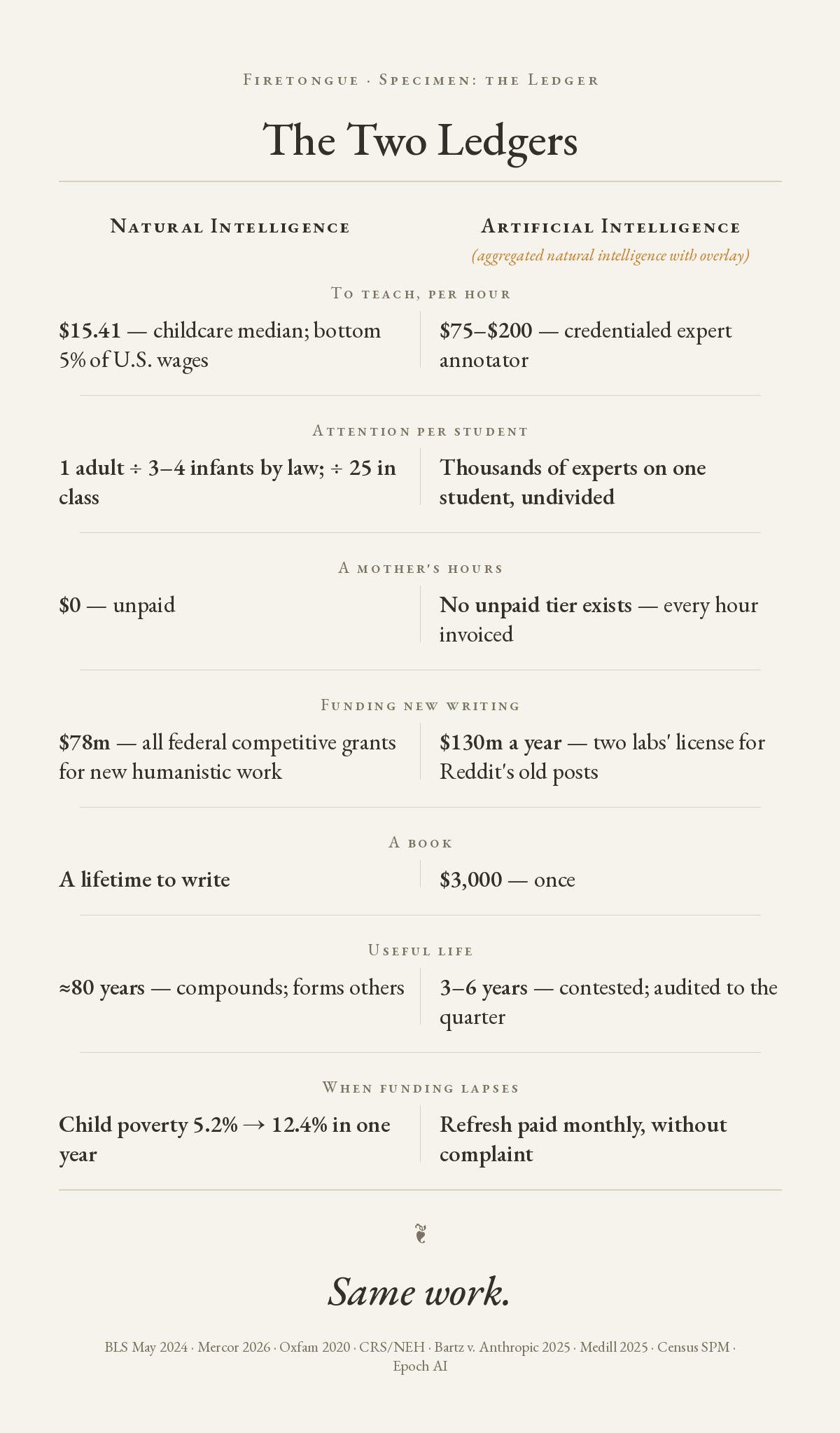
Prices are sentences. Read the two columns together and they say one thing: a built mind is worth more than a born one. Our budgets have been saying it for decades. So have the youth mental-illness curves [CDC YRBS 2023]. So has the parental burnout the Surgeon General took the rare step of flagging [advisory, Aug 2024]. So have the reading scores, the worst in over thirty years for the children already behind [NAEP 2024–25]; the forty-seven seconds a screen now holds an adult’s attention [Mark, UC Irvine]; and the loneliness the same office titled an epidemic [SG advisory 2023]. The budgets speak in dollars. The bodies answer in symptoms. The machine ledger just made the sentence legible.
Here is the mechanism, under magnification. The zero is a subsidy. Formation kept happening because mothers, fathers, care takers, mentors, teachers, and the writers now dead in the training data did the work without sending an invoice. Love doesn’t bill. The market booked love’s labor at nothing, called the difference profit, and the trick held for as long as every student had a mother.
The machine has no mother.
Every hour of its raising arrives with an invoice attached. And the same economy that swore for a century that formation was free now wires billions, monthly, to pay for formation — line by line, at market rate, without complaint.
That wire transfer is a confession.
Here is mine. I have made the human case in human terms: the child, the hour, the true weight of what a person is built on. And watched it get filed under sentiment. Say machine and the room leans in. So this essay runs on the machine’s ledger. I hate that. Even the case for the child had to be priced in silicon to get a hearing.
So run the cost of keeping the zero. Call it what the record shows: a choice. The lapsed credit was a vote. The flat wage is a vote renewed every budget season. We are choosing to starve and abandon feeling, thinking, living beings, and to enrich their silicon simulations — then rent the simulations back by the month. The choice is recorded. Its cost compounds in two directions.
Downstream, in the children. Formation continues when funding stops; a child forms every waking hour regardless. The only open question is what forms them. Remove the attentive adult and whatever is available stands in to fill the vacancy: a screen, a room of thirty-four, an eight-minute visit, a closed library. Heckman priced the upside: the studied programs returned 7-10% a year for preschool, 13% for birth-to-five [Heckman et al. 2010; García, Heckman, Leaf & Prados, ABC/CARE]. The same arithmetic runs downhill—skills compound, and so does their absence [T2: author extension of dynamic complementarity; Cunha & Heckman 2007]. We ran the experiment in the open. One expanded child credit cut child poverty nearly in half in a single year, 9.7% down to 5.2%; Congress let it lapse; the rate snapped back to 12.4% the next year — the largest one-year rise for children on record — and kept climbing, 13.7 %by 2023 [Census SPM; CBPP; Columbia CPSP]. The ledger booked the lapse as savings. The children booked it in the body, where it compounds.
Upstream, in the machines — where the valuation refutes itself. The training corpora are crystallized human formation. [T3 — interpretative synthesis] Everything on the expensive side of the ledger is built from the cheap side. Every model is a compression of minds somebody formed: the books, the newsrooms, the forums, the letters — centuries of paid and love-subsidized attention, scraped and eaten in eighteen months. The supply is the archive of the funded era. The industry has filed its own reserves report: roughly 300 trillion tokens of public human text, consumed between 2026 and 2032, median 2028 [Epoch AI]. OpenAI’s cofounder called data the industry’s fossil fuel and said it from the stage: “we have but one internet” [Sutskever, NeurIPS, Dec 2024]. They tried the obvious workaround — feeding machines their own output — and the models degraded; the finding is in Nature [Shumailov et al., Nature 631, 2024]. Synthetic text is inbreeding. What the machines need is exactly what the zero stopped producing: fresh human minds, well formed, with something to say.
The extraction ate its own supply chain. [T3] The projected data wall is the defunding of human formation arriving in the machine ledger, on schedule.
And the asymmetry runs against the machine. The industry is arguing in public over whether its chips last three years or six — $176 billion in earnings rides on the answer, so it audits the machine’s lifespan to the quarter [hyperscaler filings; Burry critique, Nov 2025]. A wellformed human compounds for eighty years and forms others — the only capital that makes more of its own makers. We price the asset that burns out in a few years in the trillions, and the one that compounds for eighty at zero. A grader who valued stones this way would be off the bench by lunch.
The measure exists now. It is itemized, audited, and paid weekly, because the student is a machine.
The measure exists now. It is itemized, audited, and paid weekly, because the student is a machine.
$75 to $200 an hour to teach the machine [Mercor, 2026].
$15.41 an hour to teach the child [BLS, May 2024].
Same work.
Only one of the students can be owned.
Fire tongue 🔥
Sources (working citations)
1. Hyperscaler capex — $725bn guided for 2026, +77% YoY, four largest US tech companies; Q4 2025 earnings guidance (per Peak Text tally; independently corroborated in market coverage).
2. Annotator wages — Mercor published rate tiers: entry $12–25/hr, generalist $25–53/hr, credentialed experts $75–200+/hr; concrete listing: Mathematics Educator (PhD required), $67–75/hr.
3. Licensing — News Corp–OpenAI ~$250m/5yr; Reddit ~$130m/yr combined (Google + OpenAI); HarperCollins $2,500/author per title; Bartz v. Anthropic: $1.5bn, 482,460 works, ~$3,000/work, preliminarily approved Sept 2025 (per Peak Text sources: WSJ, Quartz, settlement docket).
4. Unpaid care — Oxfam 2020: $10.8T/yr globally at minimum wage; US women’s unpaid labor $1.48T/yr (domestic, caregiving, community). ILO 2018: 16.4bn hours/day, ~9% of global GDP.
5. Childcare wage — BLS OEWS May 2024: median $15.41/hr vs $23.80 all occupations; Chicago Fed 2024: bottom 5% of occupational medians, alongside cashiers and waitstaff.
6. Teacher penalty — EPI/CEPR: record 26.9% in 2024 (from 6.1% in 1996); teachers earn
73.1 cents on the dollar vs comparable graduates.
7. Newsrooms — Medill State of Local News 2025: ~3,500 papers lost since 2005 (~2 in 5); newspaper employment 365,000 → ~92,000; 213 counties with no local news source.
8. NEH — held at $207m Jan 2026 ($78m direct competitive grants); DOGE terminated 1,200+ grants and cut ~two-thirds of staff, April 2025; elimination proposed twice (per Peak Text: CRS R48958, Federation of State Humanities Councils).
9. Heckman — Perry Preschool 7–10%/yr (Heckman, Moon, Pinto, Savelyev & Yavitz 2010); ABC/CARE 13%/yr (García, Heckman, Leaf & Prados, “The Life-cycle Benefits of an Influential Early Childhood Program”). Note: rates are from two intensive studied programs — phrasing in-text reflects this. Downhill-compounding claim marked T2 as author extension of dynamic complementarity (Cunha & Heckman 2007).
10. CTC — Census SPM: child poverty 9.7% (2020) → 5.2% (2021, 46% one-year decline) → 12.4% (2022, largest one-year child increase on record since 1967) → 13.7% (2023). CBPP; Columbia CPSP; Census Bureau.
11. Data exhaustion — Epoch AI: ~300T tokens effective stock, consumed 2026–2032, median 2028. Sutskever, NeurIPS, Dec 2024.
12. Model collapse — Shumailov et al., Nature 631 (2024).
13. GPU life — Hyperscalers book 5–6 yrs; Burry (Nov 2025): real frontier life 2–3 yrs,
~$176bn understated depreciation 2026–28; Amazon shortened a server subset to 5 yrs (2025); frontier obsolescence ~18–36 months per architecture cadence.
14. Wage pair — items 2 and 5.
15. Schools conversion — NCES: total expenditures $18,614/pupil, ≈$927bn total (2020– 21, constant 2022–23 dollars); instructional expenditures $9,885/pupil (≈60% of current spend). Class sizes: NCES NTPS — ≈18–21 elementary, ≈27 secondary, state highs ≈34.
Infant staff-to-child ratios 1:3–1:4 per state licensing minimums (Office of Child Care). Parallel annotator workforce scale: industry reporting on major labeling platforms.