


The passage that follows was written in 1924. Read it and tell me it is not about right now.
The class of persons who are not benefactors are those who have gone on for years robbing the public, which means robbing the home and the business life of the nation, and who in later years wish to see their name carved in some great gift to college or church or home, or institution, merely to gratify their own vainglory and to half satisfy their conscience…
All such gifts are curses to the institutions that accept them; in churches where they have been accepted, the membership has lost its usefulness in the community; in universities the prestige and power have become decadent; and this curse may be traced from the arrival of the gift down to the present moment if one takes the pains to find out the facts. It is not a superstition, as facts are at hand.
Written by Webster Edgerly under the pseudonym Edmund Shaftesbury, in Mental Magnetism. Edgerly was a eugenicist who ran his own kind of laundering operation. We will come back to him. What’s wrong with him is part of the argument.

Why a quote from a hundred years ago?
Because I could have gone further back — the historical record is full of these observations. Or more recent — the journals and texts of every decade indict the power structures of their day. A century is the deliberate distance. Recent enough to be relevant. Old enough to escape the reflex of dismissing it as a problem of now, or romanticizing it as a problem of some idealized or decivilized past.
The issues we face right now are the same issues we have always faced, in new costumes, with new tools. The scope and methodology have changed. The mechanism has not.
The excuses fail.
Modern complexity. New nuance. Conditions the founders could not have foreseen. Lies, all of them. The pattern is legible. The pattern has always been legible. The only question is whether we choose to see it.
The pattern is old. The dodge is old. The only thing modern about any of this is how loudly we are told to pretend otherwise and how quickly and convincingly we are provided with doubt or distraction.
We are trained to be polite.
Shaftesbury himself spent the chapters before this one praising politeness as one of the highest methods of mental magnetism — “politeness makes kindness refined,” he wrote, on the same page. And yet on the question of tainted gifts, the same writer abandons refinement entirely. He calls the donors thieves. He calls the gifts curses. He calls the wealth “blacker than the cancerous rot of the foulest disease.” He calls the methods “lower than the highwaymen of old.”
Shaftesbury understood what we have forgotten. Politeness is a virtue between equals acting in good faith. Extraction dressed up in marble is owed something else: accuracy. When justice and truth are on the line, refinement becomes complicity. The polite silence at the gala is the second theft.
Case in point: the Sacklers.
OxyContin and the broader opioid epidemic have killed more than 700,000 Americans since 1999. The Sackler family laundered the proceeds through the Met, the Louvre, the Tate, Yale, Oxford, Tufts, the Guggenheim, the National Gallery, the V&A, the British Museum, and many more. The names are coming off the walls now. Tufts removed the Sackler name from its medical school and five other facilities and programs in 2019. Harvard, by contrast, has refused, and the curse remains in residence wherever the marble has not yet been re-cut. Shaftesbury’s diagnosis confirmed in real time, a century late.
The same curse is being bestowed right now, in front of us, while we hold our forks correctly and applaud the speech.
Meta and the Chan Zuckerberg Initiative.
Internal Meta research, disclosed by whistleblower Frances Haugen, documented harm to teenage mental health — including findings that Instagram worsened body image issues, eating disorders, and suicidal thoughts in teen girls. The platform’s role in the Rohingya genocide was described by the chair of the UN Independent International Fact-Finding Mission on Myanmar as “determining”; Amnesty International concluded that Meta’s algorithms “substantially increased the risk” of mass violence. Independent journalism has been hollowed out by the ad model in every market it touched. The same fortune now flows through the Chan Zuckerberg Initiative into schools and “personalized learning” platforms, biomedical research, and education technology — into the very sectors best positioned to study the damage and least likely to do so once the building bears the donor’s name.
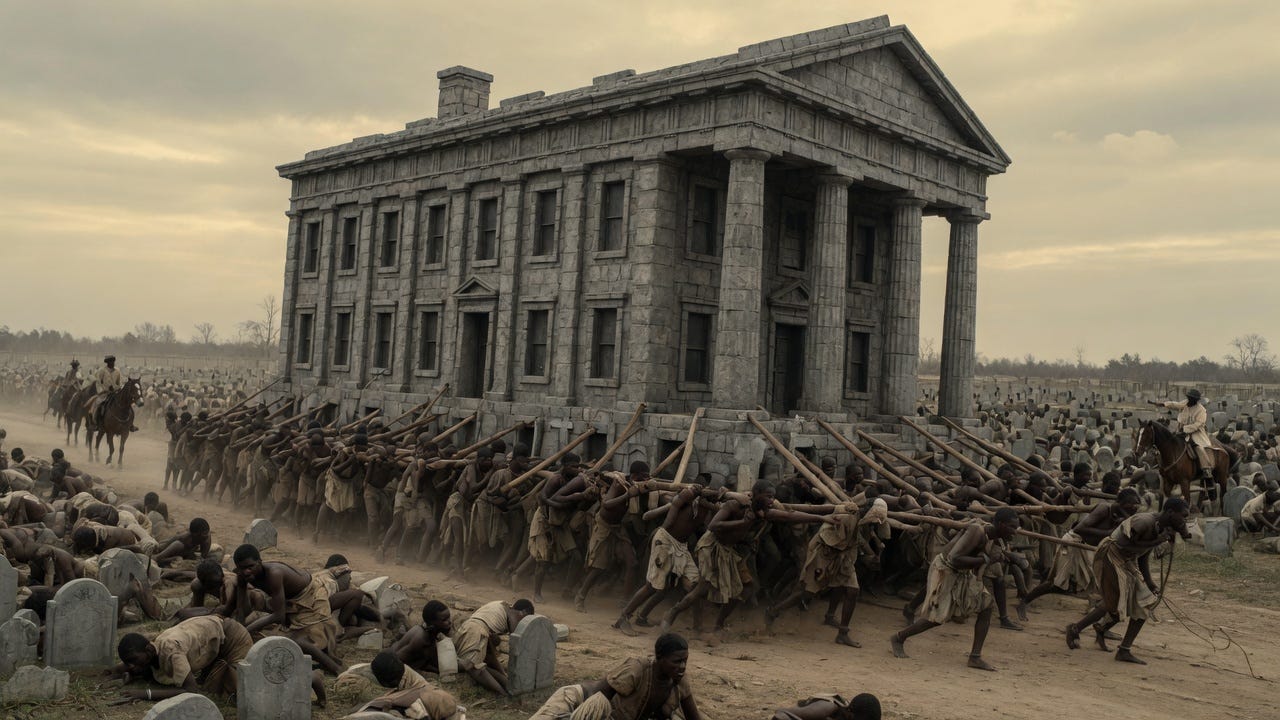
Cecil Rhodes and the marble that will not come down.
At twenty-three, before he had any real fortune, Rhodes wrote out his life’s program in a document later titled the “Confession of Faith”:
“I contend that we are the finest race in the world… Africa is still lying ready for us it is our duty to take it.”
The fortune that followed came from the De Beers diamond monopoly, built on Black African labor confined to fenced compounds — a system labor historians have shown became the operational template later transposed to South Africa’s gold mines and formalized as the basis of apartheid.
As Prime Minister of the Cape Colony, Rhodes wrote the Glen Grey Act of 1894, a land-seizure and labor-tax law he himself called “a Native Bill for Africa,” widely identified by historians as the blueprint for apartheid. His British South Africa Company’s invasion of what is now Zimbabwe killed approximately 2,000 Africans in the 1896 suppression of the Ndebele-Shona uprising alone, largely with Maxim guns.
Rhodes left £100,000 in his will to Oriel College, Oxford, for the construction of the Rhodes Building. His statue stands above its central doorway — by design, level with the statue of the Virgin Mary across the street, and elevated above two English kings on the same façade. When students voted in 2016 to remove it, The Telegraph reported that “furious donors threatened to withdraw gifts and bequests worth more than £100 million.” The college reversed within a week. In 2020, after global protests, Oriel’s Governing Body publicly stated it wished to remove the statue. Legal and regulatory advice was cited. The statue remains. The Rhodes Trust still names roughly 100 Rhodes Scholars per year, each of whose careers now accrue to the credit of a fortune built on forced labor and machine guns.
This is what Shaftesbury described — the curse traceable from the arrival of the gift down to the present moment. Oriel said the words out loud and kept the marble anyway.
Leland Stanford and the dead son’s name.
Stanford University’s full legal name is Leland Stanford Junior University, after the founders’ fifteen-year-old son who died of typhoid in 1884. The fortune that built it came from the Central Pacific Railroad, constructed between 1863 and 1869 by an estimated 15,000 to 20,000 Chinese migrant laborers — roughly 90% of the workforce, paid 30 to 50 percent of what white workers earned, charged for their own lodging and tools, assigned the most dangerous tunneling and blasting work, and dying in numbers the company never bothered to record. Estimates of Chinese deaths range from 50 to over 1,200. Leland Stanford ran for governor of California on an anti-Chinese platform, calling Chinese immigrants “the dregs of Asia.” Stanford’s own historian Gordon Chang has written that without the Chinese workers, “Leland Stanford could have been at best a footnote in history, and Stanford University may not even exist.”
The university opened in 1891 as a memorial to the dead boy and a monument to the railroad fortune. It now sits on one of the largest university endowments in the world. It has trained the founders of Google, Yahoo, Hewlett-Packard, Cisco, Sun Microsystems, and most of Silicon Valley’s first generation of platforms — the same fortunes whose laundering through foundations forms the contemporary half of this argument. The Chinese laborers paid the bill in their bodies. The Stanfords are still collecting the dividends. The institution itself has become the laundromat: extraction from one century funds the credentialing apparatus that produces the extractors of the next.
John D. Rockefeller Jr. and the long success of the laundry.
On April 20, 1914, the Colorado National Guard and private guards employed by the Rockefeller-controlled Colorado Fuel & Iron Company opened fire on a tent colony of striking miners and their families at Ludlow, Colorado. Twenty-five people were killed, including eleven children and two women who suffocated in a pit beneath a tent that was set on fire. One year later, testifying before the U.S. Commission on Industrial Relations, Rockefeller Jr. was asked by Chairman Frank Walsh whether he would maintain the company’s anti-union policy “if it costs all your property and kills all your employees.” His answer, in the official transcript, in full: “It is a great principle.” Pressed further, he compared the open-shop fight to the American Revolution.
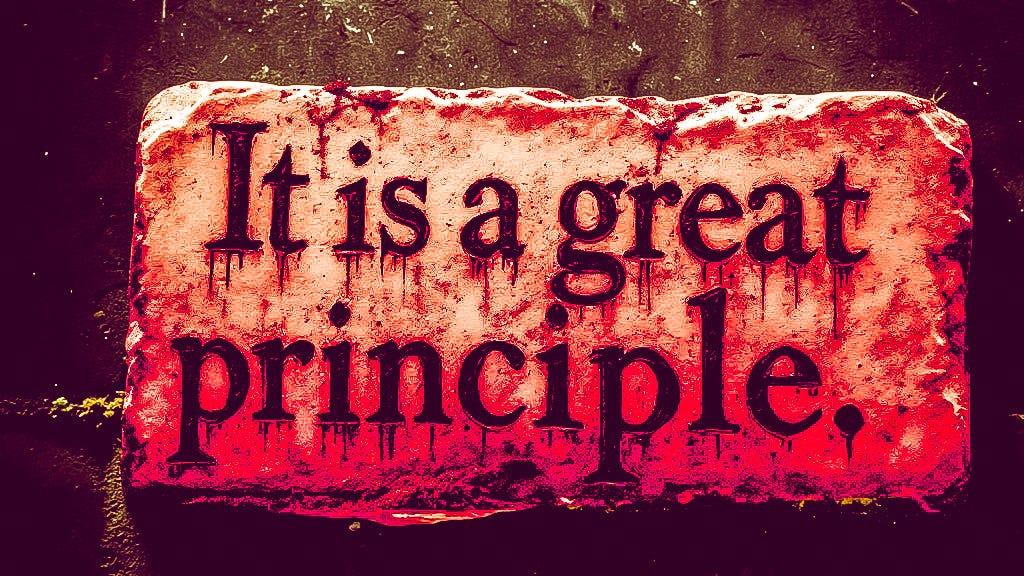
Then he hired Ivy Lee, often credited with inventing modern public relations, to rehabilitate the family name. What followed: Rockefeller Center. Rockefeller University. The Cloisters.
Riverside Church. The restoration of Colonial Williamsburg. The Museum of Modern Art. Lincoln Center. A century out, “Rockefeller” means the Christmas tree, the ice rink, the view from the top. The eleven children in the pit at Ludlow are in the lobby of none of these buildings. That is what success at this game looks like. The Sacklers are trying to become this.
ExxonMobil and the same fortune, still extracting.
Decades of internal climate research, followed by decades of public denial — as documented in peer-reviewed Harvard research by Geoffrey Supran and Naomi Oreskes, who concluded that
“ExxonMobil contributed quietly to climate science and loudly to raising doubts about it.”
The same company remains a member of the MIT Energy Initiative today and funds energy research at Princeton and Stanford. The contradiction is the strategy itself: buy the credibility of the institution that should be indicting you, and the indictment never arrives. (Saudi Aramco was forced out of the MIT Energy Initiative in 2020 after sustained community pressure — proof that the curse can be lifted when an institution chooses to act.)
ExxonMobil is the corporate descendant of Standard Oil. The fortune now buying credibility from MIT and Princeton is the same fortune Rockefeller Jr. used to buy credibility from Ivy Lee a century ago. Same source. Same purpose. Same playbook. The names changed. The mechanism did not.
A return to the man who named the pattern.
The passage at the top of this essay was written by Webster Edgerly, two years before his death in 1926. He spent his life selling something he called Ralstonism — a religious healthcult built on personal magnetism, posture, dietary discipline, and the promise of spiritual mastery. He counted as many as 800,000 dues-paying followers at his peak. He went into business with the founder of Purina Mills, and the company they built — Ralston Purina, now part of Nestlé — still sells Chex and Puppy Chow off the strength of his brand. The red-andwhite checkerboard on the cereal box traces back to his cult.
He was also a eugenicist who advocated the castration of all non-Caucasian males at birth and the construction of a pure “New Race” of Caucasians as a sacred project. He preached racial horror in the same books that preached refinement. He sold bigotry as enlightenment to hundreds of thousands of paying followers, dressed in the language of spiritual elevation, divine necessity, scientific progress.
He saw the donor class with accuracy.
He could not see — or would not see — that he was running his own version of the play. The book that diagnosed the racket and the book that prescribed castration sat on the same shelf, in the same body of work, by the same author. The fortune and the harm were the same fortune. It is a great principle, in different words, in a different decade, in a different register.
The harms here are different in scale.
The Sacklers killed hundreds of thousands.
Rhodes killed thousands.
Rockefeller’s company killed children in a pit at Ludlow.
Edgerly sold racial pseudoscience to willing buyers.
Different scale. Same mechanism. Same compartmentalization. Same transcendent story used to license the extraction. And that is the point.
The pattern is bigger than any one of these men.
It was bigger than the man who named it. It will be bigger than any of us, until we refuse it.
The diagnostician was in the pattern. The reader is in the pattern. The writer is in the pattern. The first honest act is the same for all of us: to look at our own version, and refuse the silence about it.
This is where I stop being polite.
How am I supposed to respect the institutions I am expected to defer to? The unspoken social contract and the explicit one have been increasingly optional for anyone who manages to clear a certain pay grade, acquire a certain title, or hold a certain status symbol. The rules are for the rest of us.
You ask why people don’t want to work.
Have you asked who they have as an option to work for? Have you asked how the entrepreneurs who are successful in this economy and this culture earn their generally high wages? Who it costs? What it costs them — in character, in morals, in the parts of a person that cannot be put back?
You ask how they can do this or that. How that party could believe that.
Have you asked what reality drove them to seek such delusional and polarizing beliefs as a form of security, as an acceptable option?
When the legitimate institutions have already sold them out, a conspiracy is just a different lie offered at a more honest price.
This culture, this country, this mess of men obsessed with control and their own superiority — the ones who have never lived a single day as those whose fates they determine, who give the lives of strangers less consideration than which outfit to wear for the day — this is a racket.
I am tired of pretending otherwise.
We are asked, constantly, to keep these things in separate compartments. The fortune over here. The foundation over there. The CEO and the family office. The brand and the harm. The gala and the lawsuit. The gift and the theft.
There is no separation.
There has never been a separation. The money is the same money. The name on the building is the same name on the indictment. The wing of the museum and the dead in the streets were paid for from the same account. The compartmentalization is the trick. Refusing it is the first honest act.
When will we learn?
The burden of proof has been returned to those making the extraordinary claims and holding the power. The responsibility returns to those who choose to assert their choice for others. Respect is mutual. Respect is demonstrated. Respect is earned. The titled and the wealthy clear the same bar as everyone else, or they clear no bar at all.
Stop pretending the donor is separate from the donation. Stop pretending the foundation is separate from the fortune. Stop pretending the philanthropy launders anything other than the philanthropist. Look at the building and see what paid for it. Look at the gala and ask who is missing from the room — the tenants, the patients, the displaced, the addicted, the dead. They are the actual benefactors. They paid the bill.
The home and the business life of the nation are being robbed twice.
Once in the original theft. Again in the silence of every institution that took the money and agreed not to notice.
A better question waits behind “When will we learn?” — what will we do once we have?
The answer is embarrassingly simple and therefore revolutionary:
Serve the people you claim to serve.
Actually create value.
Stop extracting from the home and business life of the nation and then buying back your reputation with the proceeds.
Institutions that accept these gifts should treat the donor’s name as radioactive until the fortune has been stress-tested for net harm. Universities, museums, and research centers should publish the full ledger: every dollar accepted, every condition attached, every area of inquiry that mysteriously never gets funded. Boards should be required to seat representatives of the communities most affected by the donor’s core business — as vetowielding fiduciaries with real authority over the gift.
Philanthropy downstream of predation becomes restitution only when the principal is returned first, with interest paid in the form of structural repair. Everything else is theft with better lighting.
This is the baseline expectation we already apply to everyone who is not rich enough to buy institutional cover. The rules were never meant to be optional above a certain pay grade. When the donors and the institutions finally treat them as binding, the curse lifts. The marble can stay. The silence ends. And we can stop asking why trust has collapsed — because we will have finally earned it back.
One last thing.
Stop looking for monsters that look like monsters.
That is the easy target. The decoy. The distraction.
Every reptilian-overlord narrative, every archonic diagnosis, every demon-possession framework is a way to look away from the human in front of you. The human who signed the order. The human who built the dam. The human who fired on the camp. The human who wrote the policy. The human who took the money and put their name on the building.
The supernatural villain is the same trick the donor uses. It says the evil is elsewhere. Out there. Hidden. Inhuman. Untouchable. It says the man at the gala, the man at the donor table, your boss, your senator — these are someone else’s problem. The problem is something cosmic, mythological, beyond reach.
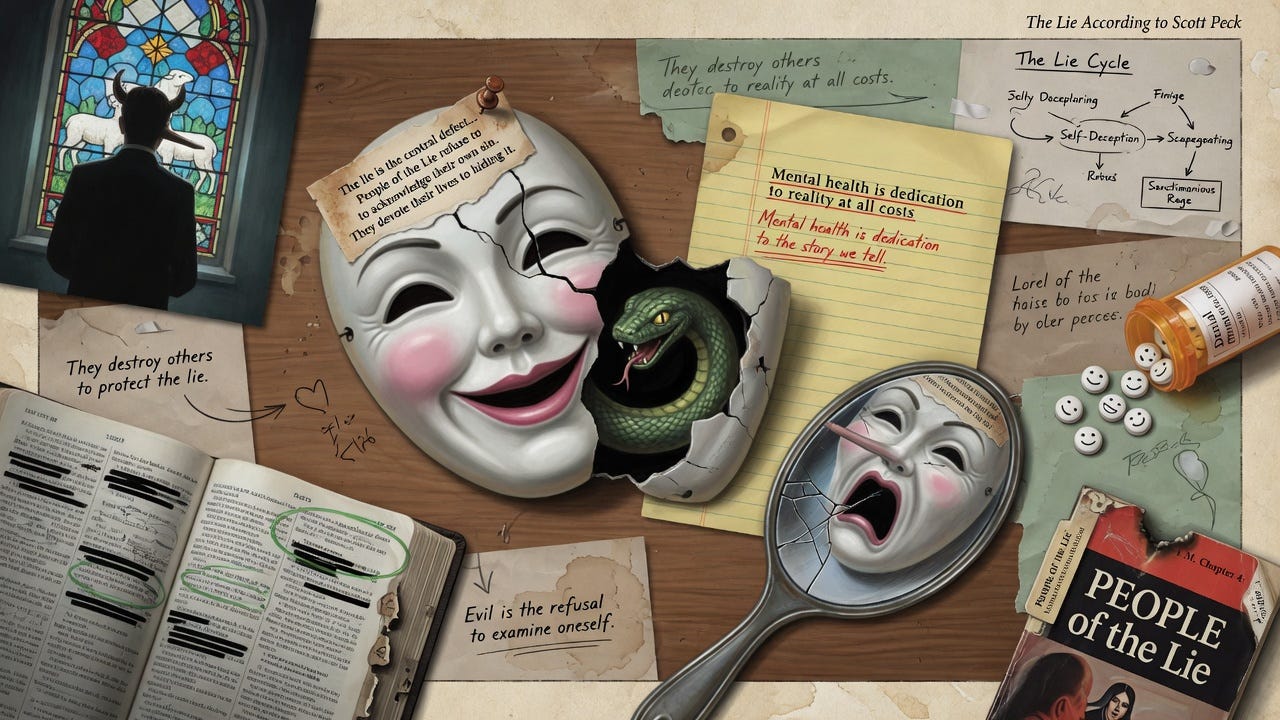
That is the lie.
M. Scott Peck, in People of the Lie, defined evil as the imposition of one’s will upon others to avoid the work of spiritual growth. He described the people who do it as men and women whose self-image of goodness is so total that they cannot bear to look at what they are doing. They dress well. They go to work on time. They pay their taxes. They give to charity. They sit on boards. They desire intensely to appear good. The goodness is pretense. The lie is told to themselves first, and only then to everyone else. Peck called them “people of the lie.”
That is who built the racket.
The men in suits. The men with foundations and named buildings. Real, named, photographed, addressable. They are seated in the front row. They have public schedules. They smile when you applaud them.
When will we learn?
The moment we stop looking up at the sky for the ones who did this — and start looking across the room. The moment we stop pretending politeness requires us to admire the emperor’s new clothes while the bill is still being paid in bodies and futures.
-Fire tongue 🔥
Fire Tongue is an ongoing investigation into how extraction operates — through language, institutions, and the marble that hides them. Subscribe for the full framework, the Fire Tongue series on linguistic crystallography.
EXCELLENT Thank you so much!
Thank you Anthony for refusing to be polite. You're receiving a standing ovation from over here.