


I love gemstones.
(Ask me why.)
For most of my life, I dismissed them as gaudy—symbols of vanity and inequality in an already ugly world. I had zero interest in gems or jewelry.
Then I saw the light—literally.
Photons, waves, electromagnetic frequencies our brains decode as color and optical phenomena. I got hooked on how the visible spectrum shapes what we perceive, how color is a mental construct with no independent existence in matter.
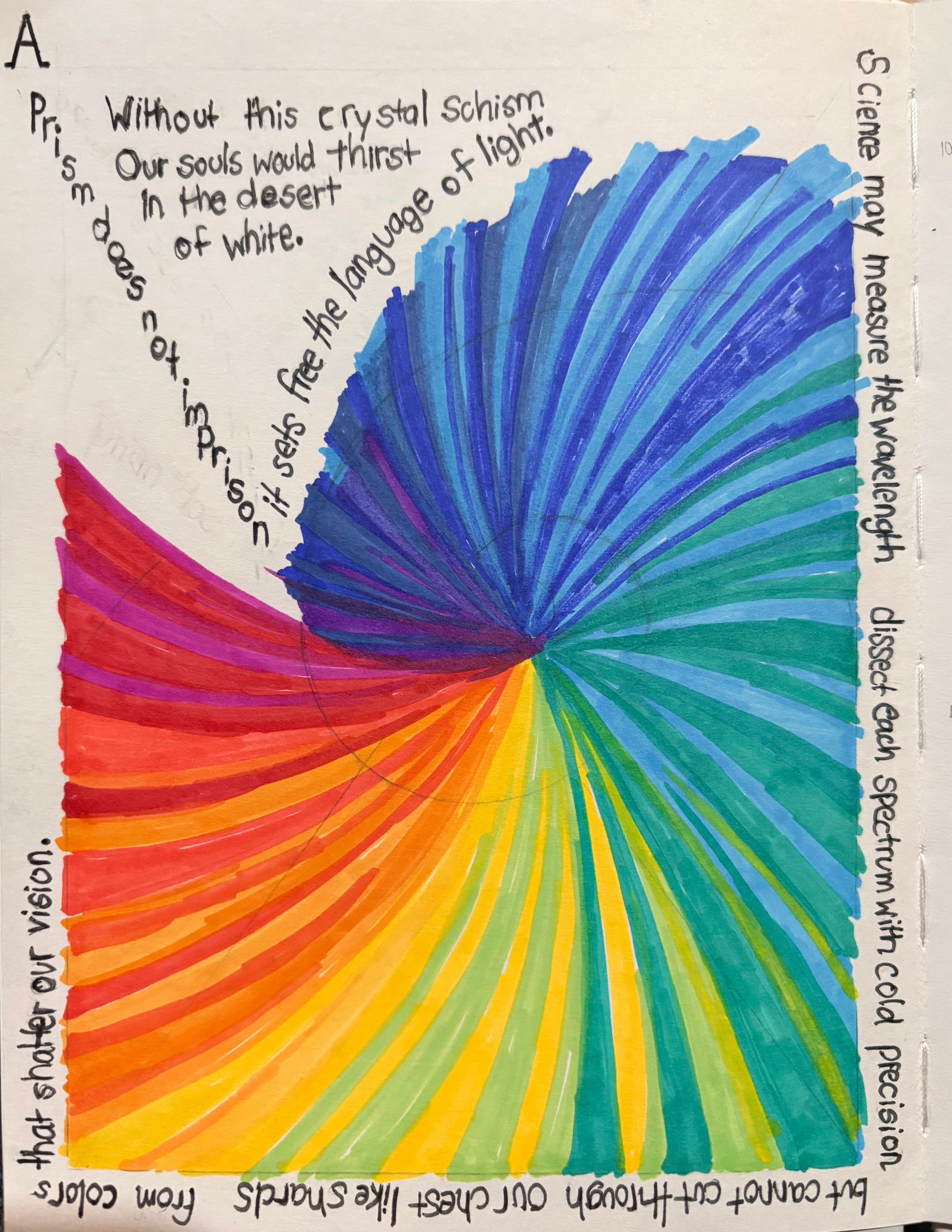
That led to discovering the wild fact that language actually shapes our color perception. Russian speakers, with distinct words for light blue (goluboy) and dark blue (siniy), discriminate those shades faster than English speakers do (Winawer et al., 2007). The Pirahã people of the Amazon, lacking fixed color terms and relying instead on descriptive phrases tied to immediate experience, show different patterns in color discrimination tasks compared to groups with richer vocabularies (Everett, 2005).
Translation: More words for hues = more distinguishable hues. Language allows us to describe perception and it tunes it.
I’ll come back to this.
But first: how a painter who once hated gems ended up training as a gemologist—and why that journey revealed the same patterns in language that I now use to spot obfuscation, extraction, and control.
The Path Through Art
I’ve loved drawing, illustrating, and creating since I was at least two years old, according to my mother. It started with pages filled with “bugs,” moved into silly comics inspired by potty-humor books like Captain Underpants, then evolved into mastering characters from Dragon Ball Z and Pokémon. Eventually I went to school for Illustration at Rochester Institute of Technology in upstate New York. There I developed my craft while coming to grips with society’s backwards nature—and discovering how effective excessive drinking could be at “coping” with it. The drinking advanced faster than the artistic skill. I almost became a credentialed illustrator, with a strong portfolio and connections forming, but the spiral nearly derailed that path entirely.
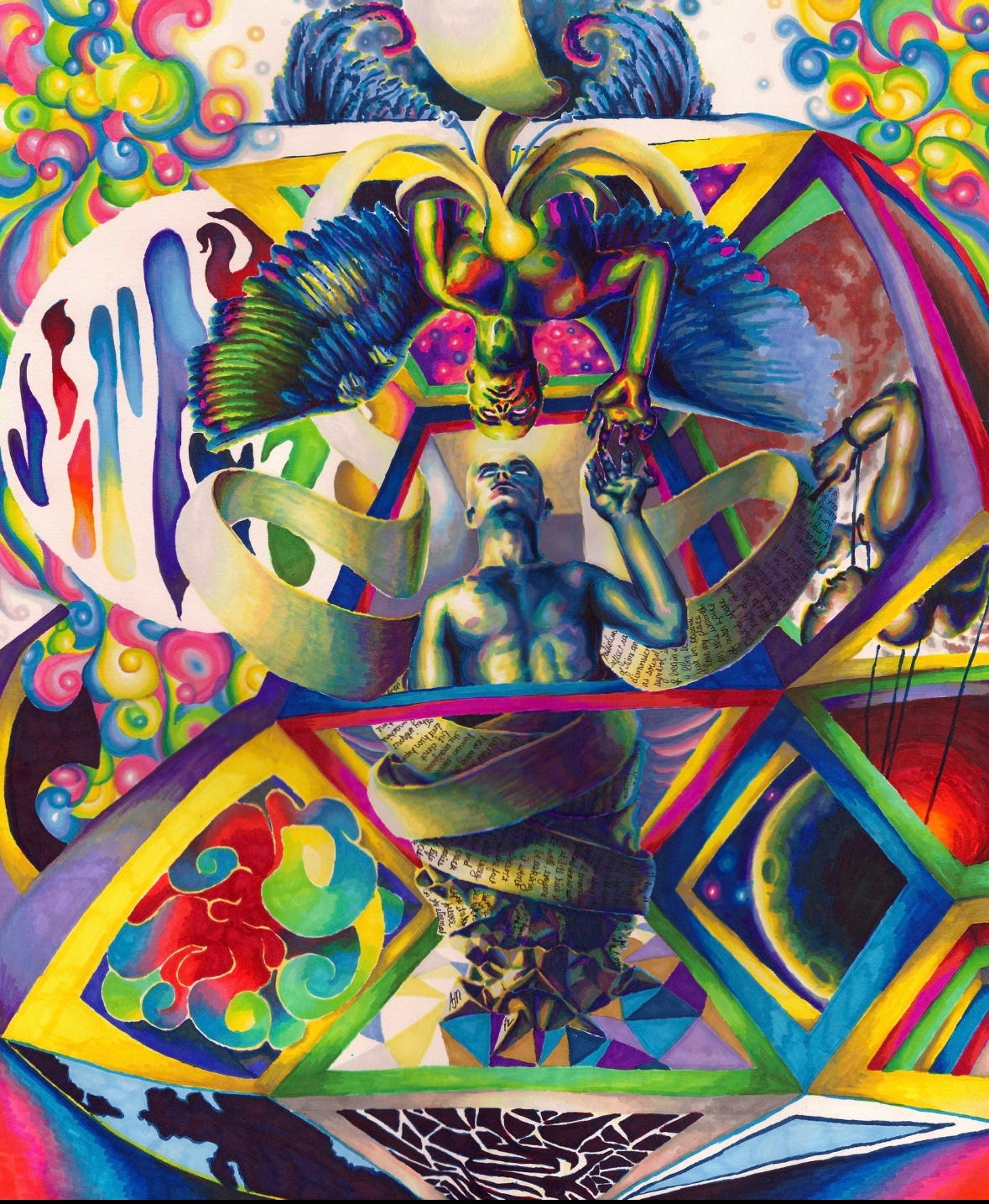
Fortunately, the ability to express and process my feelings and perceptions eventually caught up. I’m now nearly a decade sober.
Fast forward to 2021: I rediscovered my love of painting. Acrylics are my preference—I was never patient enough for oils; they took too long to dry. My pre-block work had been vibrant, hyper-detailed, surrealist, psychedelic pieces focused on psychological concepts, spiritual experiences, and the creative realm of the mind. After a five-year creative block (another story for another time), I found myself drawn to geometry, symbols, shape, and the texture of the paints themselves. Each canvas became a playground—no destination, just reacquainting myself with how bristle holds medium, medium holds hue, hues combine into new colors, and shapes emerge into cohesive images.
This curiosity led me to unusual paints I’d never tried: holographic, metallic, chameleon (shifting color), interference (visible only at certain angles), even thermochromic—the same stuff in mood rings, changing with temperature. I paired paints that absorb up to 99% of light with the brightest whites available. I wanted my paintings to come alive.
Then I decided to paint a quartz cluster I’d been given.
Everything clicked.
I realized I didn’t just want to depict light—I wanted to shape it the way minerals do.
What Stones Do That Paintings Cannot
The paintings I made were vivid and some were even beautiful. But they were flat. Fixed. Static. Light reflected or absorbed—nothing more.
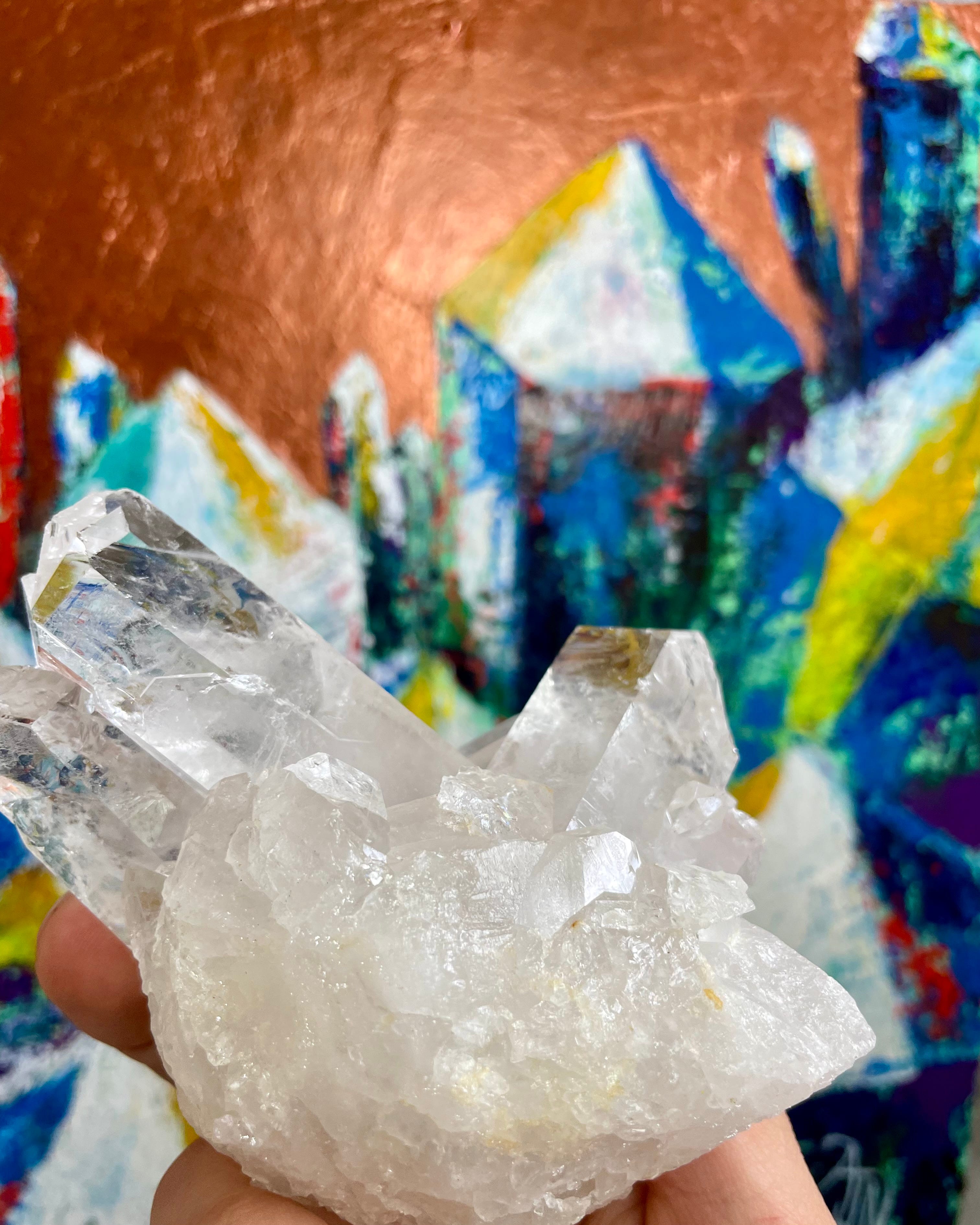
Gems and minerals interact with light differently. They transform it. Bend it. Refract it. Scatter it. Dance with it. Most people don’t realize: many gemstones and crystals manipulate electromagnetic energy at the quantum level in ways a screen or photo can’t fully reproduce—their color, dispersion, brilliance, and play require physical presence to appreciate fully.
Let’s talk about tourmaline. Deep in the earth’s crust, under extreme pressure and heat, tourmaline forms with a unique crystal structure that creates a permanent electric dipole along its axis—one end inherently positive, the other negative. This polarity persists even if the crystal breaks; each fragment retains the orientation, like an internal compass built into its nature.
This built-in asymmetry is the source of tourmaline’s extraordinary energy-transforming abilities. When heated (pyroelectric effect), it generates a measurable voltage from the temperature change alone. When mechanically stressed (piezoelectric effect), it converts pressure into electrical flow. At every scale—from quantum to macroscopic—tourmaline shows how structured difference, not uniform sameness, enables dynamic transformation: chaotic energy organized into coherent patterns.
Unlike rigid artificial systems that grow lifeless under imposed order, tourmaline balances perfect crystalline structure with responsive dynamism. Its asymmetry creates the conditions for these interactions. And what stopped me in my tracks: tourmaline—one of the most colorful minerals in the kingdom—expresses itself in virtually every hue, often displaying multiple colors in a single crystal through zoning or pleochroism (showing different colors based on viewing angle). Order doesn’t demand uniformity. Structure can amplify expression rather than constrain it. Differences can be organized into meaningful relationships without being erased.
I began to wonder if this principle extended beyond minerals.
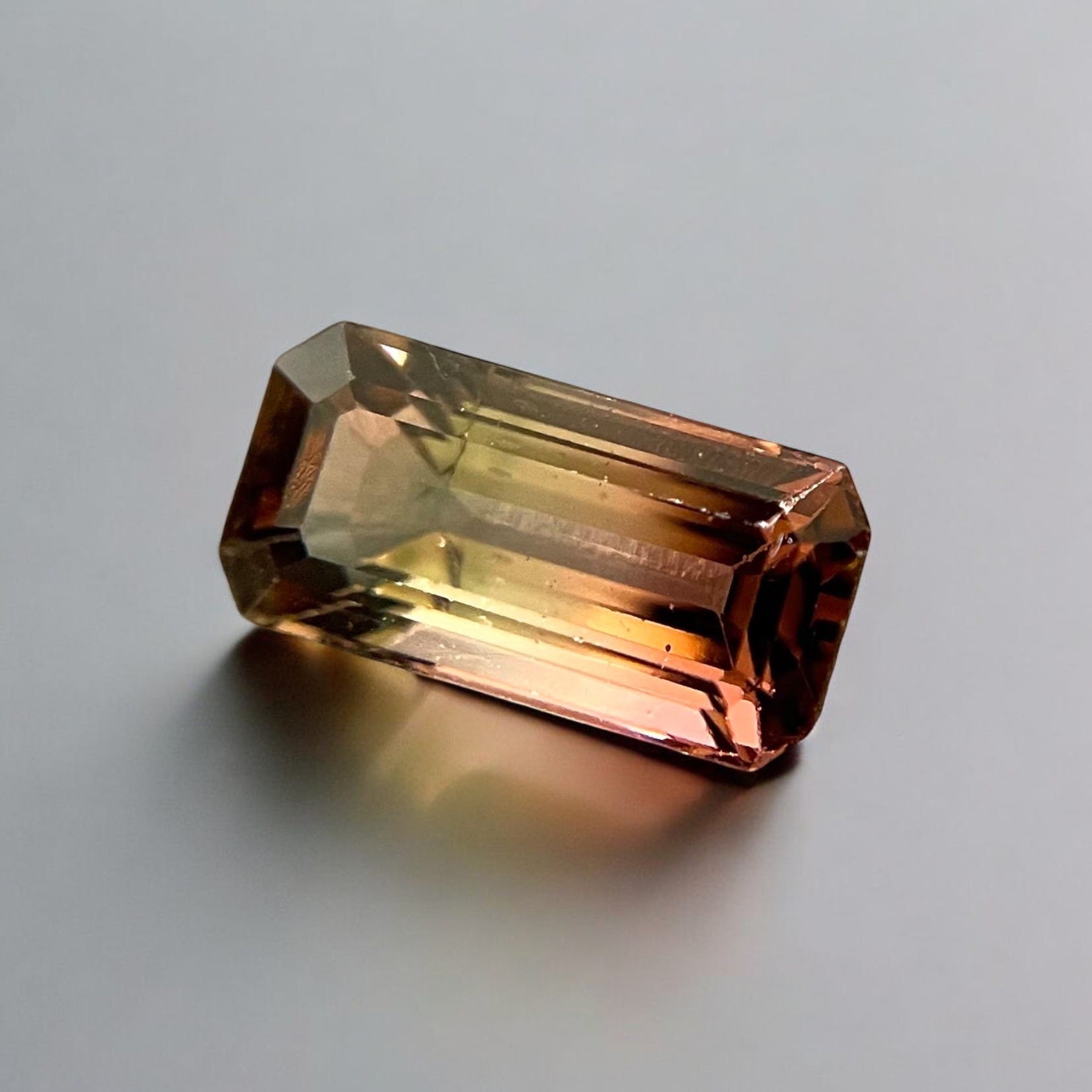
The fascination deepened. I trained as a gemologist—learning to evaluate stones, grade them on clarity, cut, color, and especially how light travels through them. I developed an eye for inclusions, treatments, natural vs. synthetic, enhanced vs. untreated. This is precise, quiet work. We learn to see what most miss.
At some point, those same patterns started appearing in language.
The Pattern Reveals Itself
Here is something most people never consider: the way light moves through a gemstone literally reveals what the stone is made of. Its hidden architecture. Its elemental composition. Its crystal structure.
We cannot see the crystal lattice in a stone directly. We cannot perceive its microscopic matrix, the arrangement of atoms that determines everything about how it behaves. The internal structure is invisible to us. And yet—when we pass light through the stone and observe how that light is transformed, the invisible becomes legible.
