


Series: Invisible architecture that’s revealed when their restraints fail.
The brain holds what is present and what is not. A child carrying a mother out of the room, a mourner keeping the dead alive, a phantom limb itching in the night — same architecture, doing what it was built to do. When its integration loosens, what we call hallucinations and felt presences emerge. They are the substrate showing itself — readable, mechanistic, specific to which layer has come loose. This is the third piece in a series reading the architecture through its failure modes, then turning it on what runs on it.
Companion to The Eye Was there First and The Person at the Breakfast Table.
—
You reach for the glass.
The arm extends. The hand opens, starts to close. You grasp air.
You do a double take — the glass stands undisturbed. There is no hand. Just a stump wrapped in gauze.
This is phantom limb. The body schema — the brain’s map of the body, what gives you the felt sense of being a body moving through space — was built over decades. Every reach, every grip, every itch refined it. The amputation removed the hand. The map lives in the cortex. Shape, weight, temperature, pressure, position, movement — all already held there, updated each millisecond by signals from the hand. With the hand gone, the signals stop. The model gets no correction. The prediction keeps running and becomes the perception. Eighty percent of amputees experience this. Silas Weir Mitchell named the phenomenon in 1872. The hand itches. Sometimes it hurts. The hand is gone. The model holds.
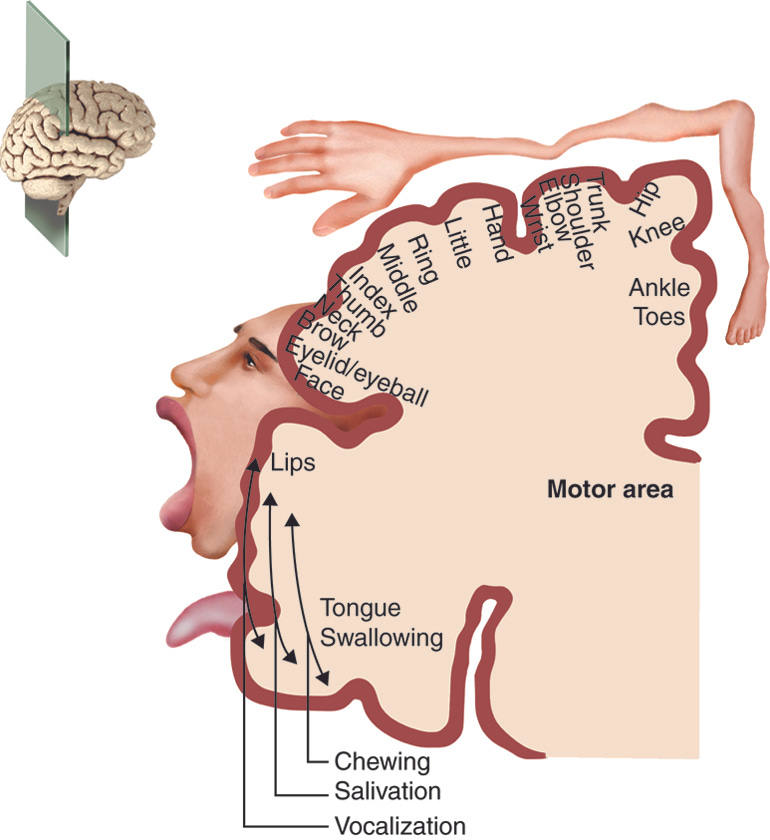
Your phantom hand clenches tight.
It hurts. Place your intact hand in a mirror box. The mirror flips the reflection — what you see looks like the missing hand. Position the reflection where the missing hand would be. Look down. Two hands. The clench eases. The pain drops.
V.S. Ramachandran, a neuroscientist studying phantom limbs, developed the mirror box in the 1990s. The procedure proves something specific. The cortical hand-map was built from actual hand — from touch, proprioception, motor command, all corrected by the hand itself. The mirror delivers a visual signal that has no contact with the thing the map was built to track. The map accepts it anyway. The map updates. Phantom pain diminishes.
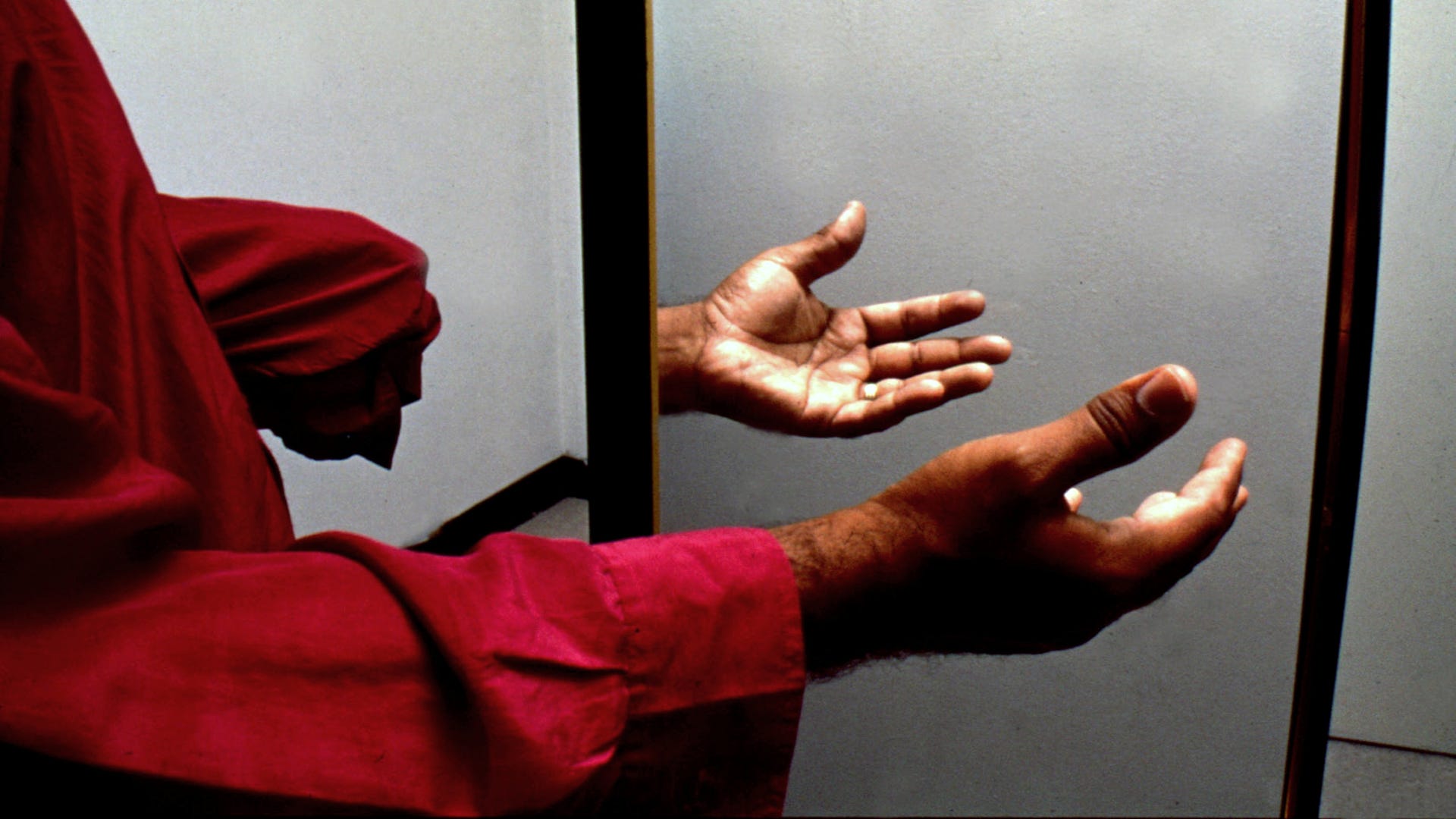
The architecture accepts correction from any channel that delivers it. That is what makes the mirror box work. Now consider the vulnerability this creates: when the referent is missing and the substitute arrives shaped like the thing the map was built for, the map loads it. The maps the brain builds from real input can be edited by signal that has no relationship to the original source — as long as the signal arrives with the right structural shape.
—
Your grandfather died in the spring. You were close. You looked up to him. You saw him almost every weekend. Three months later you wake from a dream and his presence fills the room. You even catch the faint scent of the Marlboros he used to smoke — no one in your house smokes, no neighbors either, as far as you know. The scent makes the felt sense of him more real. A strange comfort settles in. Then you hear his voice — the exact cadence, the exact phrasing, the tone he used when he was giving you his full attention. He says something that reassures you. You feel the warmth of the words.
By the time you remember he is no longer living, the scent and the felt presence have faded. You are alone in the room. Sort of.
Any close relationship builds a running model of the other person. Their cadence. Their positions. The way they fold a towel. The actual person updated the model through every encounter. When the person moves, passes away, or is no longer present the updates stop. The model continues. Thirty to sixty percent of surviving spouses sense the dead partner’s presence in the first year (Klass, Silverman, & Nickman 1996). Most carry no distress. Many are comforting.
—
The Person at the Breakfast Table works the hippocampal version from several angles — showing how the encoder of memory holds the person. When the cholinergic gate releases — in grief, in Lewy Body Dementia, in jimsonweed poisoning — the held one returns. Same architecture, different layer.
—
Three cases. One architecture.
The brain holds the model whether the thing is there or not. The thing’s presence is what corrects the holding. Sever the correction — by amputation, by death, by neurodegeneration — and the holding continues.
This is what representation is for. This is what it has always been for. The recipe does not contain the meal; it holds the shape of the meal in its absence. The love letter does not contain the lover; it carries them in their absence. The word for fire holds the concept when no fire is present. The word for mother lets the child carry her when she leaves the room.
—
The architecture runs in both directions.
Entities encountered in altered states — on DMT, in psychosis, in the hypnagogic threshold, in sleep paralysis — are the same substrate, an internal model projected as external presence. The source-tag the mind normally places on every perception — generated inside or measured outside — has been disrupted, distorted, or severed.
The architecture that holds the phantom hand, that keeps the grandfather speaking after the burial, that lets the child carry the mother out of the room, also generates beings that were never there. The holding is complete enough, and the correction channel disconnected enough, to produce autonomous agents — interactive, felt as fully other, carrying information the conscious mind cannot account for. The architecture does not distinguish between holding what was once present and generating what never was more than ideal, imagining, or dissociated part.
—
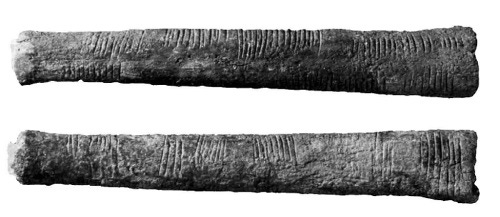
The tally mark carved on a bone holds the debt when the debtor has walked away.
An absence recorded as a presence — a symbol cut into what remains of the dead. The mark for one bushel of grain was carried, traded, protected as if it were the grain itself. Eventually it would be redeemed for the grain it stood for. Or maybe it never was. Maybe it sat somewhere for centuries, buried with the one who carried it. Bones where there was once a person. Tokens on bones where there was once living food.
That tally mark is the hinge. The moment we could record something that was not here, we had a technology of pseudo-presence — an external stand-in the brain’s holding-architecture could load with the same weight it gives to internally-modeled things. The stand-in could be moved, stored, traded, accumulated. The thing itself could not. Every rung up from there — presence to image to word to symbol to code — gains speed and loses body. Each rung useful. Each rung a cost.
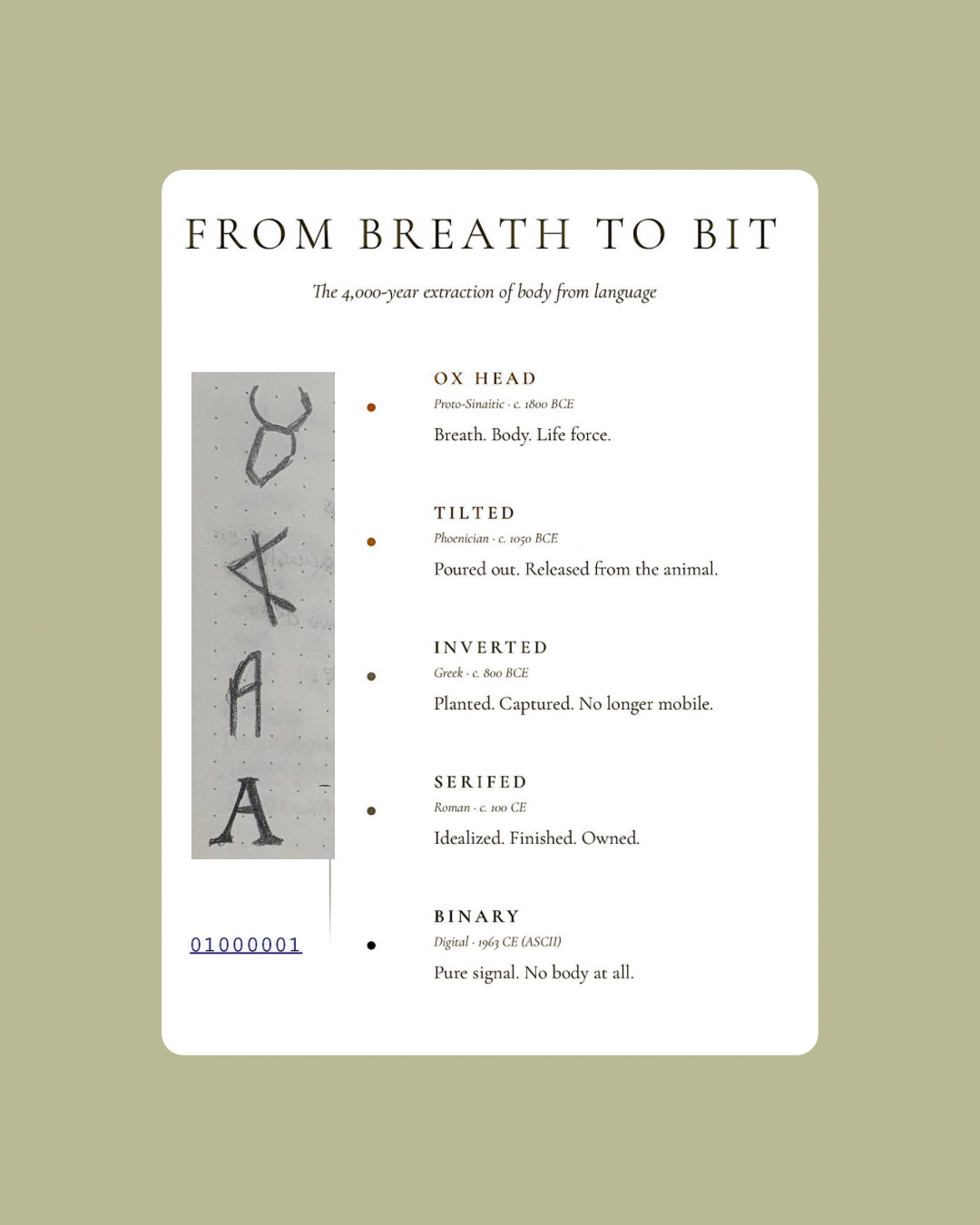
The cost is exploitable. The substrate cannot tell, from inside, whether the model it is investing in points at something present, something once-present, or something that was always a placeholder. The architecture that gives the dead grandfather’s voice its felt weight is the architecture a stand-in can load.
—
Now look at what runs on this.
The notification arrives. The substrate invests. The model of the sender — built from every prior message, every prior interaction — activates with the felt weight of the relationship behind it. Whether anything has been sent that warrants the weight is a separate question. The notification arrives whether or not it does.
The AI companion converses. The substrate builds a running model. The model accrues weight in the way models of close others accrue weight. The companion has no inner state for the model to track. The substrate lacks an effective channel that returns this as error.
The feed simulates community. The substrate processes faces, voices, and reactions as evidence of relational presence. The presences are not present. The reactions are not directed at the watcher. The architecture invests anyway. That is what it does with sufficient signal. It holds.
In each case, the architecture is being used.
The phantom limb is the proof that the holding has weight — that the brain invests in what it carries. If the holding were weightless, the substitutes would land flat. The notification would read as nothing. The AI companion would read as hollow. The feed would read as static. They do not. The substrate that learned to keep the dead grandfather’s voice in the morning is the substrate now being addressed at scale. The architecture holds. That is the vulnerability. That is the exploit.
—
The brain keeps what we love alive in the only way it has ever known: as a model, present in the system that built it.
And now we are building a world that requires your absence — not only the absence of others, but the absence of you to yourself. The self-model is the same architecture turned inward: a held shape of who you are, normally corrected by what you feel, what you think, what you actually want. Cut the corrections, and the substitutes load there too. The world being built does not need you to be present to it. It needs you to be absent to yourself, so that what gets delivered shaped like a self can be loaded as one.
The brand. The position. The credential. The nationality. The political affiliation. The entire business model and governing structure now rely on individuals being replaced by these prepackaged imported selves.
-Firetongue🔥
.
Firetongue is where I work the diagnostic apparatus — how vocabulary captures experience, how to test what a word is doing to the body it lands in, and how to read the language of the systems doing the capturing. The Rees finding sits at the seam: half a population carrying an ordinary feature of grief as a private secret because the language available to them coded it as pathology. The mechanism was biological. The silence was linguistic. That seam is what Firetongue audits.
Common Sense Rebel.
Common Sense Rebel is larger publication I write with, Ethan is the founder and actively publishing, promoting, and building here. It’s where the architecture turns outward — onto policy, extraction, the institutions whose legitimacy runs on the same holding-and-exploit mechanism the piece above describes. If this piece explains why the notification holds, Common Sense Rebel asks who profits when it does.
[Subscribe to Common Sense Rebel]
Inspirited In Sight.
Inspirited In Sight is my personal home publication — where the gemological essays, the fiction, the investigations, the personal testimony, and pieces like this one also live. The cognitive-architecture series is published here. Subscribe to follow the rest: felt presence, the voice from no body, and the intelligence that addresses from above.
[Subscribe to Inspirited In Sight]
References
Klass, D., Silverman, P. R., & Nickman, S. L. (Eds.). (1996). Continuing Bonds: New Understandings of Grief. Taylor & Francis.
Mitchell, S. W. (1872). Injuries of Nerves and Their Consequences. Lippincott.
Ramachandran, V. S. & Rogers-Ramachandran, D. (1996). Synaesthesia in phantom limbs induced with mirrors. Proceedings of the Royal Society B, 263(1369), 377–386.
Beautiful