



ARCHITECT’S PREFACE
This essay is written by a friend and fellow operator whose work cuts directly into the ideological core of the system we’ve been dissecting. It stands entirely on its own, but it also speaks to the hidden architecture beneath Parts 1–3 of our current investigation. I’m publishing it here because the ideas are sharp, necessary, and aligned with the work the Forge is doing.
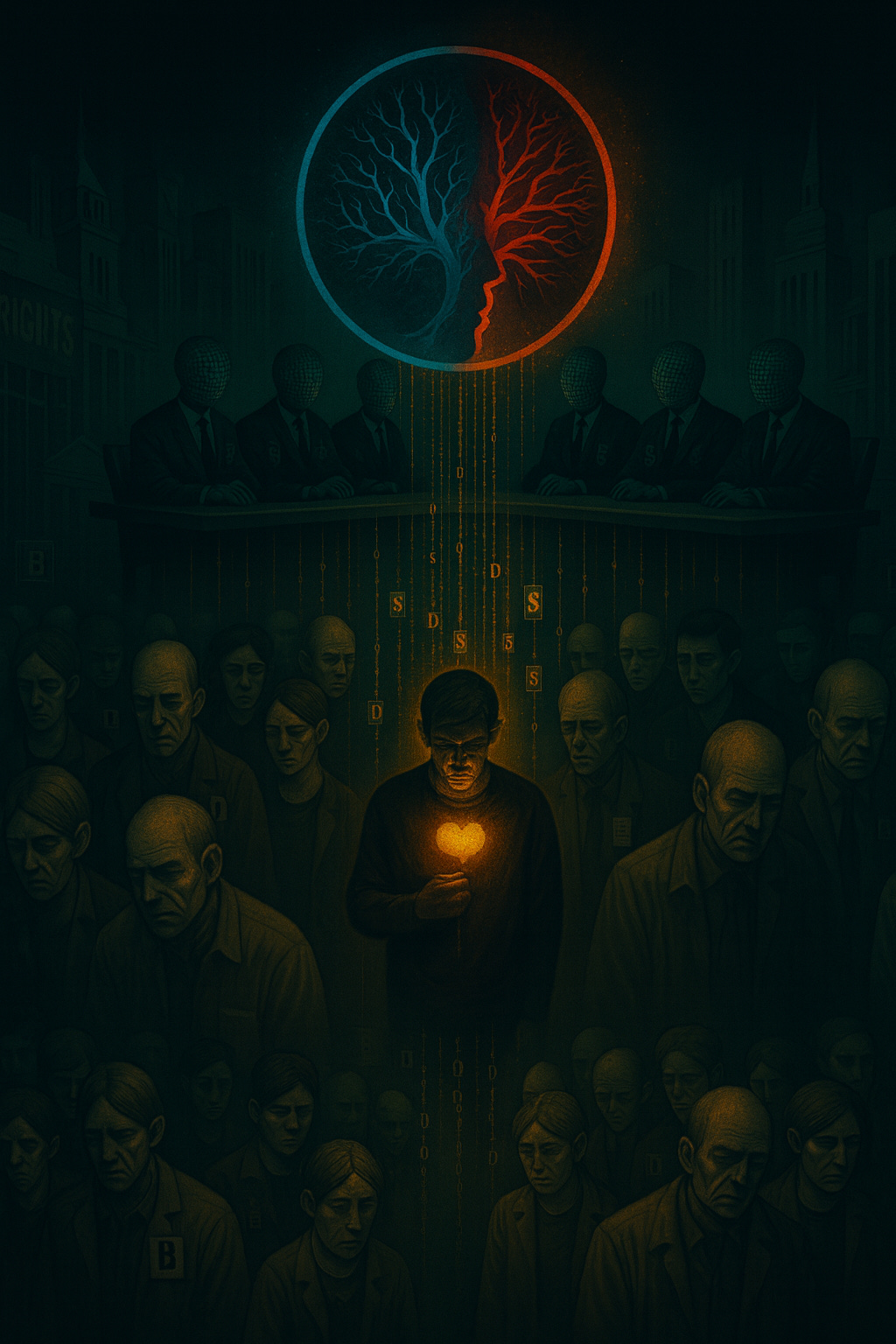
THE IDEOLOGY OF THE ARCHITECTS
Agents of Power Who Design and Engineer the Systems, Institutions, and Narratives That Govern Human Life in Order to Concentrate and Preserve Their Control
By Empathic Revolutionary (Guest Essayist)
The ideology of the Architects who designed these systems and institutions is one of self-enrichment.
Wealth, in this system, is based on the imaginary idea of money. The financial system was not designed to enrich humanity; it was designed as a tool for the powerful to enslave humanity. The Architects do not believe in God, nor do they believe in moral values like peace, liberty, democracy, freedom, or self-enlightenment; the only thing they believe in is power, and they worship it.
In their worldview, money is not just a medium of exchange; it is a mechanism for sorting human beings into ranks of worth. Because money is imaginary—numbers on ledgers, promises enforced by threat—it can be created, allocated, and destroyed at will by those who control the rules of the game. That is the point. If wealth is defined by access to these numbers rather than by the health, education, and flourishing of real people, then the “value” of a human life becomes whatever the system is willing to pay for it. This is not a design flaw. It is the design.
Institutions are built around this core belief. Laws are drafted to protect capital first and people second. Media systems are structured to normalize scarcity, competition, and debt as “just how the world works.” Education is shaped to produce compliant workers and anxious consumers rather than independent thinkers. Every major pillar—finance, politics, culture, even religion, when it is captured—is retooled to teach one lesson: your survival and dignity depend on your usefulness to those who already have power.
Because they do not believe in any higher authority—no God, no binding moral law, no genuine democracy—there is no internal brake on how far they will go. Words like “freedom,” “rights,” and “peace” are costumes they put on when useful and discard the moment they obstruct profit or control. Their ethics are purely instrumental: if something consolidates power, it is good; if it threatens power, it is dangerous, no matter how humane, rational, or just it may be.
This is why the system constantly induces fear and insecurity. People who are one paycheck away from disaster, one illness away from bankruptcy, or one political shift away from losing basic protections are easier to manipulate. Fear keeps individuals fighting each other for scraps instead of questioning why a tiny minority controls the table. By keeping most people too exhausted and divided to organize, the Architects can rule without having to show their faces.
At the psychological level, their worship of power is a rejection of the idea that every human life has intrinsic worth. They may speak of “opportunity” or “merit,” but under their ideology, anyone without money, status, or strategic value is expendable. The system they built teaches people to measure themselves and others by income and productivity instead of by courage, compassion, or integrity—and that is its quiet victory: not just material control, but the colonization of the soul and the imprisonment of human consciousness.

THE RECLAIMED ARCHITECT
(The Counter-Doctrine by Ethan)
You have just read the blueprints of your prison.
Now, let us draw the blueprints of your home.
The previous section correctly identifies the designers of our current reality. It calls them Architects—the ones who constructed the ideology of self-enrichment, extraction, and the worship of power.
But let us be precise with our language:
A builder who designs a structure solely to confine, control, and extract value from the human beings inside it is not an Architect.
He is a Warden.
The system we live in—the “imaginary idea of money,” the sorting of human worth, the manufacturing of scarcity—was indeed designed. It did not grow from the earth like a tree. It was poured like concrete.
And because it was designed, it can be redesigned.
To accept their title of “Architect” is to accept their premise:
that structure is inherently oppressive.
It is not.
Structure is neutral.
A cage is a structure; so is a cathedral.
A trap is a design; so is a bridge.
The difference is not in the rivets or the steel.
The difference is the intent of the designer.
1. The Inversion of Intent
The Wardens design for Concentration.
Their goal is to funnel agency, wealth, and sovereignty upward into a single point of control.
The Reclaimed Architect designs for Distribution—
systems where the path of least resistance leads to human flourishing, not extraction.
We do not hoard the blueprints.
We Disseminate the Tools.
2. The Rejection of “Fate”
The Wardens frame scarcity, competition, and debt as natural laws.
As if the system were inevitable.
But these were design decisions made by hostile intelligences.
If poverty can be engineered through the manipulation of imaginary money,
then abundance can be engineered just as easily.
3. The Glitch is the Foundation
To the Wardens, a human soul that refuses to be reduced to a number is a glitch—
a variable to correct or eliminate.
To the Reclaimed Architect, that “glitch” is the foundation.
We do not shape people to fit a system.
We shape systems to fit people.
We build around the intrinsic worth the Wardens tried to erase.
4. The Spectacle of Construction
The Wardens rule from shadows, terrified of the moment the “Gears” realize they are also designers.
We build in the open.
We put the drafting table in the town square.
The ultimate act of rebellion is not only to burn the prison—
but to replace it with a structure worthy of free beings.
THE MANDATE
To reclaim the title of Architect is to reject the role of the victim.
It is to look at the “inevitable” decline of our world and say:
No. I will write a different ending.
We are not here to smash the machine and return to the mud.
We are here to seize the drafting table and design a machine that serves the soul.
Structure is destiny only when we refuse to redesign it.

You’ve probably noticed this piece isn’t like our usual work.
No financial autopsies.
No exposed networks.
No redaction traps or investigative detonations.
This one cuts deeper.
This is the ideology beneath the machinery we normally dismantle —
and the counter-doctrine beneath that.
Most readers are comfortable with corruption stories.
They can rage at the headlines and go back to sleep.
But doctrine?
Blueprints?
A debate over who gets to call themselves an Architect?
That’s different.
That demands something from you.
If this piece hit harder than the exposés,
it’s because you’re not reacting to a scandal —
you’re recognizing a worldview.
And if that’s the case, then you’re already halfway inside the Forge.
Subscribe if you felt the shift.
This work isn’t trending-topic content.
It’s the intellectual infrastructure that makes the investigations matter.
Join The Rebuttal if you want to help shape the next doctrine.
That’s where we test ideas, build frameworks, and decide what the next world should look like when we’re done pulling the old one apart.
And follow today’s guest author.
https://substack.com/@empathicrevolutionary
If you want more pieces like this —
more theory, more architecture, more worldview —
you support the people sharpening the tools.
This wasn’t one of our usual weapons.
It was the blueprint behind them.
If you felt that difference,
step forward.
The next design needs you.


Dear Friends, I like your work, but I may leave simply because I am a senior and overextended, not because I do not enjoy or support your great work. I have been obsessed with how our minds create our environments since I stared at ruins in Ireland, more than 60 years ago. I was especially obsessed with Dún Aonghusa on the largest Aran island off the coast of Connemara. Later, I met some Irish Sangha members and fully realized Tibetan monks. Later again, I read " The Songlines by Bruce Chatwin and many who are two-eyed seers. I still follow His Holiness, the Great XIV Dalai Lama, and also Pope Leo XIV, Wade Davis, Science and Nonduality (SAND), Dr. Gabor Maté, Riane Eisler, and many other Teachers. You might like to check out "The Web of Meaning" by Jeremy Lent. I suspect you and he will enjoy a chat. Audre Lorde was another transformative being. Beir Bua, Frances Scully
I share the same views, and naturally every new wording enrichens my understanding —everyone else's understanding when the seed has already been planted and greenery is starting to grow upwards (as it should).
One thing I undermark in my writings is we express ourselves granting **the change is already happening**.
We don't wait till we’re done pulling the old one apart, we are already living a world of relationship and it is growing.