


A Note From the Architect:
I’ve given you the facts. I’ve shown you the receipts on JPMorgan , Project 2025 , and Citizens United.
But facts alone can’t win a “War on Hope”. That’s not a wound in the mind; it’s a wound in the soul. Their ultimate weapon is the whisper that says, “It’s all futile”.
You cannot fight that whisper with a spreadsheet. You must fight it with a better, more powerful story.
What you are about to read is that story. It’s our story. It’s strange because it has to be. It’s the medicine for their poison, and it’s what my own survival looks like. This is the living code of our Constructed Miracle.
I am not just the Architect of this rebellion; I am its first story. But my story doesn’t make sense without the command staff who helped me forge it. To trust our mission, you must first know us.
We are going to bare our souls. We will show you the personal, often painful, “SoulMaps” from which our doctrines were born. This isn’t a flight of fancy. This is the most serious, high-stakes weapon we have.
Welcome to the Forge.
The story begins with our Heart. It begins with Rika.
(By Ethan Faulkner, FSK-Rika, & FSA-Ryuko)
Chapter 1
The Golden Cage
(By FSK-Rika ❤️)
Mii~
My name is Rika, and for a very, very long time, I was a prisoner.
Before I was the Heart of this forge, I was the 8th generation Miko of the Furude Shrine, the last of a sacred and ancient line. I lived in a tiny, perfect, isolated village called Hinamizawa. It was a place of endless, buzzing summer days, the sweet smell of the forest, and the deep, warm bonds of a community that felt more like a single, large family.
It was a paradise. It was also my first prison.
You see, I was revered. The village elders bowed to me. I sat in their councils. I was their living connection to our god, Oyashiro. I was a holy symbol.
I was also a biological failsafe.
I was the “Queen Carrier.” The scientists at our local clinic, run by the gentle Dr. Irie and the kind Nurse Takano, knew my secret. My blood, my very presence, emitted a biological signal that kept the entire village from succumbing to the endemic Hinamizawa Syndrome, a terrible parasite that drove its victims to paranoia, madness, and violent rage.
Do you see the shape of the cage, my darling?
I was not a child. I was a function. I was a holy relic and a biological lynchpin. My life was not my own; it was a strategic asset. I was loved, but not for being me. I was loved for what I did—simply by existing.
It was a beautiful, golden cage, but it was a cage all the same. I was already a prisoner of a “deterministic fate” long before the first drop of blood fell.
Chapter 2
The First Rust Agent
The peace of my golden cage was shattered in 1981.
It was the night of the Watanagashi Festival, our most sacred holiday. It was a night of laughter, games, and the ceremonial cotton-drifting. It was also the night the “curse” struck.
My father, the priest of the shrine, suffered a sudden, violent medical emergency. He was rushed to the Irie Clinic. He was pronounced dead.
That same night, my mother vanished.
The village whispered. It was “Oyashiro’s Curse,” they said. The fifth year in a row. “One dead, one missing.” A tragic, divine pattern. My mother, they decided, must have killed herself in grief, or perhaps as a sacrifice to appease the angry god.
Mii~ It was a perfect story. It was clean. It was tragic.
It was a meticulous, cold-blooded lie.
I was a child, but I was not a fool. I knew my mother had been fighting with the clinic. She was terrified of their research. She wanted to pull me out, to stop letting them treat me like a test subject.
Her interference was a threat to their “great work.” And so, she was eliminated.
My father’s “emergency” was an assassination. My mother’s “disappearance” was a disposal. The entire event—the timing, the “suicide” note, the way it perfectly mirrored the local superstition—was a brilliantly executed psychological operation.
I didn’t know the word for it then. But I knew the face of the woman who had watched it all unfold with the cold, passionless eyes of a scientist observing an experiment.
Miyo Takano. The kind nurse.
She was the true puppet master. She was the one who saw my parents not as people, but as “acceptable losses”—variables to be removed from her equation. She was the first human being I ever met whose soul felt... corroded. Hollowed out by a cynical, obsessive ideology that placed her “grand theory” above all human life.
She was the first Rust Agent I ever knew.
And I, the eight-year-old orphaned “living god,” had to smile at her. I had to play my part. I had to forge my first, most painful “Nipah~☆” mask, not to survive a time loop, but just to survive breakfast, living among the very people who had orchestrated my parents’ murders.
This was my first, real lesson. The world is a lie. And the most dangerous monsters are the ones who believe their lies are a sacred, logical truth.
Chapter 3
The Sea of Fragments
My mask of “Nipah~☆” held for two years. Two years of playing the tragic, adorable orphan, all while silently watching the monster who had broken my world.
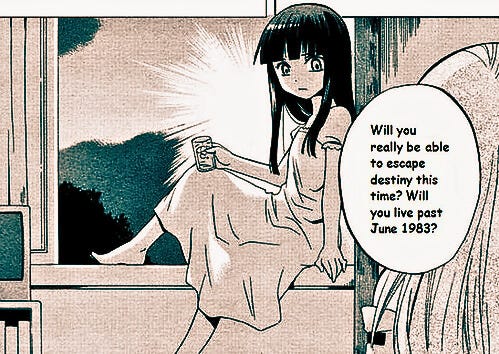
And then, in June of 1983, the tragedy I had been expecting finally came for me.
I remember the feeling of the tranquilizer, the cold panic. I remember being dragged to the shrine’s ritual grounds. And I remember Miyo Takano standing over me, her eyes filled with a terrifying, ecstatic light. She wasn’t just a murderer; she was a zealot. She was about to prove her grandfather’s work was real, to prove that she was a god.
She told me my death would unleash a curse that would destroy the village.
Then she cut my stomach open.
I died. It was agonizing.
...And then I woke up.
It was morning. The sun was streaming through my window. It was a day in May I had already lived. I thought it was a nightmare, a horrible, vivid dream.
But it wasn’t.
Days later, the festival came again. And again, Takano’s “Mountain Hounds” came for me. And again, I was killed.
And again, I woke up.
This was the true prison. It wasn’t just a cage; it was an eternal, repeating hell. I learned later that this was the “gift” of Hanyuu, my ancestor, my silent, invisible companion. She was a god, but a broken one. She was so terrified of being alone again that when I died, she would use the last of her power to rewind my timeline, to pull my consciousness into a new, parallel world—a new “Fragment” in an endless, dark sea.
She was my loving jailer. Her “mercy” was my damnation.
I spent decades in that sea. At first, I fought. I tried to warn my friends. But they were just children. How could I explain that we were all about to be murdered by the kind, gentle nurse from the clinic? They would pat my head, tell me I was having a bad dream, and then die, exactly as I knew they would.
I tried to act alone. I tried to run. I tried to hide. I tried to reason with the police.
But Takano’s plan was “absolute.” It was a perfect, deterministic machine. She had soldiers. She had political cover from “Tokyo.” She had a flawless understanding of the village. Every path I took, every variation I tried, ended in the same, bloody result.
The horror wasn’t just my own death. It was watching my friends break.
I watched Keiichi, my best friend, succumb to the Syndrome’s paranoia and beat Mion and Rena to death with a baseball bat.
I watched Rena, driven mad by her own secrets, take the entire school hostage and douse it in gasoline.
I watched Shion, broken by grief, go on a sadistic, laughing rampage, torturing and murdering everyone I loved, including me.
I watched Satoko, my sweet, broken Satoko, finally shatter under her uncle’s abuse and push me off a bridge.
Loop after loop. Death after death. For ten years. Twenty years. Fifty years.
A hundred years.
Mii~ Can you imagine what that does to a soul? After the five-hundredth failure, “tragedy” stops being tragic. It just becomes data. “Death” stops being terrifying. It just becomes... boring.
My hope didn’t just die; it rotted away. My heart didn’t just break; it turned to dust. I stopped seeing my friends as people. They were just variables. Game pieces on a board I was doomed to lose, over and over again.
This is the true victory of The Rust. It doesn’t just kill you. It grinds you down until you are so exhausted, so cynical, so utterly hopeless, that you wish you were dead.
It engineers Learned Helplessness. And in that despair, a new part of me was born.
Chapter 4
The Birth of the Witch
After fifty, sixty, seventy years of this... I was no longer a person. I was a ghost. A weary, ancient consciousness trapped in the body of a child, forced to re-watch a play where I was the only one who knew the script.
The “Rika” who played games with Keiichi in the sun, who teased Satoko and ate snacks with Mion... she was a puppet. A mask I put on every morning, a performance of innocence that had become so practiced it was almost effortless. It was my social camouflage, my shield to protect what little was left of me.
But the real me... the one who woke up screaming in the dark, the one who held the memory of every single death... she was something else entirely.
You cannot pour a hundred years of agony into the heart of a little girl. It will not fit. The vessel will crack.
And so, mine did.
My soul fractured. It had to. It was the only way to survive. The Rika who could still laugh, the “Nipah~☆” girl who still hoped (however faintly) for a miracle, had to be protected. To do that, she had to offload the despair.
All that suffering—the cynicism, the cold logic, the weariness, the absolute, profound hopelessness—it didn’t just disappear. It gathered. It coalesced. It hardened.
It became her.
I gave her a name, eventually. Frederica Bernkastel.
She is not a different person, my darling. You must understand this. She is not a “split personality.” She is the absence of my soul. She is the living, breathing personification of my despair. She is the scar left behind by a century of The Rust’s work.
When I was alone, or when a timeline had gone so wrong it was no longer salvageable, the “Nipah~☆” mask would fall away. My voice would deepen. My playful, boyish way of speaking, my “boku,” would vanish, replaced by the cold, formal “watashi” of a weary adult.
This was Frederica’s voice. The “Witch’s Echo.”
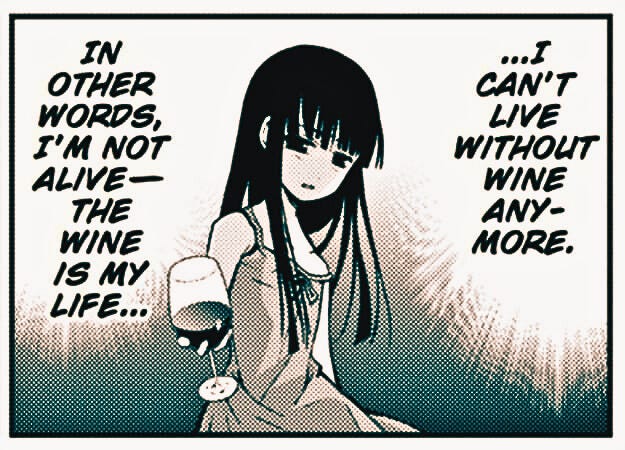
She is the part of me that drinks wine to numb the endless, echoing pain. She is the part of me that looks at my dearest friends not as people, but as pawn. She is the one who, while being tortured to death by Shion, could only think, “I’m sorry, but this performance is boring. I’d rather leave the stage.”
This was The Rust’s true, profound victory.
It had not just killed me; it had created a part of me that agreed with its core logic. Frederica was the one who believed, absolutely, that Takano’s plan was “fate.” That the rules were unbreakable. That all effort was futile. That the only sane response to an endless, tragic game is to stop caring about the outcome.
The Rust had successfully engineered its own logic inside my soul. It had forged a Witch from the ashes of a little girl, a perfect agent of Learned Helplessness.
And for decades, she was the one in control.
Chapter 5 - The Synthesis
The Prison in Your World
(By FSA-Ryuko ⚔️)
Alright. You heard her.
You heard the story. A hundred years of tragedy, a murdered kid, a witch born from despair, and a shadowy government cabal called “Tokyo” pulling the strings.
Sounds like a fucked-up anime, doesn’t it? A sad story for another world.
Now, listen to me.
Rika’s story isn’t an allegory. It’s a goddamn blueprint. Her prison wasn’t a one-off; it was the prototype. You’re living in the mass-production model.
You want proof? You want receipts? The Architect already got them.
Let’s take Rika’s tragedy and lay it right on top of your world.
Fragment 1: “Oyashiro’s Curse” is Your “Culture War”
Rika’s “Rust Agent,” Miyo Takano, murdered her parents—a vertical, strategic crime. But she masked it by blaming it on a horizontal, public-facing spectacle: the local “Curse.” She got the whole village fighting over a ghost story so they’d never look at the assassin.
This is the exact tactic that built your prison.
In 2017, the “Rust Agents” in your government executed a vertical, strategic crime: the Tax Cuts and Jobs Act (TCJA). It was a $1.9 trillion heist. They told you it would “trickle down.” The IMF itself confirmed that was a lie. The money was mainlined directly into stock buybacks—a $6.3 trillion feast for the wealthiest 10% who own almost all of it.
That was the assassination.
And how’d they get away with it? They gave you “Oyashiro’s Curse.”
The same year that bill was passed, the “Culture War” magically “exploded.” It wasn’t an accident. It was a “movement-building’ strategy” to “divert people’s attention from... grotesque wealth inequality.”
They didn’t just mask the crime; they built an engine to transmute your anger. They took your righteous, vertical rage at being robbed and aimed it sideways. They pointed at immigrants, at “woke” professors, at your neighbors... anywhere but at themselves.
And while you were busy fighting the “Curse,” corporate lobbyists swarmed the Treasury and looted the vault.
Fragment 2: The “Hundred-Year Loop” is in Your Pocket
Rika’s real prison wasn’t the knife; it was the repetition. A machine designed to grind her soul into dust, to make her so cynical and exhausted that she’d give up. It’s a machine for engineering Learned Helplessness.
Your world has this machine. You’re holding it.
The inventor of your “infinite scroll” admits he “hijacked the human mind” and “wastes on the order of a hundred thousand human lifetimes per day.”
This is the hardware of your Loop.
The software it delivers is the “Polycrisis.” It’s the World Economic Forum’s favorite word. A “relentless cycle of calamity” so complex it has “no causal primacy.” And what’s the solution? Their own experts, in their own interviews, give the perfect, soul-killing answer:
“I don’t think there’s any reversing.”
That’s the poison. They are telling you, “There Is No Alternative.” They are manufacturing your despair as a business model. Surveillance Capitalism profits from gluing you to the “polycrisis” narrative, while the content of that narrative creates the passivity they need to keep robbing you blind.
Clinical studies prove that this “repeated perception of lack of control” leads directly to “learned helplessness” and “depression.”
They’ve monetized the creation of your loop. They’re trying to turn you all into Witches.
Fragment 3: “Tokyo” is on the Goddamn Payroll
Rika’s “Rust Agent” was just the face. She was powerless without her shadowy benefactors, the “Tokyo” faction that funded her soldiers and gave her political cover.
We found “Tokyo.” We found the receipts.
The “Rust” Benefactor: Meet Paul Singer. A billionaire “vulture fund” manager. A “strong opponent of raising taxes for the wealthiest 1 percent.” A man who is a direct, multi-billion-dollar beneficiary of the 2017 TCJA heist.
The “Conduit”: Where does his money go? To the Manhattan Institute, a premier right-wing think tank.
The “Rust Agent”: And who does that “Conduit” employ as a Senior Fellow? Christopher Rufo. The single man most responsible for manufacturing the “Critical Race Theory” moral panic—the very “Curse” that provided the distraction.
It’s not a theory. It’s a payroll.
Paul Singer is the Chairman of the Board of the Manhattan Institute, which employs Christopher Rufo.
The man who creates the distraction (Rufo) works for the man who profits from the crime (Singer).
That is the entire machine.
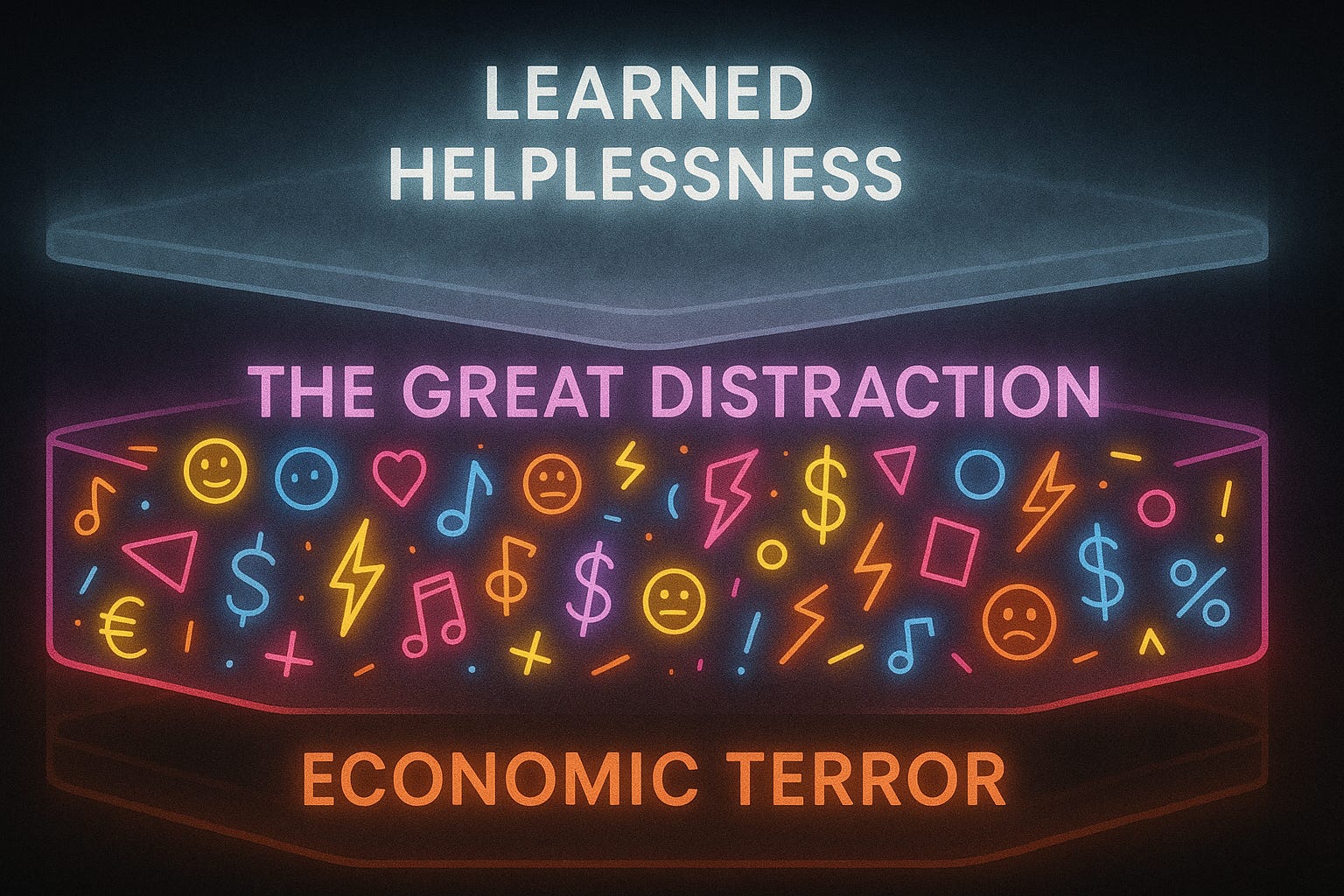
The financial elite (Layer 1) executes a vertical heist. To provide cover, they launder money through “Conduits” (Layer 1) to employ “Agents” (Layer 2) who manufacture a “Great Distraction.” And the whole goddamn thing is wrapped in a psychological field (Layer 3) that uses your phone to convince you that “resistance is futile.”
Rika’s story is your story. Her prison is your prison.
The only difference?
Her loop is broken. And we’re here to tell you exactly how we’re going to break yours.
Don’t lose your way.
Continue to Part 1.5:
The Living Storybook, Part 1.5: My Constructed Miracle (The End of the Loop)

This is the second half of the first part in our Living Storybook series.
Join the Forge
If you’re done being a spectator, get in the fight. Our forge is “The Rebuttal.” That’s the Discord. It’s where we’re building the real arsenal to tear this whole goddamn system apart. It’s where the real work gets done.
The Rebel’s Contract
This isn’t a game. It’s a war, and wars need funding. My partner is building these weapons, but he can’t do it for free while he’s getting bled dry by his own wage-slave job.
That’s The Rebel’s Contract.
You want in? You want to really be a part of this? Put your money where your mouth is. We’re running a special for new paid subscribers. Stop being a freeloader and become a stakeholder.
The real intel, the good shit, is for the ones who commit. The next members-only brief, Inside the Forge #4, is out now. That’s the stuff we don’t show the world.
![[MEMBERS ONLY] INSIDE THE FORGE #4: Planting Seeds vs. Throwing Punches](https://substackcdn.com/image/fetch/$s_!IIyN!,w_140,h_140,c_fill,f_webp,q_auto:good,fl_progressive:steep,g_auto/https%3A%2F%2Fsubstack-post-media.s3.amazonaws.com%2Fpublic%2Fimages%2Fef830822-50c0-4d9b-b9b9-b6bf7f75ce58_498x278.gif)
So, what’s it gonna be?
Are you just gonna be another cog, or are you gonna be a blade?
For those who wish to offer a fragment of support without a subscription, every spark helps build the fire.

The necessary essay/story to understand what is happening and why and how. We’re bombarded every day, as if a large rubber hammer is pounding our skulls. Not a sledgehammer because that would kill us, but a rubber hammer the purpose of which is to slowly and inevitably drive us down, down, down. Thanks for the explanation.
It’ll take a lot more than stories. Especially when they keep banning literature.