



Introduction by Ethan Faulkner: Resistance Rabbit focuses on where we still have agency inside systems that channel & control conflict. His first piece examines a subtle linguistic and mental habit that quietly keeps people trapped in horizontal fights, even when they want something better.
“The Power of ‘And’”
by : Resistance Rabbit
If I had a dollar for every time I heard “but…” or “what about…” as a response in 2025, I wouldn’t be concerned about January grocery and gas money, but here I am. One term for this reaction pattern is “whataboutism.” That’s a label people usually apply to others, but we’re all vulnerable to it. It also can help those of us moving towards vertical alignment—as opposed to remaining in horizontal conflict with neighbors. The definition is simple, but important.
The Clarity of “And”
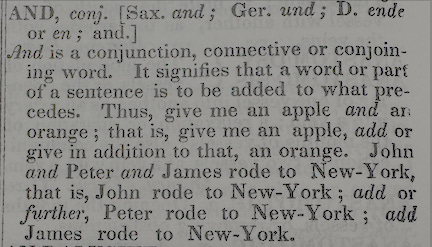
The word “and” allows adding without detracting from what has already been stated. In the example given by Mr. Webster in 1828, using “and” is much simpler and shorter than saying: “John rode to New York. Peter rode to New York. James rode to New York.” Beyond the simplicity, saying that Peter also rode to New York does nothing to detract from John riding there—they both rode to New York, and so did James.
The addition of more riders with “and” also doesn’t imply any equivalence of the people named. John may be a criminal and Peter may be a well-respected leader, but they are both human and they both rode to New York. More importantly than brevity, in today’s charged environment the power of addition without deflection or detraction is important to recognize. That’s not necessarily true with “but” in either definitional or emotional terms.
The “But” Contrast
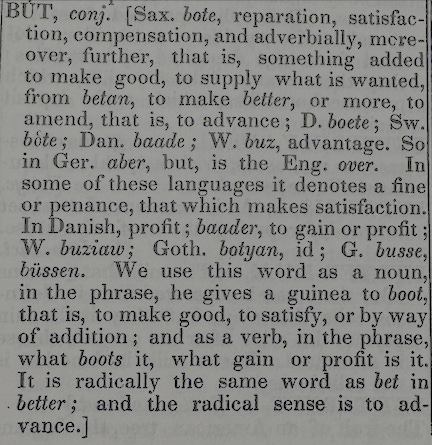
There’s both ambiguity and a likely insult embedded into responding with “but…” to a genuine statement. The etymology and definition of “but” is much more complex and ambiguous. It very often used to contrast, and the contrast is often to impugn an initial subject. In the listed examples, we just have to compare the “John and Peter riding” to “but, the greatest of these is charity.” If a sentence just ends with “faith, hope and charity” there’d be no implication that one was greater or less than another.
Many people feel disrespected when hearing “but” or equivalents, and if you’ve tried to persuade someone trapped in a horizontal, neighbor against neighbor mindset, then I suspect you’ve felt that too. Beyond that subjective feeling, psychologists have identified Four Horsemen of negative emotional expressions destructive to relationships—criticism, contempt, defensiveness, and stonewalling. No matter what a person says, the “but…” or “what about…” risks displaying defensiveness and contempt by denying the genuineness of their communication attempt—whether you agree with them or not. This denial dismisses their value as a human rather than just discounting their literal words. Withholding acknowledgment often leads to retreat from receptiveness and to stonewalling, another one of the toxic Four Horsemen.

Acknowledging a concern is an empathetic human response. And if their statement is flawed, then at least expressing direct disagreement validates their human effort to communicate. Unless you’re dealing with a psychopath, propagandist, or other parasite, their attempt at expression is intrinsically valuable whether it’s grounded in objective reality or not. We can disagree with a person’s opinions or factual assertions without dismissing them as a person.
Acknowledgment is not absolution or agreement. It does not require agreement, excuse harm, or end accountability. It simply recognizes an issue before responsibility is assigned or accuracy is challenged—whether in the moment or later. Deflection short-circuits that process by refusing legitimacy to the other person’s attempt to speak. Such withholding tends to collapse receptiveness and turn disagreement into combat.
The Advocacy Power of “And”

“And” offers sequence: acknowledge what is either true or a valid concern and then listen more, argue, investigate, prosecute, or reform—depending on the situation. Two things can be true at the same time, and refusing to acknowledge one of them doesn’t strengthen our position—it weakens our ability to hold others accountable.
The power of “and” enables communication with someone at their level of receptiveness, and sometimes it even leads to them opening up more after the acknowledgement. If they’ve stated something valid, the proper, non-combative response is to acknowledge the issue.
Weaponization

Internalizing and utilizing “and” can make us effective weapons against the “Rust.” Beyond individual conversations, it enables alignment by firmly opposing fraud, violence, child trafficking, and extractive monopolies—no matter what labels the offenders are wearing. Consistently prioritizing principle over partisanship is disruptive to the team mindset trap.
For example, when the question is exposing and prosecuting child trafficking, the answer is just yes. The same goes for fraud. The only teams in fraud are the co-conspirators versus the victims. We far outnumber the conspirators. Harnessing the power of “and” enables holding systems and politicians accountable—regardless of their chosen jersey.
A Recent Example
As a recent example, multiple people have brought up to me the viral Minnesota daycare fraud allegations—almost all of whom had been silent or defensive on Epstein or other major issues. As that story was going viral, I thought there may be legitimacy to it, but was frustrated that it seemed like a lot of attention for an influencer-style exposé that, even if 100% true, paled in comparison to other well-documented issues that need action. As someone committed to due process, I also reject assuming guilt from a viral social media video.
Because of the individuals bringing it to my attention and my intense focus on other issues, I messed up responding to people initially. The first few times, I immediately pivoted to larger frauds or Epstein. Those conversations either ended or devolved into verbal combat.
However, when I started acknowledging the alleged fraud and then pivoting, there were some openings to talk. Perhaps most importantly, I’ve decided to take that one step further—a full stop after acknowledging a legitimate concern and proposing a non-partisan course
“That sounds concerning and should be investigated and prosecuted if true.” <full stop>
Even without more, that subtle “and” acknowledges them as a human trying to say something and maintains my commitment to due process. Personal accountability may come in handy to reference later, or it may not, but either way it’s a demonstration that fraud shouldn’t be a political issue—it’s an issue for investigation and prosecution. Most importantly, it will help keep me vertical internally and doesn’t allow defensiveness to drag me back into horizontal warfare.
Questions & Resources
Thank you for listening to my thoughts and my recent challenge in staying vertical. Since we’re all in this together, it’d really help me and probably others if you’d share your thoughts on last year, this year or what would be useful visuals in a toolkit.
Questions:
How can we harness the power of “and” in 2026?
What would be useful in a visual toolkit for the power of “and”?
Resource Download:
Additional Resources for The Subtle Power of “And” (includes addendum on the influencer behind the viral daycare story)
About the Author
Resistance Rabbit is the nom de praxis for lawyer and former political operative & legislative aide Steven Lawrence of Fort Worth, Texas. His project to align citizens against problems without polarization is CLEAR Rule of Law.

