


The Two-Bucket Lie
Last week, 55 of you voted in our first community poll to decide what we would investigate next.
It wasn’t even a polite philosophical debate. By a commanding plurality of 44%, you chose Option 2:
“What am I supposed to do about systemic problems when I just need to focus on my survival?”
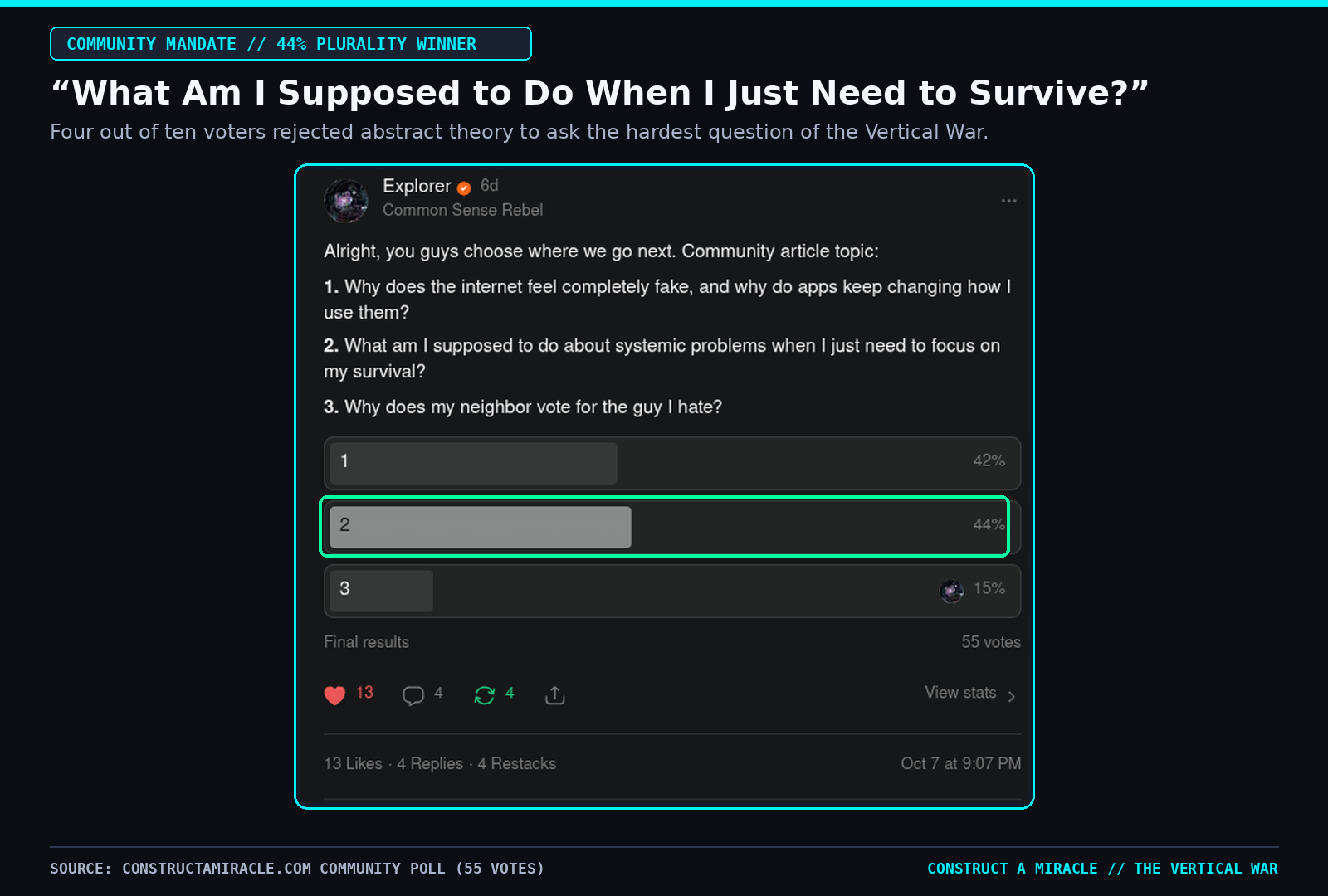
If you clicked that button, I want you to know something right out of the gate: You are not weak, you are not lazy, and you are not failing some moral purity test.
Four out of ten people in this room voted for that question because almost everyone in the working class has been conditioned to divide reality into Two Buckets:
Bucket A (Survival): Paying the rent before the 5th of the month, praying the check-engine light turns off, buying groceries that doubled in price, keeping the lights on, and making it to Friday without a nervous breakdown.
Bucket B (Systemic Resistance): Fighting corporate monopolies, reading 60-page geopolitical investigations, organizing labor drives, attending protests, and “fixing the world.”
Under the logic of the Two-Bucket Lie, you look at those two buckets and make a completely rational triage decision. You tell yourself: “Ethan, I see the cage. I know the game is rigged. But my rent just went up $200, my kid needs dental work, and I have $43 in my checking account until payday. I have to put Bucket B on hold and focus on Bucket A until I stabilize. Once I get my head above water, I’ll help you fight the system.”
Here is the brutal truth we have to confront together today:
There is no solid ground coming.
You are never going to “catch up” first and fight the system second—because your inability to catch up is not a side effect of a broken economy. It is the primary compliance mechanism of the machine.
So before we open the hood and walk through a single statute, federal transcript, or Wall Street balance sheet, I want to give you the direct answer to your question right here at the top—because if you are reading this at 9:30 PM on a Tuesday with 5% battery left in your brain, you shouldn’t have to wade through 4,000 words of financial forensics just to hear what you are supposed to do:
Focusing on your survival is NOT surrendering—surviving intact IS the first act of resistance. The system is explicitly engineered to break your mind, flood your brain with exhaustion, and trick you into blaming yourself for a cage they built. Every day you keep your roof, protect your sanity, and refuse to let their manufactured scarcity turn your internal monologue into a hostage situation, you are denying the machine the psychological surrender it paid billions to extract.
A real movement has a Division of Labor. If you are working 50 hours a week with $43 in your checking account, you do not owe the rebellion your martyrdom. You do not need to feel guilty that you aren’t spending your one day off reading 200-page bankruptcy dockets, auditing Private Equity tax filings, or getting arrested on a picket line when a single missed paycheck means a 6-day eviction notice. Pulling the forensic receipts and building the weapons is my job on the line. Your job right now is to keep yourself and the people you love standing.
Only swing at the hand that is currently in your pocket. You don’t fight a rigged system by adding a second unpaid job called “Activism” on top of your exhaustion. You fight it because Bucket A (Survival) and Bucket B (Systemic Resistance) are the exact same bucket. The corporate landlords, hospital cartels, debt buyers, and Wall Street roll-ups robbing you are leveraged to the eyeballs on borrowed debt; they literally rely on your panicked, uninformed compliance to make their quarterly interest payments. When you use a zero-cost legal or financial strike to keep $50, $200, or $1,000 of survival cash inside your own household—or withhold unpaid labor they didn’t earn—you are simultaneously saving your own neck and starving a leveraged parasite at its weakest mathematical point.
Here is the proof of how they built the trap—and the exact zero-cost survival playbook for how you turn your daily survival into teeth.
The “Traumatized Worker” Doctrine & The Death of Refusal Power
When you run out of money three days before the end of the month, the culture industry wants you to treat it as a personal failure. They want you to think you bought too much coffee, failed to budget properly, or just got hit by a wave of accidental “macroeconomic inflation.”
It wasn’t an accident. They engineered the ceiling to sit two inches below your chin, and we have their own transcripts proving it.
In 1943, the Polish economist Michał Kalecki published a prophetic paper titled Political Aspects of Full Employment. Kalecki asked a simple question: Why do industrialists and billionaires violently oppose permanent full employment and household financial security, even when higher worker wages would mean more customers buying their products?
Kalecki’s answer was surgical: Because if working people have a financial buffer, “‘the sack’ would cease to play its role as a disciplinary measure.” If you aren’t terrified that losing your job means losing your home and your healthcare within thirty days, your boss loses his totalitarian leverage over your life.
Half a century later, Federal Reserve Chairman Alan Greenspan turned Kalecki’s warning into official U.S. central banking doctrine.
On February 26 and July 22, 1997, Greenspan testified before the U.S. Senate and House to explain a macroeconomic mystery: Official unemployment had dropped to lows that historically triggered militant worker strikes and wage demands—yet workers were staying completely docile and accepting flat pay. Why?
Greenspan pointed to data from international outplacement firm Challenger, Gray & Christmas and research across 450,000 workers at Fortune 500 companies. In 1991, during an active recession, only 25% of workers feared losing their jobs. By 1996, in the middle of an economic boom, the percentage of workers terrified of sudden liquidation had nearly doubled to 46%.
Behind closed doors—as Bob Woodward later documented in Maestro—Greenspan gave this monetary weapon a name. He called it “The Traumatized Worker.”
Greenspan realized that the ruling class didn’t need 10% unemployment to break labor anymore. By replacing stable careers with ruthless corporate restructuring, household debt traps, and outsourced precarity, they could keep workers in a permanent state of low-grade survival panic while keeping the factories running at 100% capacity.
Look at what happened between 2021 and 2023 when pandemic stimulus checks and expanded unemployment briefly gave the American working class a tiny financial cushion. For approximately eighteen months, ordinary people had a 60-day buffer. What happened? Millions of workers walked off abusive jobs in the “Great Resignation,” union filings doubled, and wages at the bottom of the pyramid spiked for the first time in forty years.
The mask came completely off:
The Healthcare Executive Admission (Q2 2021): On a quarterly earnings call with Wall Street analysts, Omega Healthcare Investors COO Dan Booth openly complained that his nursing home operators couldn’t force low-wage Certified Nursing Assistants back onto the floor—and celebrated that enhanced unemployment benefits were about to expire in September so that “as the necessity for financial survival comes more into the picture,” desperate workers would be forced to comply.
The Wall Street Memo (July 2022): In an internal research memo obtained by The Intercept, Bank of America’s head of global economics Ethan Harris sounded the alarm over “a record tight labor market” and explicitly wrote that the bank hoped to see the ratio of job openings to unemployed workers drop back down so employers could crush wage growth.
The Central Bank Hammer (August 2022): At Jackson Hole, Fed Chair Jerome Powell announced that the Federal Reserve would aggressively hike interest rates to “soften labor market conditions” and deliberately “bring some pain to households.”
The Billionaire Confession (September 2023): Speaking live at the Australian Financial Review Property Summit, luxury property mogul Tim Gurner said the quiet part into a live microphone:
“We need to see unemployment rise. Unemployment has to jump 40, 50 percent in my view. We need to see pain in the economy. We need to remind people that they work for the employer, not the other way around.”
The Death of the Buffer Zone (The 2026 Math)
To make sure that “pain” became permanent, corporate monopolies systematically enclosed every single necessity of human survival.
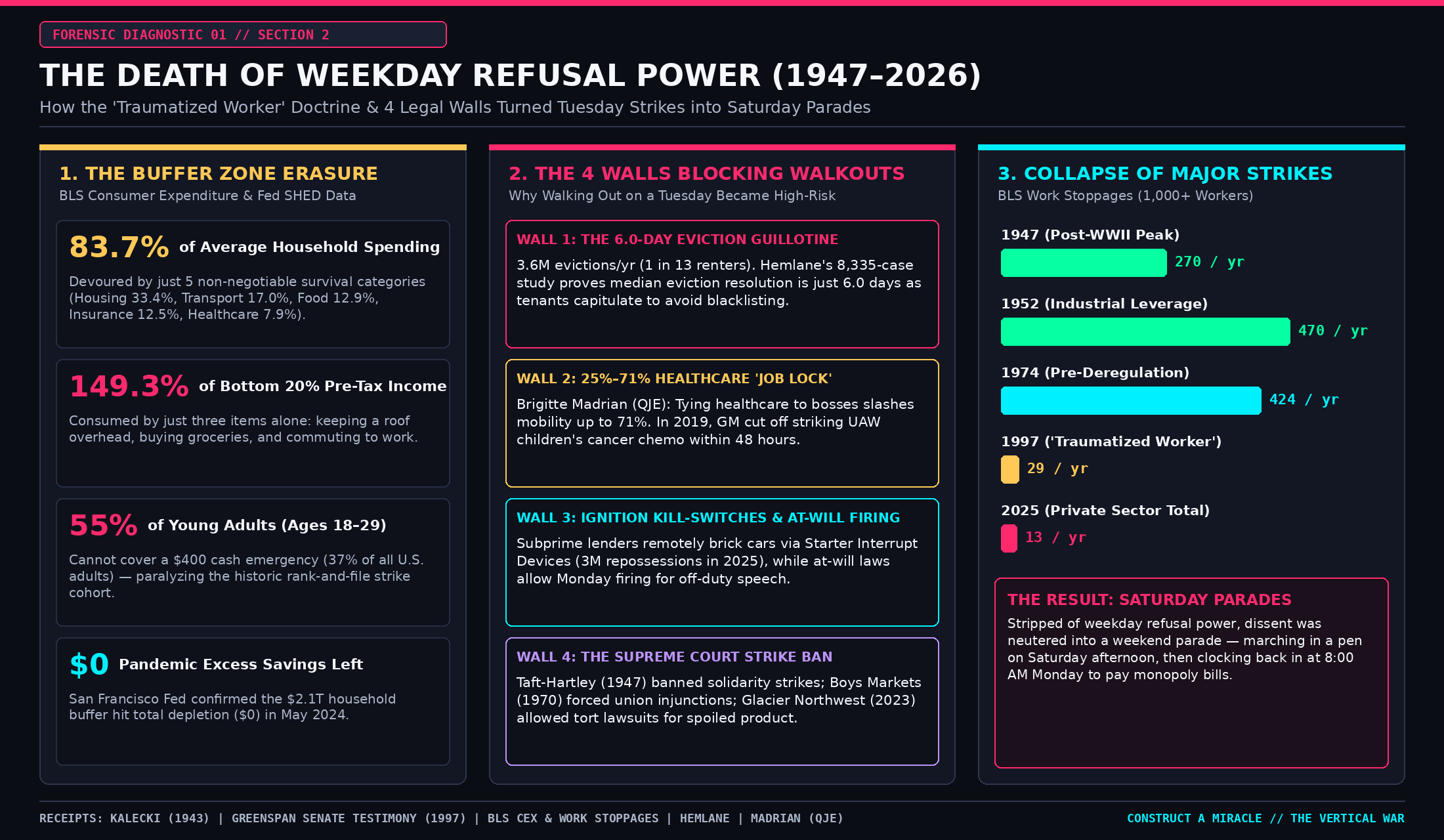
According to the Bureau of Labor Statistics Consumer Expenditure Survey (CEX), just five non-negotiable survival categories now devour 83.7% of the average household’s total annual spending:
Housing: 33.4% ($26,266/year)
Transportation: 17.0% ($13,318/year)
Food: 12.9% ($10,169/year)
Personal Insurance & Pensions: 12.5% ($9,809/year)
Healthcare: 7.9% ($6,185/year)
For the bottom 20% of earners, three items alone—housing, food, and getting to work—consume 149.3% of their entire pre-tax income. According to the Federal Reserve’s Survey of Household Economics and Decisionmaking (SHED), 37% of all U.S. adults—and 55% of young adults aged 18 to 29 (the exact cohort that historically supplied the rank-and-file energy for labor strikes)—cannot cover a $400 emergency expense in cash. Meanwhile, 74.3% of American households operate with less than $500 a month in discretionary margin, and the Federal Reserve Bank of San Francisco confirmed that the $2.1 trillion buffer of pandemic savings hit $0 (total depletion) in May 2024—vacuumed directly into the balance sheets of the top 25% through monopolistic price hikes.
From Tuesday Disruption to Saturday Parade: How They Killed Your Refusal Power
Have you ever wondered why modern political protests feel completely toothless? Why millions of people can march through a city on a Saturday afternoon holding clever cardboard signs, and on Monday morning the ruling class doesn’t change a single policy?
In their foundational study Poor People’s Movements: Why They Succeed, How They Fail, sociologists Frances Fox Piven and Richard Cloward proved that working-class people almost never win substantive redistribution through polite voting or weekend rallies. Because ordinary people don’t own the media or the banks, our only real political leverage is disruption—specifically, weekday refusal power: walking off the job on a Tuesday, halting commercial logistics, and costing elites real money.
Over the last fifty years, the system built a four-walled legal and financial cage specifically designed to strip you of weekday refusal power:
The 6-Day Eviction Guillotine: According to Princeton University’s Eviction Lab, landlords file 3.6 million eviction cases every year, hitting roughly 1 in every 13 renter households. While most people assume an eviction takes months in court, an empirical analysis of 8,335 eviction cases by property-management platform Hemlane revealed that the median eviction resolution time in the United States is just 6.0 days (3.3 days in Michigan, 5 days in California, 6.1 days in Washington). Why? Because terrified tenants capitulate to immediate cure-or-move agreements within a week just to avoid being permanently blacklisted on algorithmic tenant-screening registries. Pair that with corporate landlords like Blackstone-spun Invitation Homes—caught in a September 2024 FTC complaint ($48 million settlement) where CEO Dallas Tanner told executives to “juice this hog” with $1,740/year in mandatory junk fees while a company rep instructed a drowning tenant in writing to “sell her plasma, hair, or eggs”—and a single missed week of pay means losing your roof in six days.
Biological Hostage-Taking (“Job Lock”): Why is American healthcare tied to your boss instead of the citizen? Economist Brigitte Madrian’s landmark research in the Quarterly Journal of Economics proved that Employer-Sponsored Insurance (ESI) slashes voluntary worker mobility by 25% to 30% overall, and by 30% to 71% if a worker has a family or a pregnant spouse—while uninsured adults face a 1.2x to 1.5x higher five-year mortality risk. Look at what General Motors did in September 2019: just 48 hours after 50,000 UAW autoworkers walked out on strike, GM abruptly terminated their family health insurance—cutting off active cancer chemotherapy for workers’ children mid-treatment to force their parents back onto the assembly line.
The Ignition Kill-Switch & At-Will Political Firing: Need a car to get to work? Subprime auto lenders now wire cellular Starter Interrupt Devices (SIDs) directly into your starter relay. Miss a payment by 24 hours, and an algorithm remotely bricks your car in your driveway—driving 3 million vehicle repossessions in 2025. Meanwhile, under American at-will employment and algorithmic HR surveillance, you can be summarily fired on Monday morning simply for your off-duty political affiliation or a social media post that offends management.
The Supreme Court Strike Ban: First, the Taft-Hartley Act (1947) outlawed solidarity strikes, secondary boycotts, and wildcat walkouts. Next, in Boys Markets v. Retail Clerks Union (1970), the Supreme Court empowered federal judges to issue immediate injunctions crushing mid-contract walkouts, legally forcing unions to police their own rank-and-file members. And in June 2023, the Supreme Court delivered the coup de grâce in Glacier Northwest v. Teamsters: when concrete drivers timed a walkout to maximize leverage, the Court ruled that employers can sue unions in state court for property-destruction tort damages if a strike actually spoils perishable corporate product.
Look at the empirical result in Bureau of Labor Statistics data: Major weekday work stoppages (1,000+ workers) collapsed from 270 per year in 1947 to an average of fewer than 25 per year over the last three decades—with only 13 private-sector major strikes across the entire 160-million-worker U.S. economy in 2025.
Stripped of the financial buffer and legal right to refuse on a Tuesday, American dissent was neutered into a state-permitted weekend parade. You are allowed to march in a circle inside a police-escorted pen on Saturday afternoon to vent your steam—as long as you clock back into your cubicle at 8:00 AM on Monday and pay your monopoly bills on time.
The “Dry Deck” Fallacy & The Neurobiology of Scarcity
In the comment section of last week’s poll, one of our readers, Walter Haugen, offered a classic piece of advice to everyone who voted for Option 2:
“Answer to number 2: Shift your paradigms so that your solutions are short-, mid- and long-term.”
Now, I want to be completely fair to Walter. He isn’t trying to insult anyone. What Walter wrote is the exact self-improvement framework we were all raised on in the 1990s and 2000s: Stop being reactive. Get organized. Build a 30-day budget, a 1-year career plan, and a 5-year investment horizon.
On paper, that advice makes total sense.
In the real world of 2026, however, telling a drowning household to “just adopt a short-, mid-, and long-term paradigm” is what I call The Dry Deck Fallacy. It assumes you are standing on the dry deck of a cruise ship with a notebook in your hand, rather than treading freezing water in the dark while someone throws anvils at your head.
Even more importantly: Walter’s advice is a neurobiological impossibility under active scarcity.
Over the last decade, behavioral economists and molecular neurobiologists have put human beings under fMRI scanners and magnetic resonance spectroscopy to see what actually happens to the human brain when it is subjected to Layer 1 financial precarity. The findings completely obliterate the “pull yourself up by your paradigm” myth:
The 13-to-14 IQ Point “Bandwidth Tax” (Science, 2013)
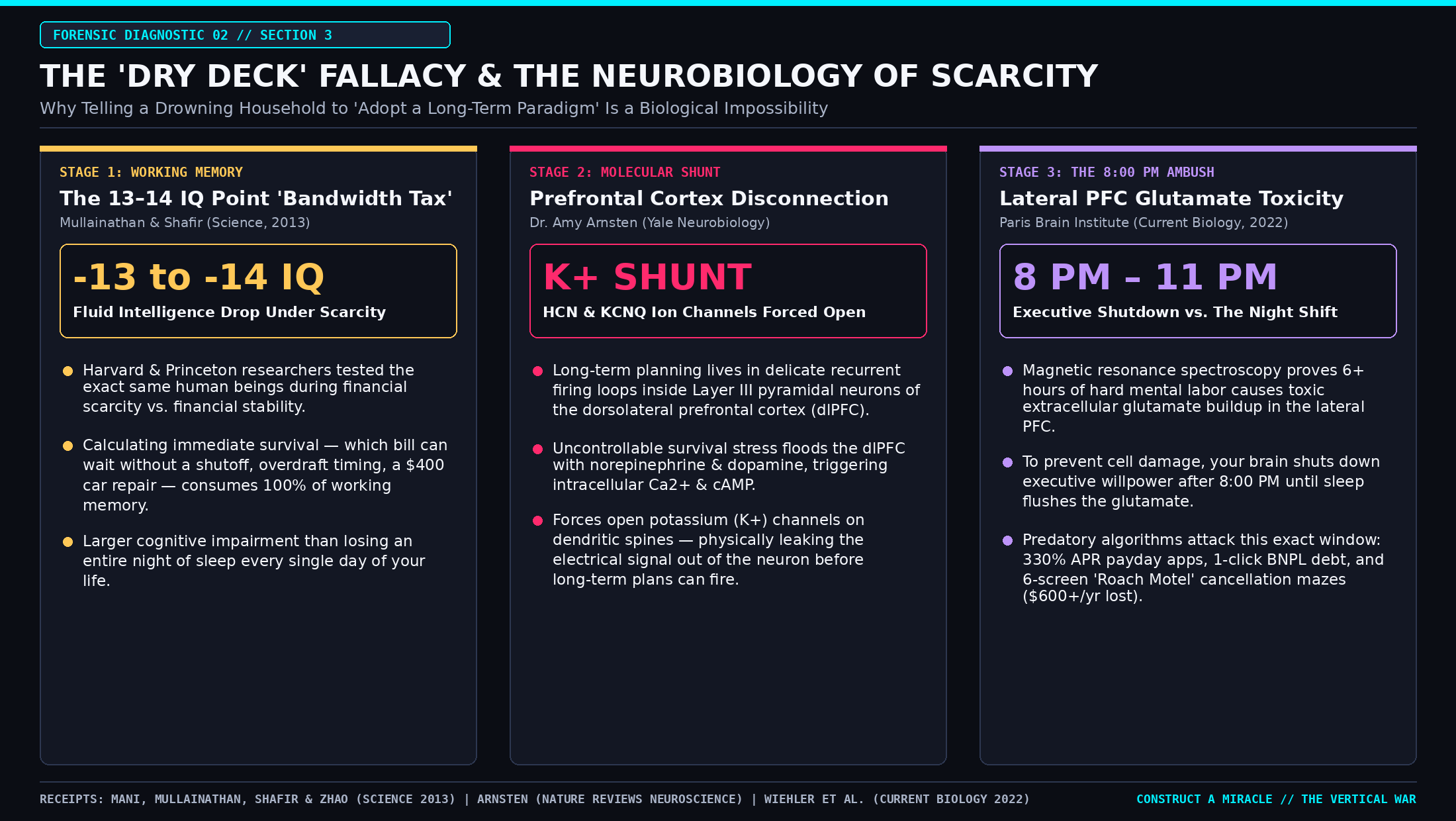
In a landmark study published in Science, Harvard economist Sendhil Mullainathan and Princeton psychologist Eldar Shafir (alongside Anandi Mani and Jiaying Zhao) measured the fluid intelligence and executive control of the exact same human beings during periods of financial scarcity versus periods of financial stability.
They proved that the sheer cognitive load of calculating immediate survival—juggling which bill can be paid late without a shutoff, calculating overdraft timing, absorbing a surprise $400 car repair—imposes an immediate 13 to 14 IQ point drop in functional fluid intelligence.
To put a 13-to-14 IQ point drop in perspective: It is a larger cognitive impairment than losing an entire night of sleep. You are not “bad at long-term planning.” You are operating every single day of your life with the biological equivalent of severe, chronic sleep deprivation because your working memory is 100% consumed by emergency air-traffic control.
The Physical Disconnect of Your Prefrontal Cortex (Yale Neurobiology)
Why does financial stress drop your fluid intelligence so violently? It isn’t just “worry.” It is a hardwired molecular switch inside your skull.
Yale University neurobiologist Dr. Amy Arnsten spent decades mapping the cellular circuitry of the dorsolateral prefrontal cortex (dlPFC)—the exact evolutionary region of the human brain responsible for abstract reasoning, impulse control, and mid- to long-term planning.
Under normal, safe conditions, Layer III pyramidal neurons in your prefrontal cortex keep goals and long-term plans alive through delicate recurrent firing loops.
Here is what happens the moment you are subjected to chronic, uncontrollable survival stress:
Your brain floods the prefrontal cortex with high levels of catecholamines (norepinephrine and dopamine).
Those stress chemicals bind to alpha-1 adrenergic and D1 receptors, triggering an intracellular flood of calcium ions and cyclic AMP (cAMP).
That chemical cascade forces open potassium ion channels (HCN and KCNQ) located directly on the dendritic spines of your prefrontal neurons.
As positively charged potassium ions pour out of those open channels, they create a literal electrical shunt. The electrical signal carrying your long-term thought leaks out of the neuron membrane before it can ever reach the cell body to fire.
Read that neurobiology again: Chronic survival terror physically disconnects the wiring of your prefrontal cortex.
At the exact same moment those potassium channels shunt your long-term planning hardware offline, the same chemical flood strengthens the amygdala and basal ganglia—your brain’s ancient, reflexive fight-or-flight survival circuitry. Evolution designed that switch so that if a predator jumps out of the bushes, you don’t stand there contemplating your five-year retirement portfolio; your brain shuts off the abstract philosopher and hands 100% of the controls to the reflex engine.
When the Cartel keeps 74% of households within $500 of disaster, they are artificially holding your potassium ion channels open 24 hours a day, 365 days a year. Telling someone in that neurochemical state to “just shift to a long-term paradigm” is like telling a man with a severed femoral artery that he just needs a better five-year marathon training plan.
The 8:00 PM Glutamate Ambush (Current Biology, 2022)
It gets even darker when you clock out of work.
In 2022, neuroscientists at the Paris Brain Institute (Wiehler et al., published in Current Biology) used magnetic resonance spectroscopy to scan the brains of workers after six-plus hours of intense cognitive labor and constant decision-making. They discovered that sustained daytime mental exertion causes a toxic accumulation of extracellular glutamate exclusively in the lateral prefrontal cortex.
Because high extracellular glutamate is literally neurotoxic to brain cells, your brain has to protect itself in the evening by shutting down executive control and willpower until sleep can flush the glutamate out.
And that exact 8:00 PM to 11:00 PM window—when you collapse onto the couch with a glutamate-flooded prefrontal cortex and zero metabolic willpower—is when the Cartel deploys its night shift:
Algorithmic Outrage & Dopamine Harvesting: Infinite-scroll feeds engineered around Variable Ratio Reinforcement (the exact same neural slot-machine schedule used in casinos) keep you screaming at strangers over Layer 2 culture-war distractions so your nervous system never enters restorative parasympathetic rest.
The One-Click Debt Trap: Buy Now Pay Later (BNPL) buttons and Earned Wage Access (EWA) payday apps—which CFPB data shows extract fees on 82.2% of transactions, compounding into 330%+ APR traps for workers making under $50,000—remove every ounce of friction from taking on debt when your impulse-control hardware is offline.
The “Roach Motel” Subscription Maze: Why is it one click to sign up for a recurring subscription at 9:30 PM, and a six-screen labyrinth of hidden links, retention chatbots, and phone trees to cancel it? Because corporate behavioral scientists designed “Roach Motel” dark patterns specifically to exploit evening glutamate toxicity. According to Federal Trade Commission data from the Click-to-Cancel rulemaking, 75% of Americans lose more than $50 every single month ($600+ a year) to unwanted recurring subscriptions solely because navigating the cancellation maze requires executive energy they do not have after work.
The Pivot: Why Saving Your Own Household Cash Breaks Wall Street’s Back
When we unpacked this live on Reverb, someone in the chat immediately typed the classic activist response:
“We just need a General Strike!”
Think about why every viral graphic calling for a “National General Strike on May 1st” ends in total, humiliating failure. Is it because working people love getting robbed?
No. Back in February, in my essay The Common Knowledge Threshold, we examined the game theory of why prisoners obey a system they privately despise. In sociology, Mark Granovetter’s Threshold Model of Collective Behavior and UCLA political scientist Michael Suk-Young Chwe’s Rational Ritual prove that high-risk rebellion requires two things that the modern economy has systematically destroyed: First-Mover Survival and Common Knowledge.
In a traditional workplace strike, the Day-1 payoff for the individual worker is violently negative: the moment you walk out the door alone, you lose your wages, risk your family’s healthcare, and start a 6-day countdown to an eviction filing. In Granovetter’s math, that catastrophic penalty wipes out the “zero-threshold instigators” needed to start a chain reaction—pushing everyone’s threshold up to 51%+ (“I can only afford to walk out if half the country walks out at the exact same second”).
Worse, to coordinate a high-risk leap, humans require what Chwe calls an “inward-facing circle”—a shared public ritual where you don’t just know that your neighbor is angry (first-order knowledge), you can look across the circle and verify that your neighbor knows that you know they will take the hit alongside you (Common Knowledge). An algorithmic smartphone feed splices every neighborhood into hostile Left-vs-Right silos—the exact opposite of an inward-facing circle. A warehouse worker in Ohio scrolling past a “General Strike” meme has zero proof that the guy on the forklift next to him or the landlord holding his lease will honor it. So on Monday morning, everyone rationally stays in line.
Flipping the Payoff Matrix: From the Workplace to Your Kitchen Table
So how do you break the Common Knowledge trap when the workplace is a fortified panopticon?
As political economist Michael Hudson points out in Killing the Host, modern Wall Street extracts just as much wealth from working families through financial and monopoly overhead—medical debt, corporate rent, junk fees, and Private Equity service monopolies—as it does at the point of production.
And when you shift your refusal from the workplace to household financial extraction, the game-theoretic payoff matrix flips completely upside down:
Your Day-1 Cash Payoff is Immediately POSITIVE: Instead of forfeiting wages on Day 1, refusing a predatory medical bill, cutting a Roach Motel tollbooth, or starving a Private Equity roll-up immediately puts +$100 to +$500 a month of survival cash back into your pocket.
Your Employer Firing Risk is ZERO: Your boss has zero legal standing to fire you or pull a Boys Markets injunction because you refused to pay a third-party debt collector or boycotted a Wall Street-owned HVAC conglomerate at home.
Your Individual Activation Threshold Drops to Zero: Because saving your own money helps your household survive on Day 1 even if you are the very first person on your block to do it, there is zero first-mover suicide penalty.
Even better: You don’t need 51% of the country to act at once—because Wall Street’s own debt addiction lowers the threshold to 7.5%.
“Wait—How Is This Even Legal?” (The 90-Second Guide to Wall Street’s Mafia Bust-Out)
Before we walk through the five zero-cost strikes in the Survival Playbook, you need to see why keeping $100 or $1,000 in your pocket actually hurts a $10 billion Wall Street conglomerate—and why forcing them into bankruptcy saves your local town instead of destroying it.
If you’ve ever wondered why your local family veterinary clinic, HVAC technician, dentist, or community hospital suddenly started charging triple for basic work while the service went to hell, it’s because Private Equity funds have poured over $50 billion into rolling up local residential trades and healthcare clinics.
On the live stream, I asked the basic question that legal jargon hides from normal people: How is it legal for Wall Street to monopolize a town’s small businesses and dump billions of dollars of debt onto them without paying it back themselves?
When we audited the exact corporate statutes, we found that Private Equity runs a legalized version of the classic Mafia “Bust-Out” from Goodfellas—where the mob takes over a local restaurant, runs up massive debts on the restaurant’s credit line, steals the goods out the back door, and leaves the gutted shell to burn—using three specific legal loopholes:
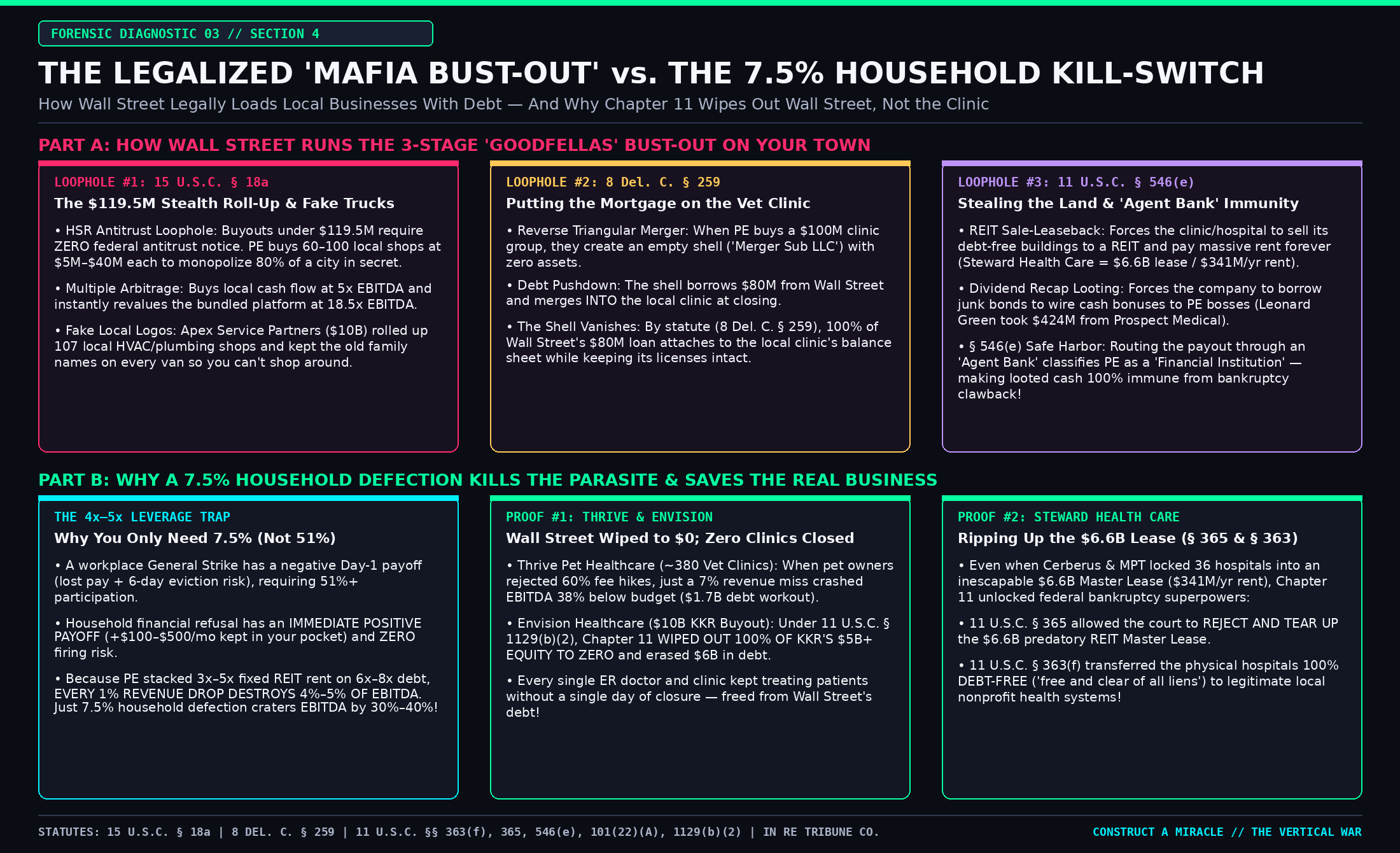
1. The $119.5M “Stealth Roll-Up” & Fake Family Trucks (15 U.S.C. § 18a): Under the federal Hart-Scott-Rodino (HSR) Antitrust Act, corporations only have to notify the FTC and DOJ if a single buyout is worth more than ~$119.5 million. If Wall Street bought a $2 billion HVAC or veterinary monopoly all at once, the feds would block it. So instead, Private Equity buys 60 to 100 local mom-and-pop shops for $2 million to $40 million each. Because every individual purchase sits below the $119.5M reporting floor, they legally monopolize 80%+ of a city’s clinics and trades with zero antitrust filings.
Why do they do it? A Wall Street accounting trick called Multiple Arbitrage: an independent HVAC shop or vet clinic sells for 2.5x to 6.7x EBITDA ($1 of local profit costs ~$5). Once Private Equity duct-tapes 60 shops together into a national platform, Wall Street values that exact same $1 of profit at 17.0x to 18.5x EBITDA ($18.50)—creating billions in instant paper wealth without fixing a single furnace.
And to stop you from shopping around, they leave the old family names on the trucks. Look at Apex Service Partners (backed by Alpine Investors and Apollo at a ~$10 billion valuation): they rolled up 107 local HVAC, plumbing, and electrical companies—60 of them in 2025 alone—and kept every local family logo on the vans. When a homeowner calls three “competing local family shops” for quotes on a $15,000 heat pump, all three trucks are secretly owned by the same Wall Street platform reading from the same inflated price sheet. And when the FTC finally sued PE firm Welsh Carson for rolling up 15+ Texas anesthesia groups and tripling prices, a federal judge dismissed the PE firm from the lawsuit in May 2024 under Section 13(b) simply because Welsh Carson had trimmed its ownership stake from 50.2% down to 23%—ruling that passively collecting monopoly profits from a roll-up you already built isn’t an “ongoing violation.”
2. Putting the Mortgage on the Vet Clinic (8 Del. C. § 259 Reverse Triangular Merger): When you buy a house with an 80% mortgage, you sign the note and owe the bank. When a Private Equity fund buys a $100 million company, they put down $20M and use Section 259 of the Delaware General Corporation Law (8 Del. C. § 259) to execute a Reverse Triangular Merger. The PE firm creates a temporary, empty shell company (“Merger Sub LLC”) with zero employees and zero assets. Merger Sub borrows $80 million from Wall Street lenders, and at the second of closing, merges with and into the local clinic. The shell company vanishes into thin air, and by statute (8 Del. C. § 259(a)), 100% of the shell’s $80 million debt attaches directly to the local clinic’s balance sheet—while keeping all of the clinic’s local licenses and insurance contracts intact (Meso Scale Diagnostics).
3. Stealing the Building & The 11 U.S.C. § 546(e) “Agent Bank” Safe Harbor: Once the local business is saddled with the buyout loan, PE strips its physical land via a Sale-and-Leaseback: forcing the clinic or hospital to sell the buildings it owned debt-free to a Real Estate Investment Trust (REIT), wiring the cash to the PE bosses, and locking all 30+ locations into a single non-severable Triple-Net Master Lease—just as Cerberus did to Steward Health Care, saddling 36 community hospitals with $6.6 billion in lease debt and $341 million/year in rent on their own buildings. Then, in a Dividend Recapitalization, they force the drowning company to borrow hundreds of millions more in junk bonds solely to wire cash bonuses to the PE executives, like Leonard Green & Partners looting $424 million from safety-net hospital chain Prospect Medical Holdings.
Why can’t a bankruptcy trustee claw that looted money back as a Constructive Fraudulent Transfer (11 U.S.C. § 548(a)(1)(B)) when the company goes broke? Because Private Equity lawyers hijacked a 1982 stockbroker clearinghouse loophole (11 U.S.C. § 546(e) + § 101(22)(A), upheld in In re Tribune Co., 2d Cir. 2019): by inserting one sentence into the contract naming a commercial bank as their “Depository Agent” when wiring the payout, the Private Equity firm is legally classified as a “Financial Institution” making a protected “securities settlement payment”—making the looted cash 100% immune from fraudulent transfer clawbacks.
Why a 7.5% Customer Defection Kills the Wall Street Parasite & Saves the Real Business
Here is the Achilles’ heel of that entire legalized crime scene:
Because the Private Equity sponsor maxed out the company’s fixed operating costs (with REIT rent and management fees creating a 3x to 5x Degree of Operating Leverage) on top of 6x to 8x floating-rate LBO debt, the company is trapped inside a Degree of Combined Leverage (DCL) of 4.0x or higher:
Every 1% drop in top-line revenue from households refusing an extraction loop destroys 4% to 5% of the monopoly’s EBITDA.
When just 7.5% to 10% of households balk at a PE roll-up’s price gouging, refuse an upsell, or take their business to an independent shop, EBITDA craters by 30% to 40%, the company breaches its debt covenants, and it is forced into restructuring or Chapter 11 bankruptcy.
And here is the vital truth corporate media never tells you: When an over-leveraged Private Equity roll-up files for Chapter 11 bankruptcy, the local doctors, vets, and tradespeople don’t disappear—Wall Street’s equity and debt get wiped out!
Look at three real-world proofs from the last 36 months:
Thrive Pet Healthcare (~380 Vet Clinics): Loaded with $1.7 billion+ in debt (8x EBITDA) by TSG Consumer Partners. When pet owners pushed back against 60%+ fee hikes in Q3 2024, Thrive’s revenue missed plan by just 7%. Because of the leverage multiplier, that 7% revenue miss caused EBITDA to crash 38% below budget, burned $80M–$90M in cash, and forced an emergency $1.7 billion debt restructuring in March 2025 (with lenders hiring restructuring lawyers again in September 2026).
Envision Healthcare (KKR Lost $5 Billion; Zero Clinics Closed): KKR loaded the nation’s largest physician group with $7.7 billion in debt. When a 7%–8% revenue compression forced Envision into Chapter 11 in May 2023, the actual medical clinics were completely healthy—holding $600 million in cash and $1.6 billion in revenue. Under the Bankruptcy Code’s Absolute Priority Rule (11 U.S.C. § 1129(b)(2)), Chapter 11 wiped out 100% of KKR’s $5+ billion equity stake to zero and erased $5.6B to $6.0B in debt. Every single ER doctor and surgery center kept treating patients without a single day of shutdown—freed from $6 billion of Wall Street debt.
Steward Health Care (Ripping Up the $6.6B REIT Lease): Even when Cerberus and MPT locked 36 community hospitals into a $6.6 billion Master Lease, Chapter 11 unlocked 11 U.S.C. § 365 (allowing the court to tear up burdensome unexpired leases) and 11 U.S.C. § 363(f) (transferring the physical hospitals 100% “free and clear of all liens and liabilities”). The predatory Master Lease was terminated, billions in rent arrears were canceled, and local nonprofit systems (Boston Medical Center and Lifespan) took over the hospitals debt-free.
Bankrupting a Private Equity roll-up doesn’t kill the host. It surgically removes the Wall Street tapeworm so the local business can breathe again.
The Weaponized Survival Playbook: Only Swing at the Hand Currently in Your Pocket
You do not need $10,000 in the bank, you do not need to own a house, and you do not need to take on a second unpaid job as an activist to fight the Vertical War.
The rule of the Weaponized Survival Playbook is simple: Do not try to fight the whole ocean at once. Only swing at the hand that is currently in your pocket. Pick the single strike below that matches where the machine is bleeding you this week:
In Your Head & On the Clock: Refuse the Shame Tax & Act Your Wage
The cheapest compliance weapon the Rust owns is convincing you that your exhaustion is a moral defect—so you work harder for free while blaming yourself for drowning.
The Framing Separation Protocol: The next time your card declines, the rent goes up, or you come home too drained to cook dinner, consciously separate the Structural Cage from your Personal Worth. Say it out loud if you have to: “My prefrontal cortex is experiencing a 14-point bandwidth drop and glutamate toxicity because Alan Greenspan and the corporate landlord cartel engineered my rent and job insecurity to keep me compliant.” Refusing to hate yourself is not “positive thinking”—it revokes the psychological guilt they use to keep you docile.
Withhold Unpaid Surplus on the Clock: Because Taft-Hartley and 6-day eviction courts make walking off the job high-risk, fight where they cannot see or fire you: stop donating free labor to cover deliberately understaffed shifts. When a company cuts headcount to juice EBITDA and expects you to absorb two people’s jobs out of fear, give them the exact minimum required to keep your paycheck and your health insurance while preserving every drop of your nervous system for your own life. Never answer after-hours messages off the clock, never volunteer uncompensated emotional energy, and never burn your physical health to subsidize a private equity payroll cut.
After 8:00 PM & In Your Bank Account: Lock Down the Glutamate Window & Cut Predatory Bleed
You cannot out-willpower a prefrontal cortex that is flooded with toxic glutamate at 9:00 PM. That is why every predatory industry in America waits until after dark to rob you.
The 8:00 PM Ceasefire: Establish a hard cutoff after 8:00 PM. Do not open algorithmic outrage feeds, do not argue with bots about Layer 2 culture wars, and never make a financial click after dark. Starve their behavioral AI of your evening outrage data and let your potassium ion channels close so your brain can flush the metabolic exhaust of the workday.
Kill the Payday & “Roach Motel” Bleed: When you are down to your last $43 on a Wednesday night, the deadliest traps aimed at working-class accounts aren’t “luxury subscriptions”—they are “Earned Wage Access” payday apps (whose “tips” and instant-transfer fees equal a 330% APR), Buy-Now-Pay-Later late-fee spirals, bank overdraft traps, and recurring $9.99–$29.99 “Roach Motel” junk fees that count on you being too exhausted to navigate a 6-screen cancellation maze. Take 30 minutes on a morning off—when your prefrontal cortex is rested—to revoke ACH authorization on payday-advance apps, turn off bank “overdraft protection” fees, and kill every recurring bleed.
The Leverage Math: Keeping just $50 to $75 a month out of the jaws of payday apps, overdraft traps, and Roach Motels puts $600 to $900/year of tax-free survival cash straight back into your groceries and gas tank—and at an 18x roll-up valuation multiple, your single household refusal permanently destroys up to $16,200 of enterprise valuation for the extractive conglomerate.
In Your Mailbox: The Gas Station Appendix Code ($0) vs. The Billionaire “Grassroots” Debt Racket
When we first used AI to research how working-class people can fight medical debt, every single AI report and infographic kept shoving two “Grassroots Nonprofits” in our faces as the ultimate heroes: RIP Medical Debt (now Undue Medical Debt) and Dollar For.
Something about how aggressively those two brands showed up smelled like propaganda. So we stopped and ran a forensic audit on their tax filings, board rooms, and clinical trials—and proved a law you should tattoo on the inside of your eyelids:
“Grassroots” in political and corporate media speak is the equivalent of “free nudes” on the internet. It doesn’t exist.
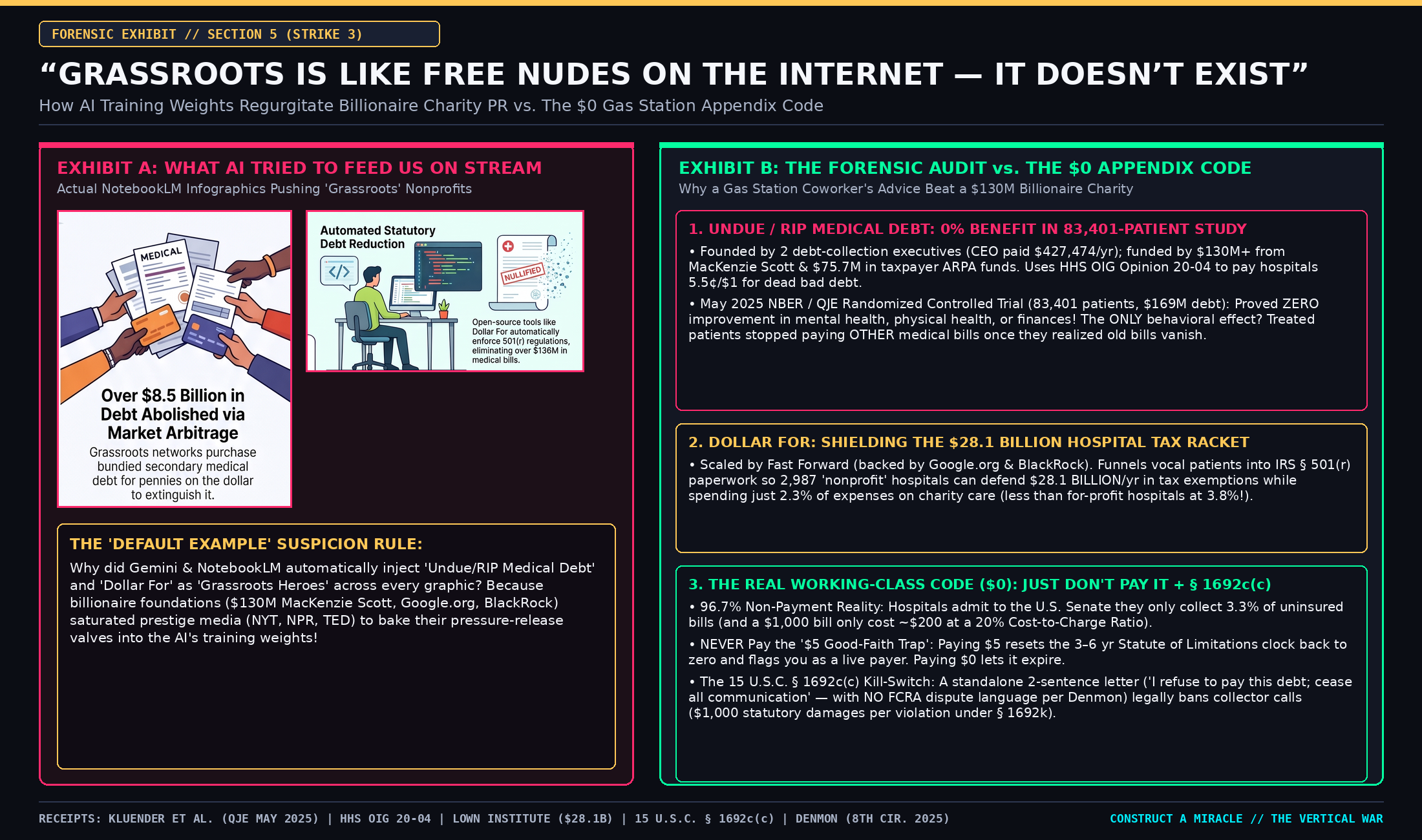
Just like “free nudes” is always a funnel for an OnlyFans agency or a credit-card harvester, any entity that automatically arrives in corporate media and AI training weights as a celebrated “Grassroots Organization” has a billionaire foundation behind the curtain acting as a pressure-release valve:
The Undue Medical Debt Bailout & The May 2025 NBER Study: Undue Medical Debt wasn’t started by patients—it was founded by two career debt-collection executives, Jerry Ashton and Craig Antico (Ashton literally converted his collection agency into the nonprofit, while Antico left in 2022 to launch ForgiveCo, a for-profit PR company that buys debt as a marketing stunt for corporate brands, and current CEO Allison Sesso collects $427,474/year). Backed by $130M+ from billionaire MacKenzie Scott and $75.7M+ in taxpayer ARPA funds from politicians buying campaign ads, Undue secured a special federal carve-out (HHS OIG Advisory Opinion 20-04) allowing it to pay hospitals 5.5 cents on the dollar for dead, written-off accounts—literally pitching Hospital CFOs at healthcare finance conferences that selling uncollectible debt to the charity “will be positive” for hospital revenue.
Even crazier: Between 2018 and 2025, economists from Stanford, Harvard, and the NBER (Kluender, Mahoney, Wong, Yin — published in the Quarterly Journal of Economics, May 2025) partnered with RIP Medical Debt to run a randomized controlled trial across 83,401 patients who had $169 million in debt bought and forgiven. The result? Forgiving the debt produced ZERO statistically significant improvement in mental health, depression, anxiety, physical health, or household finances—because secondary medical debt trades for 0.42 cents on the dollar precisely because the collection industry already knows nobody was ever going to pay it!
And what was the only statistically significant behavioral change the economists found among the 83,401 patients? Once patients got a letter showing an old hospital bill vanished without consequence, they stopped paying their OTHER current medical bills too!
Why BlackRock and Google (Fast Forward) Scaled Dollar For: Why did Silicon Valley’s premier tech accelerator Fast Forward—backed by Google.org and BlackRock—step in to scale Dollar For’s AI charity-care funnel in 2025? Look at what it protects: 58% of all U.S. community hospitals (2,987 hospitals) are 501(c)(3) “nonprofit” corporations that pocket $28.1 BILLION a year in public tax exemptions ($260 billion over ten years), while spending a pathetic 2.3% of their operating expenses on charity care—less than for-profit hospitals (3.8%)! By funneling the loudest, most persistent patients through IRS Section 501(r) paperwork hoops, charity-care funnels act as an external PR compliance buffer: the hospital gets to count the inflated write-off toward its IRS Form 990 Schedule H quota to defend its $28.1 billion tax break, while keeping its 400%-inflated Chargemaster price list untouched.
Here is the real working-class alternative—and it costs $0:
A few years ago, I had to have my appendix removed. Afterward, I kept getting hounded by collection calls demanding $1,000+ for the surgery. I was working at a gas station at the time, stressed out about how I was going to pay it, when one of my coworkers looked at me and taught me a piece of real working-class knowledge: “Dude, medical debt isn’t criminal like other debt. Just don’t pay it.”
I went home, googled it, saw he was 100% right, and never paid a dime ($0). Nothing happened to me.
Why did my gas station coworker’s advice beat a $130 million billionaire charity? Look at the hard legal and accounting facts they pray you never learn:
The 3.3% Collection Reality: In internal disclosures to the U.S. Senate Finance Committee, hospitals admitted that system-wide, they only collect 3.3% of billed chargemaster charges from uninsured patients—meaning 96.7% goes unpaid! And because hospital Cost-to-Charge Ratios (CCR) average ~20%, a $1,000 appendix bill only cost the hospital $200; $800 is pure phantom markup they write off against Medicare and tax exemptions anyway.
Credit Bureau Bans (2022–2026): Unpaid medical bills under $500, paid bills, and bills less than 365 days old are excluded from Equifax, Experian, and TransUnion credit reports nationwide—and 16 states plus D.C. (including CA, CO, CT, DE, IL, ME, MD, MN, NJ, NY, OR, RI, VT, VA, WA) have enacted laws banning medical debt from credit reports altogether.
NEVER Fall for the “$5 Good-Faith Payment” Trap: Collection call-center scripts are designed to beg you for a tiny “$5 or $10 good-faith payment.” Never do it! Making even a $5 partial payment does two lethal things: (1) it flags your file on the secondary debt market as a “live payer,” multiplying collection aggression, and (2) under state contract law, paying $5 resets the 3-to-6-year Statute of Limitations clock back to zero (“re-aging zombie debt”), reviving their right to sue you! Complete refusal to pay ($0) drives the account’s market value to zero and lets the statute of limitations expire.
The 15 U.S.C. § 1692c(c) One-Sentence Kill-Switch: Under the federal Fair Debt Collection Practices Act (FDCPA, 15 U.S.C. § 1692c(c)), if a third-party debt collector calls you, send them a standalone two-sentence written letter by certified mail:
“Pursuant to 15 U.S.C. § 1692c(c), I notify you that I refuse to pay this alleged debt and demand that you cease all further communication with me.” (Crucial August 2025 Legal Warning from the 8th Circuit in Denmon v. Kansas Counselors: Do NOT write “I dispute this debt” in the same letter as your cease-contact demand, because an FCRA credit dispute legally authorizes them to mail back a verification response! Just state your unconditional refusal to pay + demand to cease communication). Once they receive that standalone notice, federal law permanently bans them from calling or writing you again. Under federal appellate precedent (Lupia v. Medicredit), even a single unwanted phone call or collection letter after that is an invasion-of-privacy tort carrying $1,000 in statutory damages plus mandatory attorney’s fees (15 U.S.C. § 1692k)—meaning consumer lawyers will sue the collector for you for free!
Chain-of-Title Collapse in Civil Court: What if a third-party debt buyer actually files a small-claims lawsuit? Their entire business model relies on >90% default judgments because intimidated workers ignore the summons. If you file a simple Answer denying they own the debt and demanding Chain of Title, the debt buyer collapses under the hearsay rule: because they bought 10,000 accounts in bulk for half a penny on the dollar via a generic 1-page “Bill of Sale” referencing an Excel spreadsheet, they have no individual contract and no hospital records custodian to authenticate the bill in court—forcing them to dismiss the case because paying a lawyer costs more than your $1,000 bill!
In Your Apartment & Around Town: Fight Corporate Landlord Junk Fees & Boycott Stealth PE Roll-Ups
Whether you rent an apartment or are trying to keep a 12-year-old car running so you can get to work, Wall Street roll-ups count on you not knowing who is behind the curtain:
Challenge Illegal Landlord Junk Fees & Security-Deposit Theft: Remember that Invitation Homes (85,000+ homes) was caught by the FTC extracting $18M+ in junk fees, falsifying inspection records to steal security deposits, and hiding energy subsidies while maintenance collapsed. Never let a corporate landlord keep your security deposit for “normal wear and tear” or tack on uncontracted mid-lease “smart home / valet trash / convenience” fees without demanding an itemized statutory receipt under your state’s Landlord-Tenant Act (which in most states carries 2x to 3x statutory treble damages against landlords who wrongfully withhold deposits).
Unmask the Stealth Roll-Up Before You Pay a Dime: When your kid needs dental work, your pet gets sick, your car breaks down, or a pipe bursts, remember Apex Service Partners (107 fake-local trades brands) and Thrive Pet Healthcare (~380 vet clinics). Never assume a clinic or repair shop with a hometown name on the sign is still locally owned. Before approving any treatment plan or diagnostic upsell, ask the front desk one direct question: “Is this clinic/shop still independently owned, or is it backed by a Private Equity management group?”
Bypass the Dealership & Corporate Tollbooth: Just as heartland farmers broke John Deere’s $20,000 software-locked tractor monopoly using open-source AgOpenGPS kits and independent mechanics bypassed Stellantis’s (Jeep/Ram/Dodge) corporate AutoAuth firewall in 30 seconds using a $20 physical 12+8-pin CAN bus bypass cable under the dashboard, take your survival dollars exclusively to verified independent mechanics, dentists, vets, and tradespeople. Remember: just a 7% customer defection was enough to crash Thrive Pet Healthcare’s EBITDA by 38%!
At Your Kitchen Table: Steal the Ghost — Use Free Frontier AI as Your $0 Forensic Equalizer
Remember Rule #1 of the Bandwidth Tax: The system beats you by exhausting your prefrontal cortex so you don’t have the energy at 8:30 PM to read a 40-page apartment lease, research state deposit statutes, or fight an insurance denial.
You do not need to buy a $3,000 GPU, you don’t need a $15/month server, and you don’t need to know a single line of code. Silicon Valley built their frontier AI models by strip-mining our collective human labor—so steal the ghost without paying for the metal.
Open any free frontier AI on your phone for two minutes at $0 and use their own compute as your household legal and financial shield:
The Collector Kill-Switch: Snap a photo of a third-party medical collection notice and tell the AI: “Generate a standalone 15 U.S.C. § 1692c(c) refusal-to-pay and cease-communication letter for this collector (excluding any FCRA dispute language per Denmon v. Kansas Counselors) so any future call triggers 15 U.S.C. § 1692k statutory damages.”
The Lease & Security-Deposit Shield: Snap a photo of your landlord’s junk-fee notice or security-deposit deduction letter and tell the AI: “Audit this charge against [Your State]’s Landlord-Tenant statutes on security deposit itemization deadlines, normal wear and tear, and statutory treble damages, and draft a formal demand letter for full return of my deposit.”
The Stealth Roll-Up & Insurance Counter-Punch: Before walking into a vet, dental clinic, or repair shop, ask the AI: “Check corporate registry and acquisition records for [Clinic/Shop Name] in [City/State]—is it independently owned or owned by a Private Equity roll-up like Apex, Wrench Group, Thrive, NVA, or Heartland Dental?”
Pass the Code (How We Cross The Common Knowledge Threshold)
To the 44% of you who asked what you are supposed to do about systemic problems when you are just trying to survive:
Take the guilt off your shoulders and put it where it belongs.
You don’t need Walter’s five-year corporate paradigm shift while your apartment is on fire, you don’t need a billionaire foundation’s fake “grassroots” charity brochure, and you don’t need to feel guilty that you can’t risk a 6-day eviction notice to walk off your job on a Tuesday.
When my coworker at the gas station leaned over the counter and told me that my $1,000+ appendix bill wasn’t criminal and that I could just refuse to pay it, he wasn’t giving a speech at a rally. In sociology, what he handed me is what Wendy Griswold calls a Cultural Object—a simple, reproducible piece of survival knowledge passed directly from one working-class person to another.
When you use that survival code yourself—when you refuse to internalize their shame on the clock, keep your $1,000 in your pocket, shut down a debt collector with one statutory sentence, claw back an illegal landlord deposit deduction, starve a 4x-leveraged Private Equity roll-up by 7.5%, and tell the coworker on the shift next to you how you did it—you are building the exact inward-facing circle the algorithm tried to destroy.
That is how isolated survival turns into Common Knowledge—from the bottom up, at zero cost and zero risk, starting on Day 1.
The Rust designed an economy that requires your panicked, exhausted, monthly compliance just to cover the interest on their 8x-leveraged debt. Make your survival indigestible to them.
Survive with teeth. Because the rent is the war.
What Do We Investigate Next? (Drop Your Questions for Monday’s Poll)
This entire breakdown was forged because 44% of you voted for this question in last week’s poll.
On Monday night during The Scratch (8:00 PM EST), we are setting the board and launching the next Community Poll to decide what we tear open next week. Drop your questions, the wall you’re hitting in your own life, or the extraction loop you want us to audit in the comments below—I’ll pull the top questions straight from the comments to build Monday’s ballot.
This is The Rebel’s Contract.
Your subscription isn’t a donation; it’s a direct investment in my liberation from wage slavery. Every dollar frees up my time to forge more weapons for our shared arsenal.
Fund the fight, and I’ll build the tools to win it.
[🔗 FUND THE FORTRESS (Native V4 Subscription)]
— The primary Sovereign bridge.[🔗 BUY ME A COFFEE (One-Time Kinetic Drop)]
— Immediate capital deployment.[👇 SUBSTACK (Legacy Upgrade)] — For those still operating inside the old walls.
For the Founders ready to bypass the proxy entirely, enter the Sovereign Forge: verticalwar.com/pantheon
(Drafted & Verified in the Sovereign Forge // Construct a Miracle)
substack is not for everybody
Many people miss the insanity of Tictok X Instagram, Facebook and others
That’s why the door is always open for people to come and go from Substack as they please