


You know what feels bad even when it’s good for you?
Stopping.

Like that. Like we just ended right there.
But then you saw the text a little further down and kept reading. It’s easier to keep reading. At least right now.
We talk constantly about how hard it is to start something. I think we’ve misplaced the source of the discomfort. Starting almost always requires that something else stop, and that is feeling we resist.
Some stops are enforced by structure. First grade ends when you pass it. You can be held back, but nobody repeats first grade for the twenty-fourth time. Resistance to second grade is still about stopping first: giving up ways of acting that were fine before.
Some stops are forced by physics. A professional sports career can end in an afternoon. No plan, no warning, a body broken. That is where it hurts most. It is also where we adapt best, because nothing is left to decide. The door locks itself.
And some stops are forced by nothing. No season ends them, no injury settles them, no body does it for you. I had to stop withholding my words to start speaking publicly. I had to stop treating the received map as complete to start questioning things for myself. And to start living sober, I had to stop using substances. Those doors stand open every day. The stop exists only as long as I hold it.
What varies when we start is what gets stopped, who does the stopping, and whether the stop holds by itself or has to be renewed.
A start that looks free either found real slack, a cancelled plan returning a window of unclaimed time, or shipped its stop somewhere else: to later, or to someone who never agreed to hold it.
A stop that holds leaves nothing to look at. It is the drink not taken, the tumor that never formed. The cost gets paid in actions and choices unseen and unrecorded.
That third kind of stopping, the continuous, expensive refusal performed from inside, is what the elephant paid for in advance.
What the elephant paid for
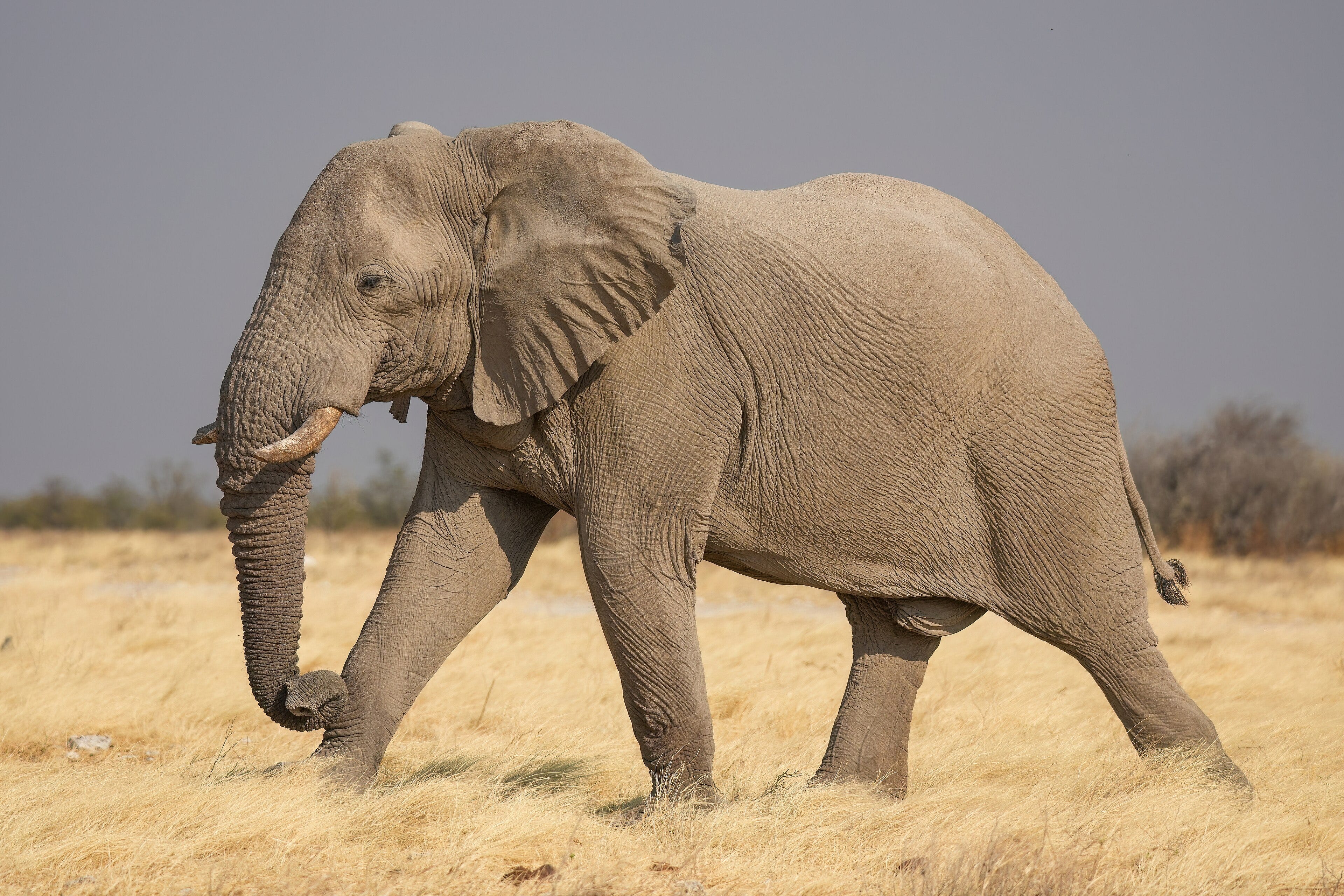
An adult elephant carries roughly 100x the cells of a human being and lives about as long. It grows and maintains itself through cell division, and every division is a chance for the copying to go wrong. On the arithmetic alone the animal should be riddled with tumors long before maturity; a tumor being what a copying error looks like when nothing stops it. It is not, however; cancer mortality in elephants is estimated under 5%. Human estimates run several times higher.
A partial answer can be found in the genome. Humans carry one copy of TP53, the gene that halts a damaged cell and, when damage is severe, orders it to die. Elephants carry around twenty. Their cells pull the trigger faster and at lower provocation. Bowhead whales solved the same problem by a different route. Every lineage that grew large or lived long paid for the privilege in advance with machinery whose only job is stopping growth.
Cancer is the standing risk of being made of many cooperating parts.
The suppression that holds it off is active, continuous, metabolically expensive, and running in every body. Driver mutations appear routinely in ordinary tissue: sun-exposed skin, the aging esophagus, the blood of more than one in ten people over seventy. The clones are common. Disease is the rare outcome when the holding system lags.
Because the supply of potential defectors is the steadier term, most of the variance lives on the other side of the equation: how well the suppression is funded, how fast it detects, whether the signal reaches, and whether correction arrives in time.
Growth at scale is licensed only by constraint at scale, and the license is purchased up front. No lineage has ever run one on credit.
The useful questions
The same structure appears wherever many agents cooperate at large scale. The most useful questions become:
What detects concentration, and what reverses it?
Is that machinery funded, staffed, and running?
How long from detection to correction — and how far can the actor move in that time?
Does it bind the largest actor as tightly as the smallest?
Does the constraint reach an actor bigger than the body imposing it?
Which costs are off the books, and who is holding them?
Which growth operates inside the constraint, and whose margin depends on it failing?
These questions have answers you can check: a budget line, a staffing number, a response time, an enforcement rate.
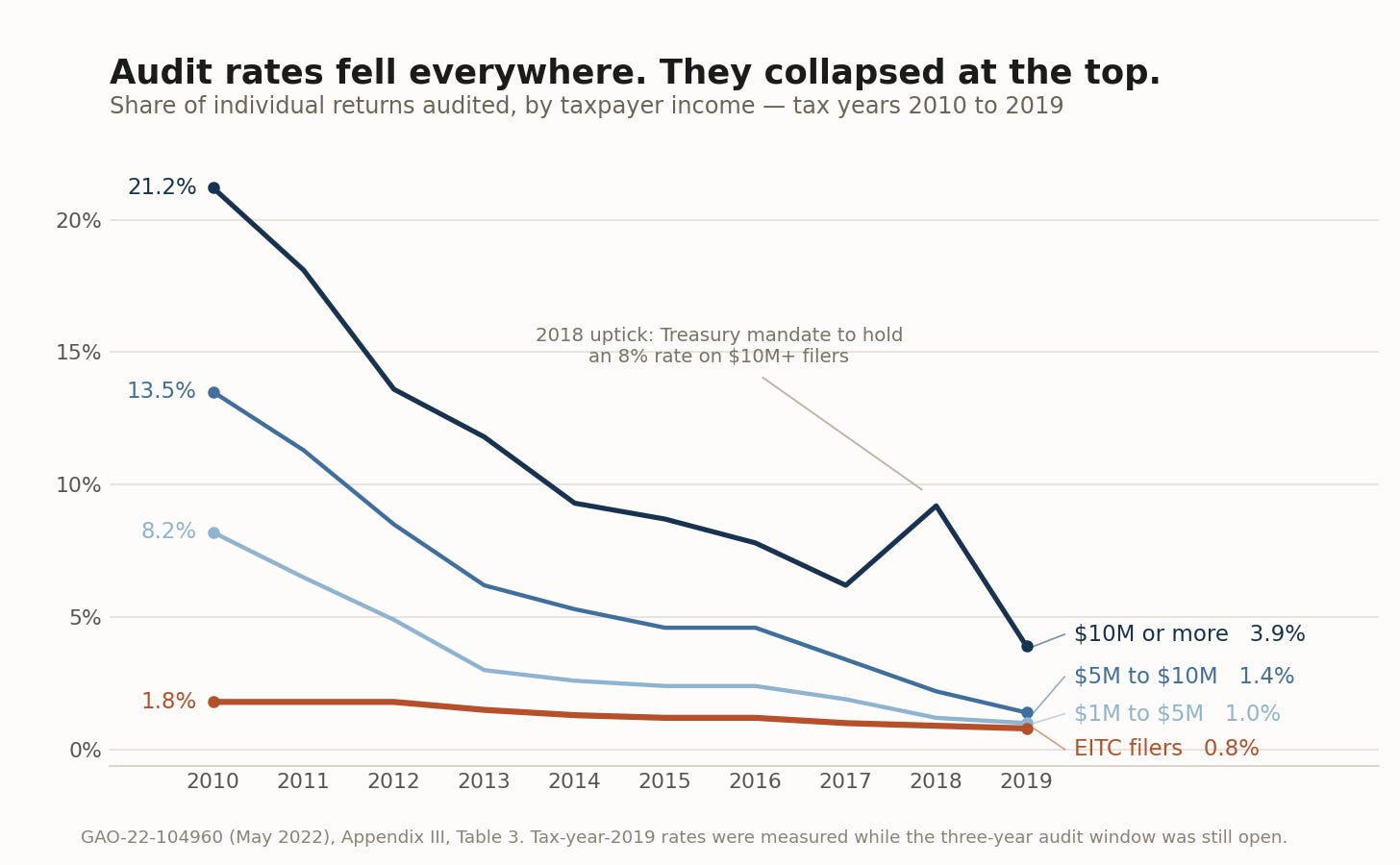
Between 2010 and 2019 the share of filers reporting over 5 million dollars in income who were audited fell, by GAO’s 2022 count, from about 16% to just over 2%.
The decline tracked a decade of appropriations cuts that reduced the agency’s inflation-adjusted budget by about a fifth and its revenue agents by roughly 40%.
Complex high-income returns require trained people and months of time; lower-income audits run largely on automation and survive the same cuts. A uniform reduction therefore produces a detection loss concentrated at the top.
By 2019 an Earned Income Tax Credit claimant was audited at 0.8 percent and a filer reporting one to five million dollars at 1.0 percent.
That second rate had been 8.2 percent in 2010. Over the same decade the EITC rate fell by one percentage point; the rate above ten million dollars fell by seventeen. An additional audit hour on a filer above five million returned around $4,900 in recommended tax against roughly $650 near two hundred thousand. The propensity to shelter income is ordinary and constant. Detection is what moved.
Congress restored enforcement funding in 2022 and has since rescinded most of it; after the February 2026 appropriations deal, the base budget sits roughly 40% below its 2010 level in real terms. Every one of those is a published number with a date on it.
Some machinery gets defunded. Some was never sized for the actor. American data centers drew 176 terawatt-hours in 2023, about 40% of the country’s electricity, and the Energy Department’s national lab projects 7 to 12% by 2028. In Virginia they already take more than one kilowatt-hour in four.
They consumed about 17 billion gallons of water directly that year, and roughly 12x that at the plants making their power. The bodies that can say no to a data center are a county zoning board and a state utility commission. The actor is not county-sized.
Two places the analogy stops
A cell could not have done otherwise. A person could. Mechanism accounts for why the distribution takes the shape it takes, and it settles nothing about who answers for a particular branch taken with the information available at the time. Intention is inadmissible as evidence because it can’t be checked. What can be checked is impact, forks, and what someone did when they stood at one.
The other break runs in our favor, it’s why I’m writing this at all. The elephant had no say in the matter. It got its twenty copies across tens of millions of years, by way of every lineage that failed to pay for its size dying out. We can draft suppression machinery in a session and amend it in the next one.
Aviation is the standing proof: reporting that carries no penalty for the person reporting, findings that bind every aircraft in the fleet instead of only the one that went down, a cycle from detection to correction measured in months. People built that on purpose, within living memory, and it produced the safest complex system we have ever made. The capacity to redesign our own constraint is the one advantage no tissue has ever had, which means the failure to use it has to be accounted for differently than a tumor’s.
Holding costs
The reasons above are empirical. Better numbers could argue them down. This one is not, and could not. The harder diagnosis is also the one that changes what you do next. What we are watching is a cancer, not a parasite.
Parasitism puts the disease outside you and hands responsibility to whoever is charged with removal. Cancer puts it in the tissue you are made of, which means the measure of health was never the absence of dangerous cells. It was the strength of what holds them.
Holding costs. The bad feeling is the cost arriving.
That is a demanding thing to accept and a better place to stand—in a body, in a country, in a life.
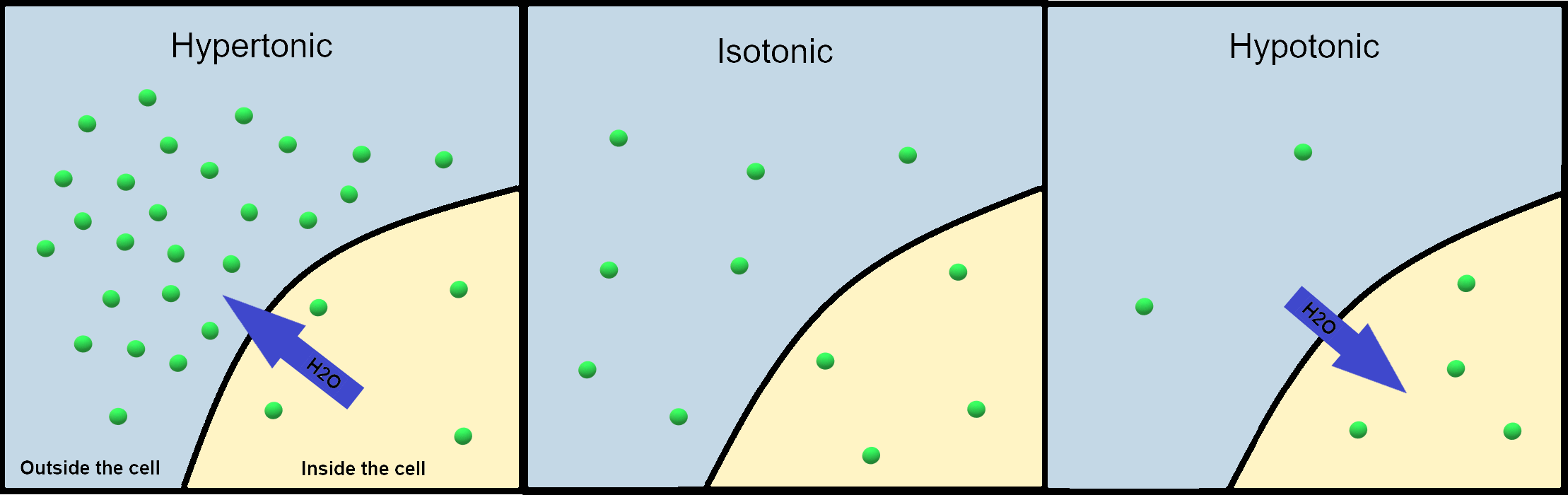
Every living thing is built behind a boundary that holds. A membrane keeps this in and that out; everything alive happens on one side of it. Constraint is the only reason there is anything here to grow at all. Cancer is its refusal.
All one body, every part of it carrying the risk.
Nobody has to be found. Something has to be held.
Fire tongue 🔥
The record
— Abegglen et al., “Potential Mechanisms for Cancer Resistance in Elephants and Comparative Cellular Response to DNA Damage in Humans,” JAMA, October 2015. Elephant cancer mortality estimated at 4.81 percent against human estimates of 11 to 25 percent; roughly twenty copies of TP53; elephant cells trigger cell death faster and at lower provocation.
— Sulak et al., “TP53 copy number expansion is associated with the evolution of increased body size and an enhanced DNA damage response in elephants,” eLife, 2016. The retrogene count and its expansion across tens of millions of years of the elephant lineage.
— Tian et al., Nature, 2013. The naked mole rat’s separate route: high-molecular-mass hyaluronan and early contact inhibition.
— Keane et al., “Insights into the Evolution of Longevity from the Bowhead Whale Genome,” Cell Reports, 2015. Duplicated DNA-repair and cell-cycle genes in a whale that lives past two hundred years.
— Martincorena et al., Science, May 2015. About a quarter of cells in normal sun-exposed skin carry cancer driver mutations.
— Martincorena et al., Science, 2018. Mutant clones under positive selection colonize much of the normal aging esophagus.
— Jaiswal et al., New England Journal of Medicine, December 2014. Clonal hematopoiesis in roughly one in ten people over seventy, rising with age.
— Gilbert and Ebert, Journal of Personality and Social Psychology, 2002. People adapt faster and more fully to outcomes they cannot reverse than to ones they can.
— Government Accountability Office, GAO-22-104960, May 2022. Audit rate for filers with total positive income above $5 million: 16.05 percent for 2010 returns, 2.35 percent for 2019 returns — measured while the three-year audit window on 2019 returns was still open; the Congressional Research Service (IF12521) later put the completed decline near 66 percent. The same report states the asymmetry: high-income audits require staff review, lower-income audits run largely on automation.
— Congressional Budget Office, “Trends in the Internal Revenue Service’s Funding and Enforcement,” July 2020. IRS appropriations down about 20 percent in real terms from 2010, enforcement resources down about 30 percent. IRS Data Book personnel tables, 2010 versus 2019: revenue agents down roughly forty percent.
— The Budget Lab at Yale, “A Weakened IRS Has Substantial Consequences,” 2025. IRS Statistics of Income audit-yield data: an additional audit hour on a filer earning over $5 million returned roughly $4,900 in recommended tax, against about $650 for filers around $200,000. Also: more than 3,600 revenue agents lost by mid-2025, about 31 percent of the auditing staff.
— Americans for Tax Fairness, analysis of IRS Data Book figures, 2023. Tax year 2020 was the first year Earned Income Tax Credit recipients were audited at a higher rate than households with income over $1 million.
— Boning, Hendren, Sprung-Keyser, and Stuart, “A Welfare Analysis of Tax Audits Across the Income Distribution,” NBER Working Paper 31376 (2023), Quarterly Journal of Economics (2025). Revenue per hour of auditing held steady through the 40 percent audit cut of 2010–2014; counting deterrence, audits above the 90th income percentile return more than $12 per dollar spent.
— Center on Budget and Policy Priorities, “Three Strikes Against Filers This Tax Season,” April 9, 2026. Rescissions total $53.8 billion of the original $80 billion in Inflation Reduction Act funding, leaving under $10 billion after funds already obligated; the base IRS budget now 40 percent below its 2010 level in real terms after the fiscal year 2026 cut of $1.1 billion.
— Treasury Inspector General for Tax Administration, “Snapshot: The IRS’s Inflation Reduction Act Spending Through September 30, 2025,” March 2026. After the $11.7 billion rescission in the fiscal year 2026 appropriations act, IRA funding stands at $26 billion, of which $15.7 billion is already spent.
— Tax Law Center at NYU Law, statements on the fiscal year 2026 appropriations agreement, January–February 2026. The deal cuts the base budget to 40 percent below its 2010 level in real terms and rescinds nearly two-thirds of the remaining IRA funds.
— Lawrence Berkeley National Laboratory, “2024 United States Data Center Energy Usage Report,” December 2024. Data center electricity use of 176 terawatt-hours in 2023, about 4.4 percent of U.S. consumption, projected at 325 to 580 TWh — 6.7 to 12 percent — by 2028; direct water consumption about 17.4 billion gallons in 2023, with indirect consumption at generating plants roughly twelve times larger. Virginia share from EPRINC analysis of 2023 state figures: roughly 32 TWh of 128 TWh.
— NASA Aviation Safety Reporting System, established 1976, under FAA Advisory Circular 00-46: confidential reporting with enforcement immunity for the person who reports. FAA Airworthiness Directives, 14 CFR Part 39: findings legally binding on every affected aircraft in the fleet. The cycle from finding to fleet-wide directive commonly runs in months.