


Why language? Because you are where the meaning lives. The word is only the mark that points at it.
See for yourself. Read this:
I love you.
Does that mean anything, sitting on the page? Do I feel it when I write it? You can’t know, only I can, and would it matter if I said I really meant it?
Now the person you feel safest with walks up, close, and says it:
I love you.
Same three words, same definition. One of them was love. Was it the words, or was it the person? Did they hand you the feeling, or did the feeling arise in you?
That gap — between the word and the living thing it points at — is where meaning lives. It is also where meaning gets taken. Someone slips a false name between you and what you feel, and if the true name already slid off the people you told, the false one is the one you reach for.
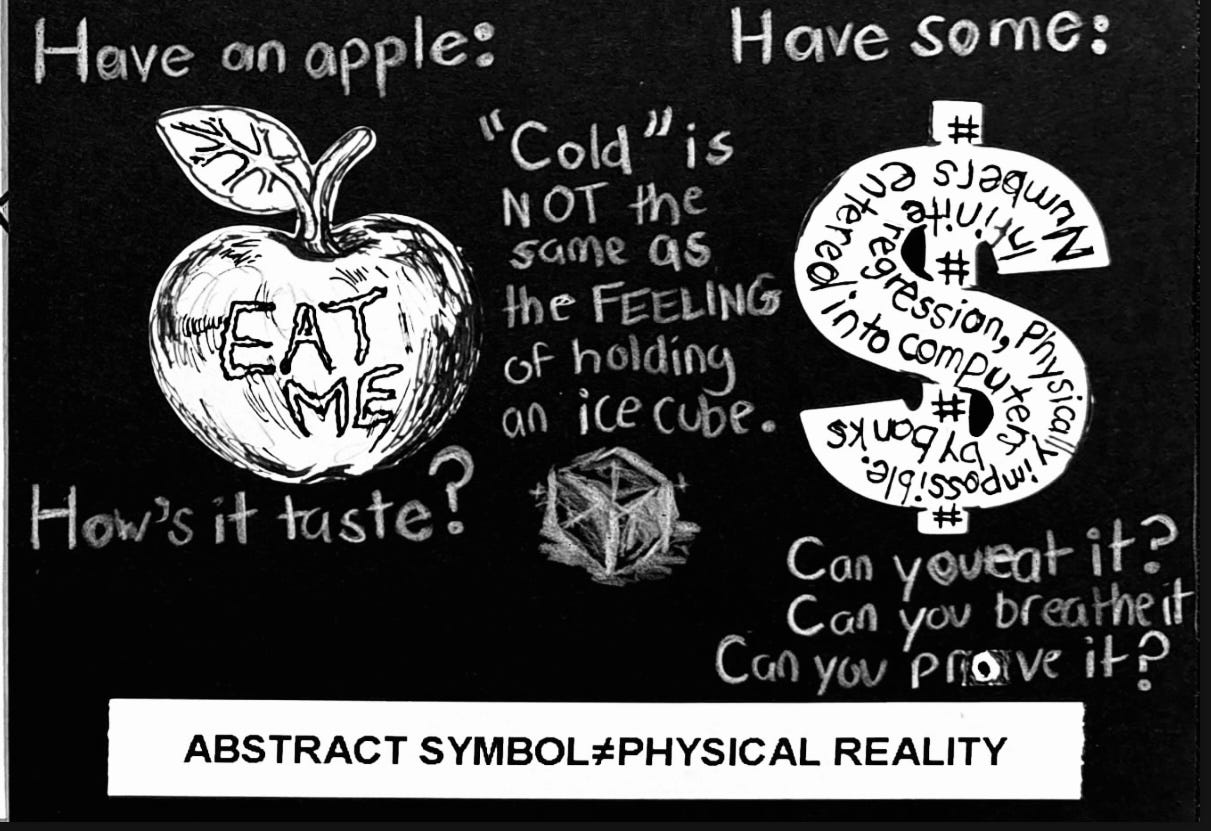
A piece keeps resurfacing that works that gap, it’s been going around online for several years now. It reads English as a “slave code” planted by hidden masters: work is secretly weak, control is con the troll, devil is lived spelled backward. It pulls hard, because it names something you feel— the depletion, the hours that vanish, the way the language of forms and offices holds you off from your own body. The office word slides in front of the living thing: you sign for what you used to just do, and on the ledger you turn into a resource to be managed, filed alongside the chairs and the software.The slave code is loud. The catch is true. The cause it names is where it breaks.
It breaks in exactly the places a real method stops. There are two ways to follow a catch like that. One checks the record. One chops the word into pieces and reads a hidden message in. From the outside they look alike — both point at a word and claim there’s more underneath. The results are opposites. One hands you something a stranger can test and use. One hands you a closed loop, where every sound-alike confirms the story and every counter-case disappears. Four of those stops are worth naming. They’re the brakes. Knowing when to pull them is most of the craft.
Cut at the real seams
The piece reads control as con + troll — a con job for the trolls. Pull the brake, because the cut is wrong.
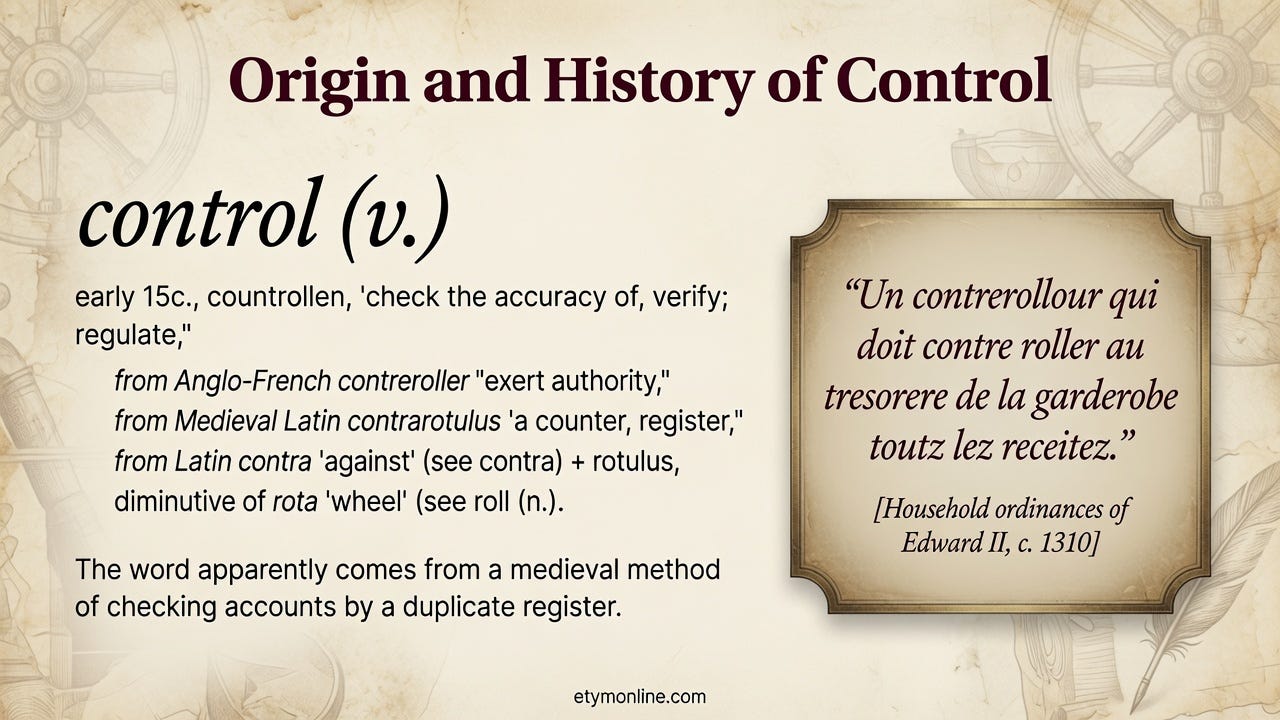
A word has seams. They are the places it was actually built — its parts, the joints the record marks. Control came through Anglo-Norman from the Latin contrarotulus: contra, against, plus rotulus, a roll. A controller kept a second roll, a counter-roll, and checked the first against it. The word’s own root is checking a claim against the record. The real seam runs contra + roll. Con and troll are later words that wandered in from other languages and happen to sit inside the spelling.
Chop a word anywhere and the pieces will look like meaning, because English is full of short words and they turn up everywhere as fragments. Find the seam the record marks before you read anything into the parts. A cut in the wrong place invents a joint the word never had.
A sound-alike is a coincidence
Work week = work weak. Weekend = weakened. The whole piece hangs on this pun. Pull the brake, twice.
First, on sound. Work and weak don’t even rhyme — work holds a different vowel. The keystone pun isn’t a true sound-match. Second, on history. Work, weak, and week came down three separate roads.
Work traces to a root for doing — it’s the erg inside energy.
Weak traces to a root for bending, for yielding.
Week is the near miss — it reaches back to a look-alike bending-root and still lands as its own word, an older Germanic one for a turn of days.
They arrive near each other in modern English by accident, after centuries of each changing on its own.
Sound is where a word starts and where it lands, and the two are rarely the same sound. Its root holds the earlier one, and the sense that rode in on it. Time moves the sound and can swap the sense; the root is what stayed put. The brake: treat a match in today’s sound as a coincidence, and check it against the root.
Name your layer
Devil is “lived” spelled backward — proof, the piece says, of the hidden hand. Grant the coincidence: d-e-v-i-l reversed is l-i-v-e-d, letter for letter. That’s true. Now pull the brake and ask which layer the claim stands on.
A word lives on three layers, and they are not the same age. There is the spoken sound, old and slow to change. There is the root, the deepest layer, the line back through the parent languages. And there is the spelling — the youngest layer, set down by scribes and printers, full of accident, fixed in English only a few centuries ago. Devil came through Latin from a Greek word for slanderer, one who throws accusations across a room. Lived is the past of the homely Germanic live. The two share no root, no road, no kin. They share a string of letters that mirrors. The mirror sits on the youngest, most accidental layer a word has.
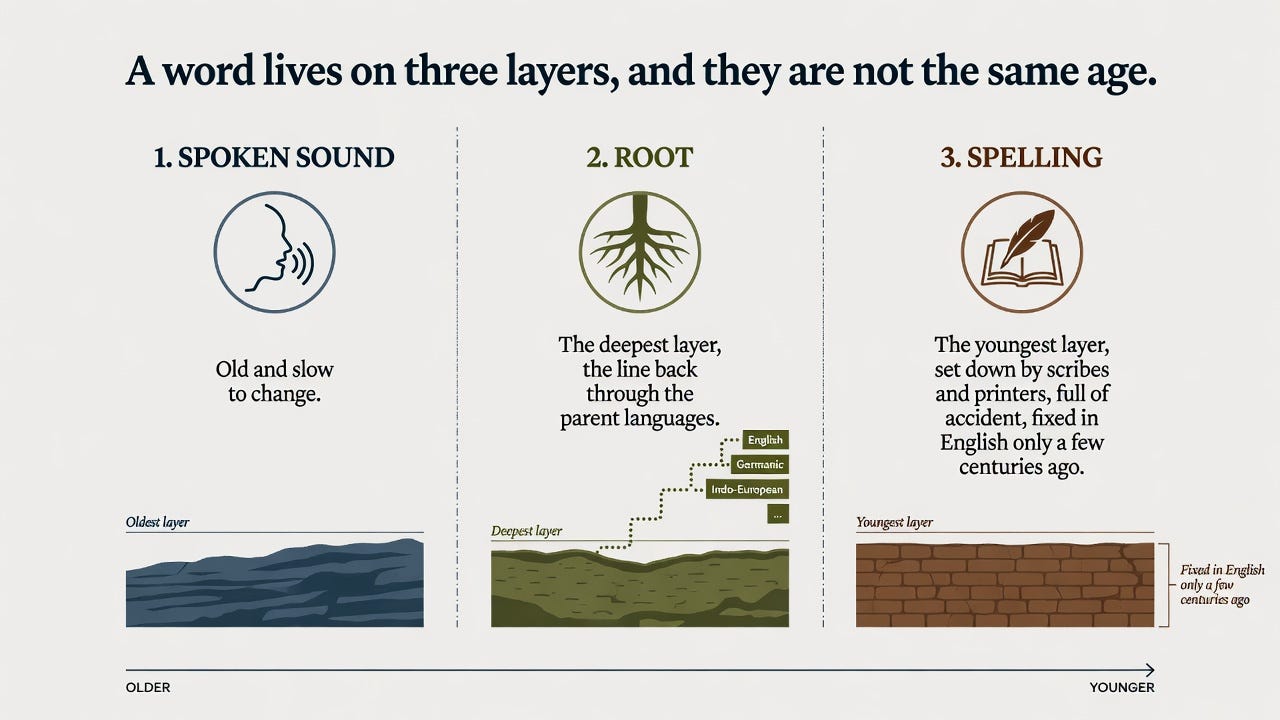
A claim is only as solid as the layer it stands on. Build it on spelling — on a reversal, no less — and you have built on the thinnest ice the language offers. The brake: before the insight, name the layer. If it’s the spelling, hold it loosely or set it down.
Keep what survives
Uniform = uni + form: one form, everyone the same. Run the same check. This time it clears. Uniform is Latin unus, one, plus forma, shape. One form. The cut sits right on the seam. The method is checking and keeping what survives, so this part survives. Keep it.
Then run the second check, on the story. The piece says the word proves you have surrendered your free will and outsourced your conscience. That part is freight the word doesn’t carry. A true structure can haul a false story. Uniform does mean one form; the claim that you have handed over your judgment is bolted on, and it comes off when you test it.
This is the check people forget, because they think the work is debunking. The work is checking. When the record backs the claim, say so. Then weigh the structure and the story on separate scales — the first can hold while the second gives way.
What it looks like with the brakes on
Strip out the hidden masters and a real claim remains, the one the piece keeps reaching for and missing: a word does work on the body, and you can measure it.
English carries two great layers of vocabulary, and they sit at different distances from the flesh. The old Germanic words name what the body meets first — home, bread, hand, sweat, ask, die. The Latin and French words arrived with conquest and the courts, and they hold you back from the body — residence, perspire, interrogate, perish. Sweat is what your body does. Perspire is what a polite stranger says it does. Ask is what your mouth does. Interrogate is what an institution does to you. Home is where you live. Domicile is what’s printed on the form.
None of this is hidden. It sits in the open record, in roots anyone can trace, and it shows up in plain measures — which words children learn first, which ones rate as concrete, which register a sentence is written in. Understand still means stand among: to know a thing by standing in the middle of it. Comprehend comes from a verb for seizing — the same word once used for arresting a man. Both are about knowing. One keeps you in the field. One grabs the thing and pulls it in.
Why the brake is the method
Pattern-recognition runs hot. It will hand you con-troll and hell-low all day, and each one lands with a click of recognition — the same click a true insight gives. That is the trap: the false match and the real one feel identical from the inside. The brake is the willingness to stop at the checkpoint and let the record overrule the click.
The feeling is right. The cause is the question.
The piece is reading something true, and a reader feels it in their body. You do arrive at the weekend worn down. Work does deplete. The language of forms and offices holds you off from yourself, and your hours are being taken by it. The body is reporting straight, and the cause is the whole game, because a cause is only worth having if you can lay a hand on it.
Their cause is hidden masters who set weak inside work before you were born, through a channel you can’t reach, for ends no one can name. What that leaves you: you can see the code. You can feel sharp for seeing it. There is no lever anywhere. The feeling gets a name and then has nowhere to go, so it circles back and runs again — and now you carry not only the depletion but a hand you will never touch behind it, which is a worse place for a body to sit. The frame feeds the thing it claims to expose. It takes your recognition and holds the loop open.
The accurate version hands you the lever. The Norman layer is on the record. The split sits in every dictionary — sweat against perspire, ask against interrogate, home against domicile. The bodily distance of office language can be measured. So the recognition goes somewhere: read the contract, hear the register, reach for the older word, close the loop, take the time back. Same feeling. Opposite exit.
There is a heavier cost of pinning a real feeling to a false cause. It makes the feeling easy to break. Work = weak is a pun any etymologist takes apart in thirty seconds, and when the pun goes the feeling goes with it, and the person walks off deciding the whole thing was nonsense.
True experience is made breakable, because it was tied to an accident. The history holds under any weight you put on it: a conquering class laid its language over the language of the body, on purpose, and you feel the seam every time you sign a form. The recognition finally gets a floor that survives being leaned on.
So the trade is real feeling against durable feeling. The conspiracy’s charge is a sugar high — it spikes while no one looks and crashes the moment someone does. The true charge releases slow and builds, because it survives scrutiny and it ends in your own hands instead of in doom. You give up the spike. You keep everything that lasts.
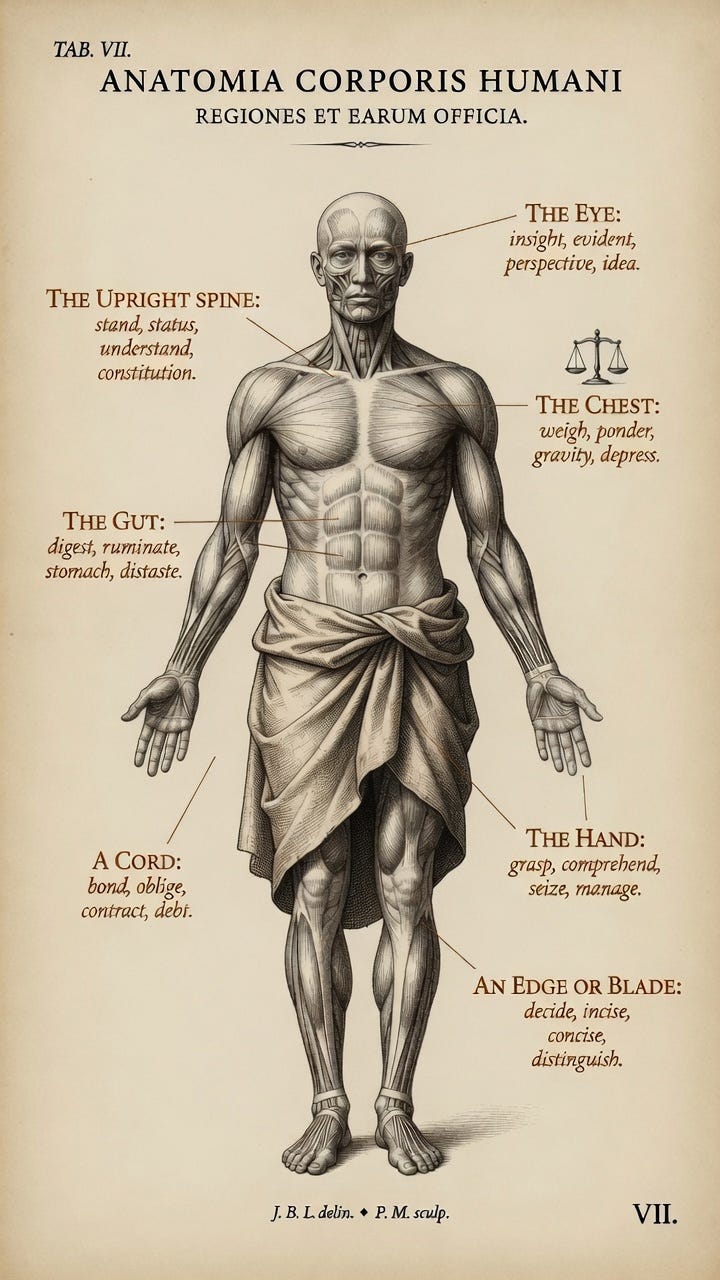
A word does measurable work on the body. That is solid ground. You can stand on it, build on it, carry it into a room and change something. Honor the feeling enough to want it resolved — and resolution needs a cause you can act on. The accuracy is what turns the recognition into something you can hold.
❧
Name the frame
This piece ran one method on one specimen. The method has a name, and it draws a single line.
A word’s power to build your reality runs inversely to how well you can check the word against the world.
Where the body can verify — sweat on skin, bread in hand — language serves. It points at a thing you can reach, and the thing overrules the word. Where the body can’t reach, language stops pointing and starts building. With nothing in the world to check it against, the word becomes the reality, and whoever sets the word sets the reality.
That single line splits the two readings clean. The slave-code cause sits at the far end, at zero verifiability — hidden masters, a channel you can’t reach, ends no one can name. Nothing in the world can overrule it, so the frame builds its own closed world and feeds on the recognition it provokes. The accurate cause sits at the near end, on the open record — roots you can trace, a split in every dictionary, a bodily distance you can measure. The world can overrule it at every step, so it stays a servant and hands you a lever.
Call it the Inverse Constraint Hypothesis. This essay is the hypothesis run on a single word-family. The full argument follows the gradient the whole way down — from a stone you can hold in your hand, to a currency you can only agree to, to the words that point at nothing and build everything.
-Firetongue🔥
For the academically inclined, read the argument in full
The Inverse Constraint Hypothesis · preprint
Zenodo · DOI 10.5281/zenodo.19211810
doi.org/10.5281/zenodo.19211810
Imprint Firetongue — the gemology of language
Register Structural-analytical diagnostic
Specimen English etymology; the “slave code” reading
Method Inverse Constraint Hypothesis, applied
Tiers
T1 established · T2 defensible scholarship · T3 author’s framework · T4 value claim
Filed 01 July 2026
I appreciate this editorial as a reminder to beware of false narratives that may only serve to pull our spirits down rather than enlighten.