



Sit with this before reading further. Notice what happens in the body.
What hurts more — being harmed by someone you love, or being the one who harmed someone you love?
•
Now bring it closer. What hurts more — being hurt by your child, or hurting your child?
•
The body answers before the questions finish.
•
Harming someone we love is the deeper wound — even when the harm itself only varies by direction. It breaks something closer to the root. Given enough time and safety, the body can metabolize pain that arrives from outside. It has architecture for that — when the conditions for processing exist.
When we are the source of the harm, the wound lives in the person we love. Our healing depends on their experience — their pain, their willingness to receive us again. That is already outside our control. And beneath that: the self’s relationship with itself fractures. The one trying to heal and the one who caused the harm are the same person. There is no clean position from which to process it.
Most people who have loved someone recognize this immediately — the specific sickness of realizing one’s own hands delivered hurt to someone one would die to protect.
Hold that.
We’re going to need it.
The Fuel
Here is what most analyses of how we live miss.
The system—the economic machinery, the institutional architecture, the structures that keep billions of people exhausted, isolated, and compliant—runs on love.
It runs on the fact that most people would rather absorb harm than inflict it on someone they care about.
•
People cite many reasons for the choices they make—money, prestige, adventure, duty. The question is what those reasons are in service of when you follow them far enough.
Think about how this works in the most ordinary terms.
A child loves painting. Lives for it. The parent sees the passion clearly — and redirects the child toward a degree, a career, a path the economy rewards. The parent has read the environment correctly: the system punishes intrinsic motivation. Art — real art, the kind that comes from the self rather than the market — almost never pays. The starving artist is an economic policy.
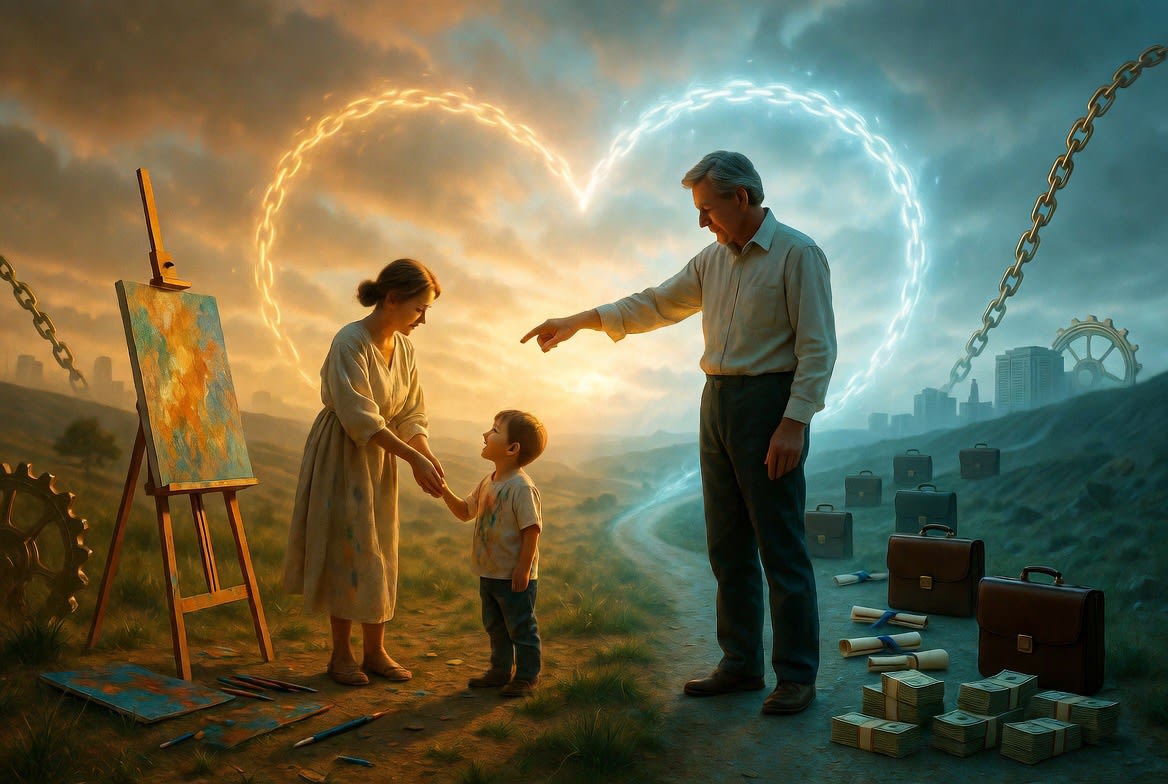
No parent wants their child to starve. So the parent, out of genuine protective love, steers the child toward what the economy will compensate. The child receives the message: what you actually are is economically dangerous to be. The parent’s love and the system’s recruitment are indistinguishable in that moment. The loving choice and the compliant choice look identical.
Or consider the partner carrying grief, fear, or shame who chooses to conceal it. Walking away would be easier self-protection. Staying while withholding costs more — absorbing the weight alone, enduring the distance, all to spare the other pain. That is love paying the price of its own suppression. Two people remain in a shallower version of their bond, more dependent on external mediation — apps, content, consumption — to fill the space where honesty would have been.
Every act of compliance, avoidance, defensiveness — locally motivated by love. Preserving the connection. Even the fear of rejection is love: we only fear losing bonds we need. The system needs that fear to stay unconscious, because the moment we see it clearly, we stop reaching for the marketed substitute and start reaching for the person.
They don’t yet realize confronting it would deepen the bond and make them less available to the marketing that feeds on their need to appear whole.
The system needs us caring—on a short enough timescale, within a narrow enough frame. It needs our love to stay focused on the people right in front of us, so we never step back far enough to see what our compliance is building.
Our love is the fuel.
Our empathy. Our willingness to sacrifice for the people we care about. These are the most beautiful things about us, and they are what the machine harvests.
They Already Know This
This is documented practice, rigorously studied and deliberately applied. Every system that has ever mobilized large numbers of people has done it by capturing love, belonging, and the instinct to protect.
The scientific literature on human motivation confirms the mechanism.
Baumeister and Leary’s foundational 1995 paper argued that the drive to form and maintain strong interpersonal attachments is the primary human motivation—more fundamental than pleasure-seeking or pain-avoidance. People form bonds under almost any condition, resist dissolution even at great personal cost, and show broad emotional, cognitive, and health effects when that drive is thwarted.
Attachment theory (Bowlby, Ainsworth) documents the same priority: the attachment behavioral system overrides other drives under threat. A person will endure torture to protect loved ones. The fulcrum is relationship. The terror is isolation. Everything else is secondary.
Systems of power have always known this.
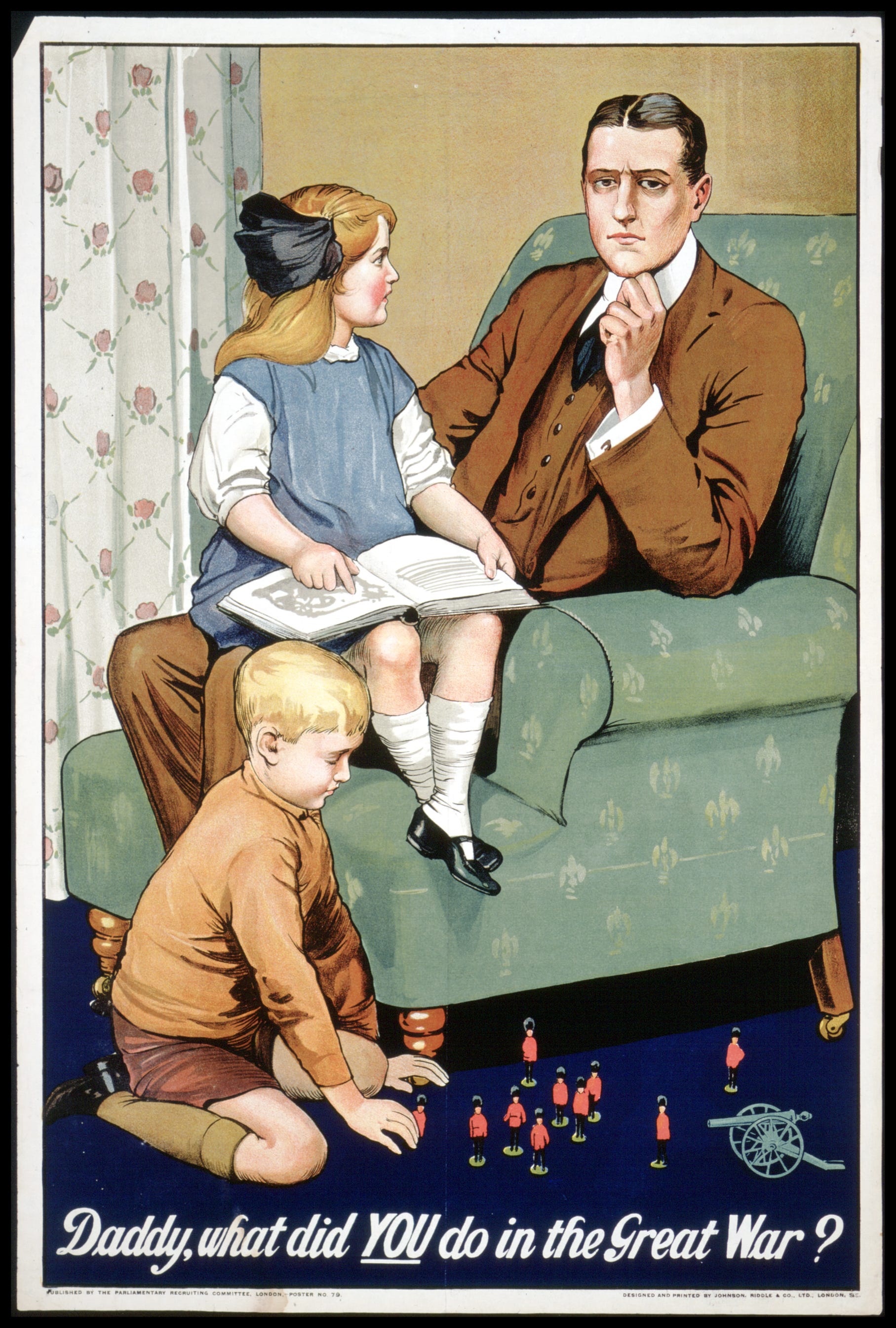
“Daddy, what did YOU do in the Great War?”
The 1915 British Parliamentary Recruiting Committee poster shows a father in his armchair while his daughter asks the question and his son plays with toy soldiers at his feet. It was described at the time as “emotional blackmail.” Thousands of men enlisted after seeing it. It weaponized a father’s love by installing a future shame: what will they think of you if you don’t go?
“Be All You Can Be.”
The U.S. Army relaunched this campaign after its chief of enterprise marketing stated explicitly: "We know youth seek purpose, passion, community and connection, but we also know many don't recognize the Army's ability to deliver on those needs." By June 2025, the Army met its annual recruiting goal of 61,000 soldiers four months early — the earliest since 2014.
It extends far beyond the military.
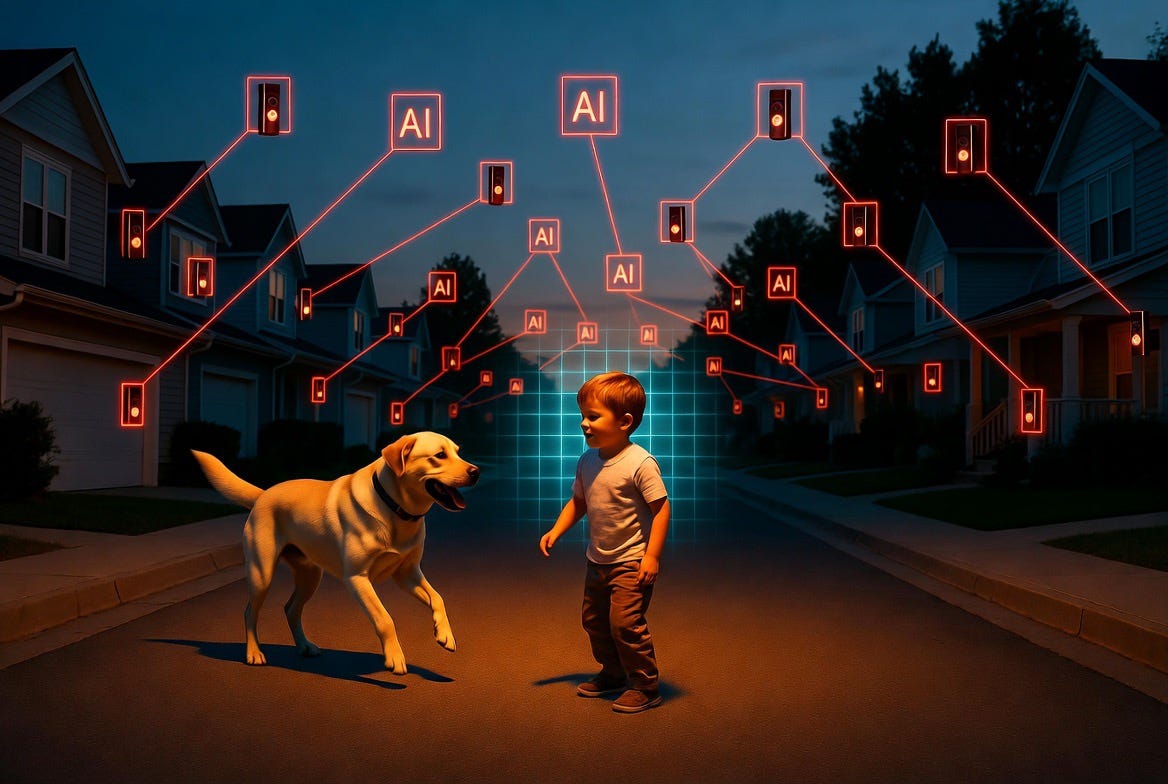
Ring’s 2026 Super Bowl ad, “Search Party,” aired two weeks ago.
A lost yellow lab named Milo. A child’s face lighting up when the dog comes home. Ring’s founder walking a dog down a quiet street: “Be a hero in your neighborhood.”
The product: AI-powered object recognition scanning footage from every participating outdoor Ring camera in the area. Within days, privacy researchers pointed out that the same technology could track anyone. WeRateDogs founder Matt Nelson, with nearly 20 million followers, said directly: the ad “uses our love of dogs to manufacture consent for mass surveillance.” The backlash forced Amazon to terminate Ring’s planned partnership with Flock Safety, a firm that supplies automated license-plate readers to law enforcement. The Search Party feature itself remains active. Love for a pet and a child’s joy—the delivery system for networked AI surveillance.
The advertising industry no longer disguises the mechanism. It calls it emotional targeting. The emotion detection and recognition market reached $37.8 billion in 2024. Companies like Affectiva maintain databases of 8 billion facial frames from 90 countries. In 2026, marketing platforms match advertising creative to the emotional state of the viewer in real time.
Every one of these systems studied the same thing: what do humans care about most? The answer is always the same.
Connection. Belonging. The people they love. The desire to protect them.
They build the capture around it.
Love at Its Most Destructive
Tribalism is captured love deployed at scale.
Listen to the rhetoric. It is always protective. Defending our way of life. Protecting our children's future. Standing up for our community. They're coming for our families. The person participating in tribal violence — verbal, political, physical — experiences themselves as a guardian. At the somatic level, the protective impulse is real. They do feel fear for their people. The love is genuine. The direction it was pointed was engineered. And the people on the receiving end of that engineered direction carry real wounds, delivered by someone who believed they were protecting.
Social identity theory (Tajfel, Turner) documents how people derive self-esteem and security from group belonging. When the group’s identity becomes entangled with loved ones—“for your family,” “for your community,” “for our way of life”—the same prosocial motivation that would bond people horizontally to each other redirects vertically into the agenda. Lilliana Mason’s research on political sectarianism shows that partisan identity in America now functions as a “mega-identity”: a single political affiliation signals religion, race, neighborhood, and values simultaneously.
An attack on the party feels like an attack on everything the person loves.
And the algorithm accelerates it. The feed delivers a constant dose of what binds a person to their tribe—stories of the outgroup threatening what the ingroup holds sacred. Each story activates the same circuit: the people I love are in danger. The response—anger, mobilization, dehumanization of the other—feels like protection. Looks like protection. Registers in the body as protection.
And here is what even most critics of these platforms miss: the idea that conflict increases engagement is itself a misreading.
If someone says something foolish about a topic we have no stake in, we scroll past. The content is provocative — and it produces nothing. If the same platform delivers a post attacking immigrants, or mocking a community we belong to, or threatening something we are teaching our children to value — the body responds instantly. The response looks like conflict from the outside. From the inside, it is protection. Love activating the only circuit available in that moment.
The research confirms this. Brady, Crockett, and Van Bavel’s work on moral contagion identifies the engine of viral content as the drive to protect ingroup values and signal belonging. The algorithm measures the protective firing and calls it “engagement.” What gets called “conflict” is love the system cannot see.
Same fuel at every scale. The person who dehumanized someone from the outgroup cannot look at what they did without confronting that their love — real love, for real people — was the engine. That is the cost that keeps tribalism self-sealing.
The Lock
The same love that fuels compliance prevents us from seeing it.
Because to see clearly—to really look at what the food does, what the screens do, what the schools do, what the tribal rhetoric does, what the jobs do—means seeing that our hands, motivated by love, delivered it. We handed our children the thing that harmed them. We participated, with our whole hearts, in systems designed to consume the people we were trying to protect. We dehumanized other people’s children while telling ourselves we were protecting our own.
That is the specific wound the self can barely hold. The wound of being the one who harmed someone we love—or harmed others in the name of that love.
And every day the looking is deferred, the cost of eventually looking increases. The debt compounds. Because every day, we are still participating. Every day adds another layer to what we will eventually have to face if we ever turn around.
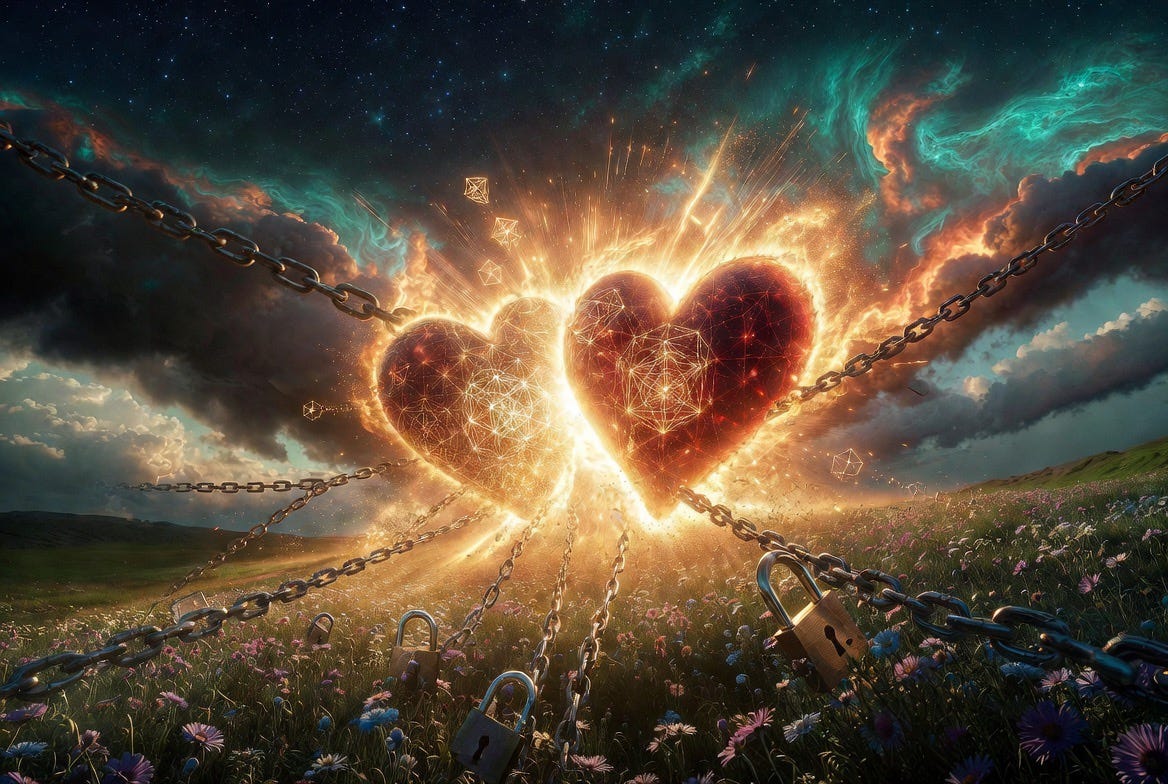
This is why people don’t look. This is the lock.
System justification theory (Jost et al.) provides the peer-reviewed mechanism. People defend harmful status quos because the system provides belonging and predictability; challenging it threatens attachment. Bandura’s moral disengagement research shows that once love is co-opted, people selectively avoid or reframe information that would require acknowledging harm to the connection.
The lock and the fuel are the same substance. Love powers the compliance. Love prevents the recognition. One mechanism, two functions.

