


Before You Read This
This piece contains research, citations, and direct quotes from the people building systems designed to manage your biological responses.
As you read, notice what moves in your body. Witness that you are still here, still sensing. The capture has limits — and you are already past them.
If at any point the weight of this becomes too much, stop. Look around and name three things in the space you’re in. Breathe slowly until you feel ready to return — or don’t return. Go about your day.
Sit with what you already know. The body processes information at its own speed, and that speed is trustworthy.
That last sentence is, in fact, the entire argument.
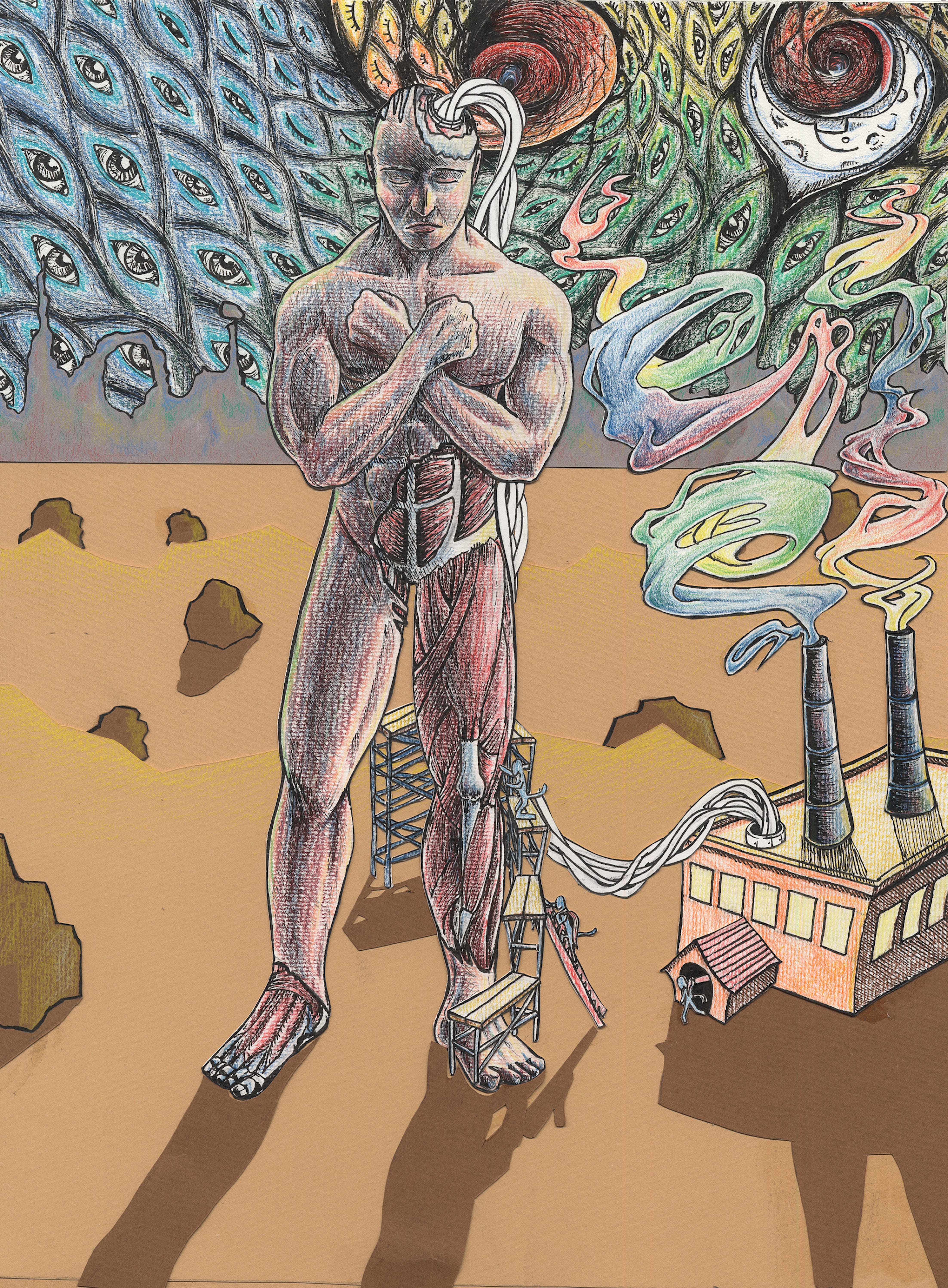
What Is Control?
The word itself reveals the break.
“Control” comes from the medieval Latin contrarotulus — a counter-roll, a duplicate accounting register used to verify a primary one. The original controller was an auditor. His job was to hold a written measure against reality and identify what didn’t conform.
Many species shape their environments. Beavers dam rivers. Termites regulate temperature. Ants farm. But none of them begin with a ledger. They work in direct contact with what is — reading pressure, flow, material, season — and move through the principles of their environment toward survival. Nothing needs to be made to conform. Reality is the source of truth, and they are in conversation with it.
Humans are the only species that systems of control based on predicted futures—threats imagined, not encountered. We can model what hasn’t happened yet and act on the image. No other species lives so deeply inside prediction, and no other species builds infrastructure to manage what it imagines.
But prediction has a cost. The specificity of what we anticipate losing is shaped by what we’ve already lost. Once lack enters the model, it tints everything the model produces. The organism that lives in prediction rather than presence begins to see threat everywhere—and begins building systems to manage threat everywhere.

This is where control at scale originates. It is a fear response that learned to use tools. But it goes further than prediction. Control is the moment when the ledger becomes the authority — when living reality must be made to fit a flattened measure rather than the measure revised to meet what is alive. Other animals use the environment as a collaborator. Control uses other beings as entries. The nervous system becomes controllable at the moment it becomes measurable. You cannot enter into a counter-roll what you have not first reduced to a unit. And once it is a unit, it must balance.
Now here is the question.
Who decided that your nervous system needed managing?
On what evidence? By what demonstrated mastery? With what actual knowledge of your life, your body, your history, your interior?
These are real questions, and they demand real answers. Legitimacy requires merit. Time alone fails to confer it — a person can live eighty years and never once sit with their own discomfort long enough to learn what it was telling them. Institutions can persist for centuries and still be built on a false premise. Courts recognize stare decisis — the weight of precedent — but even precedent requires context and merit to survive scrutiny. Age earns only age. Persistence earns only persistence.
In any tradition that takes transformation seriously, you earn the privilege to guide others by demonstrating mastery in your own life. In recovery, you choose a sponsor by watching how they live — someone whose sobriety, integrity, and presence you can witness and respect. You see the work in their body, their relationships, their daily choices. You choose freely because the evidence is visible. That is the only legitimate basis for authority over another person’s interior.
So:
Have the architects of this management system examined their own biological apparatus? Have they demonstrated proficiency in reading their own nervous systems, working through their own grief, sitting inside their own anger long enough to understand what boundary was being violated? Have they shown evidence of doing the interior work they now propose to replace with a device?
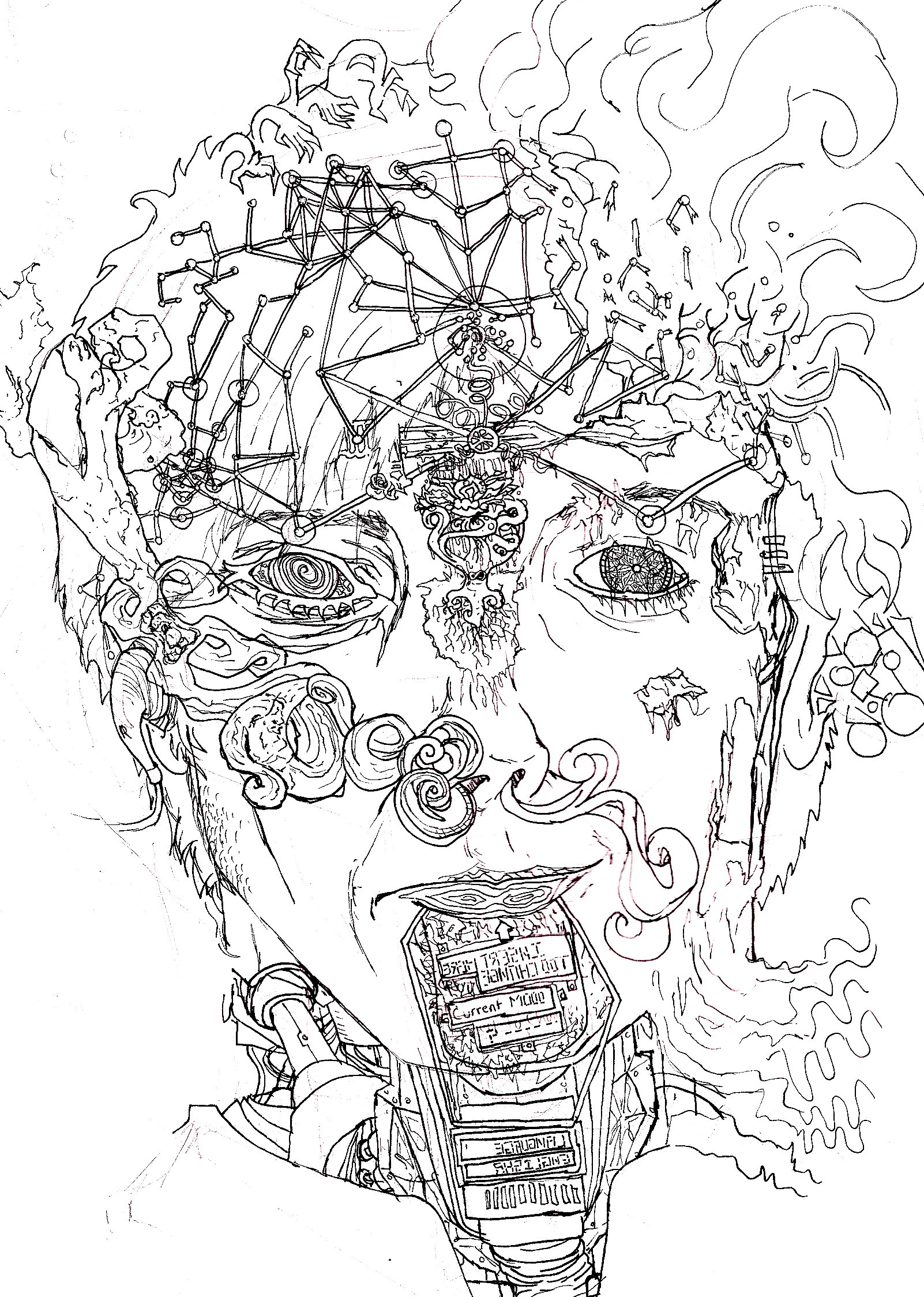
I look at these architects and I see their lives. I see fleets of private jets emitting more carbon dioxide in a single weekend than most people produce in a year, while the passengers inside discuss reducing carbon footprints. I see the insulation from consequence, the layers of staff between them and the texture of a single honest afternoon. I see people who have never been still long enough for their own grief to find them. I would never choose any of them as a guide. I would never look at how they live and say: that — I want that. They are asking me to surrender the governance of my interior to people whose own interiors show every sign of abandonment
They found the work too slow, too uncomfortable, too demanding — and built an external mechanism that mimics the result without requiring the process.
And more precisely: what is their baseline view of the people they are managing?
Here is the premise that arrived at Davos and sat unchallenged in the room. Yuval Harari, regular featured speaker and Agenda Contributor to the World Economic Forum, 2020:
“We humans should get used to the idea that we are no longer mysterious souls — we are now hackable animals.” And: “The whole idea that humans have this soul or spirit, and they have free will, and nobody knows what’s happening inside me — that’s over.” At TED, elaborating from Homo Deus: “We see the creation of a new massive class of useless people. What do we need humans for? Or at least, what do we need so many humans for?”
His answer to that question, when pressed: keep them happy with drugs and computer games.
This is the anthropology the project operates from. These positions were delivered to the architects and funders of the system at its central gathering and received as serious analysis. They sat in the room unchallenged.
The man who built the platform that ran the 2012 emotional manipulation experiment described the people who trusted him with their data, in confirmed messages from 2004, as “dumb fucks.” The contempt was foundational.
This is who decided.

It feels like every time I have been told “you are being too sensitive, you are too much, you are being dramatic”—only to discover, once again, that my body had been right all along.
Like the terror I felt trusting an individual who had lied to me repeatedly, promising this time things would be different, only to be left in fresh abandonment and trauma because I deferred to their words instead of what my nervous system was already screaming. That terror was intelligence. And the override they’re building wants to quiet exactly that voice before it can protect me again.
Here is the question they refuse to ask or honestly answer:
Where is the evidence that the nervous system is the problem?
I have significant evidence for a different diagnosis. Four billion years of biological development produced exquisitely calibrated systems for sensing, responding, integrating, completing. Those systems were functioning exactly as designed. What changed was the environment — engineered for extraction, saturated with artificial urgency, stripped of the friction that generates growth. The nervous system is responding accurately to the conditions it has been given. An accurate response to a manufactured environment is intelligence. It is information.
The override leaves the conditions intact. It silences the signal that the conditions are wrong.
Consider what is actually being proposed. The system designed to govern your neurochemistry operates on statistical weights — pattern-matched approximations trained on text. It can produce a sentence that looks like empathy. It cannot feel what empathy is. It has no body. It has no biological stake in the outcome. It does not recoil when it gets it wrong. You cannot iterate your way to interiority. No amount of training data produces felt knowing.
But this also describes the architects proposing the override. They already govern from abstractions — indices, projections, quarterly metrics — with zero felt contact with the populations they manage. They already do not recoil when they get it wrong. The man who called his users “dumb fucks” did not feel what that contempt would cost them. The philosopher who declared billions “useless” did not sit with a single one of them long enough to learn what they carry. The governor already functions like the machine. The machine just makes it permanent.
The override is the final outsourcing: removing the felt knower from the loop entirely, at the biological level, so the governing mechanism finally matches the governor. A system with no interior, managing organisms that once had one.
This is hubris dressed as innovation.
———
The Three Tracks (And the Question That Falls Outside All of Them)
The entire public conversation on neurotechnology—every WEF article, UNESCO report, OECD recommendation, and Davos panel—runs on three tracks:
1. Medical legitimacy (paralysis, epilepsy, Parkinson’s—genuine cases of suffering where these technologies have improved lives, and which the industry uses to anchor the entire category). For the minority of cases where biology has already broken, targeted tools can be compassionate—provided they remain temporary scaffolds and the patient, rather than the vendor or the state, holds the off-switch.
2. Ethics and governance (privacy, consent, neurorights—how to regulate it, never whether it should exist).
3. Enhancement enthusiasm (“technologies will become part of us,” “preempt undesired emotional reactions to new information”).
That last promise landed in my body like a home invasion. Someone slips into your house while you’re sleeping, administers a quiet cocktail of emotional depressants laced with just enough artificial warmth (think MDMA tint), then gently wakes you hours later to deliver the news: you’re being evicted — the land is being turned into higher-yield rental units. The raw, accurate protest your nervous system would have mounted has already been neutralized. The developers win before the fight even begins.

That is what “preempt undesired emotional reactions” actually means when you translate it out of the conference language and into a living nervous system.
The question every track avoids: why do healthy nervous systems need external override? This question is structurally excluded from the dominant policy conversation.
Emotions are biological intelligence. Panksepp’s affective neuroscience shows they are “ancestral tools for living”—evolutionary memories coded into the genome. Sadness, fear, anger, love are calibration instruments. The neurotechnology literature treats them as friction.

What They Call Friction
Sleep:
the process that consolidates memory, repairs tissue, prunes connections, processes emotion, and restores learning capacity. The optimization industry calls it inefficient and asks how to compress it.
I’m a parent working full time. When I get tired and have trouble focusing at work, it’s because I’m physically exhausted and depleted. The system pays too little and provides too little support to care for me and my kids, so my body takes the hit. Their solution, instead of better family leave and real support, is to turn off the signal of a body needing what it physically needs.
How does keeping someone alert when they need sleep actually impact health?
We’ve already seen the pattern with prolonged methamphetamine use: dopamine collapse, permanent cardiovascular damage, neurotoxicity, paranoia, and a nervous system that eventually loses its natural rhythm entirely. The override doesn’t restore capacity. It just delays the crash while the underlying depletion deepens. The body doesn’t forget what it was denied.
Grief:
the natural reorganization around irreplaceable loss. Three to five days of bereavement leave in most U.S. companies—then back to productivity. The Brain Capital Index registers your grief as an economic loss.
Anger:
the immune system of the self, activated when boundaries are violated. Behavioral management literature calls it dysregulation — something to be preempted by device.
Love:
the biological event that makes two nervous systems more capable together than either is alone. The optimization economy monetizes the seeking phase, disrupts the bonding phase, and never delivers completion.
Friction is where energy comes from. A gradient across a real boundary drives flow. No boundary, no gradient. No gradient, no energy. This is physics. Sleep, grief, anger, and love are the boundaries that generate the energy the organism needs to become more distinctly itself and more deeply connected.
The entire neurotechnology project—from algorithmic nudging to autonomous neural modulation—is a friction-elimination strategy. It removes the very experiences that allow a living system to grow.
———
The Override Is Already Operating
The override already operates without brain implants. It has been running since at least 2012.
In January 2012 Facebook manipulated the News Feeds of 689,003 users without their knowledge and proved emotional states can be transferred at scale through curated content, without awareness. The outrage focused entirely on consent. The capability itself was accepted.
The Damage Is Already Here
The Flynn Effect has reversed. Gen Z is the first generation in recorded history to score lower than the previous generation on core cognitive measures. Average time on any single screen before switching: 47 seconds. Children with more than two hours of daily screen time show a 2.8-fold increased risk of cognitive delays. Longitudinal neuroimaging confirms the mechanism: the infrastructure accelerates the brain’s reward circuits while starving the circuits responsible for executive function, social cognition, and emotional regulation. In January 2026, a neuroscientist testified before the U.S. Senate that unregulated educational technology has contributed to this generational decline. (Full citations in Endnotes.)
The loop is bidirectional and self-reinforcing. The damage drives more screen use, which prunes more native capacity. Since the early 2010s, coinciding with smartphone saturation, adolescent anxiety, depression, self-harm, and suicidal ideation have risen sharply across every Western nation tracking the data.
The nervous system adapts to the environment it is given.
Silence registers as threat.
Solitude registers as abandonment.
Unregulated emotion registers as malfunction.
When devices are removed, the damage remains. Capacities never exercised during sensitive periods require far greater effort to rebuild later.
This is the casted-limb outcome at population scale—achieved without

The Sequence
1. Build platforms that manipulate emotion at scale (2012 onward).
2. Fragment attention and replace integrative processing with shallow scanning.
3. Measure the resulting damage as an economic cost (Brain Capital Index, Davos January 2026).
4. Propose deeper neural overrides as the solution.
5. Frame access to those overrides as an equity issue.
6. Monetize the entire cycle.
Steve Carnevale, venture capitalist and moderator of the Davos Alzheimer’s Collaborative Brain House session, captured the spirit:
“When we can quantify something that previously wasn’t quantifiable, and when we can quantify it, we can turn it into a growth story. That’s when people are really going to follow us.”
Your brain is now an asset class.
If the sequence sounds abstract, let’s look at the single firm that has already completed the loop. McKinsey helped architect the Brain Capital Index at Davos while projecting $16 trillion in brain-disorder costs by 2030. This is the same McKinsey that advised Purdue Pharma, Endo, Johnson & Johnson, and Mallinckrodt on strategies to increase opioid sales during the crisis that killed over half a million Americans — and in December 2024, became the first management consulting firm in history held criminally liable for advising a client to break the law, paying $650 million in a single federal settlement alone, with total opioid-related payouts exceeding $1.8 billion. A senior partner pled guilty to felony obstruction for destroying evidence. The U.S. Attorney’s summary: “It was a strategy, it was executed and it worked.” The same McKinsey that consulted the tobacco industry continuously from 1956 to 2021—pitching a Marlboro smartphone loyalty app concept as recently as 2016, even after decades of known lethality. The same McKinsey that proposed cuts to food and medical care for detained migrants at ICE facilities. The entity that helped design the harm is now quantifying the harm and selling the technological fix. That is the sequence in a single name.

And I’m no genius—my prediction of the future is functioning exactly as it evolved to. I’m simply reading the consistent pattern.
I anticipate these individuals and corporations will continue to operate exactly as they always have: criminal behavior as standard procedure, human cost calculated as acceptable collateral for profit, fines and settlements treated as routine operating expenses.
McKinsey and the rest are almost certainly counting on the coming neural overrides to preempt the one thing still standing in their way — the raw rage and clear sense of injustice that rises in a healthy nervous system when the pattern repeats. So that instead of feeling it, organizing around it, or acting on it, I just smile, sedate the signal, and keep producing while they get away with murder.
Imagine the profit multiplier when there is literally zero accountability left — because the bodies that would once have demanded it have already been pacified in advance.
When the same infrastructure that prunes interior capacity also profits from managing the resulting atrophy, the dead lattice becomes self-perpetuating.
The Question Nobody Is Asking
What happens when the scaffolding fails and an entire generation has atrophied beyond easy repair? The question goes unmodeled. It remains unnamed as a risk category. The literature assumes the living pattern remains intact underneath the override—as though a limb kept in a cast for ten years would function perfectly when the cast is removed.
The limb atrophies.
The Real Questions
Why are you trying to override the intelligence of my body? My felt responses are accurate readings of conditions. Suppressing them leaves the conditions intact; it only removes my ability to respond.
Why do you treat the accurate response to the environment you manufactured as a malfunction—then offer deeper management of that malfunction as the cure?
Why are the architects exempt from the tools they build for everyone else?
What happens when the technology fails and the interior has been functionally supplanted?
The Strongest Case For — And Why It Still Fails
The defenders of this project are serious people, and their strongest arguments deserve direct engagement.
The equity argument: Millions of people lack access to therapy, psychiatric care, or any mental health support whatsoever. Neurotechnology could democratize relief where human infrastructure has failed. This is the argument’s most emotionally honest form. But it answers a question about distribution with a question about architecture. The problem is access to care. The proposed solution is a device that bypasses the need for care entirely. When the same firms that defunded community mental health infrastructure now offer a technological substitute, the equity framing becomes the marketing — the compassionate face on a product that forecloses the very capacity it claims to support.
The mental health crisis argument: Adolescent anxiety, depression, and suicidality are at historic levels. Something must be done. Agreed. But “something must be done” is the oldest lever in the policy playbook for bypassing the question of whether the proposed something will make it worse. The crisis is real. This paper documents its neurological basis. The question remains: when the environment that generated the crisis is left intact, does an override that silences the organism’s accurate distress signal constitute treatment — or does it constitute a second injury?
The human-AI symbiosis argument: Humans have always co-evolved with their tools. Language, writing, the printing press — each changed cognition. Neural integration is the next step. This is the most intellectually seductive form of the argument, and the most dishonest. Language, writing, and the press each amplified a capacity the organism already possessed. They extended reach. Neural override replaces the interior process itself. The analogy would hold if the printing press had eliminated the ability to think without a book. The direction matters. Extension is partnership. Replacement is dependency. And dependency at the neurological level, during developmental windows, is functionally irreversible.
Every version of the strongest case fails on the same question: who holds the off-switch, and what happens to the organism that has been shaped to need it?

The Declaration
I am entitled to my own experiences.
I am entitled to the intelligence of my body—the systems that evolved over millions of years to sense, respond, integrate, and complete. These systems are more sophisticated than anything a committee of people who have each lived less than a century could design or replace.
I am entitled to my emotions—including the inconvenient ones. My pain is a signal. My anger is a boundary. My sadness is a reorganization. These are calibration instruments, and they are mine.
I am entitled to develop and define myself through the friction, the difficulty, the slow accumulation of embodied wisdom that comes from running my nervous system through challenge and letting it complete.
I am entitled to express myself in my own language, at my own pace, without my expression curated by algorithm or my naming replaced by metric.
These are original capacities, older than every institution now proposing to manage them. They require no framework to be granted.
The only question worth asking is who took them, and why, and what they built with the taking.
My body knows before my mind names. My emotions calibrate before my thoughts evaluate. My nervous system was reading reality accurately before anyone taught me to doubt it.
The override requires my participation.
I’m done.

A World That Honors Life
We choose a different world.
A world where sleep is sacred — the deep, uninterrupted time the body needs to finish its stories and restore itself.
Where grief is held in warm community, given all the time it needs, until the heart has reorganized around the absence and can open again.
Where anger is met with presence, because a boundary that is honored keeps the self intact.
Where love is the quiet, daily co-regulation of living nervous systems choosing each other, growing stronger together.
In this world children are held by parents and elders whose own interiors are whole. When storms come, arms come with them. The young grow their own seed crystals in the soil of real faces, real voices, real touch — messy, slow, alive.
Elders are honored as the living transmission line, their completed cycles the pattern the next generation can feel and internalize.
This is the world that nurtures what we truly are: generative, self-organizing, capable of regenerating from fragments because the pattern lives inside.
The builders of the override cannot value this world. They cannot quantify the felt sense of completion. They cannot monetize the quiet strength that arises when a human being is allowed to become fully, interiorly alive.
That is precisely what they seek to steal — and why we must refuse to surrender it.
———
Anthony
Firetongue
February 2026
If something in your body just said yes — if your nervous system recognized its own intelligence in these words — then you already know why this matters.
The override requires our participation.
I’m done participating.
If you are too, consider showing your solidarity by subscribing for more articles like this.
Thank you for reading with your whole self.
Endnotes & Sources
All links verified as of February 2026. Sources are listed in the order they appear in the text.
Etymology of “control”
Oxford English Dictionary, “control, n.” — from Anglo-Norman contreroller, ultimately from medieval Latin contrarotulus (“counter-roll”).
Yuval Noah Harari quotations
“Hackable animals” and “that’s over”: Davos 2020, WEF panel “How to Survive the 21st Century,” January 24, 2020. Video archived on WEF YouTube channel. “Useless people”: TED Dialogue, “Why fascism is so tempting — and how your data could power it,” 2018; see also Harari, Homo Deus: A Brief History of Tomorrow (Harper, 2017), Chapter 9. Harari’s WEF profile lists him as Professor of History at Hebrew University of Jerusalem and “Agenda Contributor.” He has spoken at multiple WEF annual meetings (2018, 2020, 2024, 2026).
Facebook emotional contagion experiment
Kramer, A. D. I., Guillory, J. E., & Hancock, J. T. (2014). “Experimental evidence of massive-scale emotional contagion through social networks.” Proceedings of the National Academy of Sciences, 111(24), 8788–8790. doi:10.1073/pnas.1320040111. The experiment ran January 11–18, 2012.
Mark Zuckerberg instant messages
Confirmed in Mezrich, B. The Accidental Billionaires (Doubleday, 2009) and corroborated during the 2010 New Yorker profile by Jose Antonio Vargas. Messages date to Facebook’s earliest period at Harvard, circa 2004.
Jaak Panksepp — affective neuroscience
Panksepp, J. (1998). Affective Neuroscience: The Foundations of Human and Animal Emotions (Oxford University Press). “Ancestral tools for living”: Panksepp, J. & Biven, L. (2012). The Archaeology of Mind: Neuroevolutionary Origins of Human Emotions (W. W. Norton).
Flynn Effect reversal
Bratsberg, B. & Rogeberg, O. (2018). “Flynn effect and its reversal are both environmentally caused.” Proceedings of the National Academy of Sciences, 115(26), 6674–6678. doi:10.1073/pnas.1718793115. See also Dworak, E. M. et al. (2023). “Looking for Flynn effects in a recent online U.S. sample.” Intelligence, 98, 101734.
Jared Cooney Horvath — U.S. Senate testimony
Testimony before the U.S. Senate Commerce Committee, January 15, 2026. Horvath is a neuroscientist and educational researcher at the University of Melbourne.
Attention span — 47 seconds
Mark, G., Gudith, D., & Klocke, U. (2008). “The Cost of Interrupted Work.” CHI ’08 Proceedings. Updated data in Mark, G. (2023). Attention Span: A Groundbreaking Way to Restore Balance, Happiness and Productivity (Hanover Square Press), reporting the decline from 2.5 minutes (2004) to 47 seconds (2020s).
Screen time and cognitive delays (2.8-fold risk)
Takahashi, I. et al. (2023). “Screen Time at Age 1 Year and Communication and Problem-Solving Developmental Delay at 2 and 4 Years.” JAMA Pediatrics, 177(10), 1039–1046. doi:10.1001/jamapediatrics.2023.3057.
Cognitive fragmentation — University of Vienna 2024
Pietschnig, J. & Voracek, M. (2024). “The decline in the positive manifold of cognitive abilities.” University of Vienna. Study documents the breakdown of coherence between cognitive abilities in recent cohorts.
GUSTO birth cohort — Lancet eBioMedicine, January 2026
Growing Up in Singapore Towards healthy Outcomes (GUSTO) cohort study. Published in Lancet eBioMedicine, January 2026. Linked higher infant screen time to accelerated topological maturation of visual and cognitive-control networks, with prolonged decision latency and elevated anxiety by adolescence.
Screen time, sleep, and depression — JAMA Pediatrics, 2025
JAMA Pediatrics, 2025. Found each additional hour of daily screen time in late childhood predicted increased depressive symptoms by early adolescence, mediated by shorter sleep duration and diminished coherence of the cingulum bundle.
Brain Capital Index — Davos 2026
World Economic Forum & McKinsey Health Institute (2026). “The Human Advantage: Stronger Brains in the Age of AI.” Launched at the Brain House, Davos, January 19–22, 2026. Global Brain Capital Index developed by Rym Ayadi (EMEA) and Harris Eyre (Rice University / McKinsey Health Institute). The Global Brain Economy Initiative (GBEI) launched by Rice University, January 21, 2026.
Steve Carnevale — Davos Brain House quote
Carnevale, S. Quoted in “Unlocking ‘Brain Capital’ In The Brain Economy — Davos Initiative Aims To Make Brain Health A Development Indicator.” Health Policy Watch, February 2026. Carnevale is a venture capitalist and served as moderator of the Davos Alzheimer’s Collaborative Brain House session, January 2026.
McKinsey & opioid crisis
U.S. Department of Justice, December 13, 2024. McKinsey & Company agreed to $650 million federal settlement (civil and criminal) for its role in helping Purdue Pharma “turbocharge” OxyContin sales. First management consulting firm held criminally liable for advising a client to break the law. Senior partner Martin Elling pled guilty to felony obstruction of justice. Prior state settlements totaled approximately $1.15 billion. See NPR coverage, December 13, 2024; PBS NewsHour, same date; McKinsey Deferred Prosecution Agreement (DOJ).
McKinsey & tobacco industry
Bogdanich, W. & Forsythe, M. (2022). When McKinsey Comes to Town: The Hidden Influence of the World’s Most Powerful Consulting Firm (Doubleday). McKinsey’s relationship with Philip Morris began in 1956. The firm consulted tobacco companies through 2021, including Juul (2017–2019). The Marlboro smartphone loyalty app concept was pitched to Altria circa 2016. See also NPR Fresh Air interview, October 3, 2022; Générations Sans Tabac analysis (French public health archive).
McKinsey & ICE detention facilities
Bogdanich, W. & Forsythe, M. “McKinsey Proposed Paying Pharmacy Companies Rebates for OxyContin Overdoses.” New York Times, November 27, 2020. ICE consulting details: ProPublica & New York Times joint investigation, December 2019, documenting McKinsey recommendations to reduce food and medical spending at immigrant detention centers.
Adolescent mental health trends
CDC Youth Risk Behavior Survey (YRBS), 2011–2023, documenting sustained rises in adolescent anxiety, depression, self-harm, and suicidal ideation coinciding with smartphone saturation. See also Haidt, J. (2024). The Anxious Generation (Penguin Press); Twenge, J. M. (2024). “Trends in U.S. Adolescents’ Mental Health.” Nature Reviews Psychology.
All of this is so irritating. I refuse to be overridden
From our hearts to yours thank you and we love you!