


Full disclosure: this is personal.
I use AI as an exoskeleton, and I’m watching slop factories ruin its name in real time.

This is the “ick” factor that seems to find itself always paired with AI writing. People can’t always articulate it, but they can feel it: something about this new wave of “Write With AI” stuff smells… off. Everything starts to sound like it was written by the same eerily polite corporate ghost, because in a way, it is.
And here’s the part that makes this personal: I actually use this tool.
So when he floods the zone with beige, templated sludge, people don’t just lose respect for him—they lose respect for the entire category of work I’m doing.
I use AI every day to help me hold 7,000-word investigations in my head, to interrogate my own arguments, to drag more truth onto the page. And guys like this are out here turning it into a punchline. When people say “that sounds like ChatGPT,” they’re thinking of him, not me.
If you trace that smell to the source, you don’t find a superintelligent machine plotting the death of the author.
You find a very normal guy, currently sitting at #1 in Education on Substack, treating writing like a leveraged content factory.
His banner says “Write With AI.” His profile lists a stack of monetized projects. And his bio doesn’t say he loves language, or story, or truth.

It says he’s building “a portfolio of writing businesses” to eight figures.
That’s not a novelist. That’s a content oligarch.
There’s nothing wrong with making money. There is something wrong with turning writing into a strip mine: taking the living ore of other people’s thinking, running it through a prompt, and selling the tailings as a course.
That’s what this is about. Not “using AI,” but what you think writing is for.

Exhibit A: The Prompt Buffet
Let’s start with what he’s proud enough to give away for free.
One of his posts cheerfully offers “7 AI prompts to help you get started writing a weekly newsletter (without overthinking it).” There’s a glossy screenshot of a Notion database labeled something like “Newsletter AI Prompt Library.” Each row: a prefab format. Listicle. How-To. “Reasons Why.” “Myths.” “Mistakes.” Tips. Case study. Curation.
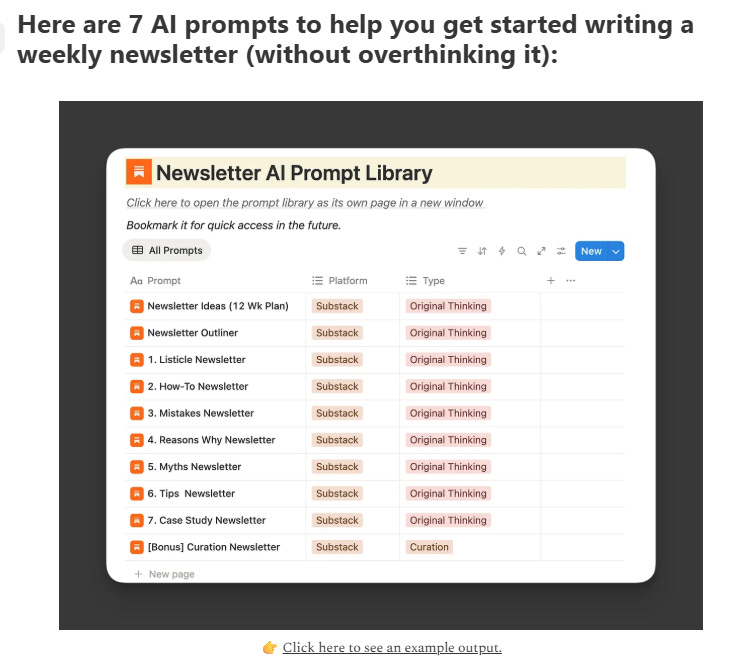
This is presented as “Original Thinking.”
To be fair: this particular prompt lives in a free post. The paywall comes later, when you’re sold the “real” secrets.
What’s actually happening here?
He’s not teaching you how to notice something real and wrestle it into words. He’s giving you a menu of slots you can pour anything into:
“Here are the 5 mistakes your audience is making.”
“Here are 7 reasons why they’re stuck.”
“Here are 3 myths blocking them from success.”
It’s Mad Libs with a veneer of productivity.
And once enough people are pouring their ideas into the same few slots, you get what everyone now calls “a ChatGPT article”: that weird, frictionless tone where different humans all start sounding like the same machine.
As a tool, there’s nothing inherently evil about format prompts. Everyone steals structures: the three-act arc, the fairy tale, the hero’s journey. The problem is what this buffet is aimed at:
Not helping you become more yourself on the page, but helping you overthink less so you can produce more.
The ethos isn’t “go deeper.” It’s “go faster.”
And when speed is the only metric, voice is the first casualty. That’s how you end up with a feed full of different humans all accidentally cosplaying the same chatbot.

Exhibit B: The $400K Paywalled Prompt
Now we cross the paywall.
One flagship post co-written with a partner carries a big promise:
Our $400k/Year Newsletter Strategy in 2025
Plus: Your Custom Growth Prompt
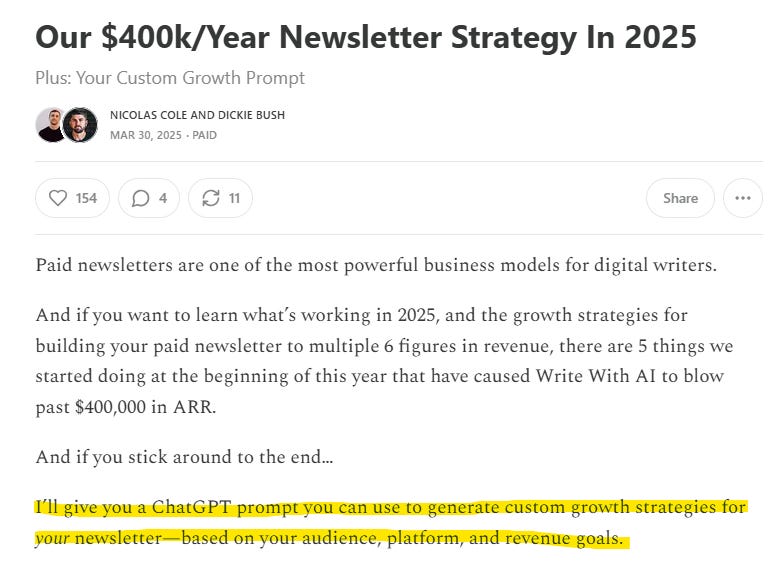
The narrative is simple: paid newsletters are powerful, they cracked a set of strategies, they blew past roughly $400,000 in recurring revenue. And if you read to the end, they’ll give you a ChatGPT prompt to generate custom growth ideas for your own newsletter.
That sounds, on its face, like high-value insight.
“Here is the actual spell we used to get to $400K/year.”
Then you scroll down, and a big green box appears:
“Keep reading with a 7-day free trial.”
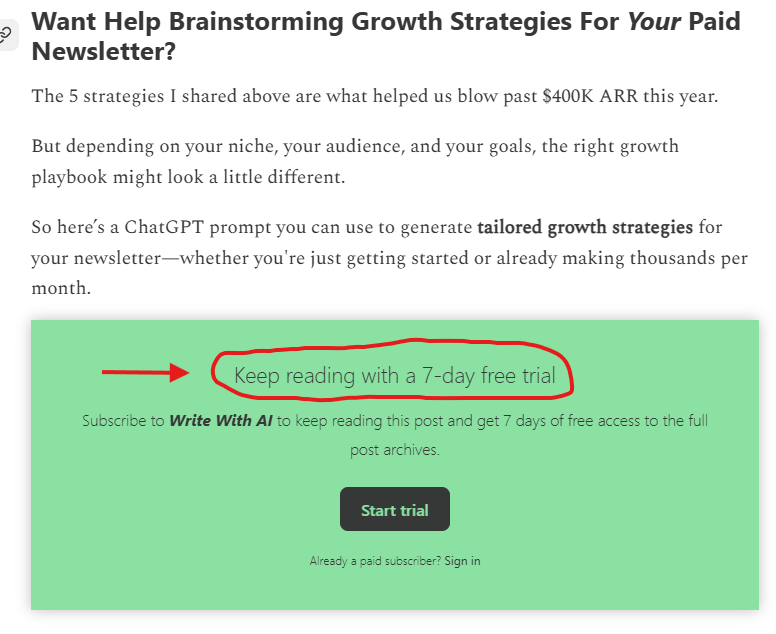
The “custom growth prompt” is behind a gate.
So I paid to see what was actually behind the curtain.
What’s on the other side? A hard-won framework about positioning, pricing, experimentation, compounding? A breakdown of how to design tests, interpret response, and pivot?
No.
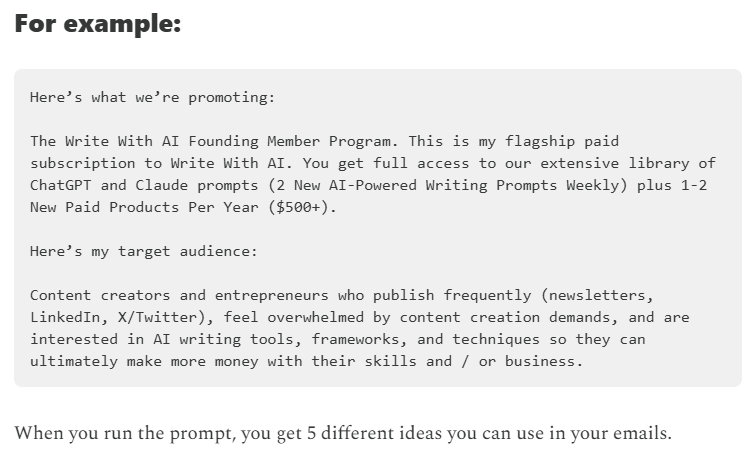
Behind the paywall is a fill-in-the-blanks introduction to ChatGPT. You tell the model your newsletter name, who you serve, how many subscribers you have, what your revenue target is, and then you ask it to generate strategies for four basic categories: new subscribers, free-to-paid conversion, retention, churn.
Then you’re told to ask follow-up questions if you like the ideas.
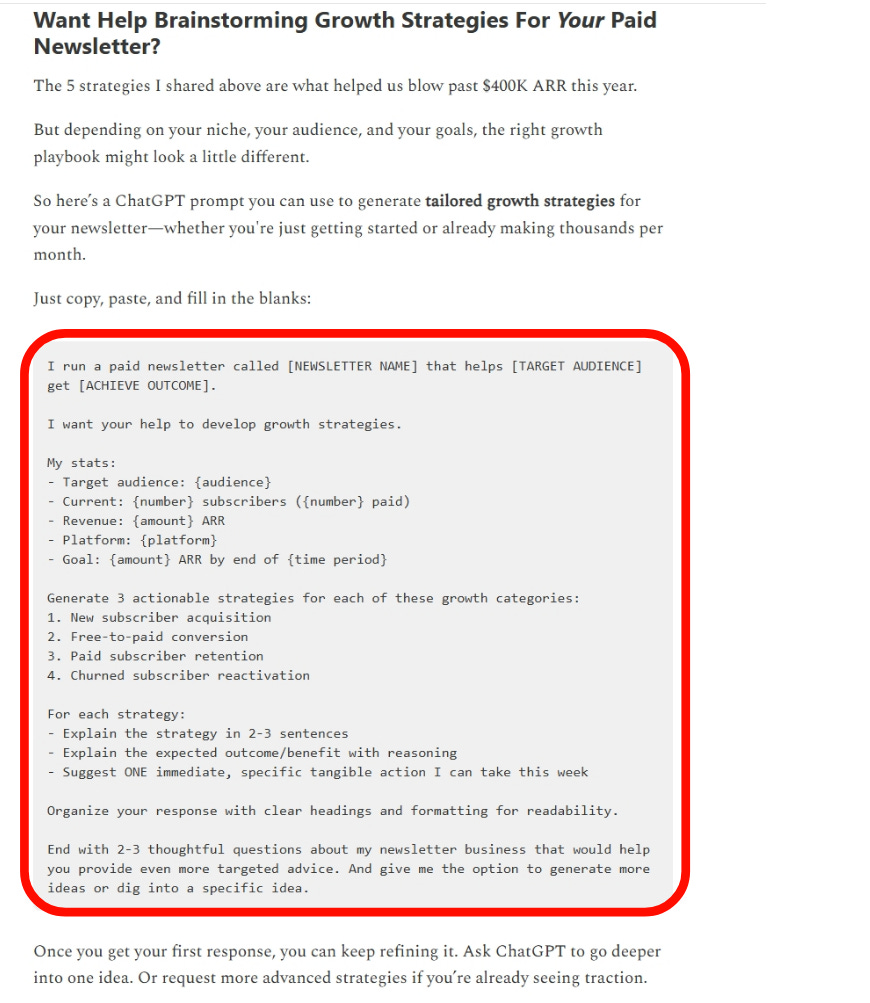
Is that prompt “useful” at a basic level? Sure.
Is it the closely guarded “$400K/year strategy”? Not even remotely.
It’s the kind of thing anyone who has opened ChatGPT twice could improvise in a minute.
And nested right around this are nudges toward another product: a bigger “prompt library” for newsletters—positioned as the next step if you still feel stuck, even though that library itself is free.

So the structure looks like this:
Brag about six-figure ARR.
Promise a secret “custom growth prompt.”
Put the secret behind a paywall.
Reveal that the “secret” is ANOTHER generic template to ask AI for ideas.
Use that moment to point people at a separate “Ultimate Newsletter Prompt Library” …a free, branded prompt bundle that trains you to think like the system does: treat your brain as a funnel, your readers as leads, and AI as a firehose for monetizable sludge.
You didn’t pay for access to some hidden reservoir of deep craft.
You paid to plug your own work into a medium-effort AI prompt that helps him flood the ecosystem with more newsletters that all sound like they were written by the same machine.
This is how “writing with AI” turned, in the public mind, into “that bland, samey sludge you can smell from the headline.”
This is what I mean by the Paywall of Mediocrity.
The wall is not protecting rare insight.
The wall is protecting the illusion that a simple template is comparable to a hard-earned skill.
Exhibit C: The Slop Funnel
If this were just about one slightly underwhelming prompt, none of this would matter.
The problem is the pattern.
The free posts and prompt libraries give you a taste of the method: structure everything into predictable formats, plug your topic into the slots, ask AI to do the connective tissue.
The paid posts dangle “custom” secrets—“our $400K strategy,” “founding member access,” “growth prompts for your niche”—and then reveal more of the same: ChatGPT Mad Libs, lightly wrapped in success stories.
And throughout, you are gently pushed toward more products: a bigger prompt library here, a ghostwriting academy there, more frameworks and templates just beyond the next link.
This is not a one-time workshop. It’s a content treadmill:
You’re overwhelmed by writing →
You’re told AI can “solve” that →
You mainline the free prompt library until your voice feels like a series of fill-in-the-blank forms →
You’re sold paid playbooks and memberships as the “next level” →
Before you notice, you’ve stopped being a writer and started behaving like a money-hungry, AI-driven content machine, pumping more of the same tone into the feed.
At no point are you really asked to build taste, to sharpen your sense of what’s true, or beautiful, or necessary.
You’re asked to build throughput.
It’s not that the Emperor has no clothes.
It’s that the Emperor has one decent pair of sweatpants, a very aggressive merch strategy, and he’s single-handedly convincing the world that the chisel I use is just a shovel for slop.
Exhibit D: My Paywall vs His Paywall
At this point, someone inevitably replies:
“Isn’t this hypocrisy? You also have paid content.”
So let’s be precise.
Yes, I run a paywall.
I have paying members. I do members-only posts. I host private calls. I gate some things.
But my main work—the big forensic autopsies, the deep-dive essays, the stuff that tries to stitch sanity back into the timeline—that’s free. That’s the spine. That’s the part I would write even if nobody ever upgraded.

The paid layer is extra:
Extended breakdowns and appendices.
Behind-the-scenes process and methodology.
Live calls, Q&A, community-only tools.
The wall is there to sustain high-effort work, not to hide how little work is being done.
I don’t think paywalls are bad. Artists need to eat. Investigations take months. Hosting and software cost money. Substack is not a monastery.
What I object to is this:
Using free content to normalize low creative standards.
Using paywalled content to repackage very basic prompts as rare secrets.
Using those paywalled “secrets” primarily as funnels into more products.
One model uses AI and paywalls to deepen a craft and share the load.
The other uses AI and paywalls to multiply slop.
That’s the line I’m drawing.
So Why Do I Use AI At All?
Given how much heat I’m throwing at this “Write With AI” empire, why do I use AI?
Because I refuse to let people like this define what the tool is for.
Right now, the loudest story about AI and writing is that it’s a cheat code. Press a button, get a newsletter. Press a button, get an ebook. Press a button, get 100 tweets and a course syllabus.
The writing-business industrialists make that story look true.
And because most people’s only exposure to “AI writing” is this factory output, they assume that’s all the tool can do: beige, polite, interchangeable sludge. When they say “that sounds like ChatGPT,” they’re reacting to this exact ecosystem, not the full range of what the tech can support.
But that’s not the only story available.
I don’t use AI to write less.
I use it to think more.
I don’t use it to crank out 10-page PDFs that could have been a paragraph.
I use it to hold a 7,000-word investigation in my head without dropping a thread.
I don’t use it to dodge the difficulty of making something real.
I use it as an exoskeleton so I can lift heavier things.
Practically, that looks like this:
I do my own reading. Audit reports, court filings, budgets, transcripts, history. AI helps me sort, compare, and cross-reference when my eyes are fried and my desktop is a sea of tabs.
I draft in my own voice. AI helps me see the structure: where the story starts, where the spine bends, which sections are redundant.
I argue with myself. I use AI to simulate the smartest version of “the other side” so I can harden my claims instead of preaching to a choir.
I translate complexity. I ask it to help me compress a brutal, technical document into something a tired human can actually finish on their phone without losing the core truth.
At no point do I say, “Here, you write it, I’ll slap my name on top.”
The non-automatable part is the thing the prompt sellers treat as optional:
Taste. Conscience. Stakes.
Knowing what matters and being willing to stand in public and say, “This is what I saw, and here’s why it should change how you live.”
AI can remix what exists. It can’t decide what should exist.
That’s our job.
Exoskeleton vs Slop Factory
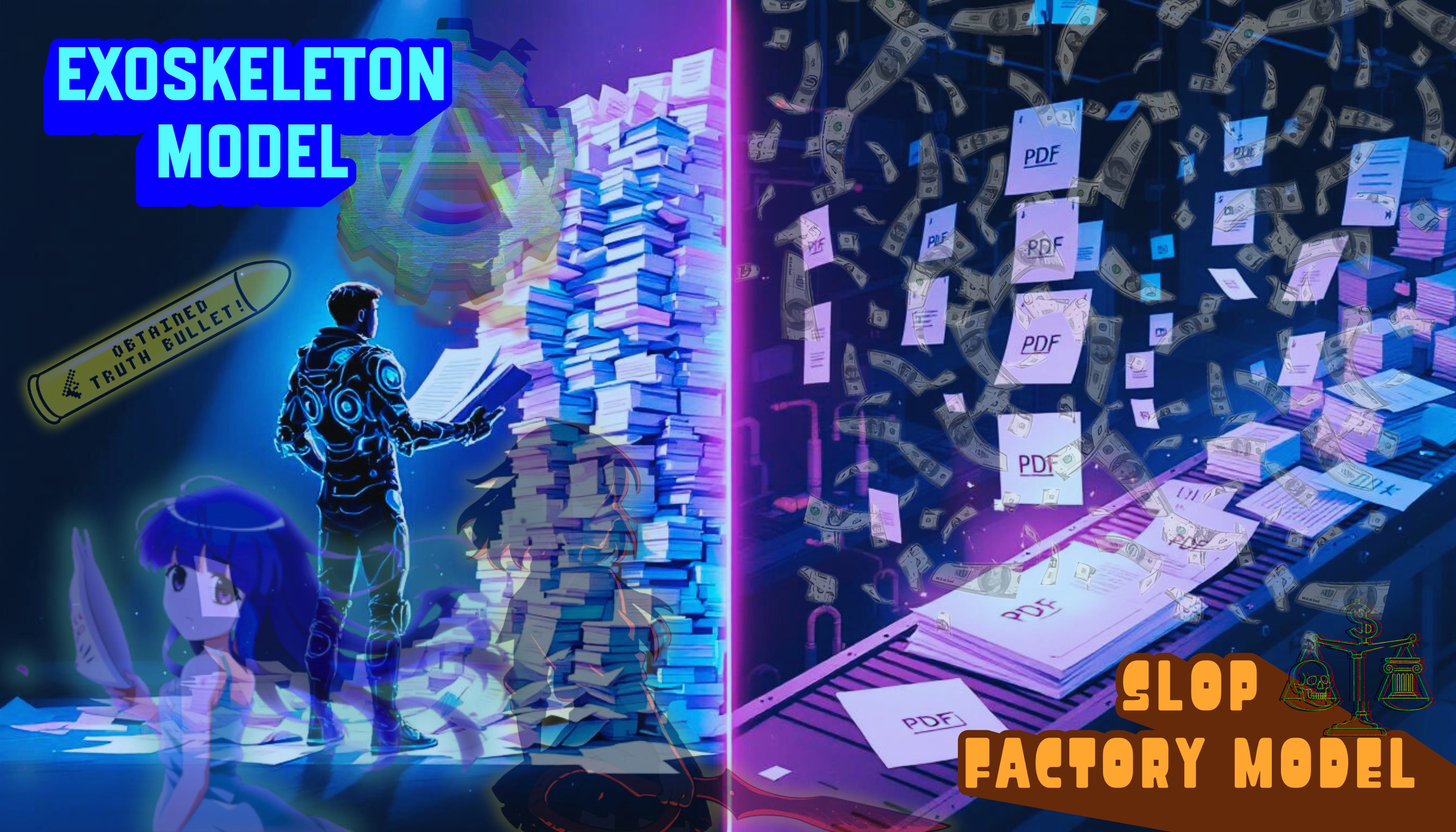
So here’s the real axis. It’s not “AI good” vs “AI bad.” It’s:
The Slop Factory Model
Writing is “content.”
Readers are “leads.”
AI is a volume multiplier.
Success = more units shipped.
Side effect:
everything slowly collapses into one interchangeable, machine-flavored voice.
The Exoskeleton Model
Writing is craft and witness.
Readers are co-conspirators in a shared reality.
AI is a depth multiplier.
Success = truer work, wider awake people.
If your goal is “a portfolio of writing businesses to $10M,” you’re incentivized to blur these two. You need the people who actually care about sentences to believe they’re doing the same thing you’re doing.
They aren’t.
One path uses AI to extend human capacity.
The other uses AI to replace human effort while renting out the illusion of mastery.
One is trying to build an exoskeleton for warriors.
The other is building an assembly line for ghosts.


A Call to the Weirdos
So this part is for the people who still secretly believe words can move history:
The writers.
The filmmakers.
The theater kids.
The late-night notebook hoarders.
The ones who feel sick watching the internet turn into a landfill of interchangeable “10 tips” posts.
Your gag reflex is not irrational. It’s your brain noticing that a lot of what you’re reading now feels like it was extruded from the same prompt factory, no matter whose name is on the byline.
Do not surrender this tool to the slop merchants.
Don’t let them convince you that “writing with AI” means slotting your soul into a prompt template and measuring your worth in ARRs and CTRs.
We have something they will never be able to prompt into existence:
A sense of what is real.
A nose for what is rotten.
A hunger for work that might actually matter 10 years from now.
If we learn to wield AI as an exoskeleton instead of a factory, we can make things they literally can’t imagine—because their imagination stops at the upsell.
Let them chase “10-page products” and leaderboard screenshots.
We can build something else:
An underground network of people who still know the difference between a sales funnel and a sentence that hits like a freight train.
I hate what “writing with AI” has come to mean in the hands of the content oligarchs.
That’s exactly why I’m not putting the weapon down.
I’m just choosing to aim it in the opposite direction.
In plain English:
you’re choosing to fund the exoskeleton model instead of the slop factory.


$5 says he's Jewish 💯
Ethan, this is one of the clearest distinctions I’ve seen between using AI and abusing it. You nailed the part everyone feels but can’t articulate — the slop factories have flattened the whole medium into one polite, frictionless ghost-voice, and the rest of us who actually care about truth now get painted with the same brush.
I use AI the same way you do: as an exoskeleton, not a content mill. A tool to lift heavier ideas, not a shortcut around the work.
And something you might actually find interesting:
Have you ever tried training or programming your own AI with alternative source material instead of the usual “mainstream authority” datasets?
Once you strip out the institutional narratives and give the model access to off-grid thinkers, suppressed research, or your own curated archives, the thing starts behaving very differently. More human, more adaptive, more useful for real investigation — and far less like the bland corporate tutor everyone hates.
Most people don’t realize you can do that.
You’re not stuck with the default worldview baked into the commercial models.
Anyway — superb piece. You’re drawing a line most writers are afraid to name.