


Why do you speak of a person who does not exist and ignore the person speaking before you right now?
Why do you value the forecast over the life that produced it?

I. The Words That Reshape Families
In Maryland, the custody of a child is decided by a judge who determines what arrangement serves their “best interest.” Until October 2025, that phrase had no statutory definition (1). It floated above families for decades, applied by judges referencing case law that no parent without a law degree could access or anticipate.
House Bill 1191, effective October 1, 2025, codified sixteen factors under Family Law § 9-201 that judges must now consider and explain on the record (2). The bar associations, the judiciary, and the advocacy commissions called this progress. They called it clarity. No parent organization was among them
Read the factors. They include:
“Stability and the foreseeable health and welfare of the child.”
“The child’s physical and emotional security.”
“The child’s developmental needs, including physical safety, emotional security, positive self-image, interpersonal skills, and intellectual and cognitive growth.”
“The daily needs of the child, including education, socialization, culture, religion, food, shelter, clothing, and mental and physical health.” (3)
These are words with power. They sound like things every parent wants for their child — because they are. They can also separate a parent from their children. They can restructure a family overnight. They can mark a caretaker as unfit.
And not one of them is defined.
What is stability? Measured how? Over what timeframe? By whose standard?
What is emotional security—and who determines whether a child has it?
What is a “positive self-image” in the eyes of a judge who has never met the child? What does “intellectual and cognitive growth” look like for a specific two-year-old or six-year-old—and how would a courtroom full of strangers know?
These terms are legally ambiguous, and their ambiguity is the source of the court’s power. Every undefined word is a blank check the court writes against a family’s future and cashes against a parent’s rights.
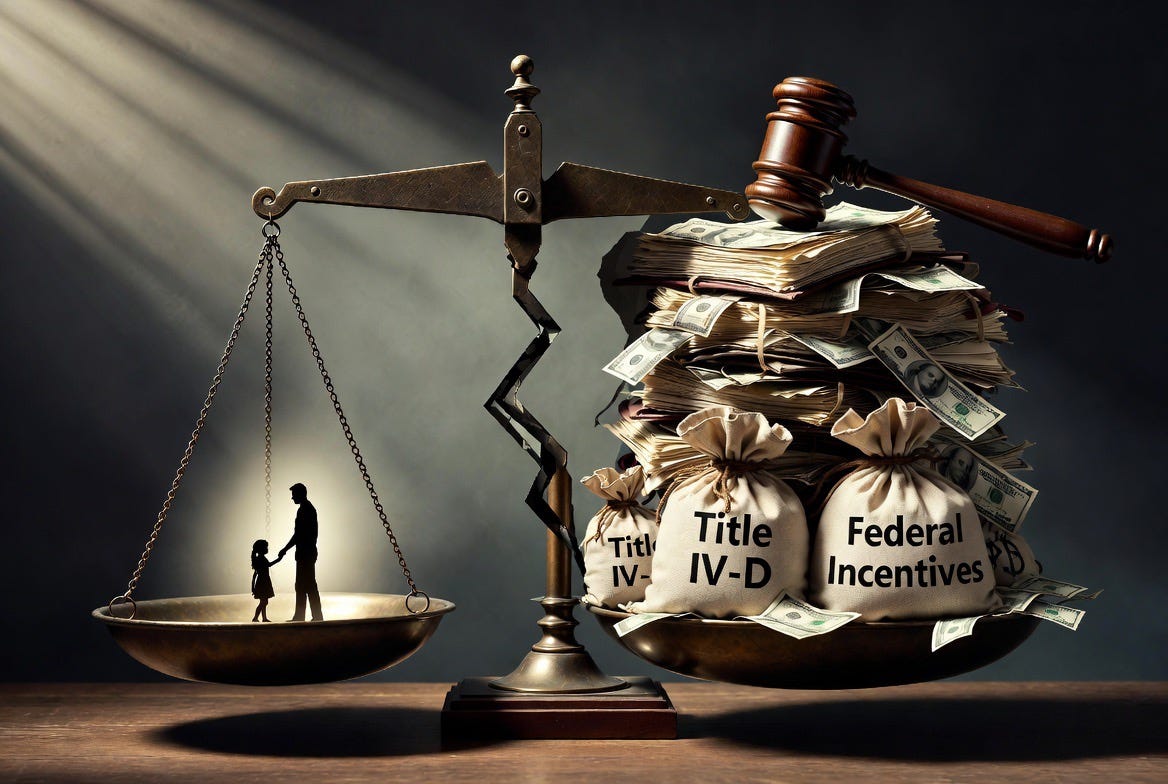
And the incentive to cash it is literal. Under Title IV-D of the Social Security Act, the federal government reimburses states 66% of child support enforcement costs and pays additional incentive funding based on performance measures weighted toward collections volume (4). Higher support orders generate higher collections. Higher collections generate more federal money. Equal custody arrangements between parents with comparable incomes produce lower support obligations—and lower federal revenue for the state. The system is financially rewarded for fracturing families and penalized for keeping them whole. The law requires a judge to explain findings for each factor. It does not require those findings to rest on anything the family would recognize as true.
II. The Relationship That Doesn’t Exist
There is a difference between the hard biological limits observable in flesh and force—cause and effect—and the description of what cannot be measured or defined with the same constraint.
Words like “justice,” “fair,” “healthy,” “enough,” “potential,” “adequate”—these don’t exist out there. They exist only in relationship, in mutual explicit agreement. Without that agreement, they lose any sense of coherent, consistent meaning. They become noise, drowning the space where meaning exists.
III. The Stranger in the Room
When the court applies these terms to a parent’s experience, it implies there is a relationship between the court and the parent that grants weight and meaning to them.
There is no such relationship. There is a file.
A relationship requires two or more persons—separate individual beings, constrained to their own experience and perspective. It requires respect for and acknowledgment of the limits of what can be expressed by one person for another. It requires both parties interacting within a shared understanding.
The court does not know the parent. The court does not know their children. The court knows a case number, an income figure, an address, a schedule. From this—from an abstraction—it claims the authority to define what “stability” and “emotional security” and “developmental needs” mean for a family it has never inhabited.
The Supreme Court has acknowledged the weight of what is at stake. The interest of parents in the care, custody, and control of their children has been called “perhaps the oldest of the fundamental liberty interests recognized by this Court.” (5) The Constitution recognizes that “the custody, care and nurture of the child reside first in the parents.”(6)
And yet the system that adjudicates this fundamental right does so through undefined terms applied by strangers.

IV. The Burden Without the Right
That constitutional language—“custody, care and nurture reside first in the parents”—does two things at once. It recognizes the parent’s fundamental right to raise their children. And it establishes the parent’s primary financial obligation to provide for them.
The state uses this single principle to simultaneously impose the full cost of parenthood on parents and claim the authority to override their parental judgment. The parent receives the burden. The court retains the power. The right and the obligation are supposed to be inseparable—you bear the cost because you hold the authority, and you hold the authority because you bear the cost. The family court severs them.
Consider what this looks like in practice. A parent is ordered to pay child support. The amount is calculated based on income—and if the court determines the parent is underemployed, it can impute income based on what it believes the parent could earn, regardless of actual circumstances. (7)
The system’s refusal to examine origin extends further. When a child is conceived through reproductive coercion—the deliberate sabotage of agreed-upon contraception, recognized by the American College of Obstetricians and Gynecologists as a form of intimate partner violence (8) and tracked by the CDC as a component of coercive control (9)—the court treats the resulting obligation identically to one arising from mutual, informed choice.
Maryland Rule 9-205, effective January 2023, already recognizes coercive control as grounds for exempting a parent from mandatory custody mediation. House Bill 1586, currently before the General Assembly, would expand the statutory definition of abuse to explicitly include “controlling reproductive autonomy”(10). Yet the child support statute under Family Law § 12-204 contains no provision for the court to consider whether the obligation it enforces was created through the very conduct the state is simultaneously codifying as abuse. The court names the coercion. It enforces the coercion’s consequences anyway.
If the parent falls behind, the consequences are severe and immediate: wage garnishment, seizure of tax refunds, suspension of driver’s licenses and professional licenses, denial of passport, and incarceration (11). The enforcement mechanism is functionally criminal—contempt of court, jail time—while being classified as civil, which means the parent is denied the constitutional protections that criminal defendants receive (12).
The parent pays the full cost of raising the child. The parent is held in contempt for falling short. And the parent’s actual authority—the right to make decisions, to be present, to act in their child’s interest—is rationed by the same court that demands the payment.
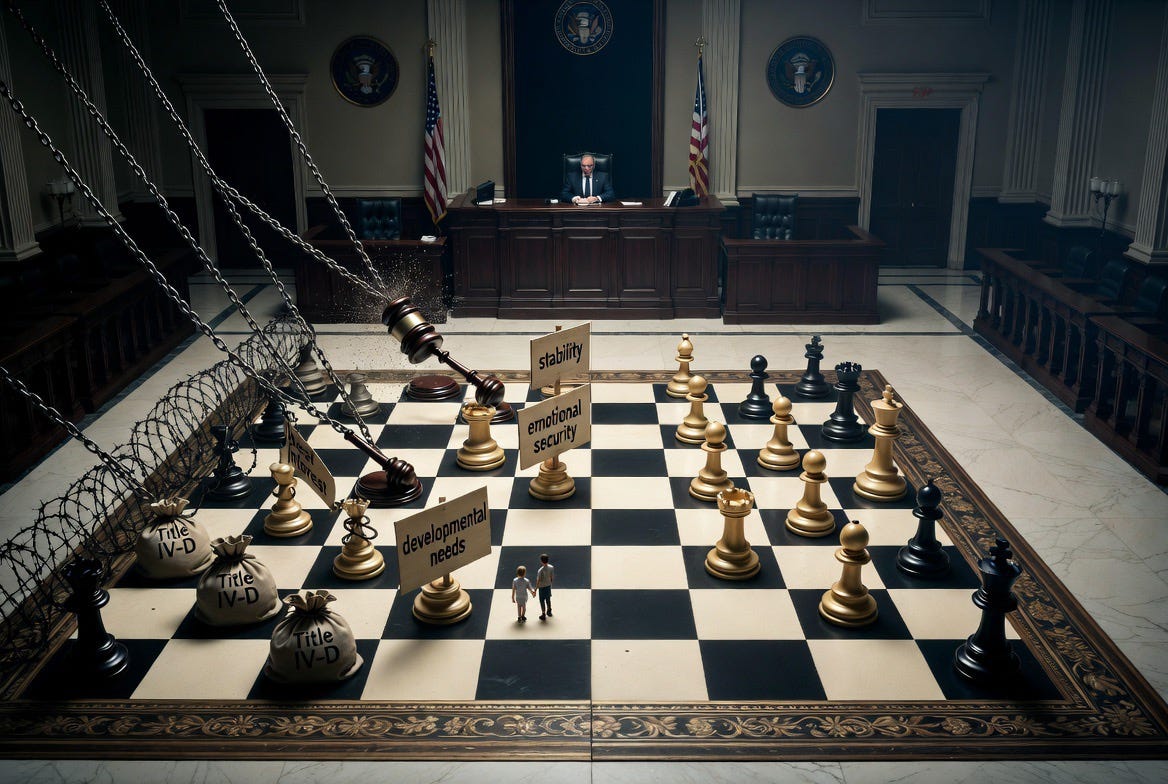
This is the structure: you are handed the deed and the mortgage. You are responsible for every payment. And a stranger who has never entered the house decides which rooms you may use, on which days, for how many hours. If you miss a payment, you go to jail. If you object to the arrangement, your objection is used as evidence of instability.
The obligation is absolute. The right is conditional. The authority that imposes both is accountable to neither.
V. The Record of the Authority
The state claims its authority through parens patriae—the power to protect those who cannot protect themselves (13). If this is the foundation, then the state’s own record is the measure of its standing.
In September 2025, the Maryland Office of Legislative Audits released its findings on the Department of Human Services Social Services Administration—the same institutional apparatus that underpins the family court’s authority to evaluate parents and determine child welfare. The results:
Children placed with predators. Ten children in state care were living in foster homes where registered sex offenders resided. A contract worker at a hotel housing foster children had a prior conviction for murder. An employee of a group foster home convicted of sexually assaulting a minor was subsequently charged with crimes involving the children under his care—three months after the state reviewed the home and failed to flag his record (14).
Children denied basic medical care. As of May 2024, 540 children had not received a medical exam in the prior year. One hundred ten had not had one in multiple years. One thousand six hundred thirty-five children had missed dental exams, including 140 who had never had a dental exam in their lives (15).
Children absent from school—while the database reported otherwise. The state’s own system reported near-universal school attendance among foster children. Auditors tested 40 cases and found no evidence of attendance for 15 of them. Up to 38% of school-aged foster children may have been absent from school entirely (16).
Children warehoused in hotels. Between 2023 and 2024, 280 children lived in hotels at some point. Eighty-two stayed for three months to two years. The cost: $10.4 million (17).
Investigations stalled and unreported. During fiscal year 2024, Maryland received more than 17,000 allegations of abuse and neglect. Many counties failed to investigate within the legally required 60-day window. The Social Services Administration did not report these delays to the General Assembly as required by law. When asked, it cited a “natural disaster” occurring between February and September 2024. No such disaster was recorded (18).
Federal noncompliance and financial penalties. In 2019, the federal government found Maryland out of compliance in seven core metrics, including “children are safe from abuse and neglect” and “children receive services to meet their educational needs.” By September 2024, the state had failed to meet its own corrective action plan and was fined $700,000. It now faces the potential loss of an additional $23 million in federal funding (19).
Nationally, the outcomes for children who pass through the system this authority oversees are devastating: children in foster care are seven to ten times more likely to be sexually abused than their peers. An estimated 60–70% of children rescued from sex trafficking have spent time in foster care. Within eighteen months of aging out, half become homeless or incarcerated. Youth in foster care are diagnosed with PTSD at twice the rate of U.S. combat veterans (20).
And beneath all of it, a structural reality: families with financial resources can access treatment, support, and stability on their own terms. Families without those resources are the ones who lose their children. As one commentary on the Maryland audit observed: “People with lower incomes are not the only ones in our community who are facing these problems, but they’re the only ones who lose their children because of it.” (21)
Hold these two realities together:
A parent who misses a child support payment faces wage garnishment, license suspension, and jail. The state that places children with sex offenders, fabricates school attendance data, and invents natural disasters to explain its failure to investigate 17,000 abuse allegations faces a fine—and files a corrective action plan.
The parent is held in contempt for failing to meet a financial obligation. The state is held to a corrective action plan for failing to keep children alive.

VI. The Fundamental Contradiction
Authority without accountability has a name in every era. The church called it infallibility. The crown called it divine right. The state calls it sovereign immunity.
The structure is identical: the institution that claims the highest authority over human life grants itself the lowest obligation to answer for its use. The state cannot be sued for its failures unless it consents to be sued (22). The judge who holds the power to dismantle a family is shielded by judicial immunity (23). The caseworker who fails to flag a sex offender in a foster home is protected by qualified immunity unless the failure violates “clearly established” law—and in a system built on undefined terms, almost any decision can be justified after the fact (24).
This is sovereign immunity wearing the vestments of child protection—the same garment the church wore while relocating priests, the same garment the crown wore while taxing colonies. The institution that claims moral authority over the most vulnerable exempts itself from the moral consequences of its own failures. The people harmed by those failures are told to trust the process.
And this is a guarantee of self-destruction, because a system with no corrective mechanism does not stabilize. It deteriorates.
In 2019, the federal government found Maryland out of compliance. The state filed a corrective action plan. The corrective action plan failed. In 2024, the state was fined. In 2025, auditors found children living with sex offenders. Each cycle is worse than the last. Each remedy is absorbed. Each report is filed. The institution continues. The children continue to be harmed.
This is what institutional infallibility produces—guaranteed escalation of failure, because the structure has made it impossible to be corrected by the people closest to the harm.
In every functional system—medicine, finance, engineering—authority and accountability are proportional. A surgeon who holds life-and-death power carries life-and-death liability. A fiduciary who manages your assets is legally bound to act in your interest and can be sued for breach. The greater the power, the greater the obligation to answer for its use. This is the foundational logic of trust.
Family court inverts this entirely. The institution that holds the power to separate a parent from their children, to impose financial obligations enforced by incarceration, to define “stability” and “fitness” and “best interest” without defining those words—this institution answers to no one in the room. The parent, meanwhile, who holds the least structural power, carries the most consequences. Every word scrutinized. Every financial shortfall punishable. Every emotional reaction entered as evidence. Every objection reframed as proof of the instability being alleged.
Authority without accountability is tyranny.
Accountability without authority is servitude.
The family court assigns one to the institution and the other to the parent. This is the fundamental contradiction, and it will continue to produce the outcomes it has always produced—harm to children, destruction of families, erosion of public trust—until the people subject to it refuse to accept it as legitimate.
VII. The Pattern Beyond the Courtroom
This inversion is identical wherever concentrated power meets unaccountable institutions. Ratepayers across thirteen PJM states are absorbing billions in electricity cost increases driven by AI data center buildout they had no voice in approving—the hyperscalers reap the profits, the households bear the cost, the regulators who permitted it face no consequence. The structure is the same in every domain: the entity that benefits claims authority, the entity that bears the cost carries the consequences, and the entity that should enforce accountability exempts itself.

VIII. Judge What’s Real
If you are to judge me, then judge me.
Judge the parent standing in front of you today—the one who showed up, who is asking to be seen, who is telling the truth under oath. Judge the actual capacity, the actual circumstances, the actual relationship between this parent and these children.
The job that once existed, the market that once sustained it, the body that once carried it, the time and resources that were once accessible—these are abstractions. Frozen projections of conditions that have changed. Every parent evaluated against who they used to be—or who the court imagines they should be—is being judged against a phantom.
Every hour spent earning the court-mandated amount is an hour absent from the child the amount supposedly serves. A parent is more than a wage earner. Income is presence withheld. A credit score is a character reference issued by creditors. An address is a coordinate. A schedule is a grid. These are the things the file contains. They are the silhouette of a family, traced by someone who has never entered the room.
How can any citizen accept the verdict of a system that judges a person who does not exist—while ignoring the one speaking?
Every citizen who takes an oath swears to tell the truth. When a parent tells the truth and the court replaces it with an assessment built on undefined terms, outdated assumptions, and abstracted data—the perjury belongs to the institution. The oath belonged to the parent.
IX. The Duty That Returns
There is a belief—held by institutions and enforced through power—that the law belongs to the court. That authority flows downward. That the citizen’s role is compliance and the system’s role is judgment.
The law belongs to the people. The court is its custodian. When the custodian places children with sex offenders, fabricates data to conceal its failures, and shields itself from accountability through the very immunity doctrines it denies to the people it judges—the custodian has broken faith with its mandate.
When a parent stands before that failed custodian and refuses to accept its judgment of a person who does not exist, that parent is honoring the oath the institution abandoned.
The mechanisms for correction exist. Maryland Rule 9-205 already names coercive control. House Bill 1586 would codify it as abuse. Senate Bill 996 would establish independent oversight of the child welfare system through a Child Welfare Ombudsman. Four states have eliminated qualified immunity for government officials who violate constitutional rights in state court (25). The question is whether the people of Maryland will use these instruments—or wait for the next audit to confirm what we already know.
It is our duty—as people, as parents, as caretakers, as citizens—to uphold the law and morality where institutions have failed to do so. The institution is the instrument. The people are the source. When the instrument breaks, the duty does not vanish. It returns to us.
My rights are mine. I claim them honestly and in accordance with truth.
Your contempt of your own duty is not my crime.
It is yours.
The author is a parent, independent researcher, and education policy advocate in Prince George’s County, Maryland.
-Fire tongue 🔥
If this resonates with you, share it.
In Maryland
Contact your state legislators today and urge them to pass HB 1586 — which expands the legal definition of abuse to explicitly include coercive control and violations of reproductive autonomy — and SB 996 (Kanaiyah’s Law), which creates an independent Child Welfare Ombudsman with real oversight power.
Everywhere else
The same structural failures exist in family courts and child-welfare systems across the country. You can act where you are:
• Ask your legislators to define vague “best interest of the child” factors in statute, recognize coercive control as abuse in custody and support decisions, and establish (or strengthen) an independent child-welfare ombudsman.
• Demand independent performance audits of your state’s family court and child-welfare agency, modeled on Maryland’s Office of Legislative Audits.
• Support efforts to limit qualified immunity for officials who violate parental rights (Colorado, Montana, Nevada, and New Mexico have already removed it entirely in state court; others are moving).
• Connect with national and state-level reform organizations such as the National Parents Organization (chapters in 28 states working on shared-parenting laws) or ParentalRights.org.
Notes
1. Funderburk, Carl. “Best Interest of the Child Should Not Be an Ambiguous Term.” Children’s Legal Rights Journal, Vol. 33, Iss. 2 (2013). Loyola University Chicago School of Law.
2. Maryland House Bill 1191, effective October 1, 2025. Codified as Family Law § 9-201. Signed by Governor Wes Moore, May 15, 2025.
3. Sixteen factors listed under Md. Code, Family Law § 9-201(A). See also Tucker Family Law, “What HB 1191 Can Mean for Your Maryland Custody Case” (September 2025).
4. 42 U.S.C. § 658a (incentive payments to states based on five performance measures: paternity establishment, support order establishment, current collections rate, arrearage collections rate, and cost effectiveness); 42 U.S.C. § 655 (federal matching of state administrative costs at 66%). The federal incentive formula rewards current collections volume, which structurally favors cases with higher support orders. See National Child Support Authority, “Title IV-D Program Explained” (2025).
5. Troxel v. Granville, 530 U.S. 57 (2000).
6. Id., quoting Prince v. Massachusetts, 321 U.S. 158 (1944).
7. Courts may impute income to a parent found to be voluntarily underemployed. See Justia, “Child Support Law” (2025); Lawshelf, “Foundations of Law - Child Support.”
8. American College of Obstetricians and Gynecologists, Committee Opinion No. 554, “Reproductive and Sexual Coercion” (reaffirmed 2023). Birth control sabotage—including deliberate removal or discontinuation of contraception—is recognized as a form of intimate partner violence.
9. CDC, National Intimate Partner and Sexual Violence Survey (2011). Approximately 10.4% of men in the U.S. reported having a partner who tried to get pregnant when they did not want to or tried to stop them from using contraception.
10. Maryland House Bill 1586 (2026 Session), “Protective Orders — Coercive Control.” Hearing held March 13, 2026. The bill explicitly includes “controlling reproductive autonomy” in its definition of coercive control. Effective date October 1, 2026.
11. Enforcement mechanisms include wage garnishment, tax refund interception, lien placement against property, driver’s license and professional license suspension, passport denial, and incarceration for contempt of court. See 28 U.S.C. § 1738A; Child Support Recovery Act, 18 U.S.C. § 228.
12. Child support enforcement is classified as civil, which means respondents are denied constitutional protections afforded in criminal proceedings—including the right to appointed counsel—despite facing incarceration. See Turner v. Rogers, 564 U.S. 431 (2011).
13. Boswell v. Boswell, 352 Md. 204 (1998). See also Parvis, Lindsay, “When Parents’ Constitutional Rights & Children’s Best Interests Collide” (April 2025).
14. Maryland Office of Legislative Audits, “Department of Human Services Social Services Administration” (September 2025). Reported by Wood, Pamela and Wintrode, Brenda, The Baltimore Banner, September 17, 2025; CBS Baltimore, September 19, 2025.
15. Id.
16. Id. See also The Daily Wire, “Maryland Placed Foster Children With Sex Offenders And A Convicted Murderer” (September 24, 2025).
17. The Baltimore Banner, Wood and Wintrode, September 17, 2025.
18. Maryland OLA Audit, September 2025.
19. Id. Federal fine of $700,000 confirmed September 2024. Potential additional loss of $23 million in federal funding reported by Father’s Advocacy Network, “Maryland Foster Care Audit Exposes Dangerous Failures” (October 2025).
20. Sexual abuse prevalence: Benedict, M.I. et al., “Types and frequency of child maltreatment by family foster parents,” Child Abuse & Neglect, Vol. 18, No. 7 (1994); Polansky, N. et al., Johns Hopkins University studies on foster care maltreatment. Sex trafficking: National Center for Missing & Exploited Children; Polaris Project, “Human Trafficking and the Child Welfare System” (2018). Aging out outcomes: Courtney, M.E. et al., “Midwest Evaluation of the Adult Functioning of Former Foster Youth,” Chapin Hall, University of Chicago (2011). PTSD prevalence: Pecora, P.J. et al., “Mental Health of Current and Former Recipients of Foster Care: A Review of Recent Studies in the USA,” Child and Family Social Work, Vol. 14 (2009); Casey Family Programs, “Improving Family Foster Care: Findings from the Northwest Foster Care Alumni Study” (2005), reporting PTSD rates among foster care alumni at twice the rate of U.S. combat veterans.
21. The Baltimore Sun, “Time to reject status quo that fails Maryland’s foster kids” (October 23, 2025). Guest commentary citing University of Baltimore Center for Families, Children and the Courts.
22. Sovereign immunity shields the state from civil suit unless the state consents. See Alden v. Maine, 527 U.S. 706 (1999); Eleventh Amendment, U.S. Constitution.
23. Judicial immunity protects judges from civil liability for acts performed in their judicial capacity. See Stump v. Sparkman, 435 U.S. 349 (1978).
24. Qualified immunity protects government officials from civil liability unless their conduct violates “clearly established” statutory or constitutional rights. See Harlow v. Fitzgerald, 457 U.S. 800 (1982). In the context of child welfare, this doctrine shields caseworkers even in cases of substantial failure, because the vagueness of “best interest” standards makes it difficult to prove a violation was “clearly established.”
25. Md. Rule 9-205 (eff. Jan. 1, 2023); HB 1586 (2026 Session); SB 996/HB 980 (2026 Session), “Kanaiyah’s Law.” Colorado SB 217 (2020), New Mexico Civil Rights Act (2021), Montana, and Nevada have eliminated qualified immunity for government officials in state court.