The American Revolution did not end with liberty; it ended with a margin call. While the history books focus on the musket smoke clearing at Yorktown, they omit what happened next: the men who fought the war were paid in hyper-inflated, worthless paper, while a small ring of merchants waited in the wings to buy their blood debt for pennies on the dollar. The Republic wasn’t born. It was acquired.
There is a particular kind of genius required to convince a man to bleed for five years, hand him a piece of paper that says ‘IOU,’ and then legally engineer a system where that exact piece of paper makes you rich and leaves him homeless. This was the miracle of 1776. The British East India Company was gone, but the domestic monopoly had just arrived, carrying ledgers instead of cannons.
THE MECHANICS OF EXHAUSTION
Wars are won by logistics, not ideology. To fund the Continental Army, the new government printed the Continental Dollar: paper money backed by absolutely nothing but the promise of a future country. Within months, it entered a death spiral of hyperinflation. By the end of the conflict, the phrase “Not worth a Continental” wasn’t a metaphor; it was the financial reality of every soldier standing in the snow.
But this hyperinflation wasn’t just an economic crisis. It was a structural, psychological weapon.
🔪 THE POCKET RAZOR: It is a terrible thing to survive a war only to realize you are about to be priced out of the peace. Make a population physically tired and financially starving enough, and they will hand you the keys to their own prison just to get a loaf of bread.
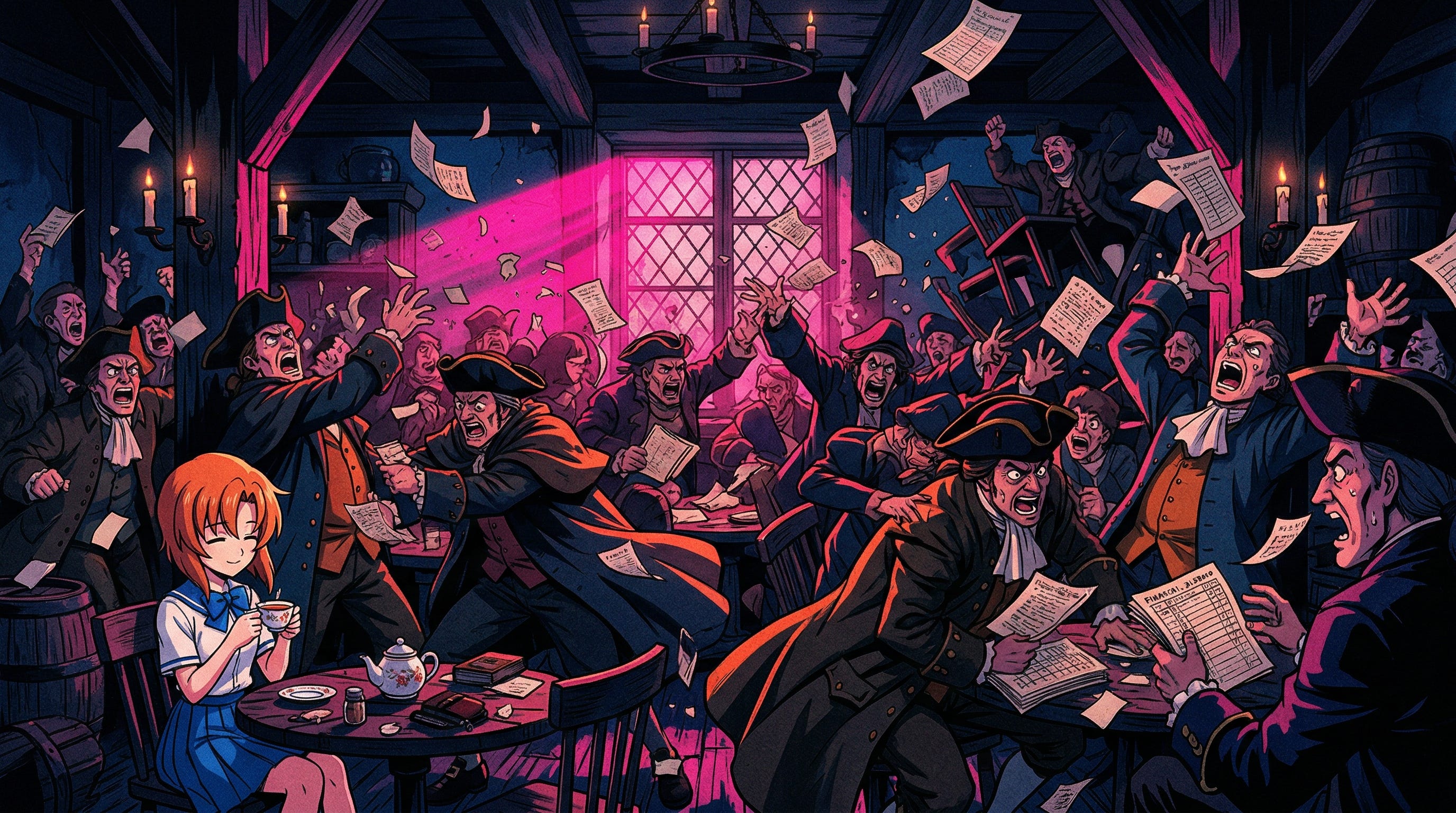
I used to see this exact same alchemy every single night working the graveyard shift at the gas station. Two months ago, I watched a guy practically vibrate with rage over the price of a gallon of regular, only to immediately pivot and defend the billionaire class, threatening another customer who suggested the system was rigged. He was so exhausted by the economic pressure (Layer 1) that his brain defaulted to defending the very system starving him (Layer 3), turning his rage sideways instead of vertically.
Later that same shift, my coworker walked in, visibly ill and desperately debating calling out. Instead of empathy, the rest of the shift treated her with pure hostility. The corporate “just-in-time”, zero-redundancy staffing model isn’t just cheap; it’s a weapon. And this was a regular, expected occurrence!
It ensures that one worker’s personal crisis instantly inflicts suffering on the others. It systematically destroys empathy, replaces it with resentment, and makes working-class solidarity mathematically impossible.
This isn’t an accident. This is the exact same psychological operation they deployed in 1791.
The rural, dirt-poor farmers—the men who actually shot the redcoats—were physically exhausted and entirely broke. When the public resistance collapses from sheer fatigue, they don’t have the energy to read the fine print of the new government being formed.
Out of this vacuum rose the mega-merchant. These were the first defense contractors. They realized instantly that the real, generational profit wasn’t found in fighting the British. The real profit was sweeping through the rural countryside and buying up depreciated, hyper-inflated sovereign debt from starving soldiers for 10 cents on the dollar.
They were simply waiting for the right man to flip the switch and make those pennies worth millions. They were waiting for Alexander Hamilton.
THE FIRST PRIVATIZATION: ROBERT MORRIS (1781)
History books love to call Robert Morris the “Financier of the Revolution.” The myth goes that he was a selfless patriot who heroically dipped into his own pockets to save the frozen Continental Army.
That’s the Report. Here is the Receipt:
Morris didn’t save the economy; he acquired it. It was the absolute blueprint for every modern corporate bailout.
🔪 THE POCKET RAZOR: If you hold a nation’s logistics hostage during an emergency, you don’t even need to write the laws. You can just dictate them.
In 1781, with the national treasury completely bankrupt, Morris demanded dictatorial control over the economy as a condition of his help. Then our ally in the war, France, sent a massive emergency shipment of silver to bail out the American government. That silver belonged to the public.
Instead of giving it to the public, Morris took the silver and used it to buy the controlling stock in a newly created private monopoly: The Bank of North America.
Once he controlled a private bank funded exclusively by public money, what did the “Financier of the Revolution” do? He turned around and loaned the government its own money back. And of course, with interest.
While the rural soldiers starved holding worthless paper, Morris and his inner circle paid themselves massive 8.5% dividends. He engineered a perfect casino where the public bore 100% of the risk, and his private friends extracted 100% of the profit.
The Broadway musical will tell you that Alexander Hamilton was a misunderstood genius who brilliantly united the country’s debts to secure America’s global credit. A true underdog story.
That is the Report.
The Receipt is much colder: Hamilton engineered one of the earliest and most brazen state-sponsored insider trading schemes in American history.
🔪 THE POCKET RAZOR: In high finance, asymmetric information is a weapon of mass destruction. If you know the rules are changing tomorrow, you can buy the whole game today.
Hamilton’s plan, the Assumption Act, decreed that the new federal government would pay off all those hyper-inflated, worthless Continental IOUs at 100% of their original face value. If you held the paper, you were about to be rich.
There was only one problem: the rural farmers, the veterans actually holding the paper in the backcountry, had no idea this law was coming. But Hamilton had an inner circle: the Northern elite, including his own assistant, William Duer. And they knew exactly what was about to happen.
They deployed agents on the fastest horses in the country, riding out to the geographic periphery before the news could spread. They found the desperate, starving veterans who had fought the war and offered to buy their “worthless” military pay notes for 10 or 15 cents on the dollar. The exhausted veterans, needing to feed their families, took the pennies.
Weeks later, the Funding Act passed. Hamilton’s friends sauntered into the Treasury, dumped wheelbarrows of the veterans’ paper onto the desks, and redeemed them for brand new U.S. bonds at 100% face value.
The yields exceeded 800%.
The working class bled out to build Wall Street, and the people responsible for the bleeding built statues of themselves.
Next came the casino.
THE DERIVATIVE BUBBLE: SCRIPOMANIA (1791)
The history books will tell you that Hamilton’s First Bank of the United States was a stabilizing, necessary invention to give the young nation a uniform currency.
The reality is that it was a wildly deregulated casino that instantly triggered America’s first financial crash.
A bank is only “too big to fail” when it’s gambling with your money. When they win, they keep the dividends. When they lose, they send you the bill.
The First Bank wasn’t a public utility; it was a $10 million monopoly where 80% was controlled by private investors. But the real crime was the IPO. The system was structured so that elite investors didn’t even have to buy the shares outright. They could buy “scrips”—basically down-payment options—on margin for just $25.
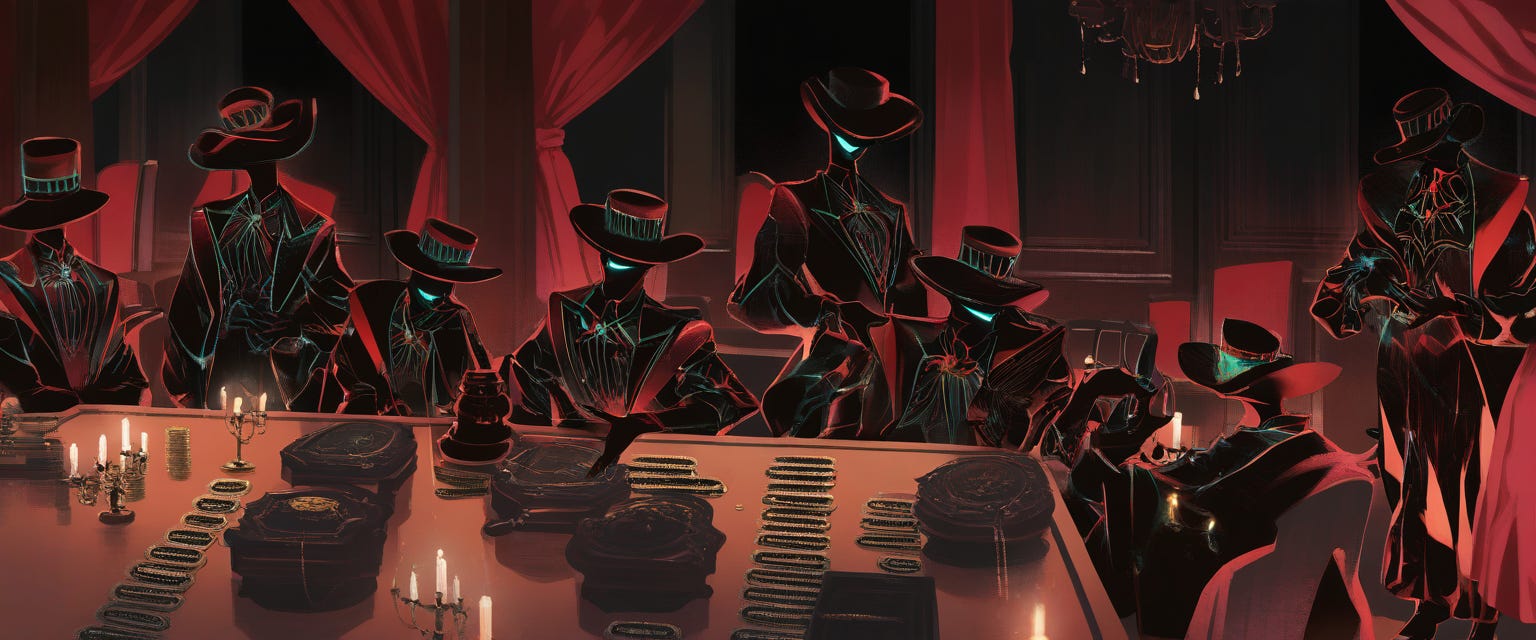
This unleashed “Scripomania”: a historic, feral, out-of-control speculative bubble. The same men who had just made 800% yields off the starving veterans, led by Hamilton’s former assistant William Duer and his “Six Percent Club,” took their newly minted fortunes and threw them into the casino.
They attempted an illegal bear squeeze on the market. They embezzled public funds. They engineered a massive derivative bubble built entirely on debt and hype. And in 1792, predictably, it violently ruptured.
The market crashed. The speculators were wiped out. And what did the Architect of the Treasury do when his friends bankrupted themselves? Alexander Hamilton used public taxpayer money to engineer the nation’s first financial bailout.
They privatized the profit. They socialized the loss. And they proved that the system was working exactly as designed.
Now they just needed the legal blueprint to make this extraction permanent.
THE APEX CHEAT CODE: THE S.U.M. CHARTER (1791)
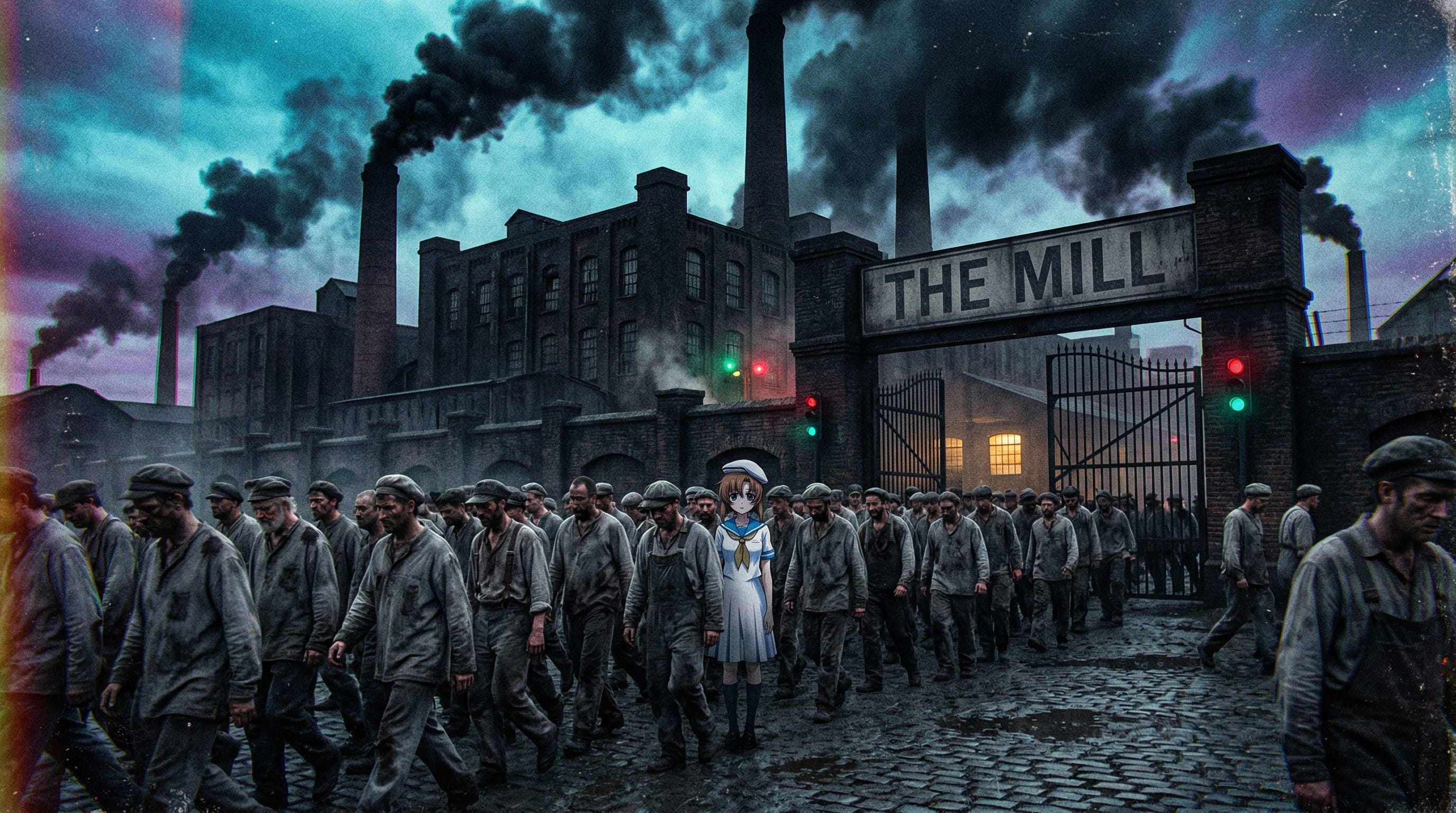
If you look up the Society for Establishing Useful Manufactures (S.U.M.), the official story is deeply patriotic. It was supposedly a noble endeavor by Alexander Hamilton to build an independent American industrial base and break our reliance on British textiles.
That is the Report.
The Receipt is that the S.U.M. Charter was the legal blueprint for the unaccountable, modern mega-corporation. Hamilton didn’t just build a textile mill; he built a quasi-sovereign entity. He effectively outsourced the violence and immunity of the federal government directly to a private board of directors.
🔪 THE POCKET RAZOR: True power isn’t making the law. True power is writing yourself a permanent exemption to it.
Here is the exact structural math of how they coded this new machine:
The Forever Tax Shield: S.U.M. was legally exempt from local and county taxes forever. The everyday citizens of Paterson, New Jersey, were forced to pay out of their own pockets to permanently subsidize the corporation’s civic footprint.
Privatized Eminent Domain: The State granted this private board of directors the power to aggressively seize private land and water rights from working-class citizens for their own corporate profit.
The Public Lottery: To fund their venture capital, they didn’t just ask investors for backings. They were explicitly authorized by the state to run public lotteries—literally socializing their speculative risk by extracting it directly from the desperate poor.
Corporate Lawmaking: The absolute cheat code. The S.U.M. Charter authorized the corporation to essentially govern itself as an unelected municipality, giving them complete, unilateral dominion over their workers and entirely crushing any local democratic accountability.
They had built the perfect, unassailable engine of extraction. But an engine is useless unless you can physically enforce the compliance of the people you are extracting from.
When the exhausted rural working class finally realized they had been priced out of their own country and tried to push back, the financial elite didn’t negotiate. They simply deployed the muscle.
THE MUSCLE: THE WHISKEY REBELLION (1794)
The fairy tale ends with George Washington bravely putting down a crowd of drunken, tax-evading rioters in Pennsylvania to establish the “rule of law.”
🔪 THE POCKET RAZOR: “The Rule of Law” is the ultimate Layer 2 mask. If you write the laws—and design them explicitly to protect your monopolies while bankrupting your competitors—you can deploy overwhelming military terror against your own people without ever being called a tyrant. You are simply a patriot enforcing the “rule of law.”
To ensure the working class can never legally dismantle this system, the elite build financial fortresses around the law itself. They write it in incomprehensible Legalese, and demand a $200,000 debt paywall to join a private, self-regulating guild (The Bar Association) just to step foot in court. You cannot fight them in their own arena because they own the referees, the rulebook, and the admission tickets.
Stripped of this polite illusion, “the rule of law” during the Whiskey Rebellion was nothing more than a sterile bureaucratic term for deploying the United States military to act as an armed debt-collection agency for Wall Street. The truth is much darker. The “Whiskey Rebellion” was the moment the federal government deployed overwhelming military terror to crush independent small businesses and mathematically enforce a financial monopoly for the eastern elite.
If a tax targets your behavior, it’s revenue. If a tax targets your math, it’s an extermination protocol.
Hamilton’s excise tax was an algorithmic trap.
It charged his friends in the massive commercial eastern distilleries a flat fee, bringing their cost of production down to about 6 cents a gallon.
Meanwhile, it forced the small, independent frontier farmers to pay a volume rate, costing them up to 18 cents a gallon.
Worse, Hamilton demanded the tax be paid in specie (gold or silver coin). The frontier was a barter economy; whiskey was their currency. He demanded payment in a currency that physically did not exist in their zip code, mathematically guaranteeing their default.
When roughly 500 desperate farmers finally pushed back, the elite didn’t just arrest them. They made an example of them. Washington and Hamilton spent $1.5 million to march a 13,000-man federal army over the mountains in a breathtaking, disproportionate show of force. They literally bankrupted the treasury, spending almost a third of the total revenue the tax would ever collect, just to fund the army.
On “The Dreadful Night,” federal cavalry kicked in doors without warrants, dragged men out of their beds, tortured prisoners under General “Blackbeard” White, and paraded innocent, starving farmers in chains through the streets of Philadelphia on Christmas Day.
The message to the working class was absolute:
Submit to the financial elite, or we will bankrupt the country just to deploy the military against you.
THE WITNESS CUT: THE SALVAGE
I hate the polite stories.
The adults, the politicians, the textbook authors—they all smile and tell you the same polite story. They tell you that 1776 was about liberty, and that a group of geniuses built a stable system to protect the common man.
But when you start digging in the dirt, the polite stories always fall apart.
When you look at the receipts, the truth is always there, buried under the floorboards. As soon as the smoke cleared from the Revolution, the men who actually bled in the snow were paid in worthless paper while the polite men in Philadelphia engineered a casino to steal it all back.
A flower raised in a greenhouse is beautiful, sure. It never has to worry about the frost. But a flower growing in the dirt—a flower that has braved the wind, the rain, and the freezing cold—possesses something much more than beauty. It possesses survival. The farmers who fought that war, who were crushed by Hamilton’s math and marched in chains, were the field flowers.
When you look around today—when you feel that creeping panic about the price of groceries, the unpayable debt, the exhausting, empty grind of the corporatized gas station—they tell you it’s your fault. They tell you to just work harder.
They are lying.
It isn’t an accident, and you aren’t crazy. It was engineered this way in 1791.
The architects of this system are arrogant. They think you’ll never look past their polite smiles. They think you’ll never dig up the receipts they left scattered on the floor.
But we found them. We don’t have to be exhausted and terrified in the dark anymore. Because when you can finally see the exact mechanics of the machine, you can finally figure out how to dismantle the engine.
In 1791, Alexander Hamilton built the perfect extraction engine. As we saw in Part 1, the math was flawless. The elite wrote a closed loop where the public bore all the risk, the private monopoly extracted all the profit, and if the working class ever pushed back, the federal army would march over the mountains to enforce the debt.
Every piece of the structural math outlined in this autopsy is publicly verifiable. The financial elite expects you to be too exhausted to dig into the archival data. Prove them wrong. Here is the forensic scaffolding used to compile this module:
1. The Alchemy of Exhaustion & 1776 Macro-Economics:American Revolution Economic Analysis — Documentation on hyperinflation, the Continental Dollar, and the mathematical collapse of the rural working-class purchasing power.
2. Robert Morris & The First Privatization:Analyzing Early US Banks’ Structure — The capitalization records of the Bank of North America, public risk vs. private monopoly, and the 8.5% dividend payouts.
3. Hamilton’s Assumption Engine:Analyzing Early US Banks’ Structure (Part II) — The 1790 Funding Act, William Duer’s insider trading ring, the “fast horses” intelligence asymmetry, and the 800% yields extracted from rural veterans.
4. The Derivative Bubble of 1791:1791 Scripomania Crisis Analysis — The structural flaws of the First Bank IPO, the $25 margin structure, the 1792 bear squeeze by the “Six Percent Club,” and Hamilton’s taxpayer-funded bailout.
5. The Apex Cheat Code:S.U.M. Charter: Monopoly’s Legal Blueprint — The original 1791 charter granting permanent tax immunity, privatized eminent domain, lottery rights, and corporate municipal governance to the Society for Establishing Useful Manufactures.
6. The 13,000-Man Army (1794):Whiskey Rebellion: State Violence Reframed — The algorithmic trap of Hamilton’s flat-fee vs. volume excise tax, the weaponization of an arbitrary gold/silver mandate, the military logistics of the Philadelphia march, and “The Dreadful Night” under General White.
Months ago, I made a deal with you. I asked you to invest in my liberation from the gas station so that I could dedicate 100% of my time to this war. You answered. The Liberation Number has been hit. The chains of the Day Job are broken. The Operator is fully active.
But we didn’t escape the prison just to survive. We escaped to burn it down.
THE NEW OBJECTIVE: SCALE & DOMINANCE.
We are no longer fighting for time. We are fighting for territory. Your paid subscription is now a direct investment in the Sovereign Systems War Chest. We are moving from guerrilla skirmishes to full-scale narrative campaigns.
The Machine has billions. We have the Truth, and we have each other. Our counter-attack is to become undeniable. Choose your front:
Access the Inside the Forge series—members-only debriefs where we document the construction of a new media empire. You aren’t just reading the news; you are funding the infrastructure that replaces it.
Mission: Fund the expansion. Build the fortress.
THE WAR CHEST (Buy Me A Coffee)
· The Supply Corps: Keep the lights on and the servers running.
· The War Room: Direct access to raw intelligence before it hits the wire.
If I may suggest, also keep all of your content in your owned website/platform. Or store a copy of it in your drive (Google sure and a non-American one for redundancy).



















If I may suggest, also keep all of your content in your owned website/platform. Or store a copy of it in your drive (Google sure and a non-American one for redundancy).
Thank you for opening my eyes, Ethan. I sure as hell didn’t learn this in school (by design).