



I’d been at the bar an hour past when I should have left because the suit was the only one I owned and it wasn’t going out in that rain. The man who took the stool next to mine wore a watch that cost what my house did. Maybe that’s why he started talking to me. It was a piece you’d have to be close to real money to recognize, and selling luxury watches gave me the proximity without the ownership. He ordered without raising his voice and the bartender leaned halfway across the wood to catch it. Then the man turned to me with a warm smile that stopped just short of his eyes.
“You ever worked construction?” he said. “How about demolition?”
“Construction.”
“Then you’ll get this. Most people don’t know how to build anything. With their hands, I mean. Piece by piece. What’d you build?”
“Homes. Single-family. Started as a laborer, then carpentry. Eventually worked my way into the office. You?”
“I’ll get to that. But good, then you know what I mean. Most people don’t, they don’t know how a thing is made, so they don’t know how to take it apart either. Anybody can knock a thing down — watch a two-year-old with a pile of blocks, watch the news. Doing it right, that’s the asset. That’s my trade.”
“What do you mean?”
“Demo gets expensive. Say you want ten homes on a lot and there’s an old building on it. It has to come down, and the longer it’s stood the harder it is. Asbestos, lead paint, other shit like that. You test, you abate — clean, documented. Expensive. Slow.”
“That’s the right way to do it.”
“You’re not listening. Hear me out. It’s slow, and you know what slow means. Every day the debt accrues and nothing pays out until the job’s done or the house sells. You’re on borrowed money the whole way.”
I nodded. I knew that part. Every delay, every day a house sat unsold, came out of the margin.
“And say you want to build somewhere else — the block that’s been dragging the numbers down for years. You get people who won’t sell. Want to stay for their own reasons. Now you’re fighting them too. That’s conquer. That’s doing the demo yourself. Here’s the right way.”
I listened, he had my attention.
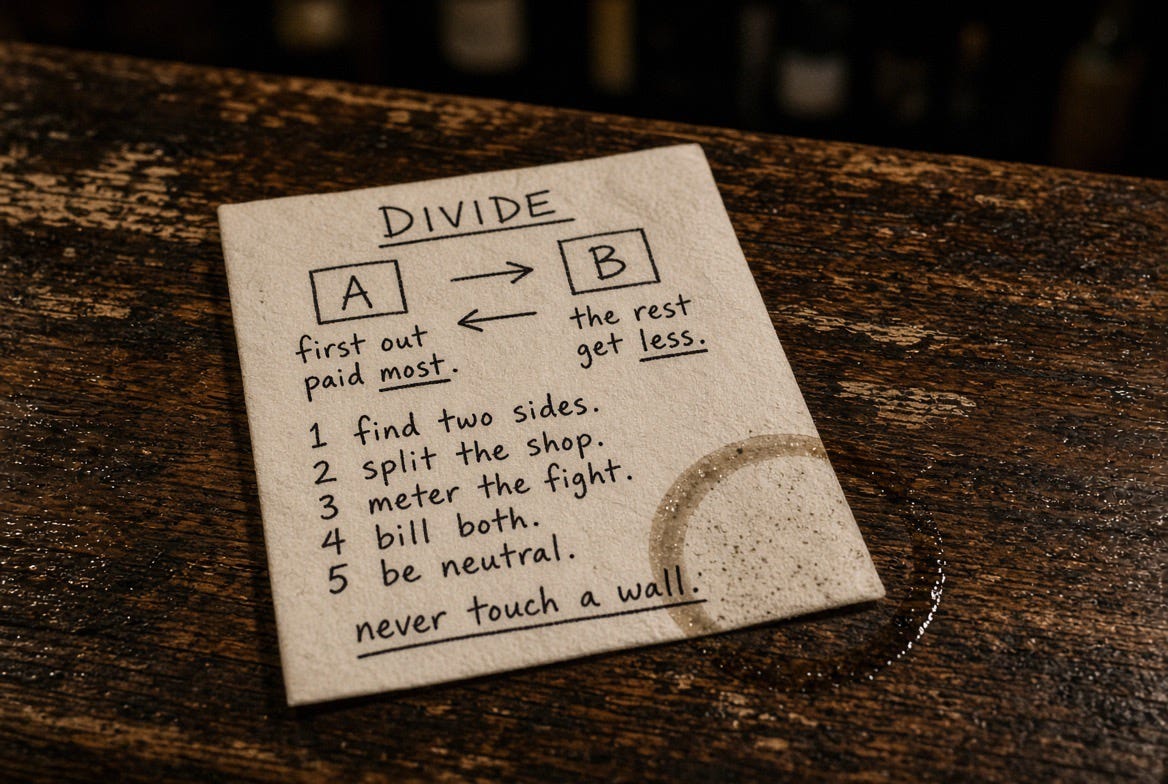
“Divide. Don’t conquer. Instead, get the residents to move each other out. Offer them different amounts, openly, and let them talk — you want them talking. Pay the first one out the most. Everyone after gets less, and they know it. Now some will follow. Pretty soon the only ones left have been sold out by their own neighbors, and they’ll never sit at one table again — not against you anyways. They’ll tear each other apart eventually. You never touch a wall.”
I didn’t say anything, I was still trying to take in what he had just said and why he was telling me this. The man continued:
“That’s one block, you master that, you can rule the world. It’s no different for a country. Give it two parties and fund them both. Let them talk, let them fight over votes, and sell the fight to everyone watching — by the hour, by the click. The things you need pass either way. And if that’s too slow, start a war. Let them tare it down, it will be faster than you ever could and you’ll get paid. You just sell the guns, the drugs, the lines they can say with a straight face. Then you sit back and watch it rot. When it’s rubble, you clear the land and they pay you again — to clean it, and to build something new. You own them. And you don’t have to maintain a thing. You take what you want, when you want it.”
He held up a hand. “Five moves. Works at any size.”
Find two sides. Don’t pick one. Sell them both what they can’t wait for — a loan, a road, a machine, the news. Sell it when they need it worst. Nobody reads the terms in an emergency.
Split your shop. Lending desk, ranking desk, legal. Nobody in the building sees the whole thing, so nobody in the building did it. When the letter comes, the desk that reads it can’t act, and the desk that could act never reads it. File it.
Meter it. A little more to one side this month. A little short to the other. Keep the fight the same shape — nobody wins, nothing ends. Where the meter isn’t enough, pay for the law and pay for the story.
Bill the fight — by the truck, the hour, the click, the dollar collected. Bill the rebuild. Hold the deed.
Be neutral. On the record. That’s the whole trick. Say you have no stake. Put it in the founding document so anyone can check it. What you’ve built is the one thing nobody may check, because checking you would be the tilt, and the tilt is what you swore off. You don’t exist, not really. Nothing to sue, nobody to vote out, no door to knock on. And you’re not just holding the deed now. You’re holding the rails every one of them runs on, and if it ever comes to it you can pull the whole lifeline out from under half of them and point at somebody else. Best part — you never call a meeting. Set the pay right and it runs itself.
“Sounds like a con,” I said.
“It’s already running. Watch.”
“Name one.”
“Look at the one everybody’s heard of and nobody’s read. Articles of Agreement, Article 4, Section 10. Heading says political activity prohibited. The bank and its officers shall not interfere in the political affairs of any member, shall not be influenced by the political character of any member, and only economic considerations shall be relevant, weighed impartially. Signed 1944. Article 7 makes the archives inviolable and the bank hard to sue. Now read the name on the door.”
He showed me a picture on his phone screen, a rich wooden door with a plaque.
“World Bank.” I read.
“International Bank for Reconstruction and Development. Reconstruction comes first. Money arrives in tranches. Tranches arrive when terms are met. They set the terms. The country gets the rebuild, the bank gets the debt, and the only file on whether any of it worked is the bank’s.”
“That’s countries. I develop lots, quarter acre of land maybe.”
“Then bring it down to one house. You got kids?” He asked abruptly.
“Two.”
“Sign the paper at the hospital?” He pressed.
“Everybody signs the paper.”
“Staff filled it out for you. Free. Witnessed it. In a lot of states you can sign it at sixteen with nobody’s permission. No test, no hearing, no lawyer. Sixty days later it’s fixed, and after that even a DNA result saying the kid isn’t yours won’t undo it by itself. Nothing happens yet. The paper waits.”
“For what?” I asked.
“For one of you to need something. Years go by, you split, the one with the kid runs short and applies for help. That application signs the kid’s support over to the state and opens a case on the other parent Nobody files anything. Nobody has to want it. Now there’s a court between you, and the court says it’s the neutral one — you two are too close to see straight. It sets a number.”
“On what you make.” I say a little too forcefully.
“On what you could be making, if you don’t show, or can’t prove it. Every month you miss becomes a judgment by law and can’t be lowered later. The agency gets paid by the dollar collected. Five federal measures — paternity, orders, current collections, arrears, cost-effectiveness. The child is none of them. So the neutral party is paid by the signature and by the dollar collected out of one side.
“And there’s two lines on that order. The money line has a machine behind it — garnishment, license, passport, jail. The time line, the days the kid is supposed to be with you, has a form you can file and a hearing when they get to it. Same paper. One side runs itself.”
“They can’t set it on money you don’t have.” I insist.
“They can. They do. In 2016 the government wrote down what that does — debt, joblessness, off-the-books work, jail, and it hurts the kid — and then left every old order standing. North of a hundred billion owed, most of it by people with nothing. And here’s the tell. States forgive the slice they own, and they publish why: parents work more, earn more, and pay more when that debt comes off. They know relief works. They do it where it pays them.”
“The judge —”
“Can’t be sued for what he does on the bench. And the Supreme Court has said twice the state owes no duty to protect you from the other side. A home like that is an adverse childhood experience on the government’s own checklist — four or more and the addiction odds run four to twelve times. The court has a name for itself in all this. Parens patriae. Parent of the country.
I didn’t say anything.
“Last one. It’s in your pocket.” I turned the phone face down. “You ask it things?”
“Sometimes.”
“You pay by the word. Not by whether the answer was any good. They sell usage and the usage always arrives — that part never fails. When it goes wrong, the argument is how much was the tool and how much was you holding it wrong, and that argument has no end and no referee. When it goes right, the headline says the machine solved it. Somebody asked, and everyone’s work came back arranged.”
“Whose work?”I asked.
“A federal judge ruled last year that training on books they bought was fair use. Free. What cost them was the pirated library — half a million titles, a billion and a half dollars. They paid for how they got it, not for having it. The corpus stays. And when you and the person you’re fighting both open an account, you get two rooms, two accounts, and no shared transcript. Neither of you can produce the record. There isn’t one.”
He nodded at the phone. “You turned it over. That’s the only move you’ve got on that one.”
“Where doesn’t it work?” I said.
He looked at me for the first time like I finally asked the right question.
“Two places, and they’re the same place. Where the bill lands on their kitchen table the same month. And where the county can still say no. Those data centers — the ones going up for the thing in your pocket. The neighbors could read their own electric bill and the zoning board could vote. Seventy-five of them stopped in one quarter this year, a hundred thirty billion, because the neighbors could read their own electric bill and the zoning board could vote. That’s the whole defense. Can they see what it cost them, and can they say no. Everything I told you tonight is how to make sure the answer to both is no.
“I can tell you that because it takes two of you. And you came in alone.”
He stood and put a bill on the bar that covered both of us.
“You’ve been leaning in like I’m pitching you,” he said. “I’m not. You’re one of the two sides. So is whoever you’ve been fighting.”
Then he was gone, and I was still there, and so are you.
The whole thing runs on the two of you never looking up at the same time.
-Fire tongue🔥
How to undo fragment steal and destroy people families communities take their good will , demolish their good faith dealing , their decades of hardwork , This descis a malevolent force to be slayed This is our work
Intriguing. Plans within plans. Strategy to disarm, keep impotent, and records, if any, un-openable.