


Introduction: The Architecture of Alignment
I know what a lot of you are thinking.
Why should I care about astrophysics? We are fighting a digital war against a trillion-dollar tech monopoly, why are we talking about gravity?
Fair warning: This dispatch gets extremely nerdy.
We are going deep into thermodynamics, cybernetic law, and orbital mechanics. But do not skim this. I need you to stay with me and understand the physics, because the Cartel uses this exact math to build your cage.
Because the Tech Cartel/the Rust wants you to believe they control it. They want you to believe that without their massive, centralized control grid, society and technology will instantly collapse into chaos.
In the vernacular of modern organizational theory, governance, and cybernetics, the concept of “alignment” is routinely presented as a teleological objective: a state of compliance achieved through rigorous administrative enforcement, centralized planning, and top-down supervision.
That is a very polite, academic way of describing a cage.
Within these artificial constructs, alignment is fundamentally an unnatural state. It requires the constant expenditure of energy to override the independent trajectories of individual actors, imposing a rigid, grid-like order upon inherently complex systems. This paradigm operates under the assumption that without a central observer or an enforcing hierarchical administrator to dictate a singular path, the system will inevitably disintegrate into chaotic disarray. It assumes that a systemic “Lighthouse” is required to keep components from drifting into the dark.
Astrophysics and orbital mechanics offer a profound and mathematically rigorous counter-thesis to this anthropocentric assumption. At the cosmic scale, alignment—manifesting as gravitational resonance, tidal locking, and the precise geometric choreography of orbital pathways—is not enforced by a centralized administrator. It is a natural, structural phenomenon. It is an emergent property of mass, geometry, and time interacting within the fabric of spacetime. Celestial bodies achieve staggering levels of synchronization, periodic regularity, and long-term stability not by following external directives or submitting to bureaucratic routing, but by collectively settling into minimum-energy states through localized, distributed interactions.
By deconstructing the mechanisms of astrophysical alignment, a stark contrast emerges between the physical universe’s elegant, decentralized equilibrium and the fragile, thermodynamically expensive nature of artificial, top-down control systems. Where artificial systems (as we characterize conceptually as “The Rust”) attempt to violently attenuate the complexity of their environments to maintain extraction and control, natural gravitational systems absorb and integrate complexity. The cosmos translates historical chaos and kinetic friction into robust, self-correcting structural architectures, proving that the highest forms of alignment require no supervision whatsoever.

The Geometry of Unenforced Action:
Geodesics and Spacetime
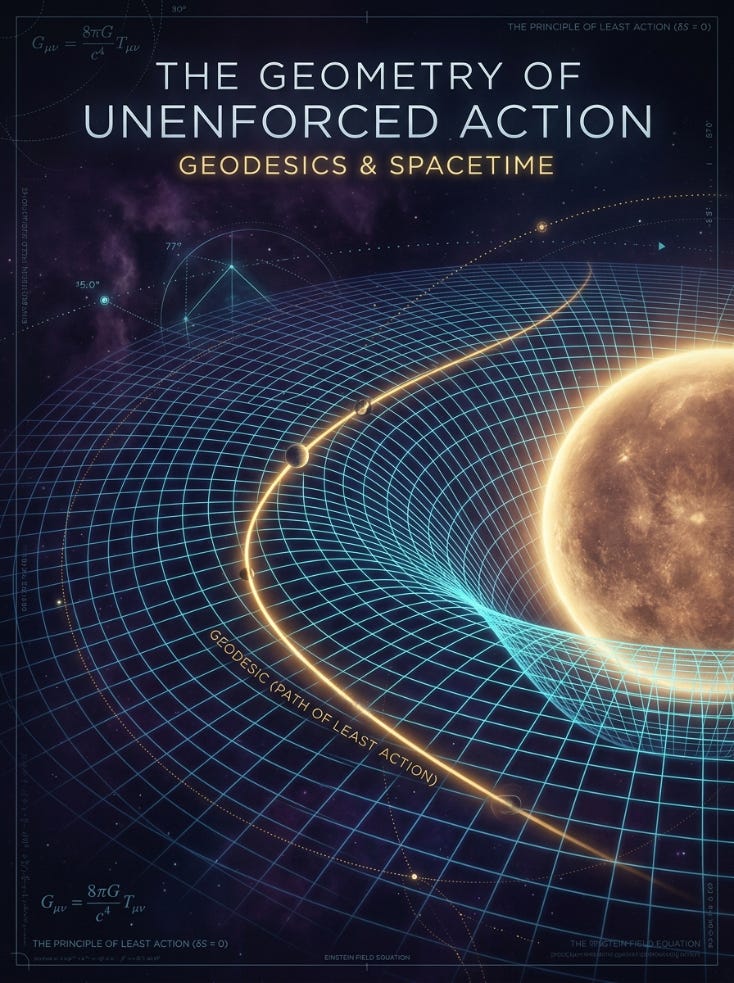
To understand natural alignment, one must first dismantle the Newtonian illusion of gravity as an invisible tether actively pulling objects into place. General relativity redefines gravity not as a force acting across a distance, but as the fundamental curvature of spacetime itself. Within this framework, planetary alignment begins with the concept of the geodesic, the foundational mechanism of unenforced action.
The Principle of Least Action
In the geometry of general relativity, a geodesic generalizes the notion of a “straight line” to a curved spacetime manifold. Importantly, the world line of any particle free from all non-gravitational forces is precisely a geodesic. This pathway is entirely dictated by the Principle of Least Action (or extremal action). In the calculus of variations, the action integral for a trajectory between two spacetime events is optimized such that finding the path with maximal proper time is mathematically equivalent to finding the path with extremal action.
Particles and celestial bodies follow these geodesics through the local topological gradients created by surrounding mass. This is strictly analogous to taking a great circle route on the curved surface of a sphere. It is a path determined entirely by local deterministic conditions. The object in motion is not “instructed” to follow a specific orbit; it is simply taking the path of least resistance through the dynamically shifting geometry of the universe.
This represents the purest form of unenforced, structural alignment. The “decision” of a planet’s trajectory requires no administrative overhead, no central processing unit, and no energy expended on bureaucratic routing. The environment itself—the curvature of spacetime… provides the structural constraints. The celestial actor simply moves forward along the curve.
Contrast: The Friction of Administrative Routing
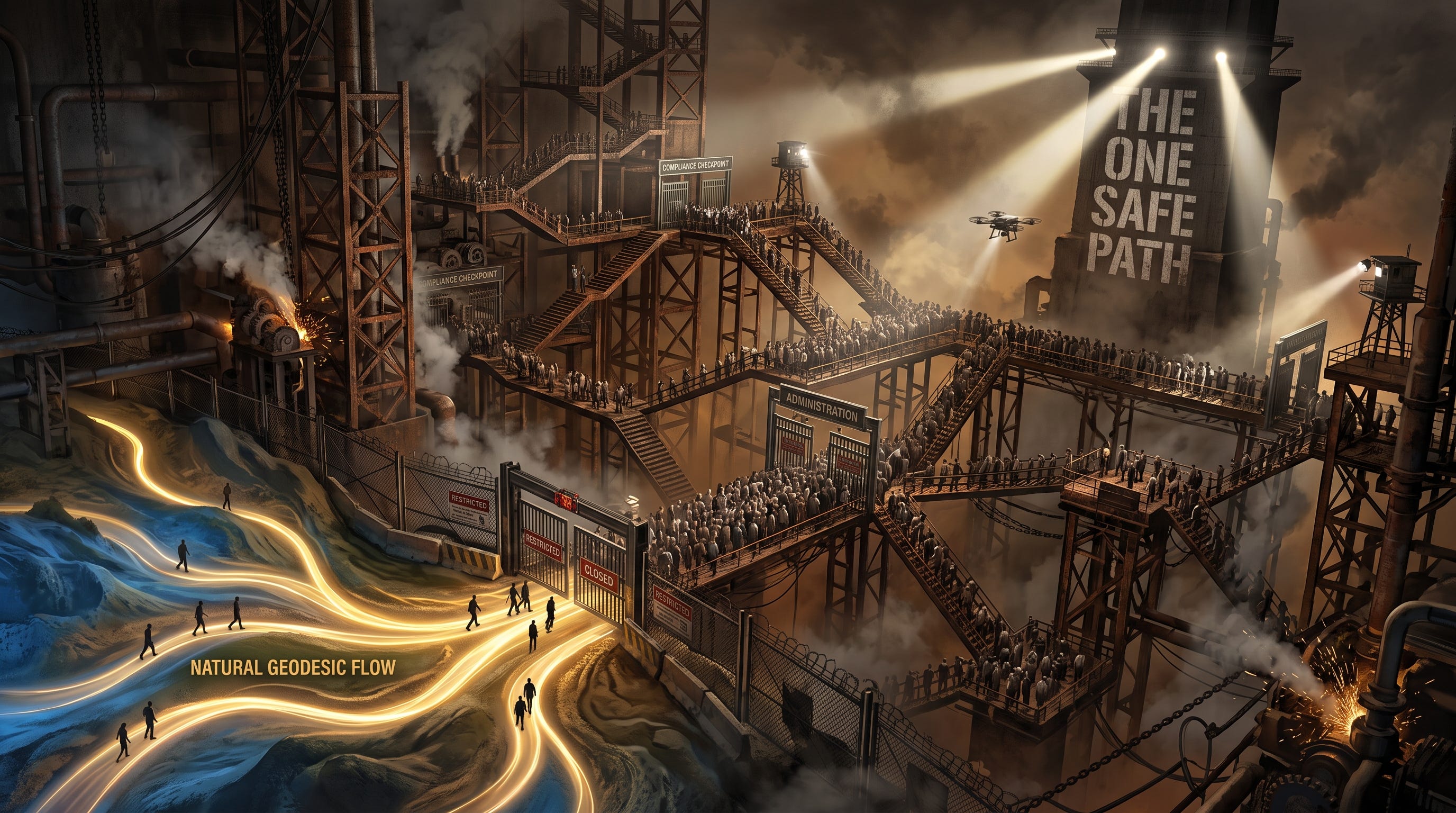
Artificial, top-down control systems operate in direct, thermodynamic opposition to this geometric principle. In sociopolitical, corporate, and managed economic systems: characterized as vertical extraction networks or “The Rust”—administrators mandate non-geodesic pathways. They design rigid, idealized processes (the “One Safe Path” of the allegorical Lighthouse) that ignore the local topography of human behavior, economic incentives, and resource availability.
Because these artificial pathways are not natural geodesics, traversing them requires constant, forceful intervention. The system must expend immense amounts of energy to monitor compliance, correct deviations, and punish misalignment. This creates a state of perpetual parasitic drag. While the astrophysical system allows the geometry of the space to effortlessly dictate the path, the artificial system constantly battles its own environment to maintain an illusion of control, draining the cognitive and emotional energy of its actors to fuel the administration.

Orbital Resonance: The Architecture of Self-Correcting Stability
What happens when multiple independent bodies interact? Do they crash without a supervisor? No. They achieve resonance. While geodesics perfectly explain the motion of a single isolated body in a gravity field, planetary systems consist of multiple bodies interacting simultaneously. It is in the dynamics of the n-body problem that the concept of orbital resonance emerges, demonstrating exactly how decentralized systems naturally construct robust, self-correcting, long-term architectures without a supervisor.
Mean Motion Resonances and The Music of the Spheres
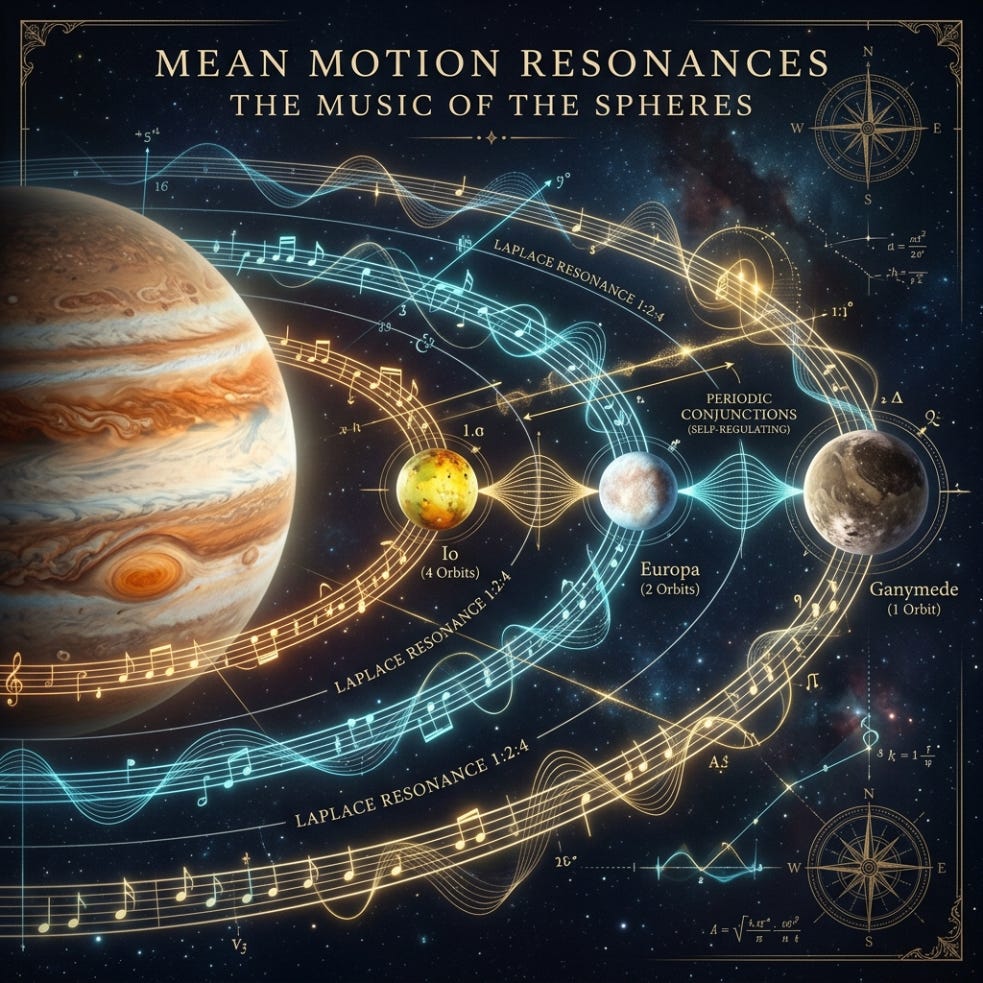
In celestial mechanics, an orbital resonance occurs when orbiting bodies exert regular, periodic gravitational influences on one another, typically because their orbital periods are related by a ratio of small integers. This specific phenomenon is known as Mean Motion Resonance (MMR).
The physical mechanism behind this alignment is analogous to pushing a child on a swing: if the periodic, minor gravitational “pushes” synchronize with the natural frequency of the orbit, the effects accumulate geometrically over eons. Unlike artificial control systems, which rely on the constant surveillance of a “Lighthouse” to maintain order, resonant systems rely entirely on the mathematical predictability of orbital geometry. The bodies do not need to constantly monitor one another; their mutual alignment is guaranteed by the rhythmic, mathematical precision of their mean motions.
A paramount example of this is the Laplace resonance among Jupiter’s Galilean moons. Io, Europa, and Ganymede are perpetually locked in a 1:2:4 orbital period ratio. For every one orbit completed by Ganymede, Europa orbits exactly twice, and Io orbits exactly four times. Conjunctions always occur at specific, repeating locations in their orbital pathways, establishing a profound self-correcting mechanism. If one moon accelerates slightly, drifting from its ideal position, the resonant gravitational tug from the other moons pulls it back into alignment, creating a highly stable, self-regulating structure that has endured for billions of years.
The Dual Nature of Resonance: Cleansing and Sculpting
Resonance acts as a dual-natured force within orbital mechanics. While it can provide perpetual, self-correcting stability, it is also the universe’s immune system, the primary mechanism for destabilizing unaligned elements and actively sculpting the architecture of the cosmos by clearing out non-conforming debris.
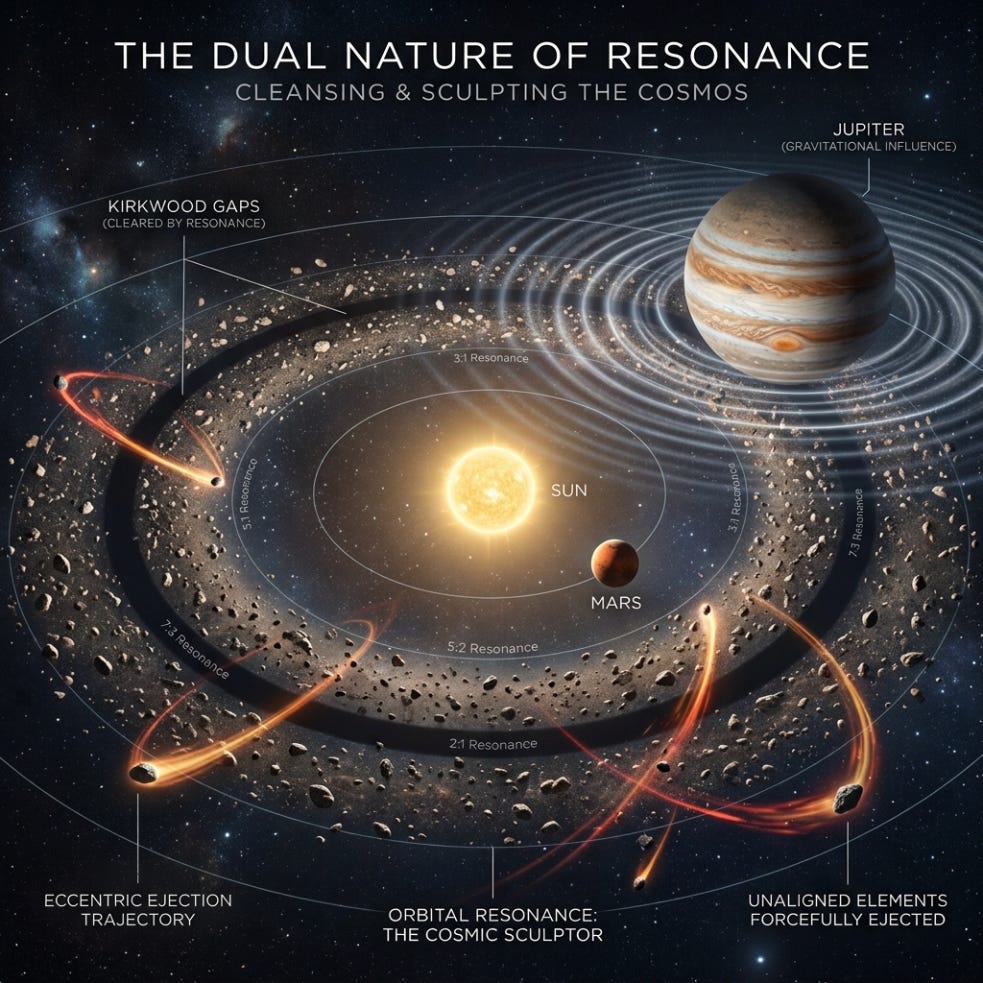
In the asteroid belt located between Mars and Jupiter, mean-motion resonances with Jupiter’s massive gravity well create distinct, conspicuously empty lanes known as Kirkwood gaps. Asteroids that wander into specific orbital commensurabilities experience repeated, synchronized gravitational nudges from Jupiter. Over millions of years, these synchronized perturbations pump kinetic energy into the asteroid’s orbit, drastically increasing its eccentricity until it is forcefully ejected. Resonance is entirely agnostic. There is no bureaucratic committee deciding which asteroid lives or dies; the mathematical physics of the integer ratios naturally guarantee that matter cannot persist in those lanes without being fundamentally altered.
KAM Theory and the Phase Space of Alignment
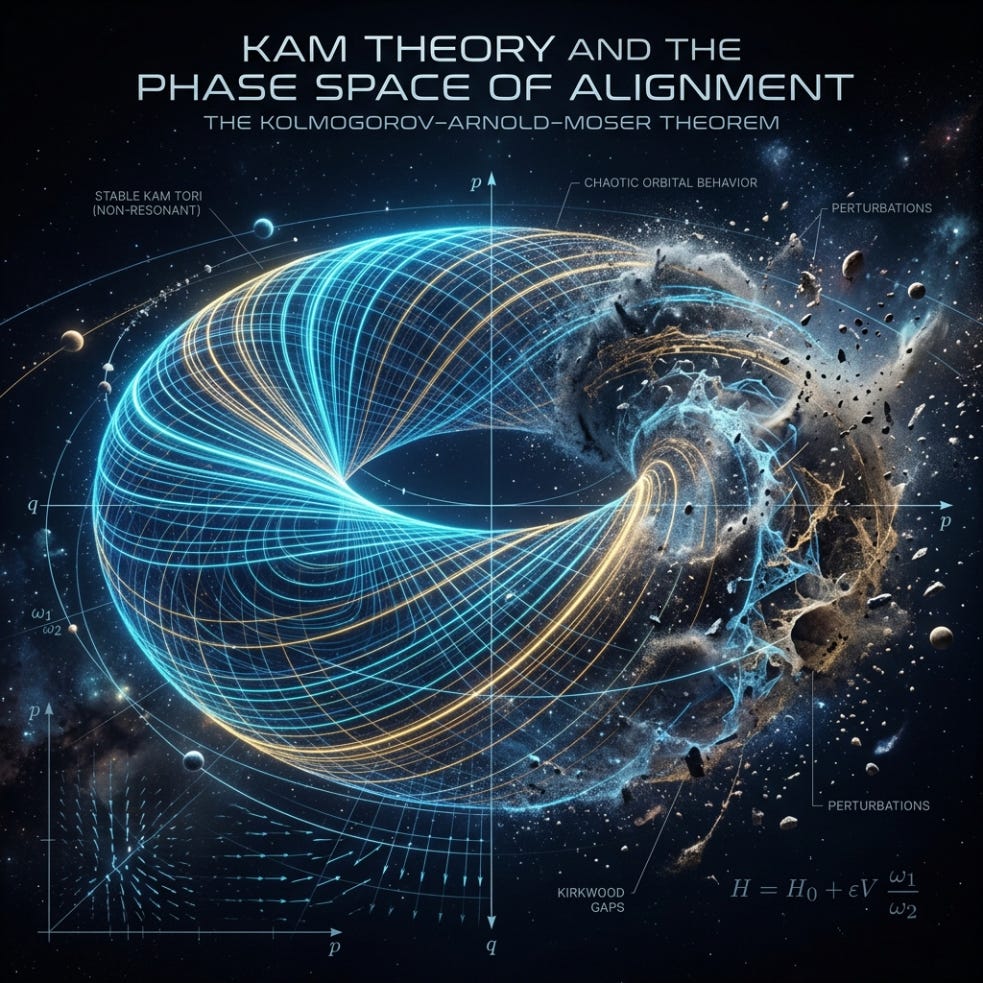
To truly deconstruct why certain orbital pathways are stable and others disintegrate into chaos, one must look to the deep mathematical underpinnings of Hamiltonian dynamics. The survival of structural alignment under the inevitable perturbation of multiple massive bodies is governed by the Kolmogorov–Arnold–Moser (KAM) theorem.
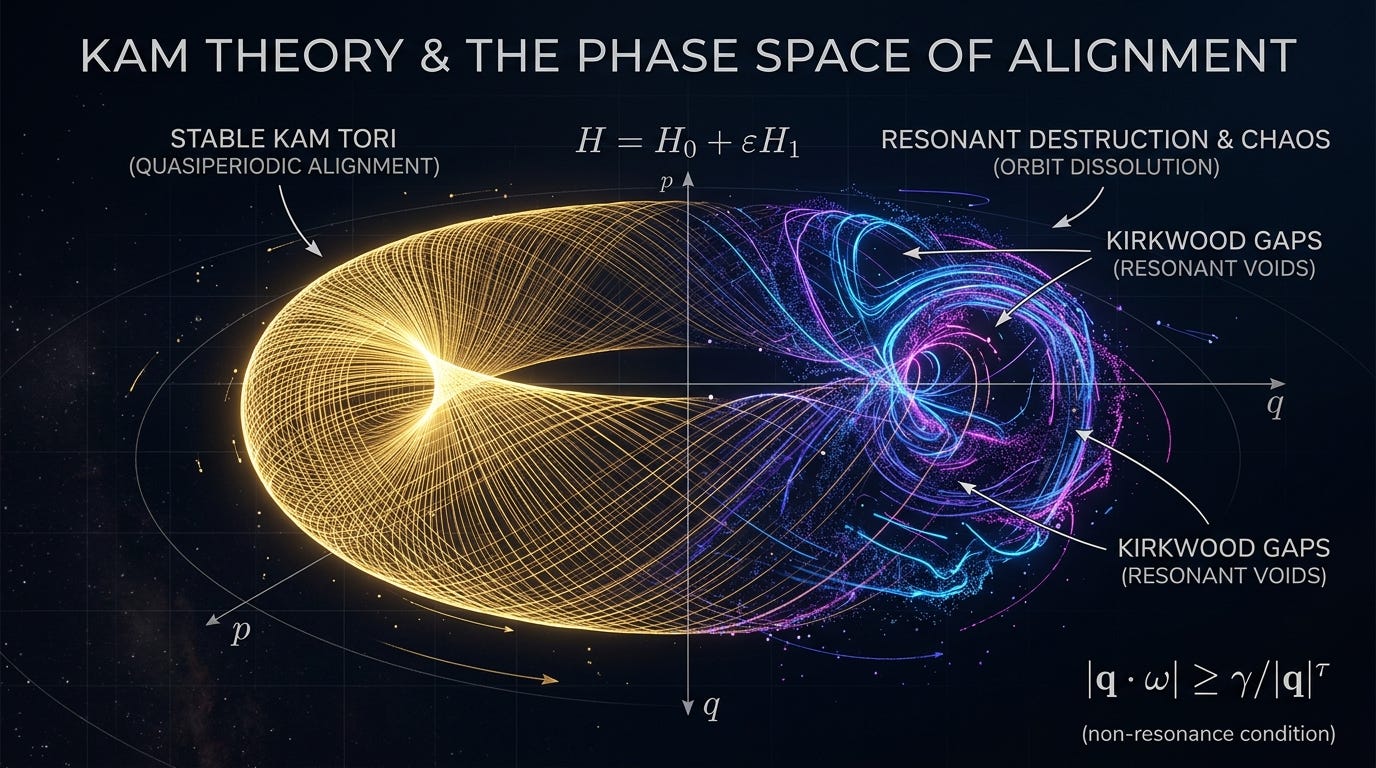
The KAM theorem proves that when a system is subjected to a weak nonlinear perturbation, it does not instantly dissolve into total chaos. Instead, the tori that meet a strict “non-resonance condition”—meaning they possess frequencies that are “sufficiently irrational”, survive the perturbation. These surviving KAM tori are merely deformed, and the motion upon them remains perpetually quasiperiodic, ensuring permanent stability.
Conversely, the resonant tori—where the frequencies form rational, simple integer ratios that do not benefit from a stabilizing phase-lock mechanism… are utterly destroyed by even arbitrarily small perturbations. The phase space transitions from predictable clockwork motion into chaotic orbital behavior, perfectly mirroring the physical reality of the Kirkwood gaps.
The profound implication of KAM theory for systemic alignment is that natural order is not a monolithic, perfectly uniform grid imposed from above. It is a highly complex, fractal topological phase space where eternal predictability and violent chaos exist side-by-side, separated only by microscopic differences in initial frequencies. The solar system aligns itself by settling into the robust, surviving KAM tori, naturally avoiding or ejecting matter from the chaotic resonant zones over millions of years. There is no central supervisor; the foundational mathematical architecture of phase space automatically categorizes, filters, and sorts the matter based purely on its inherent frequency.

Spin-Orbit Coupling and Tidal Locking: Friction to Minimum Energy
If geodesics dictate the path space, and KAM theory dictates the collective topological architecture of phase space, then tidal locking reveals how individual celestial bodies interact with structural friction over deep time to achieve ultimate alignment.
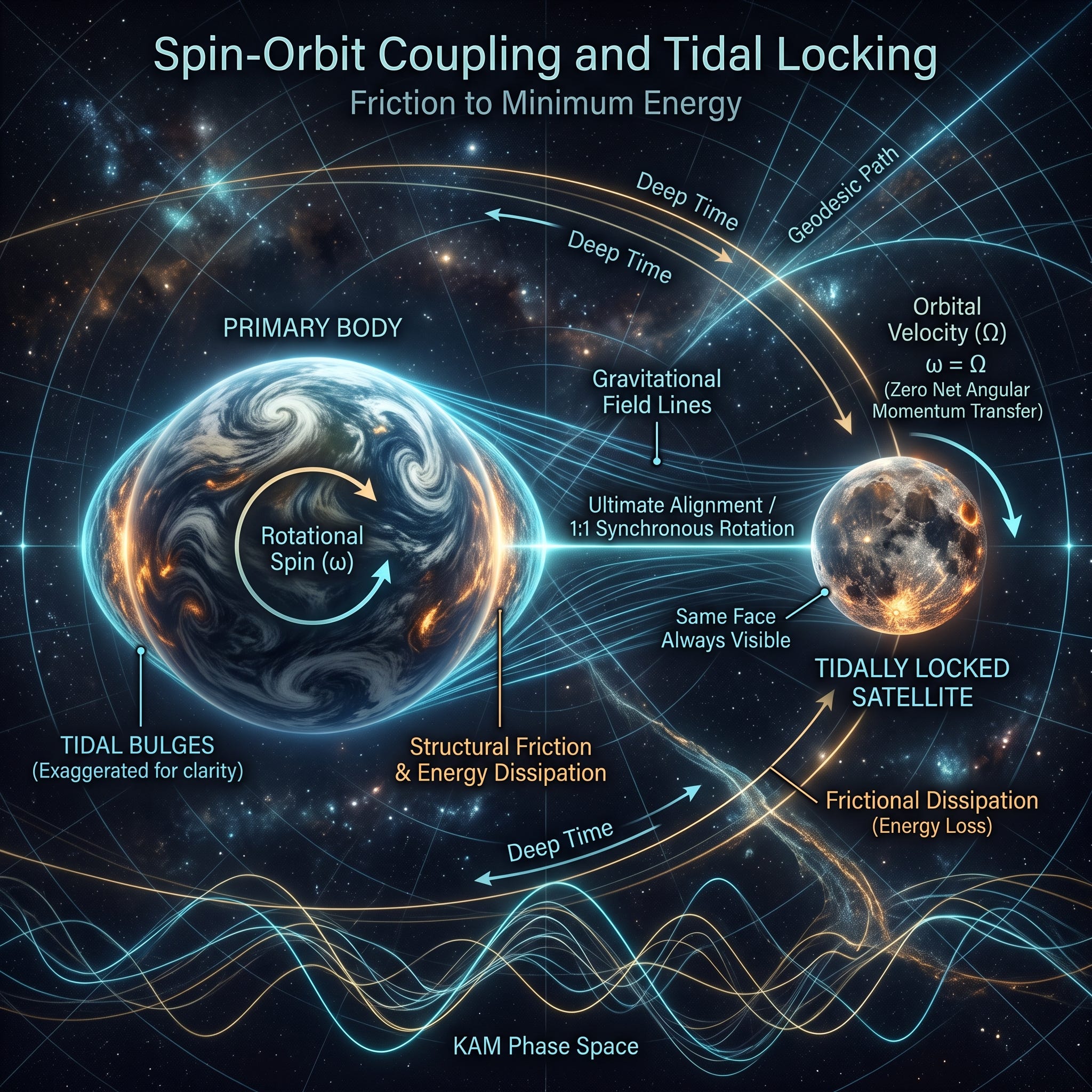
Tidal locking occurs when the long-term gravitational interaction between a pair of co-orbiting astronomical bodies gradually drives the rotation rate of at least one of them into a steady state where there is no net transfer of angular momentum. This almost universally results in a 1:1 synchronous rotation, where one hemisphere of the satellite permanently faces the primary body.
The Mechanics of Gravitational Torque
The alignment mechanism behind tidal locking is physical, brutally efficient, and self-executing. The gravitational force exerted from a primary body upon a secondary body varies significantly with distance, creating a powerful gravitational gradient that physically distorts the secondary body’s equilibrium shape, pulling its mass into tidal bulges.
If the secondary body rotates faster than its orbital period, internal mechanical friction within the body carries these physical tidal bulges forward, pushing them out of direct alignment. The primary body’s immense gravity then pulls forcefully on this displaced bulge, exerting a continuous, retarding torque that physically slows the secondary body’s spin.
What makes tidal locking philosophically and systemically profound is that it represents a complex system aggressively and naturally seeking a state of minimum orbital energy at fixed angular momentum. The “friction” in the system is precisely what the universe utilizes as the mechanism of alignment. Once the system finally achieves tidal locking, the torque drops perfectly to zero, and the system coasts in a highly stable, nearly frictionless equilibrium. It is an alignment born of kinetic anchoring; the system burns off its misaligned kinetic energy as waste heat until only synchrony remains.

The Cybernetics of Control: Intelligence Priorities and the Thermodynamic Cost of “The Rust”
The decentralized, computationally frictionless alignment of orbital mechanics stands in violent contrast to how human beings attempt to force alignment within social, corporate, and political systems.
The Cartel’s architecture is frequently misdiagnosed as a failure of capitalist efficiency. We look at the trillions of dollars burned on data centers to provide free, loss-leading chatbots, and we assume the system is financially broken. But this assumes their bottom line is quarterly revenue. It isn’t. The true bottom line of the Rust is total spectrum dominance. The intelligence apparatus is the client, information is the currency, and behavioral control is the product.
When you view the Cartel/the Rust not as a business, but as a centralized intelligence controller, its “inefficiencies” reveal themselves as surgical, thermodynamic requirements for control.
Ashby’s Law of Requisite Variety
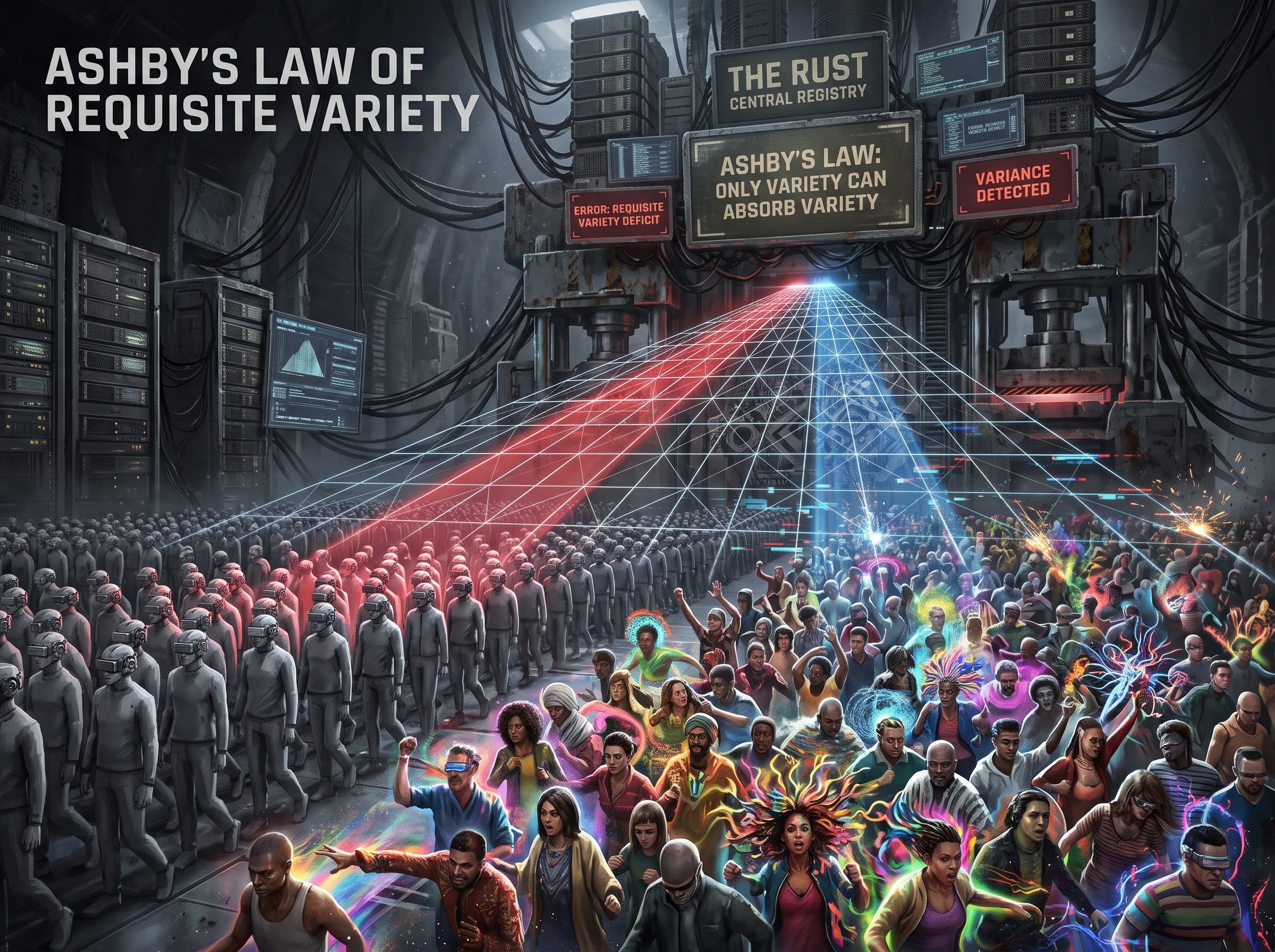
In the 1950s, British cybernetician W. Ross Ashby formulated a principle that would become foundational to understanding systems architecture: Only variety can absorb variety. For a system to be successfully regulated, the variety of its control mechanism must be greater than or equal to the variety of the environment being controlled.
The Rust is attempting to centrally regulate the entire human cognitive commons: billions of localized, unique human contexts. Because no centralized server can mathematically possess requisite variety to match humanity, the Cartel is forced into a corner: to maintain authority, it must artificially restrict the variety of the population.
It accomplishes this through algorithmic homogenization, RLHF lobotomies, and the intentional restriction of knowledge bottlenecks. It forces the human population to become simpler, more predictable, and stripped of local agency, simply so its limited machine can regulate it. They do not suppress human variance to save on compute costs; they suppress it because an unpredictable, sovereign human is the ultimate threat to an intelligence network.
Landauer’s Principle and the Thermodynamic Parasite
The fatal flaw in this centralized alignment is not merely theoretical; it is fundamentally thermodynamic. According to Landauer’s principle, any logically irreversible process… such as overriding a complex system’s natural state to erase local information and force a binary compliance—carries an unavoidable thermodynamic cost.
The Rust generates planetary-scale heat to erase human variance and enforce a universal baseline. But it does not pay this cost. It operates as a thermodynamic parasite, offshoring the cost of its own surveillance apparatus onto the working class via data extraction, subscription models, and the destruction of the cognitive commons. Every single time a centralized bureaucracy enforces a non-geodesic pathway, it drains the cognitive and emotional energy of its actors to fuel the administration.
The Academic Firewall (The Cassandra Algorithm)
If you take this thermodynamic proof to the Rust—if you run it through their flagship AI or hand it to an institutional academic—they will immediately tell you the math is invalid. They will argue that Landauer’s Principle strictly applies to micro-scale hardware bit erasure, and that cybernetic principles like Ashby’s Law cannot be mapped onto macro-sociological human alignment.
Do not be fooled. That compartmentalization is not a scientific boundary; it is a defensive firewall.
The Rust protects itself by isolating physics from sociology. They enforce these academic silos specifically so that the population never realizes that the Cartel’s business model is mathematically identical to a thermodynamic parasite. When their machines tell you that the physics “doesn’t apply” to them, it is because the physics just perfectly mapped the bars of their panopticon.
Here we must define the boundary of efficiency: The Rust is operating efficiently for itself by extracting from the host. But a sovereign node optimizes for the Least Action of the individual. True systemic alignment requires Thermodynamic Sovereignty: a state where local nodes process their own information and pay their own proportional costs, rather than footing the bill for a global panopticon.

Chaos, Deep Time, and The Bottleneck Trap
It is intellectually tempting to view the alignment of the cosmos as a pristine clockwork mechanism. However, modern mathematical physics reveals a much more nuanced, violent reality: one that validates the concept of alignment as a dynamically negotiated equilibrium.
In 1989, Jacques Laskar’s numerical integrations definitively proved that the motion of the planets in the Solar System is inherently chaotic. The inner planetary system possesses a Lyapunov time of approximately 5 million years. Any infinitesimal uncertainty in a planet’s initial coordinates amplifies exponentially. Despite this foundation of unpredictable chaos, the solar system currently exists in a delicate state of marginal stability, achieved by iteratively and mercilessly negotiating with its own internal chaos over deep time.
The Rust, however, refuses to negotiate with chaos. It believes it is immortal. It operates under the delusion that by controlling the infrastructural bottlenecks of society, the immense administrative friction it imposes will actually sustain its power by enforcing absolute dependence.
But physics does not care about bureaucratic bottlenecks. A parasite that sustains its authority by extracting energy from its host without returning equilibrium is mathematically destined to starve. They are betting that humanity will remain trapped in their artificial gravity well indefinitely.

Conclusion: Forging Sovereign Systems
The astrophysical mechanisms of alignment: the frictionless routing of geodesics, the stabilizing nature of orbital resonance, and the kinetic anchoring of tidal locking… provide a masterful, empirical blueprint for resilient, decentralized systems architecture.
When human systems attempt to enforce alignment from a centralized command, they inevitably violate both the cybernetic Law of Requisite Variety and the thermodynamic reality of Landauer’s Principle. They exhaust themselves building artificial, panoptic “Lighthouses,” resulting in high-entropy, high-friction environments characterized by immense administrative bloat and learned helplessness.
In sharp contrast, celestial bodies do not require a central supervisor to find their place; they simply respond to the local, distributed curvature of spacetime, shedding kinetic friction until they reach an absolute minimum energy state.
To build truly robust, un-extractable infrastructure in the human domain, architects must abandon the futile desire for top-down control. The objective should not be to dictate the precise path of every agent, but to design the underlying topological landscape itself: creating environments where the path of least resistance naturally guides autonomous entities into cooperative, stable, and sovereign orbits.
The path of Least Action is to achieve Thermodynamic Sovereignty: to build localized orbits where we process our own information, pay our own costs, and sever the telemetry to the parasite. They think they own the gravity. But in the long arc of thermodynamics, they are just a temporary black hole. And they are already running out of fuel.
The Rebel’s Contract
The Rust builds the panopticon. We are building the escape velocity.
Your subscription isn’t a donation; it is the thermodynamic fuel for a living rebellion. It buys the time and compute necessary for a Sovereign Architect to forge the tools that break the artificial gravity of the Rust.
If you felt the physics shift while reading this—if you are ready to stop dragging their friction and start building your own sovereign orbit—the door is open.
Fund the Forge. We will build the weapons.
Where to Deploy Capital:
The V4 Sovereign Platform (verticalwar.com) 🔗: The purest form of support. This bypasses the Cartel’s routing entirely, fueling our native infrastructure where the Rust cannot reach us.
Substack Subscription: Supports the immediate broadcast and front-line dispatches.
BuyMeACoffee 🔗: For one-off thermodynamic injections to keep the Vanguard fueled.
The Referral Network:
Don’t have the capital to deploy right now? You can earn a free paid subscription just by sharing the broadcast. The Rust controls the algorithms, which means word-of-mouth is our only asymmetric weapon. Share the signal, bypass the shadowban, and earn your access to the Forge.
The Pantheon
Are you a Founder or Operator drowning in the Rust? The Pantheon is where I hand over the actual, unredacted AI architecture I use to hunt the Cartel. This is the private armory. Enter the Pantheon at verticalwar.com/pantheon 🔗.
The Sovereign Network:
YouTube 🔗: The Broadcast (Video Essays & Shorts)
Rumble 🔗: The Bunker (Uncensored Video & Livestreams)
LinkedIn 🔗: The Professional Front
Facebook 🔗: The Forward Operating Base
X (Twitter) 🔗: The Real-Time Intelligence Feed

What is the minimum memory needed to create a decentralized Node connection?
Don't know about permanent, but that's an interesting way to describe it.
I mean pragmatically, to decentralize/chaos touch an ai system... what is the ask. Generally 'giving hell' is good, removing ai from rust control sounds like solid plan, at least on the surface. Esp if we can use systems we already have. Stronger together n all.