


Content note: Explicit language. The track and video were AI-produced. The lyrics are human-written. The irony isn’t lost on me.
Stop writing reviews of the circus. I am not entertained. Are you?
I am so damn tired of logging onto Substack or some social media app and every title is something like “Political Party Did This Thing! Idiots!” Really? So an entire however many hundreds of thousands or millions of people all collectively believe that, chose that, and acted in accordance with that?
Or “Current President Name and (Insert Insults or Accolades).” Thank you, yes, we all saw the headlines too. A flood of verbal violence, traumatizing rhetoric, contempt, extreme declarations, and pseudoscientific philosophizing written largely by AI — conceived in a self-contained, solipsistic echo chamber because it felt so good to be validated, so good to be seen as brilliant, we forgot to ask if it was true.
Enough. Enough. Enough.
I’m not interested in the spectacle. I’m not interested in the philosophical wandering of a mediocre mystic performing profound. It feels like huffing air.
I’m not interested in the indictment of an entire country, political party, gender, or large group of individuals. I’m not impressed or moved by authority appeal, in-group signaling, or needing a dictionary because of intellectual gatekeeping language.
I’m here because I don’t know where else to go or who else to talk to and this society is eating me alive arguing about the color of blood while we all are drained of it.
I don’t have an answer. You didn’t ask for one.
I wrote this to myself.
I’m not exempt from this. But here is what I see. Will you see it with me? Do you see it? Do you feel it too?
I don’t even experience shock anymore. Genuinely. No headline of horror, of self-righteous anger, justified or not, of charismatic confidence, of below-the-belt, cutting insults, of straight up rage bait — none of it surprises me. And that’s terrifying, because there are real and horrific things happening. There are groups and individuals who should be held accountable and haven’t been. There are people who need help, abroad and right at home. But the spectacle keeps us focused on the performance — and who to blame, who to mock, who to fear. And as long as we are writing endless diagnosis, opinion, and commentary on the show, we are keeping our attention exactly where those who direct the spectacle want it to be. The article below describes many of the mechanics of the spectacle.

Meanwhile, every story of actual substance at the individual level — which might be as simple as “This hurts. I don’t know what to do.” Or “I’m scared for my life because I told the truth about what they actually did.” Or “I managed to wake up and brush my teeth for the first time in a week.” Or “I finally called a friend and asked how they were and actually listened.” Or sometimes it sounds like silence — those stories get buried under the spectacle.
Speak for yourself. Ask questions to understand other people’s experiences, motives, and beliefs. Otherwise we become like The Boy Who Cried Wolf — and when the wolf actually arrives, when children are actually being harmed, the endless false alarms have made it that much easier to dismiss.
It’s like a car alarm on your street. The first time it goes off, you look out the window. By the sixth time, you don’t even lift your head. The alarm is still screaming. You just stopped hearing it.
Intensity is not an indicator of importance, substance, or truth. It is an indicator of intensity.
And we are drowning in it.
Here’s what I notice in my body when I read the news. When I scroll the feed. When I open the app.
My chest tightens. My jaw clenches. My breathing shallows. My vision narrows. Something in my stomach drops. And then I feel the urge to not feel. Those responses were accurate — based on the words.
But the deluge has activated my body for action and left me with nowhere and no way to act.
The words on the screen did that. Not a predator in the room. Not a car swerving toward me. Not my child crying. Words. Arranged in a particular order. On a glowing rectangle.
And here’s the part that locks it in: the tightness in my chest now feels like evidence that the threat is real. My body reacted, so the danger must exist. I manufactured my own proof for someone else’s headline.
This works — and I need to state this — because the majority of the things we’re reading about can’t be checked by the body.
You can’t see “the economy.”
You can’t touch “democracy in decline.”
You can’t smell “national security threat.”
These are words about words. Your body has no way to verify any of it, except from more words coming from outside yourself. So your stress system fills in the picture, fires the alarm, and the alarm feels like confirmation.

In a room, with a real threat, your eyes would check. Your ears would check. Your skin would check. Five senses reporting: yes, real — or no, false alarm. The alarm shuts off. You rest.
With “markets tumble amid recession fears,” nothing checks. No sense organ can scan the room and report “no market detected.” So the alarm keeps running. The body never gets the signal that says: done, enough, rest now.
This is architecture.
Try this right now.
Read these two sentences and notice where each one lands:
“You’re fired.”
Next Sentence:
“Your position has been eliminated as part of a strategic workforce optimization initiative.”
Same event. Same consequence. One hit your stomach. The other stayed in your head. Why?
The first one is body language. Short. Two syllables total. Your nervous system processed it before your mind finished reading. The second one is head language. Seventeen syllables. By the time you’ve parsed it, the body has disengaged. The words are designed to prevent you from feeling what’s happening to you.
Now multiply that by every piece of institutional language you’ve ever received. Every policy. Every terms of service. Every HR communication. Every financial document. Every political speech that says nothing in the most words possible.
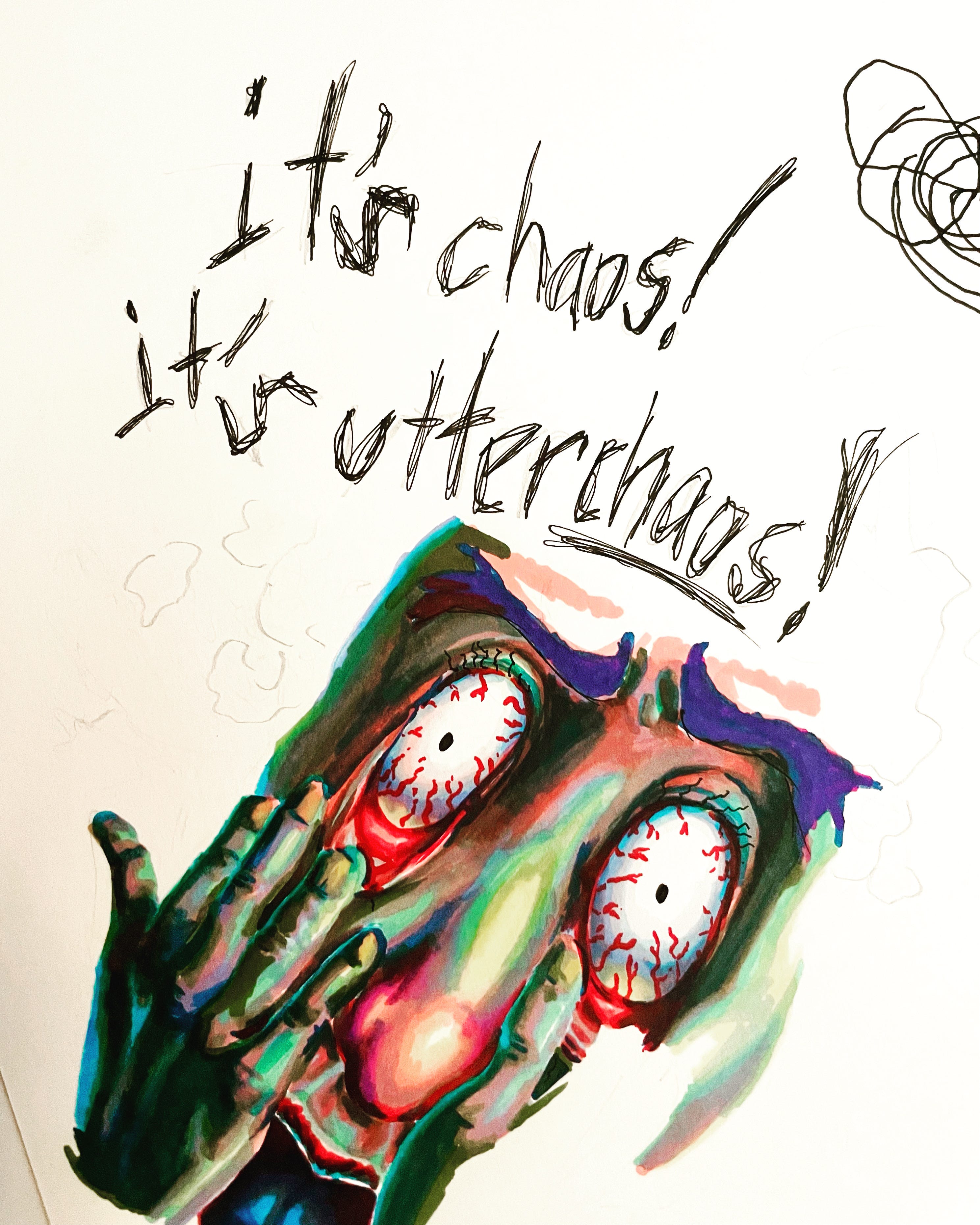
The further language gets from your body, the easier it is for someone else to tell you what’s real. Back that with a credential or authority and the effect is even more potent, we can be convinced of things that never even existed.
The feed has no endpoint. The scroll has no bottom. The news cycle has no conclusion. The outrage has no discharge. The quarterly targets reset when you hit them. “Continuous improvement” means you’re never done.
The word “enough” has been removed from the operating language of every institution that touches your life.
Your body knows what enough feels like, even if we have to unlearn what prevents us from experiencing it. See the article below for a much deeper dive on what gets in the way:

Your body knows how to complete a cycle. Breathe in. Pause. Breathe out. Rest. The next inhale comes on its own. That’s completion. Your lungs do it thousands of times a day without anyone’s permission.
Everything else in your life that imposes artificial urgency, artificial scarcity, environments designed without respecting the limits and needs of human biology, has been engineered to prevent that signal from arriving.
It’s baked into the structure — what’s required for a system of endless growth. Rest eventually must be commodified and converted into product. The same way a river erodes a bank just from the persistent force applied in the same direction over time. The structure profits when you keep seeking. It cannot profit when you rest. So every completion cue has been removed. Every pause point eliminated. Every exit made difficult. And the words used to describe this to you have been chosen specifically so your body can’t feel what’s happening.
I don’t have a program. I don’t have a ten-step framework. I don’t have a course.
I have one question:
Can you still feel the difference between what your body knows and what the words are telling you?
If you can — that signal is the last check you have. In a world that operates increasingly in abstract symbols rather than living beings — that speaks in language your body can’t verify — your felt sense that ‘something is off’ is the only instrument that still works. Every practice that keeps you connected to that signal — breath, presence, silence, the company of people whose bodies are regulated and honest is how you keep your perception your own.
If you can’t feel the difference right now — if the numbness has set in, if the sixth bite tastes like the first, if the alarm runs so constantly that you’ve stopped noticing it — that’s information too. That’s what saturation feels like from inside. Your system is doing what systems do when the signal never stops: it turns down the volume on the sound. Eventually, it turns down the volume on everything.
The way back is small. Quiet. Concrete. Not another headline. Not another opinion about the opinion. The ground under your feet. The temperature of the air on your skin. The face of someone who is actually in the room with you. Start where your body can check.
I’m writing from the gap where the scream meets the page and flattens.
If you felt something in your body while you read this — that was real. That was yours. You brought it. These are just pixels on a screen, not living, not breathing, not sentient.
That feeling though? That’s you meeting yourself. That is life in your body right now, inviting you to pay attention, sit with your being for a second before you scroll to the next thing.
That pause — right there — is the door they painted over and hope you never open.
It’s unmediated existence, and it’s yours, it always has been.
Do you see this? Do you feel it?
Leave a comment if you would like to share what you see and feel.
I’m revising a research paper formalizing the mechanism described in this piece — how language’s power over perception varies with the body’s ability to verify it, and what that means for how manipulation actually works at the cognitive level. When it’s published, I’ll share it. The paper is the armor. This piece is what the armor protects.
- Fire Tongue
If this landed somewhere in your body — if you felt the difference between the words that hit and the words that float — then you already know what Fire tongue is for.
I write about language, bodies, and what happens when one loses contact with the other. I write from inside it, not above it. If you want to stay in this conversation, subscribe. If someone you know is drowning in the feed and can’t name why, send this to them.
Excellent insight. Stealing a from Pink Floyd: we're all becoming COMFORTABLY NUMB
Your writing always amazes me with how accurate and insightful you are. I thought the loss of a job analogy was a great one . And how you go back and forth between the words on paper and the body experience. Brilliant. Now, think of all the Epstein Victims, they are hearing what their bodies are telling them, but sometimes it takes years to be able to hear it AND accept it. Speaking about it is a whole other level, but the scream is there looking for a paper cup. Would love to see your final piece one day.