


I dropped my daughter off at my parents’ this morning, grateful they could watch her for me since school doesn’t resume until next week. The handoff is usually brief. Today I had a few extra minutes, so my mother and I got to talking about plans — that I want a home of my own, that between my current role and the side hustles I run, I still cannot afford this. We talked about what I write about here. About how much harder it has become to build the foundation she and my father built for us. Rent against wage. The cost of raising children. Steady work that houses a family without help has become a thing I read about rather than a thing I hold.
She agreed with most of it. She said it seemed like everyone in my generation was either scraping by or posting from somewhere expensive about the millions they were making. I said that gap was the thing I keep writing about, and I walked her through some of the machinery underneath it; who books what, and where the cost lands.
I named the problem. I had not named a cure.
She said: “Socialism is not the answer though.”
I did not say socialism. I did not describe socialism. I could not define it for you now if you put a gun on the table and demanded it, and I have stopped treating that as my failing. It sits with fascism, capitalism, and communism as sounds my ears hear as static, theories I have never seen instantiated, each one carrying a verdict welded on before it arrives, the verdict flipping depending on who is holding it. I had said I cannot afford a mortgage or rent. She answered a question I hadn’t asked.
That was the morning. The article came in the afternoon.
Hours later a headline caught me:
Robert Reich, Corporate America EXPOSED! A title to tempting to believe, and I knew it, and I clicked it anyway.
I did not buy his frame. I want to be plain about that, because his frame largely agrees with me: corporations captured the government, the returns run up and the wages run flat, the people who set the terms do not live under them. Agreement is the cheapest thing I can be sold. When a piece slides in that easily, that is my signal to slow down and go find what it stood on.
I traced the sources cited, starting with the Wall Street Journal, articles by Gerard Baker. Two names now between me and the sources they build on before I had read a sentence of the foundation. When I pulled up the Journal’s follow-up column, the subtitle read:
My readers agree socialism isn’t the answer — and they offer creative ideas about what to do instead.
So I went and got the receipts.
The original column is Gerard Baker’s, titled “Socialism Is the Wrong Answer, but the Questions Are Real.” It opens by conceding everything I have been saying at kitchen tables for years. Inequality on a scale not seen in a century. Mobility falling. Oligopoly-level concentration in almost every sector. Endemic cronyism. A healthcare system run principally for the benefit of insurers and pharmaceutical companies. Regulation and legislation applied for the benefit of big companies. A business-political class promoting its own well-being at the expense of competition, the market, and ultimately the people.
That list, a man at the Wall Street Journal wrote it.
I traced what he had built on.
Baker’s first citation is Gallup. “Four in ten Americans say they have a favorable view of socialism”, he writes, and sets that beside what he calls widespread popular dissatisfaction with the working of modern American capitalism. I opened the Gallup page he is pointing at. It is titled Image of Capitalism Slips to 54% in U.S. Here is the whole trend, published on the same page:
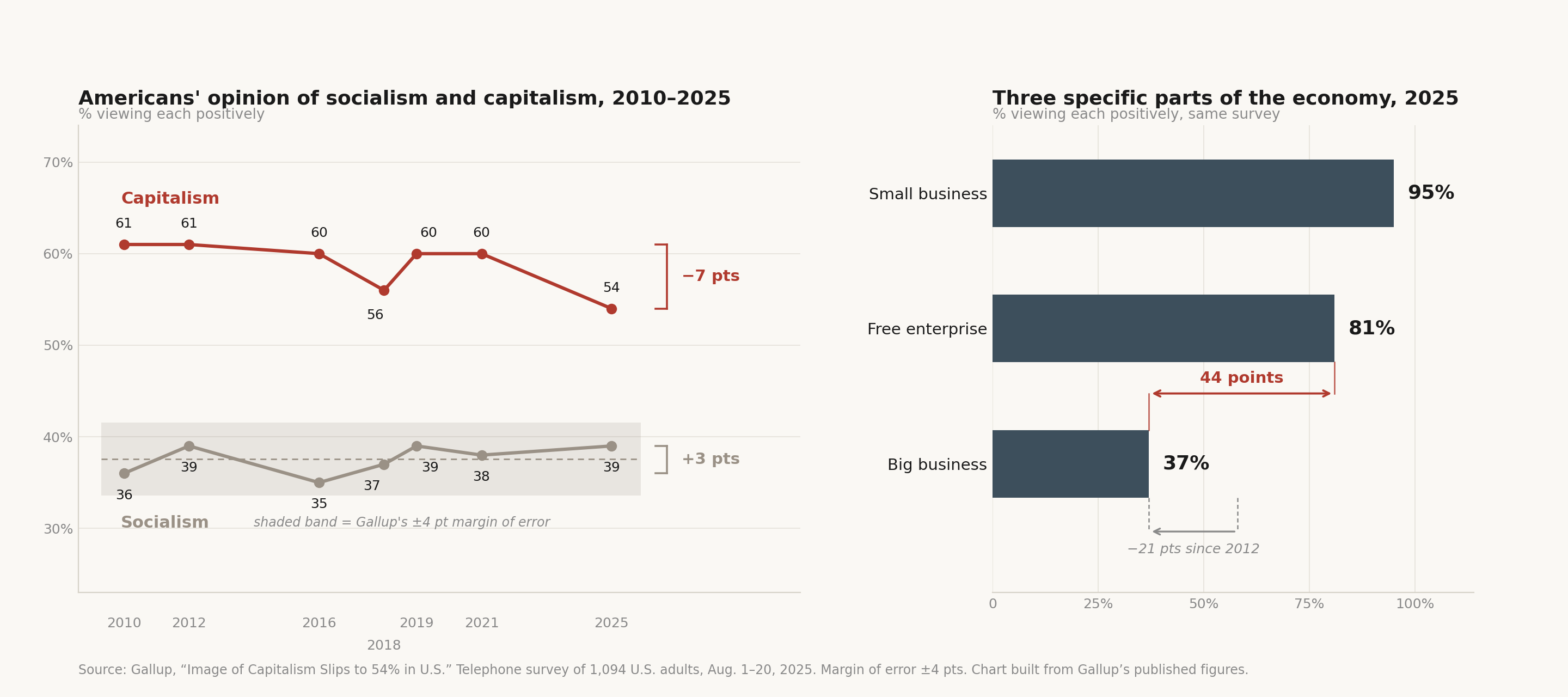
Socialism: 36% in 2010, 39% in 2012, 35% in 2016, 37% in 2018, 39% in 2019, 38% in 2021, 39% in 2025.
Capitalism: 61% in 2010, 61% in 2012, 60% in 2016, 56% in 2018, 60% in 2019, 60% in 2021, 54% in 2025.
Fifteen years. Every reading on socialism sits inside the margin of every other, which Gallup puts at 4 points on a sample of 1,094 people reached by telephone. Capitalism dropped 7. Baker cited the flat line. Gallup put the moving line in the headline.
Those calls were placed between the 1st and 20th of August, 2025. The column ran a year later, and the number arrives as the current temperature.
He also walked past the rest of the survey, which asked the same people about three things that have edges.
Small business: 95% positive. Free enterprise: 81% positive. Big business: 37% positive, 62% negative, down from 58% positive in 2012.
44 points of daylight between free enterprise and big business, from the same mouths on the same call. That is Baker’s own thesis — capitalism eaten by corporate power — sitting in the file he opened, measured, dated, left out of his article.
Second citation.
Baker writes that the New York Fed reported “the labor share of income—wages and salaries—fell to its lowest level in 80 years as returns to capital continue to soar.”
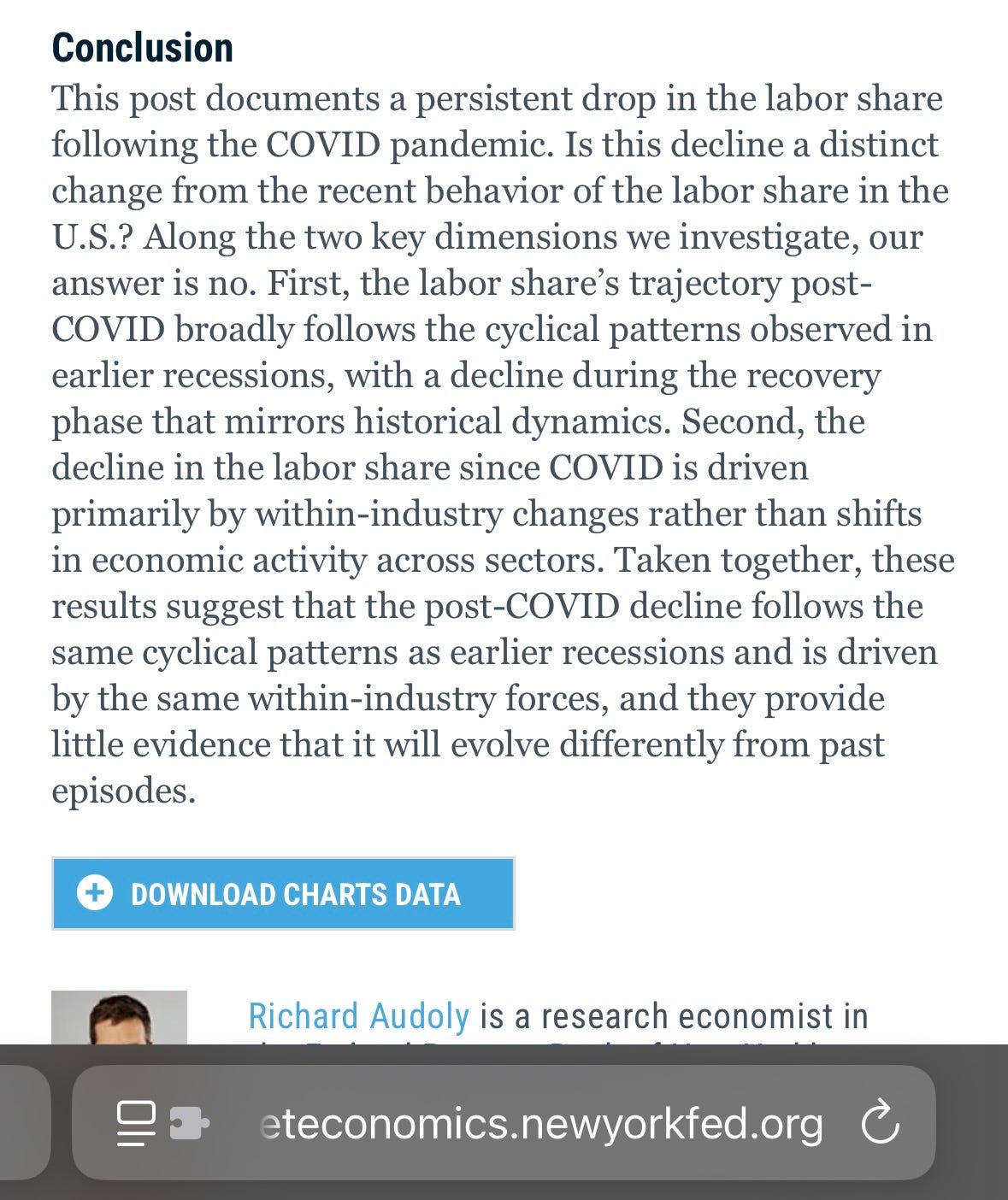
The post is by Richard Audoly, Miles Guerin, Srinidhi Narayanan, and Rachel Schuh, dated June 24, 2026. The number is real. The labor share sits at a post-war low — the post-war period runs eighty-one years, so his arithmetic holds — 1.6 points under where it sat before the pandemic. The authors then ask whether this decline is a new and distinct phenomenon.
They answer no. Twice. The trajectory tracks earlier recession cycles. The fall came from within industries rather than from output shifting between them. Their last sentence: the results suggest the decline follows the same cyclical patterns as earlier recessions, and they find
“little evidence that it will evolve differently from past episodes.”
Baker kept the alarming number and dropped what the authors concluded about it — that the drop follows the same cycle as the recessions before it. The clause about returns to capital soaring appears nowhere in the post; that one is his. And the literature the post cites for the long-run slide names technological change, superstar firms, and rising markups — market power, concentration, the exact disease Baker had already named in his own second paragraph. He had the mechanism handed to him by his own footnote and he left it there.
Twice now — Gallup, then the Fed. Same move. The number is the one the source claimed; however, the actual finding attached to it did not make the transfer.
Third Citation.
Baker’s remedy list includes eliminating corporate welfare, and that plank traces back through a Cato Institute event to Chris Edwards, Corporate Welfare in the Federal Budget, Cato Institute, 2025.
Cato’s articles of incorporation were filed on the nineteenth of December, 1974, under the name Charles Koch Foundation, listing Charles Koch, George Pearson, and Roger MacBride as directors at the Koch Industries address in Wichita. Accumulated Koch giving runs near thirty million dollars against roughly four hundred million raised since then.
Swing at the funding and you miss. Cato and the Kochs went to court over control in 2012, and Cato came out with a board that appoints itself. Nobody is holding the pen..
Look at the definition instead.
Corporate welfare, as Cato scopes it, means federal budget outlays to business. Accept that and the fix has to land in the spending column, which is why “eliminate corporate welfare” sits down comfortably beside a line saying entitlements and welfare spending must be scaled back to a sustainable level. Regulatory capture, tax expenditures, market concentration — the things Baker named as the disease — sit outside the definition, and so they sit outside the cure.
A reader arrives angry at corporations. The anger is real, the diagnosis was handed to you freely, and the remedy routes you to cutting the floor under your own feet. Nobody had to lie. The redirect happened inside a word.
Fourth citation
Baker’s mobility claim points at a Visual Capitalist infographic — a design product, built by Marcus Lu in 2020, from Opportunity Insights data, with its wage comparisons running to 2018. The research underneath it is real, and the finding holds.
He cited the picture rather than the study, and the picture was six years old when he used it to describe where the country is now.
Baker concedes the diagnosis at full strength, then assigns the cause to government and prescribes less of it.
The diagnosis says corporations captured the state. The cure says shrink the state. That is the reversal, and the concession is what buys it. A reader who has spent ten years being told their pain is a budgeting failure finally hears it named, and the naming arrives with a bill attached.
Two sentences of Baker’s hold the reversal up.
The first: “under Citizens United, corporations have a First Amendment right to seek to influence politics, and there isn’t much that can be done about the need for money to win elections.” One sentence after he names campaign money as the engine of capture, it becomes something we can’t do much about—weather.
The second: “lest all this sound like a recipe for dirigisme of the sort historically proven to suppress enterprise and innovation.”Dirigisme means the state steering the economy. Two words carry the sentence — historically proven — with no citation under them, standing in for a literature that argues both ways. And the clause names the reader’s alternative before he can reach for it, in a French word with the verdict already welded on. That is the move from the kitchen table. My mother arrived at that conclusion in a few minutes because that is the box left for anyone who’d argue the opposite.
Then the remedies, in the order Baker gives them:
more transparency about campaign money, reform of the party primaries, shrink government, scale back entitlements and welfare, cut the debt, stop the central bank backstopping excess.
Count where they point. Four at government — its size, its spending, its debt, its central bank. Two at elections, and he has already told us the first of those cannot be fixed. None at a company.
Break up monopolies appears once. No enforcement standard, no merger test, no budget, no agency. The fiscal remedies name what to cut — entitlements, welfare, the debt. The one remedy aimed at the disease he diagnosed names nothing at all.
That last plank on the list, the central bank one, traces to a TD Economics report, A History of Fed ‘Puts’, by James Orlando and Brett Saldarelli, dated March 21, 2023 — written in the two weeks after Silicon Valley Bank failed. A Fed put is the market’s expectation that the central bank will step in when prices fall far enough. The report confirms the hazard Baker points at: a standing rescue invites the risk it insures, because investors who expect a catch take bets they would otherwise refuse.
Then it prescribes, and the prescription runs the other way. Its cure is stronger rules on the banking system — more capital held against losses, tighter supervision — so that fewer rescues are needed. The one time the backstop was withheld was Lehman Brothers in 2008, and the report names that as the trigger for the worst downturn since the Depression. Baker’s plank says stop the backstopping. His source says keep it and regulate harder around it.
The hazard survives the hop. The cure stays behind.
The diagnosis is about power: who owns whom, who sets the terms. The prescription is about budget lines: what the government spends, what it owes. You do not need to claim anyone coordinated this, and I am not claiming it. Set the disease beside the cure and read them together. He names the sickness in one organ and writes the prescription for another..
On the Tuesday of the week ending August 16, 2026, Ainsley Earhardt read Baker’s column aloud on Fox & Friends.
The inequality line, the line that capitalism needs reaffirming rather than replacing, and the remedy list — break up monopolies, eliminate corporate welfare, acknowledge the public’s economic pain. The Wall Street Journal and Fox News sit under the same controlling shareholder, the Murdoch family trust.
One column. One owner. Two properties. Inside a week.
I cannot tell you which pipe carried it to my mother, and I am not going to pretend I can. Fox on a Tuesday, a forwarded link, a friend at church, the ambient air. What I can tell you is that it got there before it got to me, arrived without a citation, and arrived with the verdict already attached.
I did not go looking for Baker to refute him. I went looking for a witness whose authority I could borrow.
My father does not believe my reports. He has heard them, in detail, more than once, with numbers — the firsthand accounting and the peer-reviewed studies both. The reports come from a son who would benefit from being believed, and that makes them easy to set aside as biased when the conclusion is uncomfortable. The studies have no such interest, and they get set aside anyway. So when I saw a Wall Street Journal editor at large writing inequality on a scale not seen in a century, my first reaction was not analysis. It was: if this guy says it, maybe my dad will finally hear me.
If I’d acted immediately, I would have taken a person with a position, writing for an audience with a position, and handed it to my father as testimony, because the authority borrowed would be useful at that table. Wanting it first and checking it after is the order that gets people. My rule is that the standard has to cut its holder first, and it cut me on the sequence — only on the sequence, because I did check.
What checking found is that the witness comes with a rider. To hand my father Baker as proof of the diagnosis, I also hand him a document arguing that entitlements and welfare must be scaled back. The credibility and the remedy ship in one envelope, and I cannot open it halfway.
The price of being believed is arriving in support of the policy that takes the floor out from under the exact condition I was describing.
My mother is the proof the trade has already cleared once in this family. She took delivery of the diagnosis and the refusal together, and the refusal was seated before I opened my mouth at the kitchen table.
Gallup asked 1,094 people about two words with no edges and got one line flat for fifteen years and one drifting seven points.
Gallup asked the same people about three things with edges — small business, free enterprise, big business — and got 95, 81, and 37, moving hard, moving coherently, telling you exactly where the country stands. The terms that carry information are the ones nobody fights about. The national argument is conducted in the two words that measure nothing.
That is why the sentence worked on me at drop off and why I had no answer for it. Refusing a word with no edges costs nothing and obligates nothing. You cannot be wrong about it, because you never made a checkable claim. My sentence had edges. Rent against wage, hours against a month, a number of dollars against a bill. Checkable, therefore expensive to say, therefore easy to mark down as a failure of budgeting or grit.
Both were spoken in the same two minutes by two people who love each other.
I can hand you the finding: the Fed post concludes the opposite of what the column used it to say.
Go read it, it takes four minutes. But you are taking my word that it is worth four minutes, and my word is the thing in question. The audit does not travel. The work stays with whoever did it. What travels is the result, and the result arrives as an assertion from an interested party, which drops you back into the room I started in.
Socialism is not the answer though regenerates on contact, costs nothing, obligates nothing, survives being wrong forever because it never risked being right. My sentence in the kitchen was and is checkable. That is why it was expensive. That is why it lost.
I am not sure the arithmetic clears. I am sure the ledger is worth keeping.
If you want to do something with this rather than agree with it:
Go find one claim you accepted this month because a source you trust said it. One. Follow it back to the primary document — the actual poll page, the actual paper, the actual filing — and read the conclusion the authors wrote in their own hand. Then come back and tell me in the comments what survived the trip and what did not. Cite the link. Name the gap if there is one, and say so plainly if there is none, because a clean chain is a finding too.
I will read every one of them.
Fire tongue 🔥
Recently lawyer Mitch Jackson here on Substack gave a very good argument on what "social ism" really means in the American context that everyone should read to gain understanding of how it applies to our current experience.
The beginning of our socialism is rooted in the Constitution. Do you understand that? In the wording and intent of our founders.
Simply, it's part of our social contract with ourselves. It revoles around our ability to take care of ourselves, our families, our larger community up through our States and our Federal governments. To wit: the wording of certain establishments, the Post Office and Post roads. Washington used this wording to begin naming the Post roads to help commerce amongst the localities and the intra and interstate to become more efficient and increase simple trading. The post roads were deemed important because they helped everyone under that social compact. Jefferson did the same by establishing light houses up and down the coast to aid navigation beneficial for all. Eisenhower after World War Two created the Interstate Highway System. We all contributed to these as part of our "socialism " compact. Without a simple use of socialism in the American context we wouldn't have free highways but a system of private roads under onerous tolling systems. We would not have a rudimentary postal system but a set pf service providers based solely in profit motives. We contribute to our society, our social order under Constitutional socialism because it works for all.
Jackson's analogies delve much deeper in his explanations.
Another one was a very simple safety explanation that Benjamin Franklin expanded upon even before the Constitution layed it out. Volunteer fire companies. Going from the community and neighborhood safety of bucket brigades in those Colonial times to our modern fire service throughout this nation. Where people provide the manpower to fight fires but the community socialism works together to fund the stations, the bunker gear worn and the expensive apparatus driven to the scenes. In urban areas the salaries and benefits are tax payer supported, still part of the original social compact for the benefit of the whole.
For the benefit of the whole. That's American Socialism. The roads, the public schools, the Interstate Highway, the Post Office, the military that we have chosen to protect our way of life, the Space Program from the beginning that put the first humans on the moon, all the spin offs from every endeavor that could be seen as a positive for the benefit of the whole.
Go read Mitch Jackson's essay on what socialism is in our context.
For the benefits of everyone that has planted their feet in this land from the very beginning. It's not what you may have thought or been exposed to recently. His is from the legal and Constitutional aspect based in the readily seen evidence of history of these United States of America. The Founders had ideas to form a more perfect Union and used principles based in the Enlightenment to create a documentary framework to give us a workable social compact to achieve it. American Socialism is unique. It's not anyone else's. It's ours to use for OUR BENEFIT.
I’ve read this, including re-reading parts, and I find it hard to follow. Your transitions sometimes escape me.