



The Sandcastle and the Symphony
If a meditation instructor ever tells you to close your eyes, take a deep breath, and picture a bright red apple floating in the middle of a sunny meadow, they are quietly assuming that your skull contains a working movie theater. As I wrote in For Thirty Years, I Thought “Visualize” Was Just a Metaphor, for a large chunk of the human population, there is no movie theater in there. There is just a dark room, an incessant voice talking to itself at ninety miles an hour, and the invisible gut sense of where the furniture sits so you don’t stub your toe on the way to the bathroom.
When psychologists and internet charts try to explain the kind of near-total aphantasia I have—being almost completely blind in your mind’s eye—they usually describe it as seeing “dim or vague outlines.” That description never sat right with me. Saying you see vague outlines implies you can still pull up a blurry sketch whenever you want and hold it still while you look at it.
Hell no. I can’t do that. My bottleneck has nothing to do with how blurry the picture is. It comes down entirely to control: being able to summon a picture on command and actually keep it there.
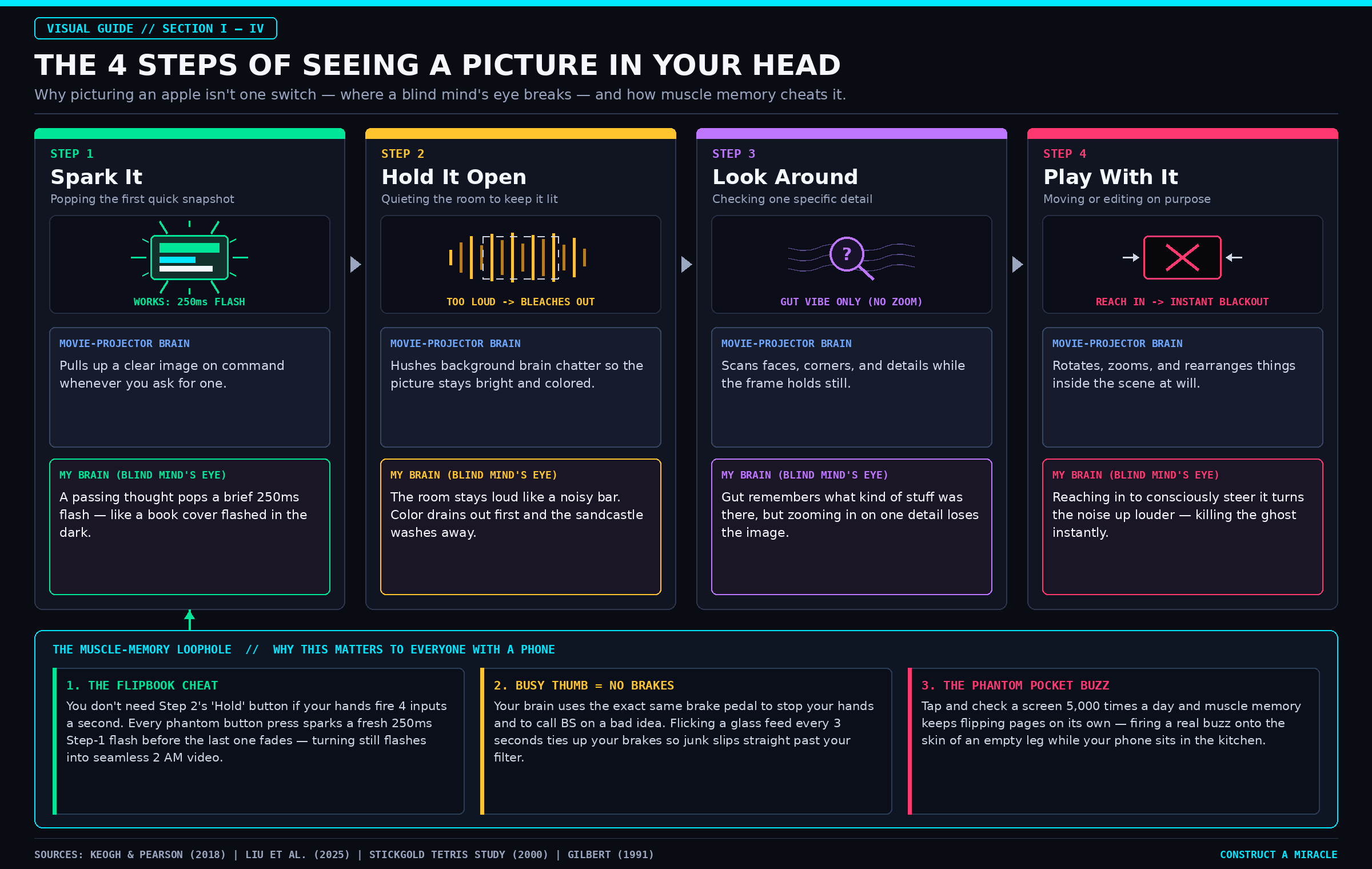
Every once in a blue moon, if I strain with an absurd amount of mental effort—or if I am high, chilling in flow, and idly thinking about how to rearrange a webpage—a single snapshot punches through the black like a camera flash in a dark room. For about 250 milliseconds, a quarter of a second, that frame actually has real detail. It works the exact same way you catch the colors and layout if someone flashes a book cover in front of your face and snatches it away. If all I need is a gut read on the types of details, cool. I remember that there was more on the page. Ask me to hold onto one specific detail, and the whole image washes away like a sandcastle in the tide. Worse, the split second I try to reach in and play with the layout on purpose, trying to control the image is the switch that kills it. You reach for the ghost, and the ghost evaporates.
Before anyone assumes that means my imagination is just weak across the board, step across the hallway to the audio channel inside the exact same skull. Right now, on command, I can make Darth Vader argue with Bart Simpson inside my head, fire off sound effects underneath them, and conduct a full symphony orchestra of original music behind their conversation without dropping a single note. On audio, I own the whole recording studio. On video, somebody handed me a disposable camera with one flashbulb and confiscated the pause button.
For decades, scientists assumed people wired like this just had a sleepy visual center at the back of the head, like a projector with a burned-out bulb. Then brain-stimulation studies actually measured the room. The visual part of our brain isn’t dark because the power is out. It is dark because the room is too loud.
Seeing a picture in your head isn’t one single switch. Researchers break it into four separate steps: sparking the picture, keeping the room quiet enough to hold it open, looking around inside it, and moving things around. To hold a clear image, the front of your brain has to hush the background chatter in the back of your brain, like quieting a noisy bar so you can hear one person across the table.
In brains like mine, the bar stays loud all night. Every now and then, a passing thought still pops a quick snapshot, the same way a bright camera flash leaves a brief glowing afterimage in your eyes. Holding onto color takes extra juice, so the color drains out first and bleaches into a pale outline. Try to concentrate harder to edit the picture, and you only turn up the noise in the bar. The sandcastle washes flat.
Why Nobody on the Questionnaire Asked If My Eyes Were Open
Once you separate sparking a flash from holding it open, you start noticing how strange standard psychology questionnaires really are.
Almost every test for mental imagery opens with the exact same instruction: “Close your eyes.” The people who wrote the clipboard clearly had working movie projectors in their heads. They closed their eyes to block out the living room wallpaper so they could watch IMAX on the inside of their eyelids. Nobody in the department thought to ask the rest of us a basic follow-up question: is it easier with your eyes open?
Because for me, catching a mental snapshot with my eyes open is ten times easier than with my eyes closed. When my eyes are open, the physical room in front of me acts like free scaffolding. My brain can use the real walls, the desk, and the corners of the room like coat hooks to hang a quick impression in open air, instead of building a whole world from scratch in the dark.
The second I close my eyes, you saw the scaffolding out from under me.
Figuring that out at thirty years old finally explained why I have hated going to sleep my entire life. Growing up, I assumed I was just a stubborn night owl who didn’t want the day to end. Look at what actually happens when the bedroom lamp clicks off. A strong visualizer shuts off the physical room and flips on an internal movie until they drift away. When I close my eyes in the pitch dark, the visual world just cuts to black.
Once I am finally out, I don’t even remember most of my dreams. Plenty of the ones I do catch feel like loose shapes and moods with no real rhythm, though a vivid visual one still breaks through every once in a while—like a dream I had at a cabin in Maine where I looked up at the night sky and saw a giant dragon stretched across the stars. Lying awake before sleep hits is a different story. Closing my eyes in bed means locking that ninety-mile-an-hour radio announcer inside a pitch-black closet with nothing to lean on.
The 2:00 AM Call of Duty Flipbook
There were only two exceptions in thirty years, and both of them happened at two in the morning.
When I was fourteen, I got completely addicted to Call of Duty—the kind of fourteen-year-old addicted where your parents kick you off the console, you wait until the hallway goes quiet, and you sneak back downstairs after bedtime to keep grinding. At eighteen, the exact same thing happened with League of Legends. Both times, after staring at a screen for ten or twelve hours straight, I would crawl into bed, shut my eyes in the pitch dark, and try to sleep.
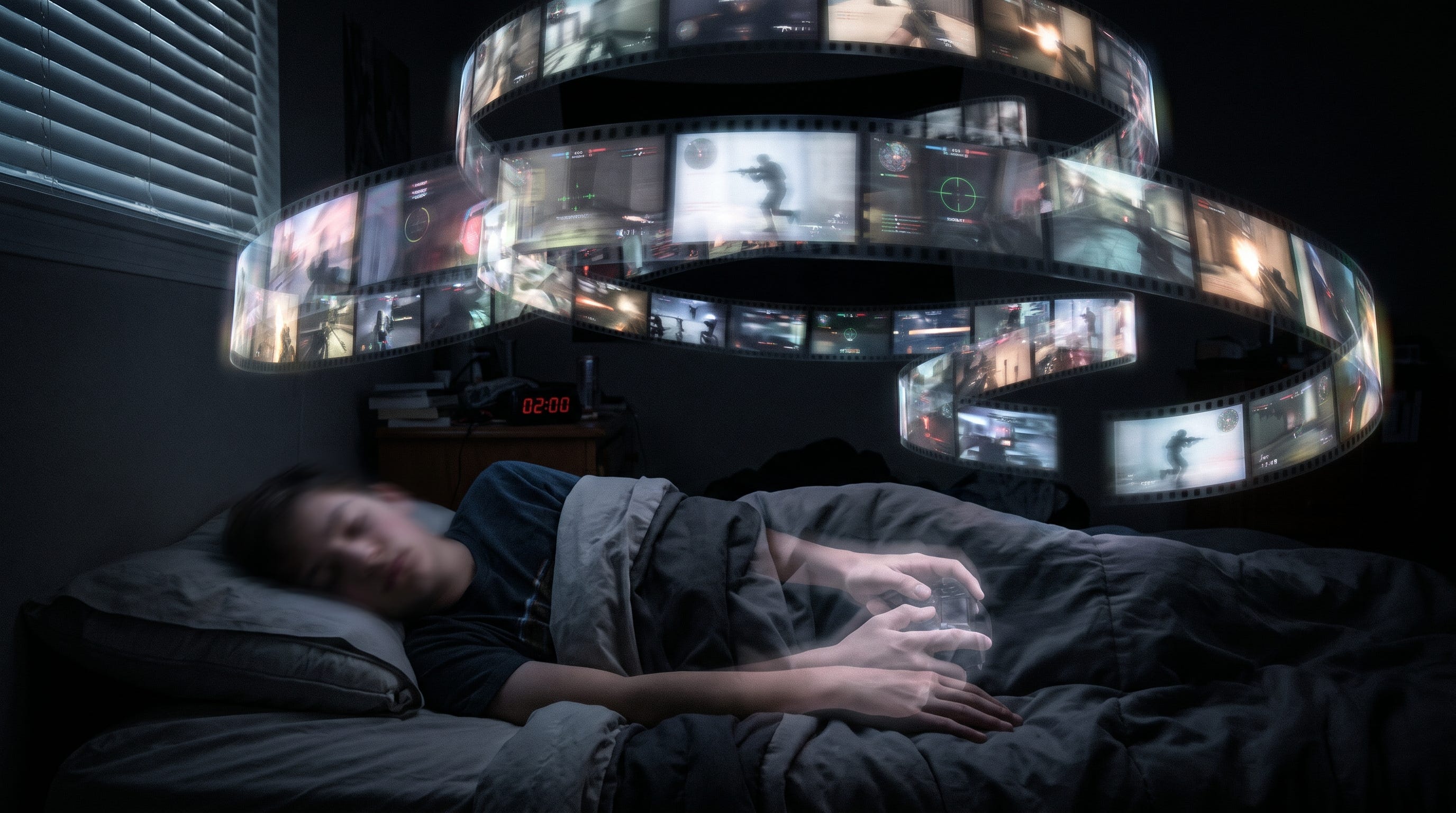
I couldn’t sleep. Behind my closed eyelids, I was watching seamless gameplay footage for hours.
That shouldn’t have been possible. A guy whose visual sandcastles die in 250 milliseconds has no business watching non-stop video in the dark.
Then I remembered what the rest of my body was doing under the covers. I wasn’t lying there passively watching a movie from a theater seat. My brain was still making the inputs. Even with my physical hands resting flat on the mattress, my muscle memory was firing every thumb flick, crosshair snap, and mouse click in real time.
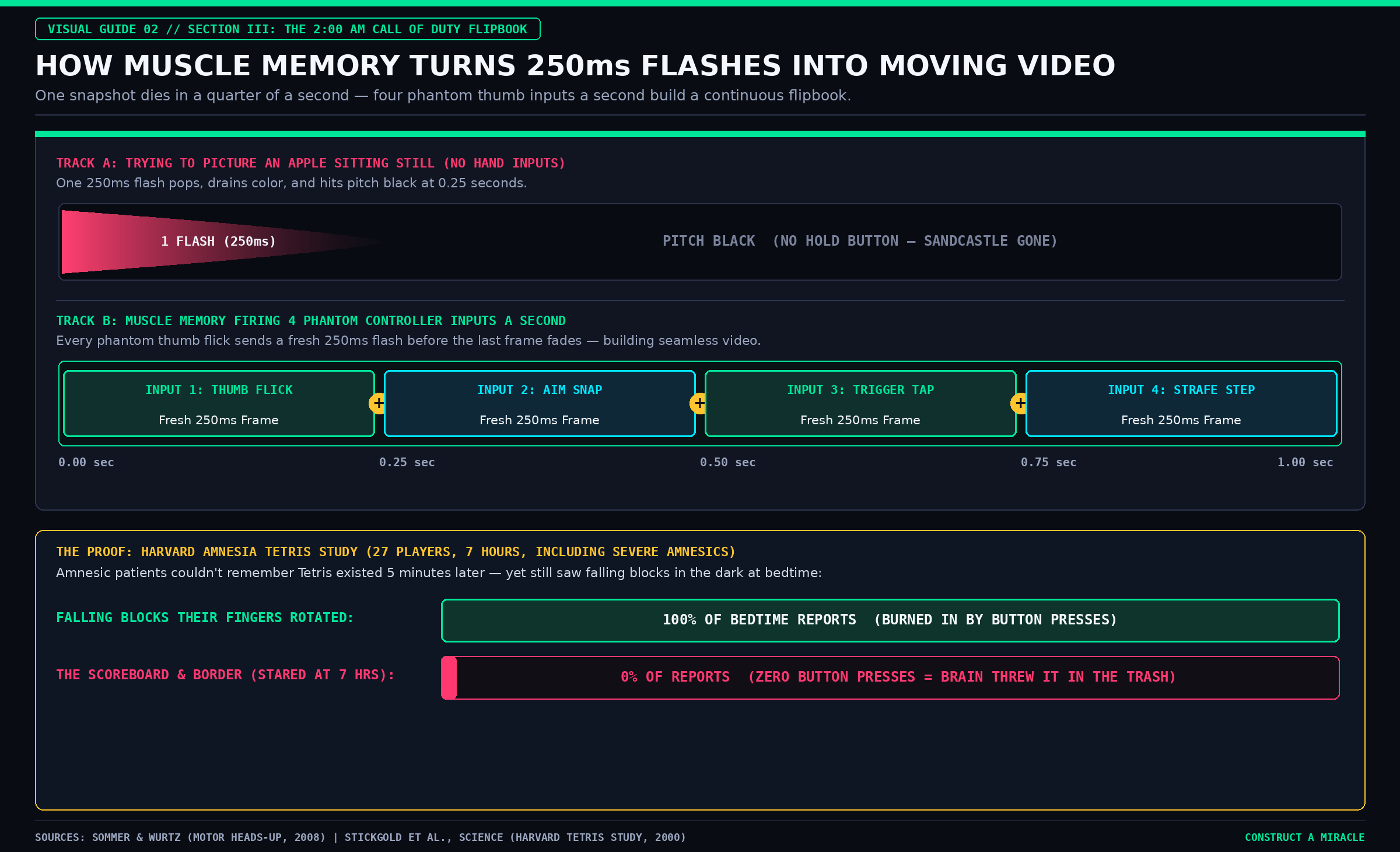
Whenever the part of your brain that moves your hands sends an order to your thumb, it also sends the rest of your brain a quick heads-up about what that move is supposed to look and feel like. That heads-up is the reason you cannot tickle yourself: your brain already got the memo before your fingers arrived. And even in people who cannot summon mental pictures on command, unplanned, automatic flashes still work just fine. One 250-millisecond afterimage on its own dies in a quarter of a second. Fire four phantom controller inputs a second in the back of your head, and every single button press sparks a fresh 250-millisecond flash before the last frame can fade to black.
You don’t need a working movie projector anymore. Your muscle memory is thumbing through a stack of 250-millisecond snapshots fast enough to turn still afterimages into a moving flipbook.
In the year 2000, a sleep researcher at Harvard named Robert Stickgold paid twenty-seven volunteers to play seven hours of Tetris across three days. Three of those volunteers had severe amnesia and could no longer form new memories at all. Ask those three patients five minutes after a session whether they had ever played Tetris, touched the computer, or met the scientists standing in front of them, and they would politely tell you they had never seen any of it in their lives.
Then the researchers turned off the bedroom lights. Right on cue, the people who didn’t know Tetris existed watched little geometric blocks falling and rotating behind their closed eyelids.
Across all thirty-eight bedtime reports in that study, not a single person ever saw the scoreboard or the decorative border around the screen, even though their eyes had stared directly at both for seven hours. Every single report consisted strictly of the falling pieces their fingers had rotated. Because you never press a button to move the scoreboard, the brain threw the scoreboard in the trash. Ordinary memory wasn’t playing back a movie. Muscle memory had burned whatever their hands controlled straight into the wiring.
Why Your Leg Vibrates When Your Phone Is in the Kitchen
Once I saw how that button-press flipbook worked, my first honest reaction was “Oh shit, this is MKUltra, bro.” My second thought was about my right front pocket.
Think about the strangest collective hallucination of the twenty-first century—one that hundreds of millions of perfectly sane adults shrug off every Tuesday like mild weather. You are standing in line at the grocery store or walking down a hallway, and you physically feel your phone vibrate against your leg. Not a metaphor. Not a stray thought. The nerves on your thigh register a crisp mechanical buzz. You reach down to check it, pat empty denim, and remember your phone has been sitting on the kitchen counter for twenty minutes.
That is the exact same 250-millisecond flipbook running in reverse on the skin of your leg. In a conditioning experiment at Yale, researchers showed you can train ordinary, healthy adults to see lights and hear sounds out of thin air simply by pairing two cues together often enough that the brain jumps the gun and fires the feeling early. Tech companies never needed a sci-fi chip to get under your skin. They handed us a piece of glass that the average person taps and swipes thousands of times a day, tying random buzzes directly to an automatic reach-for-your-pocket reflex.
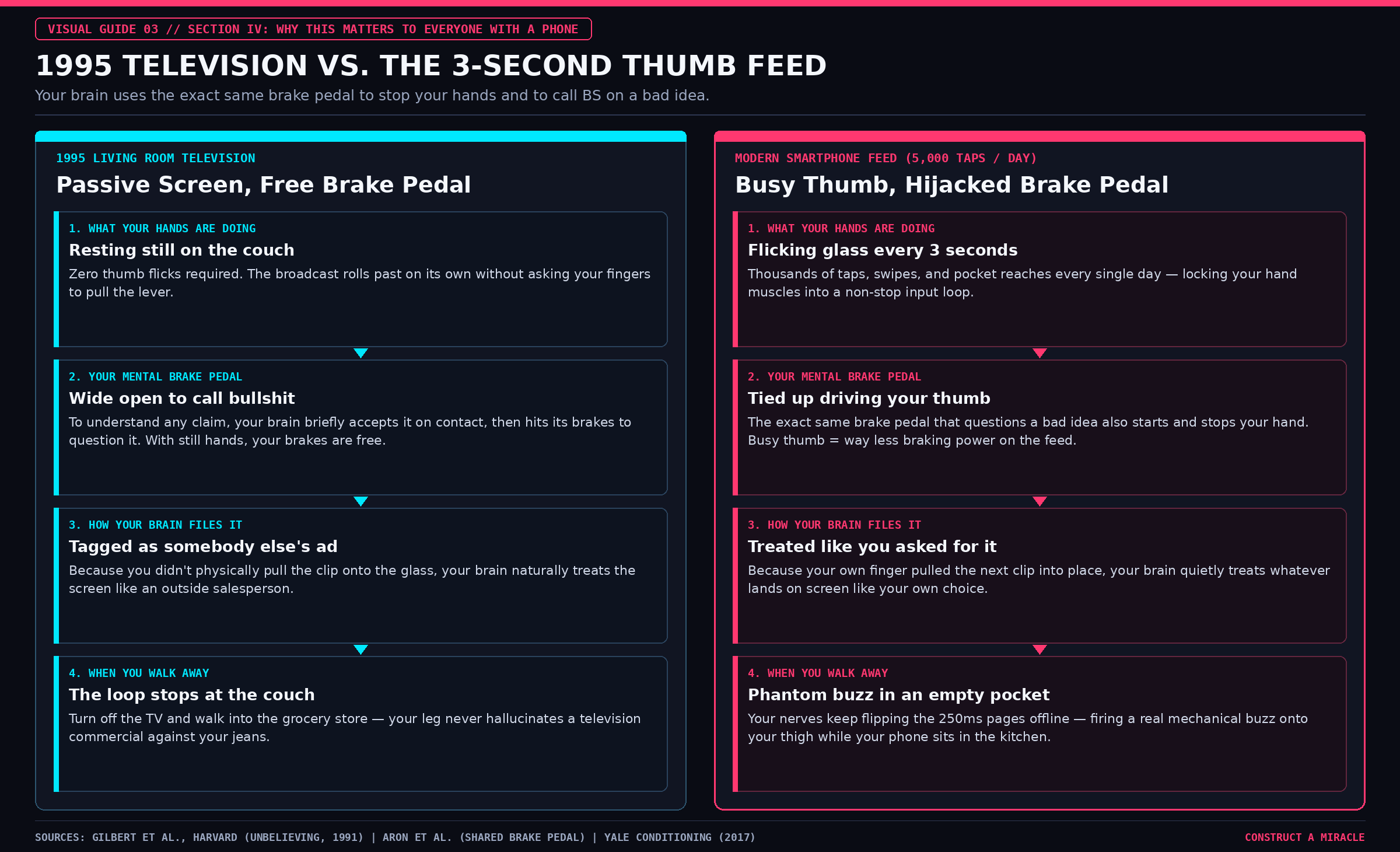
That constant thumb movement is also why scrolling a phone hits your head so much harder than watching television in 1995. Harvard psychologists showed that a human brain cannot actually weigh a new claim in neutral first. Just to understand a sentence or a video clip, your brain accepts it as true on contact. Only a split second later does it step on its mental brakes and say, “Wait a minute, that’s bullshit.”
Modern feeds live inside that split second. The exact same mental brake pedal your brain uses to question a bad idea is the one it uses to start and stop your hands. Sit still on a couch watching a dumb TV commercial, and your hands are resting, leaving your brakes wide open to roll your eyes at the screen. Keep your thumb flicking glass every three seconds, and two traps spring at once. Your brake pedal stays too busy driving your thumb to question what just flashed past your eyes. Worse, because your own finger pulled the next clip onto the screen, your brain quietly treats whatever garbage lands in front of your face like something you asked for yourself.
Run that reflex five thousand times a day, and it doesn’t clock out when you lock the screen. Your nervous system keeps flipping the pages by itself—firing a phantom buzz into an empty pocket just to make your hand finish the reach.
Years ago, the only way I finally killed the phantom vibrate in my leg was by shutting off push notifications across every app I owned. This past weekend, I caught one last scoreboard that had snuck back in through the side door: my own Substack engagement notifications. Every little badge and ping was quietly training my inner voice to check how a thought scored instead of letting the thought wander where it wanted to go.
So I turned that switch off too. Within an afternoon, the twitch went quiet. For a guy with a dark room and a loud radio in his skull, there is no cinematic sunset when a conditioned loop finally breaks. You just notice, all at once, that the voice in the dark isn’t talking to a scoreboard anymore. It’s just yours again.

How This Place Stays Open: I don’t run ads, I don’t take sponsors, and I don’t lock essays behind paywalls—because regular people shouldn’t be priced out of understanding how their own heads or the systems around them work. Paid subscribers are the only reason I get to dig through the research and write these full-time instead of punching somebody else’s clock. If you’ve got the room to chip in, upgrade to paid; if money’s tight, just send this to one person who’d actually read it.
[Subscribe to the Vanguard] | Buy Me A Coffee (One-time support)