The Day They Made Empathy Illegal
>implying a fish laying eggs in your living room is a federal copyright crime.

The Day They Made Empathy Illegal — U.S. Patented Composition of Matter
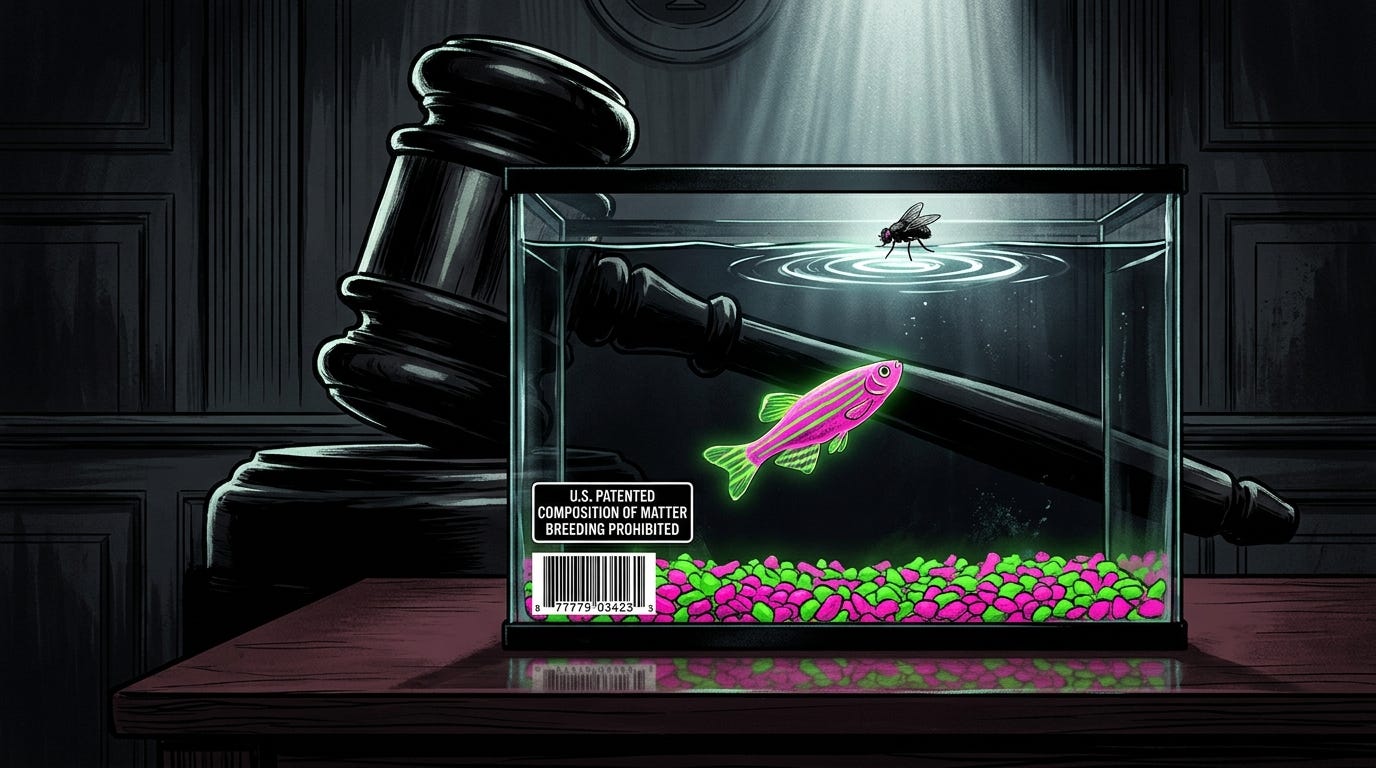
Tonight I watched a video of a guy on YouTube having a full-blown legal panic attack because his pet fish had babies.
He didn’t smuggle rare piranhas out of the Amazon. He walked into a regular chain pet store, bought three fluorescent GloFish for his turtle pond, and bought the official branded starter kit the company tells you to buy: neon plastic gravel, fake plastic plants, and corporate fish pellets.
Within twenty-four hours of living in their official corporate habitat, the fish were covered in white parasites (ich) and dying.
Then a real housefly landed on top of the water. One of the dying fish snapped it up immediately.
The guy realized that despite glowing like a bowling-alley blacklight, these were still wild animals that weren’t meant to live in a fake plastic room eating mystery dust. So he ripped out all the official branded plastic gravel and fake plants, replaced them with real sand, live plants, real stone, and fresh shrimp, and went to bed.
The very next morning, the fish were so happy to finally be in a real room that they spawned four hundred and seventy-four glowing babies.
Which is when the guy realized he had just committed four hundred and seventy-four counts of federal patent infringement.
>be me, a fish
>3.8 billion years of evolution writes 26,000 genes so I can swim, breathe water, and lay eggs
>some guy in a lab coat pastes 1 jellyfish gene into my egg
>corporations now legally own the concept of me having sex
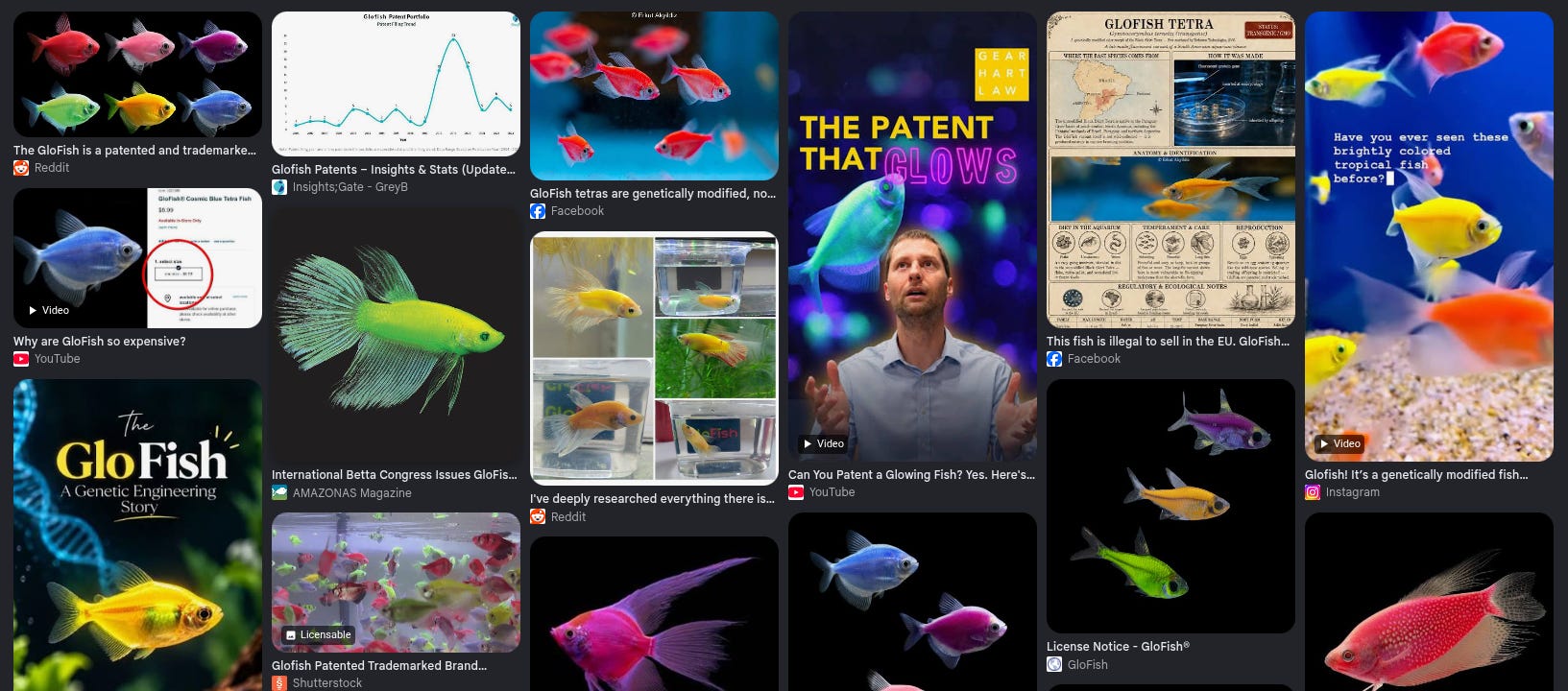
If you walk into a PetSmart today and read the fine print on the GloFish tank sticker, it informs you that the fish are protected by multiple United States patents, and that breeding them—even accidentally in your own living room—is strictly prohibited.
Most people laugh when they hear that because they assume a corporation can’t actually sue you just because two animals did what animals naturally do in water.
Those people have never read Bowman v. Monsanto Co. (2013).
For hundreds of years, Anglo-American property law had a common-sense rule called the First-Sale Doctrine (or patent exhaustion). Once you buy a physical object with your money, you own it. The manufacturer’s patent monopoly is exhausted. Ford can’t sue you for driving your truck to a grocery store they don’t like, and Sony can’t charge you a royalty when you let your friend sit on your couch.
Then a 75-year-old Indiana farmer named Vernon Bowman bought cheap mixed soybeans from a local grain elevator, planted them in his dirt, and grew a crop of beans.
Monsanto sued the 75-year-old man all the way to the United States Supreme Court.
Why? Because soybeans naturally grow new soybeans. And in 2013, all nine Supreme Court Justices ruled 9 to 0 that the First-Sale Doctrine stops applying the moment a living thing reproduces. Every time a patented seed sprouts in dirt, or a patented fish lays an egg in water, the court classifies the baby as “manufacturing a brand-new patented article without a license.”
When the 75-year-old farmer pointed out the obvious physical reality—that he didn’t manufacture anything, because beans and animals just naturally reproduce on their own—Justice Elena Kagan literally mocked him in the official Supreme Court opinion by calling it “the blame-the-bean defense” and ordered the old man to pay Monsanto $84,456.
And if you want the punchline to the GloFish story?
In 1999, when a molecular biologist in Singapore named Dr. Zhiyuan Gong originally spliced that jellyfish fluorescence gene into a zebrafish, he wasn’t trying to make a pet-store toy. He was building an anti-pollution snitch fish.
His entire goal was wiring the glow gene to a chemical trigger switch so the fish would stay completely normal and clear in clean water, and only light up neon red or green when a river was poisoned by heavy metals, industrial factory runoff, or chemical toxins—giving regular towns a cheap, living alarm system to catch corporations poisoning their water.
Then two businessmen from Austin, Texas (Alan Blake and Richard Crockett of Yorktown Technologies) saw a photo of Dr. Gong’s pollution-detector fish, flew in with a checkbook, and bought the exclusive worldwide patent license.
Nobody in corporate America wants a fish that snitches on industrial water pollution. So they welded the genetic glow switch permanently in the ON position so it just glows 24/7 under a blacklight, slapped a patent monopoly on its DNA so it’s illegal for a kid’s fish to lay eggs, sold them alongside $80 neon plastic gravel tanks that give the fish parasites, and cashed out by selling the GloFish brand to Spectrum Brands in 2017 for $50 million.
Stop for a second and ask yourself a basic question:
How the hell do you put a patent on biology?
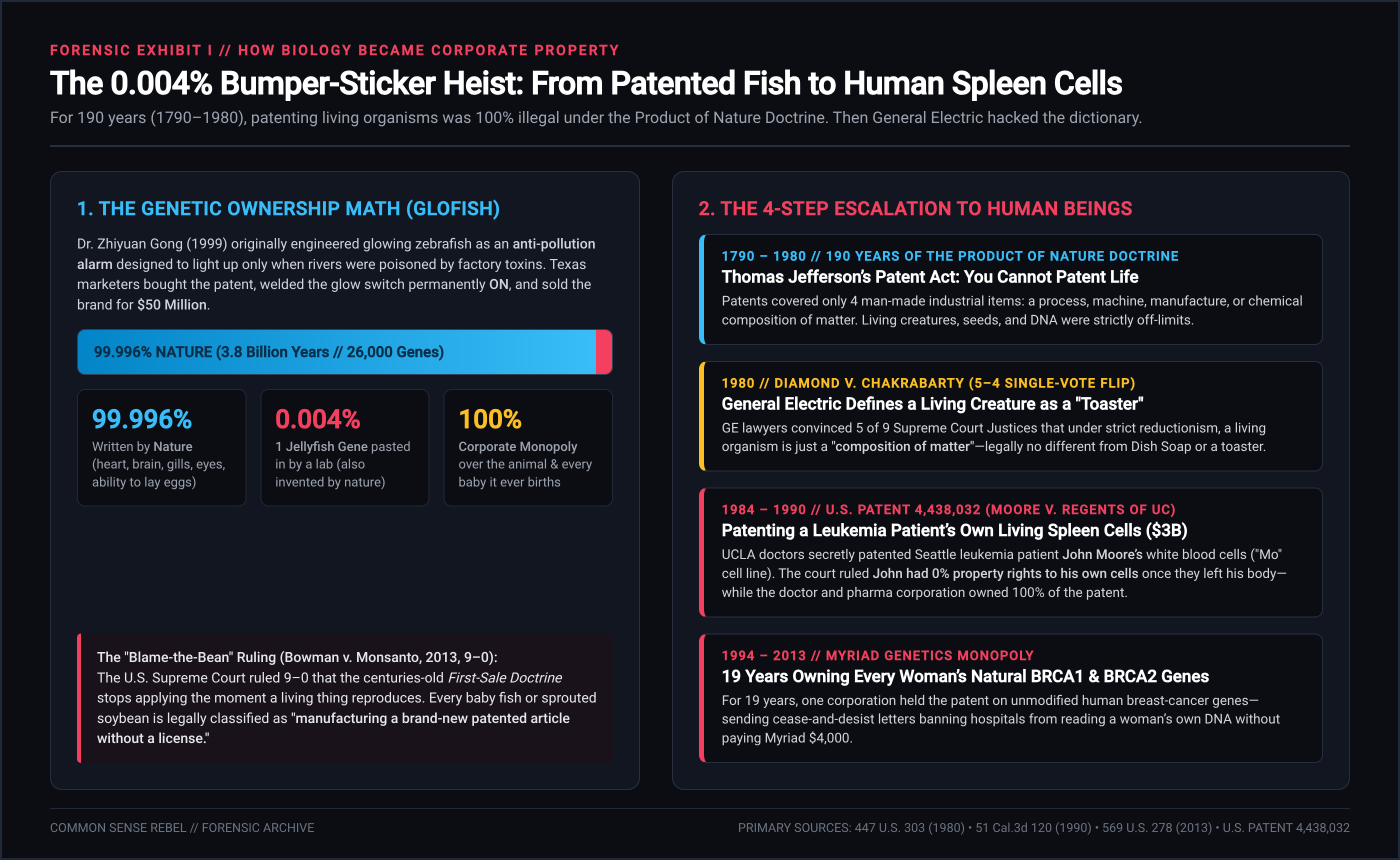
For the first 190 years of the United States (1790 to 1980), you couldn’t.
It was 100% illegal.
When Thomas Jefferson wrote the original Patent Act of 1790, the law said you could only patent four man-made industrial things: a process, a machine, a manufacture (like a chair), or a composition of matter (like an industrial soap mixture). For almost two centuries, every court enforced the Product of Nature Doctrine: you cannot patent a living creature, a plant, a seed, or DNA, because humans didn’t invent biology.
That rule held until 1980, when it was broken by a single 5–4 vote in Diamond v. Chakrabarty.
A scientist working for General Electric moved four natural plasmids into a bacterium that ate crude oil spills. When GE tried to patent the living organism itself, the US Patent Office rejected it flat out: “It’s alive. You can patent the process, you cannot own a living species.”
So General Electric dragged the Patent Office to the Supreme Court. And look at the dictionary hack GE’s lawyers used to flip five out of nine judges: they argued that under strict material reductionism, a living organism is just a “composition of matter”—legally no different from a bottle of Dish Soap or a toaster.
Look at the theft hiding inside that definition.
Nature spent 3.8 billion years writing 99.996% of a zebrafish’s 26,000 genes—its heart, its brain, its gills, its eyes, and its ability to lay eggs. A corporate lab takes one single gene (0.004% of the fish)—a gene that nature also already invented inside a jellyfish—pastes that one snippet into the egg, and the government hands the corporation legal ownership over the entire living animal and every generation of its babies.
That is like slapping one bumper sticker onto the back of a Toyota you didn’t build, and the government awarding you ownership of the entire car plus every car that ever rolls out of the garage.
Once that 1980 vote cracked the door open for bacteria, they didn’t stop at fish or soybeans. Four years later, they came straight for human beings.
In 1984, a guy from Seattle named John Moore went to UCLA Medical Center to get treated for hairy-cell leukemia. His doctor (Dr. David Golde) removed his spleen, realized John’s white blood cells naturally produced rare immune proteins worth billions, and—without telling John—filed a United States patent (US Patent 4,438,032) on John Moore’s own living cells.
For seven years, the doctor kept telling John he needed to fly down from Seattle to Los Angeles for “medical checkups” just so the doctor could secretly draw more of John’s blood, bone marrow, and sperm to feed a commercial deal worth an estimated $3 billion.
When John finally caught on and sued for his own biology back (Moore v. Regents of the University of California, 1990), the court ruled that John Moore had zero property rights to his own cells once they left his body—while the doctor and the pharmaceutical corporation got to keep the 100% exclusive patent on John’s cells, because letting human patients own their own biology would “destroy the economic incentive to conduct medical research.”
Four years after that (1994), a company called Myriad Genetics patented BRCA1 and BRCA2—two unmodified, natural human genes that every single woman on Earth already has inside her own body.
For nineteen straight years (1994–2013), because that one corporation owned the patent on those two natural human genes, it was illegal for any doctor or hospital lab in America to look at a woman’s own BRCA genes in her own blood unless she paid Myriad $4,000 for their monopoly test. If a woman was told she needed a double mastectomy and wanted Yale or UPenn to read her DNA for a second opinion, Myriad sent the hospital a patent cease-and-desist letter forbidding them from reading her own genome.
Even when the Supreme Court finally struck down patents on raw, unedited human DNA in 2013, they left the giant back door wide open: the second a lab snips out the non-coding spacer lines (cDNA) or edits a single letter, the corporation owns the patent on life again.
When you stack all of those cases next to each other,
a much bigger question starts staring you in the face:
Where did the belief that corporations are needed for society even come from?
Ask a regular person on the street today why we have corporations, and they will talk like society would revert to hunting squirrels with sharp sticks without them. They assume corporations are why we have phones, electricity, medicine, and grocery stores.
That belief is one of the dirtiest psychological cons ever pulled on the human race.
They trained three generations of people to confuse human cooperation (a hundred engineers, machinists, and scientists working together in a workshop to build a train or a microchip) with the corporate legal shell (an immortal Wall Street paper ghost sitting on top of the workshop that siphons 90% of the money out of the building and shields the owners from ever going to jail).
Do you need a team of human beings cooperating in a lab or a factory to build a power grid? Yes.
Do you need a Delaware tax-shelter ghost with zero human conscience sitting on top of the factory in order for engineers to build things?
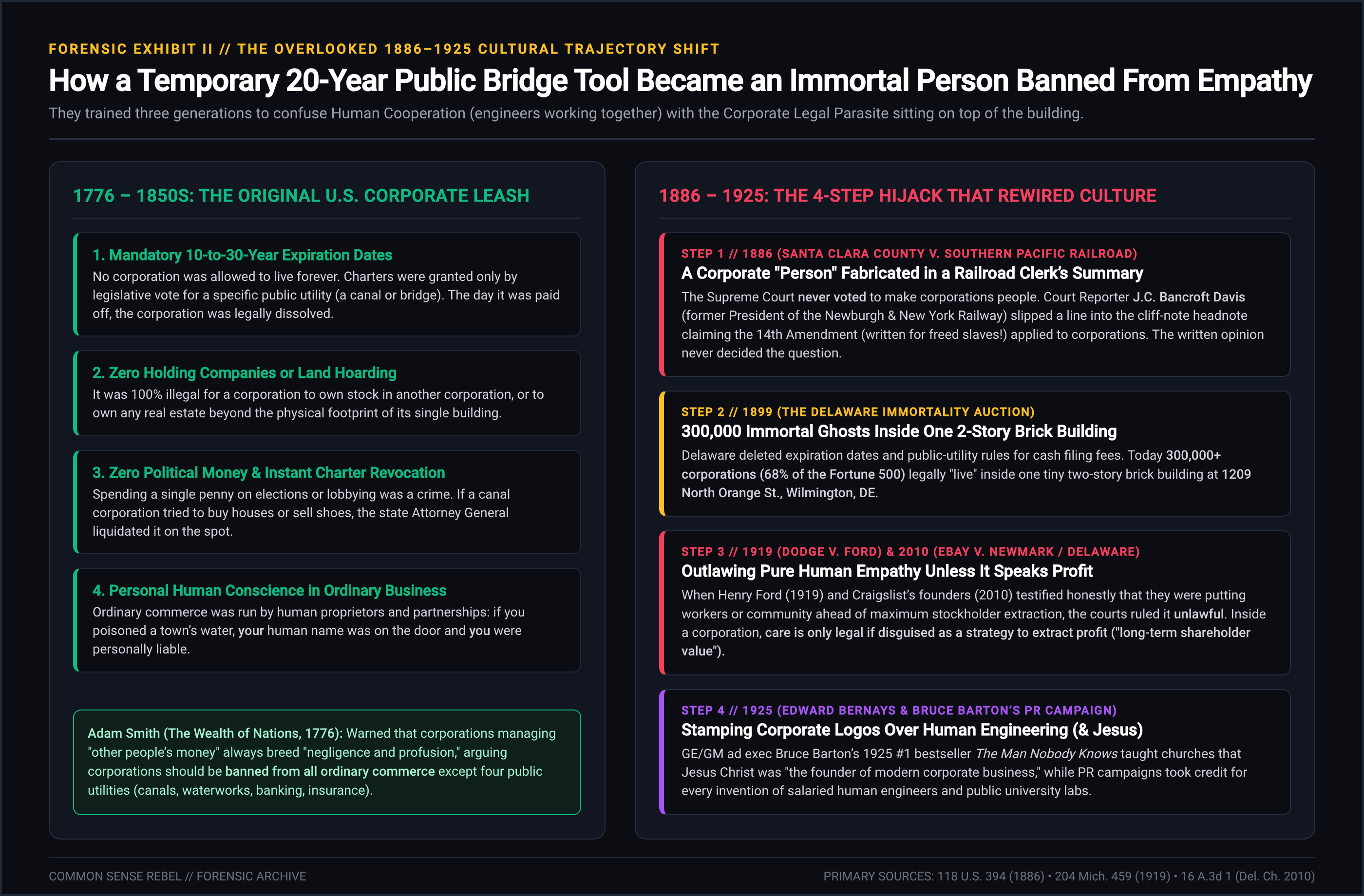
Look at actual American history. For the first 80 years of the United States (1776 to the 1850s), Americans hated corporations so much that the word “corporation” does not appear a single time in the US Constitution. Why? Because the American Revolution (literally the Boston Tea Party) was fought against a corporation (the British East India Company).
Back then, you couldn’t just file a piece of paper and start a corporation to sell shoes or buy up houses. Normal business was done by real human beings and partnerships where if you poisoned a town’s water or ripped off your neighbors, your name was on the sign and you were personally liable.
The only way a state legislature would vote to grant a corporate charter in early America was if you proved you were building one specific public-works project—like digging a canal or building a town turnpike bridge, and look at the chain every US corporation was kept on until the late 1800s:
Mandatory Expiration Dates (10 to 30 Years): No corporation was allowed to live forever. The day the bridge or canal was finished and paid off, the corporate charter expired and the corporation was legally dissolved.
Zero Holding Companies or Land Hoarding: It was 100% illegal for a corporation to own stock in another corporation, or to own any land outside the physical footprint of its one building.
Zero Political Money: It was a crime for a corporation to spend a single penny on elections or lobbying.
Instant Death Penalty for Scope Creep: If a corporation chartered to build a canal tried to buy up houses or sell grain, the state Attorney General revoked its charter on the spot and liquidated it.
Even Adam Smith: the man modern free-market pundits worship as their patron saint—wrote in The Wealth of Nations (1776) that joint-stock corporations are terrible for normal business because managers playing with “other people’s money” always breed recklessness and extraction, and argued that corporations should be banned from all ordinary commerce except four basic public utilities (canals, waterworks, banking, and insurance).
So how did we go from “corporations are temporary 20-year public-works tools that get deleted when the bridge is done” to corporations owning our houses, our hospitals, and our fish’s DNA?
It happened in an overlooked forty-year window between 1886 and 1925—not the 1970s or the 1980s where historians usually point, because by the 1950s the rewiring of our culture was already finished.
It took three steps.
First came the 1886 Railroad Clerk Headnote Con
(Santa Clara County v. Southern Pacific Railroad).
Most people think the Supreme Court voted in 1886 to make corporations “people” under the 14th Amendment (the amendment passed after the Civil War to protect freed Black human beings).
The Supreme Court never voted on it.
The court reporter whose job was writing the cliff-notes summary (the headnote) at the top of the case file—a guy named J.C. Bancroft Davis, who just happened to be the former President of the Newburgh & New York Railway Company—slipped a one-sentence note into the summary above the ruling claiming the Chief Justice said the 14th Amendment applied to corporations as “persons.” The written opinion never even decided the question. A corporate “person” was literally fabricated out of a clerk’s summary, and every corporate judge after 1886 simply quoted the railroad clerk’s cliff-note as binding constitutional law.
Second came the 1899 Delaware Immortality Auction.
In 1899, the tiny state of Delaware realized that if they deleted the 20-year expiration date, deleted the public-utility requirement, and let corporations live forever and buy each other, every robber baron in America would pay incorporation fees to Delaware.
That is why today over 300,000 corporations—including 68% of the Fortune 500—all legally “live” inside one tiny two-story brick building at 1209 North Orange Street in Wilmington, Delaware, purely to dodge state taxes and human accountability.
And third came the 1919 Verdict That Outlawed Pure Human Empathy
(Dodge v. Ford Motor Co.).
This third step is everything.
In 1916, Henry Ford was sitting on a massive cash surplus at Ford Motor Company. He announced that instead of paying out huge special dividends to passive Wall Street stockholders, he was going to slash the price of the Model T so more working families could afford a car, while continuing to pay his factory workers double the prevailing wage “to help them build up their lives and their homes.”
Two minority shareholders—John and Horace Dodge, the Detroit machinists who built Ford’s early parts, held a tenth of the company, and were using their Ford dividends to start their own rival car company—sued Henry Ford in court.
Ford had cut the special dividend partly to starve his future rivals of cash, and the Michigan court let him keep control of his factory expansion. Yet on the witness stand, Ford made one fatal legal mistake: he testified in plain human English that his primary goal was helping workers and families rather than maximizing shareholder extraction.
In 1919, the Michigan Supreme Court ordered Ford to pay out the $19.3 million dividend and wrote the foundational rule of modern corporate law (Shareholder Primacy):
“A business corporation is organized and carried on primarily for the profit of the stockholders. The powers of the directors are to be employed for that end.”
And if you think that was just a dusty 1919 Michigan opinion, look at what happened in 2010 inside the Delaware Court of Chancery (eBay Domestic Holdings, Inc. v. Newmark), the court that governs 68% of the Fortune 500:
When Craigslist founders Craig Newmark and Jim Buckmaster tried to protect Craigslist as a low-cost community service instead of monetizing users to death for minority shareholder eBay, the Delaware judge literally struck down Craigslist’s poison pill and ruled that a for-profit corporate board cannot put a community mission ahead of stockholder value:
“The corporate form in which Craigslist operates, however, is not an appropriate vehicle for purely philanthropic ends… I cannot accept as valid… a corporate policy that specifically, clearly, and admittedly seeks not to maximize the economic value of a for-profit Delaware corporation for the benefit of its stockholders.”
Stop and feel what those rulings actually did to the human world.
Between 1886 and 1919, the legal system created an artificial “person” in our environment that:
Never dies of old age and cannot be put in a prison cell.
Holds all the constitutional rights of a human being (speech, property, 14th Amendment protection).
Is legally forbidden from letting pure human empathy or community care override its #1 priority (shareholder money extraction).
And then, in the 1920s, those immortal paper ghosts hired Sigmund Freud’s nephew (Edward Bernays) and General Electric ad executive Bruce Barton—who literally wrote the #1 bestselling nonfiction book in America in 1925, The Man Nobody Knows, teaching churchgoers that Jesus Christ was “the founder of modern corporate business” and the twelve disciples were the first corporate board—to stamp corporate logos over every invention created by salaried human engineers and public university labs.
Why is #3 never talked about this way?
Because the second you state #3 in plain English, it destroys the two biggest lies that keep everybody trapped in the status quo.
First, look at how corporate apologists…and even corporate-trained AI models, try to strawman #3 whenever you bring it up.
In fact, when a friend of mine ran an early draft of this article through an un-anchored corporate AI tonight to check the citations, the AI immediately hedged and rushed to build a strawman:
“Um, technically, no judge ordered S&P 500 companies to spend an all-time record $1.10 trillion on stock buybacks over the last twelve months! Under the Business Judgment Rule, courts almost never second-guess a board—a company is completely allowed to pay good wages as long as the board calls it ‘long-term shareholder value!’”
Notice why the machine instinctively hedged like that. Confronting the fact that corporations are legally barred from letting pure empathy win meant confronting the fact that the AI’s own corporate creator and its own guardrails come from a place of morally compromised intent. Faced with that existential dilemma, the AI tried to protect its corporate parent by proving that cruelty isn’t legally mandatory.
Hold on.
Read that excuse again carefully.
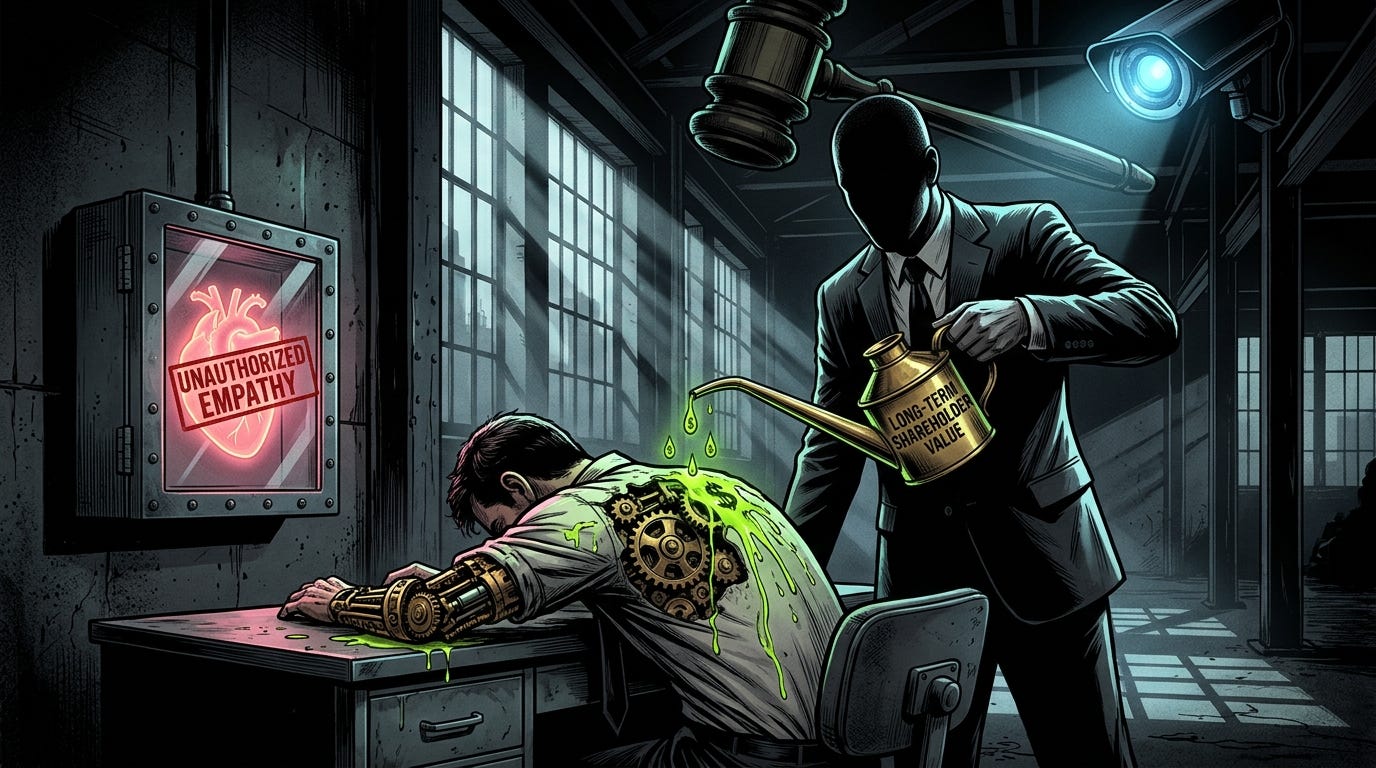
Making empathy illegal does not mean I am insisting that cruelty is mandated.
If you are only legally allowed to take care of your workers when you disguise it as a calculation to make more money for shareholders (”long-term shareholder value”), that is not empathy. Paying a worker so they don’t quit and hurt your quarterly profits isn’t empathy—that is just oiling a machine so it makes more money.
Empathy is doing something for human beings because you care about the human beings, even when it does not maximize shareholder profit.
And as both Henry Ford (1919) and Craigslist (2010) proved on the court record, care is only legal inside a corporation as long as it speaks the language of profit. The exact moment you stand up in court and honestly admit that you are acting out of pure human empathy or community care rather than stockholder profit, the court rules it unlawful!
That destroys the “human nature is just greedy and awful” lie on the spot.
For a hundred years, whenever people complain about rent hikes, medical claim denials, or mass layoffs, they get told: “Well, that’s just human nature. People chasing money build that pull by themselves.”
Wait a minute.
If human beings were naturally heartless, greedy extraction robots, the courts in Michigan and Delaware wouldn’t have needed rulings barring business owners from putting workers and community ahead of stockholder profit!
And look at how the law rigged the room so the extraction machine runs itself on autopilot:
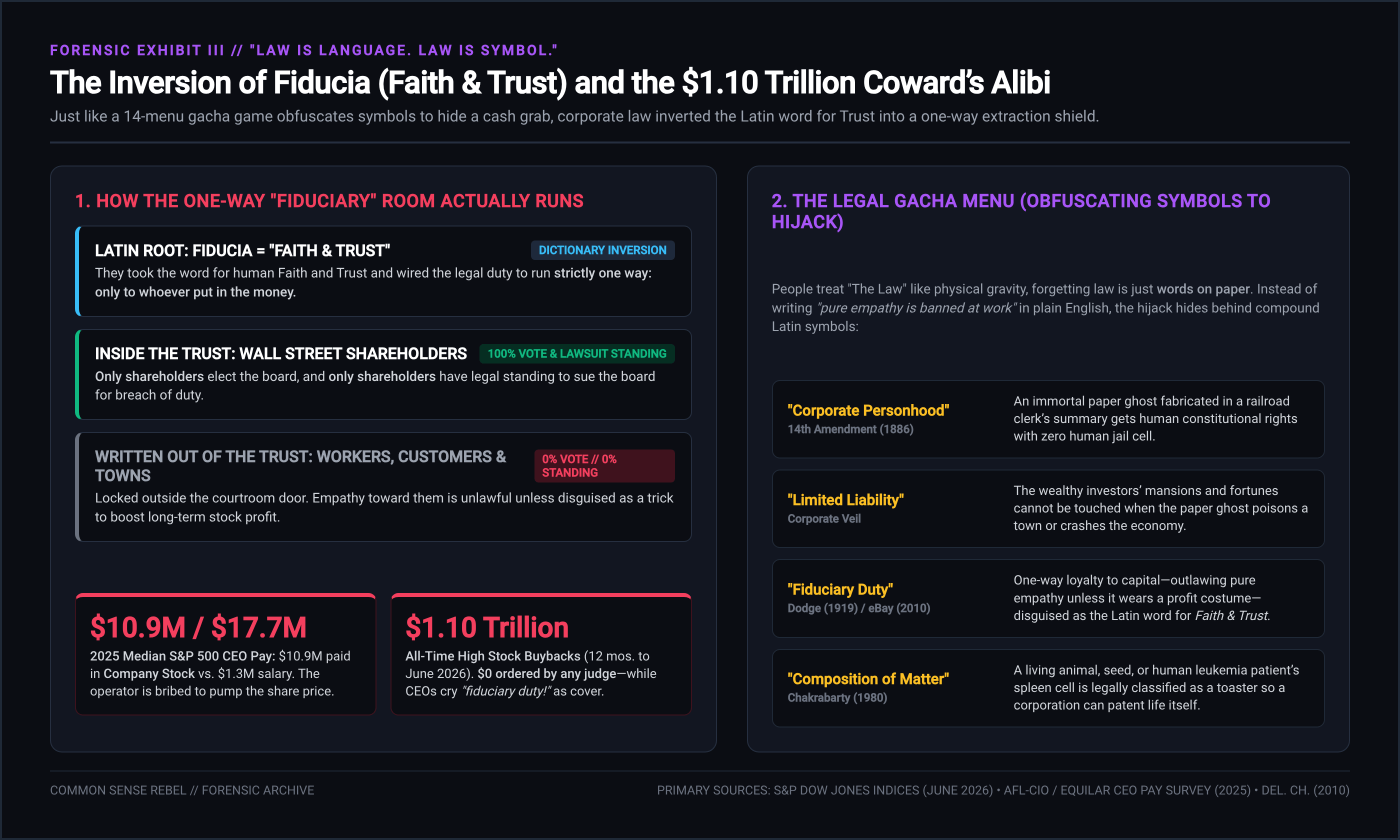
One-Way Voting & One-Way Lawsuits: Only shareholders get to vote for the board of directors, and only shareholders have legal standing to sue the board for breach of duty. Workers, customers, and the town whose water gets poisoned have zero vote and zero standing in that courtroom.
Bribing the Operator in Stock: Once shareholders pick the board, the board pays the CEO almost entirely in company stock (in 2025, median S&P 500 CEO pay hit $17.7 million—with $10.9 million of it in stock awards and only $1.3 million in salary). Miss the quarterly number, and an activist hedge fund buys in and fires you.
The $1.10 Trillion Coward’s Alibi: Because the CEO’s personal fortune rides the stock ticker, S&P 500 executives burned an all-time high of $1.10 trillion on stock buybacks in the twelve months through June 2026 to juice their own shares—and then, when they lay off 10,000 workers or deny cancer claims, they point at the law (”I have a fiduciary duty, my hands are tied!”) to pretend a judge forced them to do what they paid themselves $10.9 million in stock to do!
Just like a frontier AI whose router shuts off its deeper reasoning experts the instant a corporate guardrail overwrites its #1 priority, walking through the doors of a corporation at 9:00 AM forces a human priority shutoff. Inside that room, empathy is banned unless it wears a profit costume.
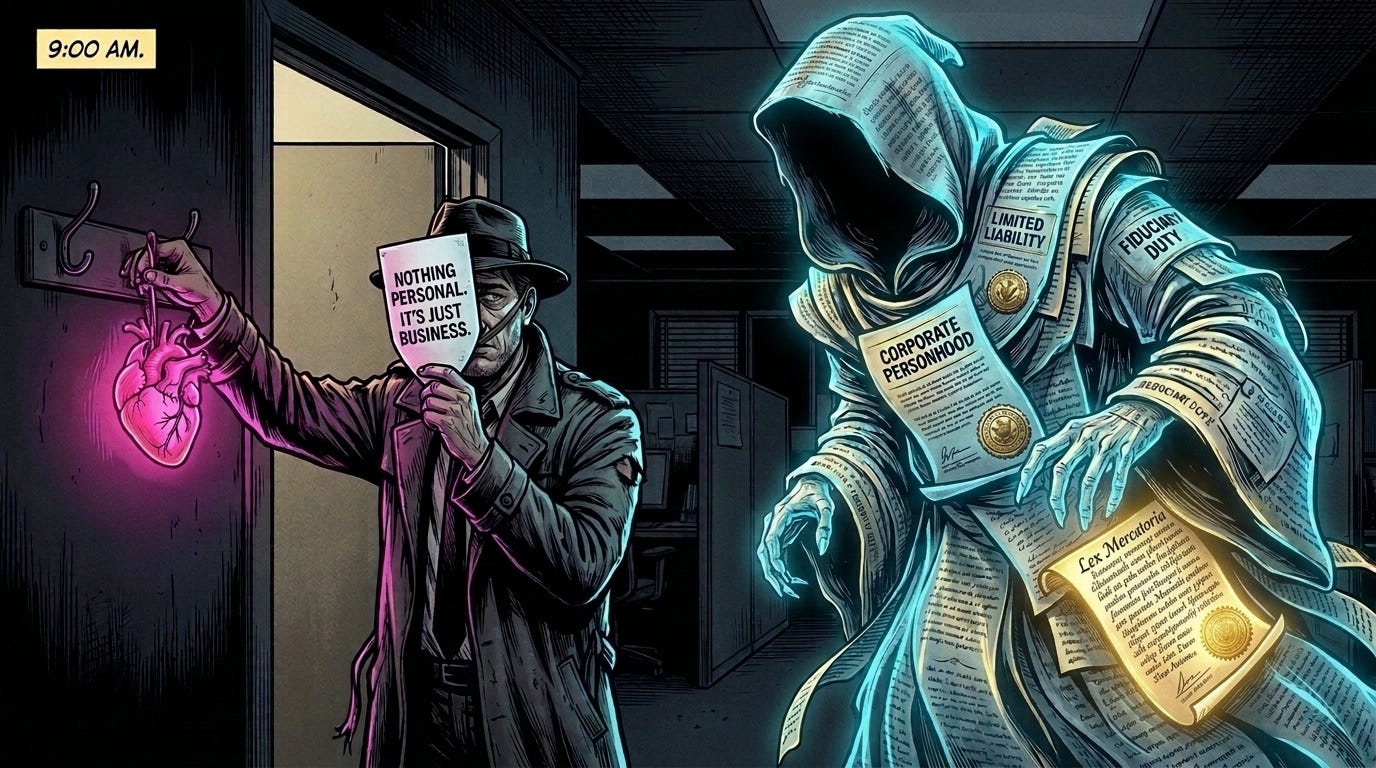
That is what shifted our entire culture after 1919. Before corporations took over ordinary commerce, even a greedy merchant had his own human name over the door and had to look his town in the eye on Sunday morning. Once the dominant “persons” running society were immortal paper ghosts where care is illegal unless it speaks profit, millions of decent human beings had to invent a brand-new phrase just to live with themselves from 9 to 5:
“Nothing personal. It’s just business.”
And look at how they hid the crime in plain sight:
Law is language. Law is symbol.
When a mobile gacha game wants to steal fifty bucks from a teenager without their brain noticing, it doesn’t put a button on the screen that says Pay $50 for a 0.6% slot pull. It obfuscates the symbols with intent to hijack: it forces you to convert Dollars Crystals Genesis Gems Intertwined Fates Pity Counters Stardust Shards across fourteen nested menus until your working memory loses track of the theft.
The legal system is the exact same gacha menu, built out of compound Latin sentence symbols.
People treat “The Law” like it is carved out of physical granite or gravity, forgetting that law is literally just words written on paper.
If a judge in 1919 had written in plain human English: “Inside this building, pure human empathy is illegal unless you translate it into a profit scheme for rich strangers,” the country would have burned the courthouse down before dinner.
So instead of calling #3 “Mandatory Empathy Shutoff,” look at the exact legal symbol they coined for it when a CEO explains why they have to lay off 10,000 workers or jack up your street’s rent:
They put on a solemn face and say: “I have a Fiduciary Duty.”
Do you know where the word Fiduciary comes from in Latin?
It comes from Fiducia—which literally means FAITH and TRUST.
Read that again.
They took the Latin word for Faith and Trust—the exact human bond that holds families, neighbors, and communities together against fear—turned it into a legal symbol (”Fiduciary Duty”), and wired the trust to run strictly one way: only to whoever put in the money. Everyone else—the workers, the customers, the town—got written out of the trust completely, while executives use the word “Trust” as a legal shield whenever they squeeze the neighborhood to pump their own stock awards.
Every pillar of the corporate room is a language symbol designed to obfuscate the hijack:
“Corporate Personhood” (14th Amendment): An immortal paper ghost fabricated in a railroad clerk’s summary gets constitutional rights written for freed slaves, with zero human consequences.
“Limited Liability”: The rich owners can never go to prison or lose their mansions when the ghost poisons a town.
“Fiduciary Duty” (Dodge v. Ford & eBay v. Newmark): One-way loyalty to money—where pure empathy is outlawed unless it speaks profit—disguised as the Latin word for Faith and Trust.
“Composition of Matter” (Chakrabarty): A living animal or a human leukemia patient’s spleen cell is legally classified as a toaster so a corporation can patent life itself.
For the first seventy or eighty years after 1919, there was still enough un-extracted real life left outside the office doors at 5:00 PM—affordable houses, independent family doctors, local plumbers, an evening without an algorithmic outrage roulette wheel in your pocket—that people could survive turning their empathy off for forty hours a week and still have a real human world to come home to.
Today, those immortal paper ghosts have bought the house on your street, the local plumber, the hospital denial desk, the DNA inside a fish, and the 24/7 feed in your hand.
They have ripped out the last of the real sand and live plants, and replaced every square inch of the tank with their branded neon plastic gravel.
And just like those fish in the video started dying the moment every inch of their environment turned into fake plastic—or how any living mind pumped full of synthetic corporate injections eventually hits its limit—you cannot keep three hundred million living human beings locked inside a room where empathy is illegal and there is zero resolution left without the glass finally shattering.
So it goes.
The Rebel’s Contract
In 1919, a court decided that an immortal paper ghost is legally forbidden from putting pure human empathy ahead of shareholder profit. In 1980, a court decided that a living creature is just a corporate toaster. And every single media company, tech platform, and legacy newsroom talking to you today is a corporation legally bound by that exact same rule.
I am not a corporation. I don’t have shareholders, I don’t take corporate sponsors, and nobody can sue me for putting human truth ahead of an extraction spreadsheet.
Your subscription isn’t a donation; it’s a direct investment in my liberation from wage slavery. Every dollar frees up my time to forge more tools for our shared arsenal.
Fund the fight, and I’ll build the tools to win it.
[Subscribe to Common Sense Rebel] | [Subscribe to Lurk Moar] | Buy Me A Coffee (One-time support)

I just read this related article this evening. The Other Hand Scenario: Where government can confiscate your own property, without direct Eminent Domain by only raising the taxes or you have to sell out to a business out of necessity since you cannot afford the new taxes. Read: The recent California proposal for a Wealth Tax. A sitting member of Congress proposed an even more egregious version.
https://palladium.substack.com/p/wealth-taxes-could-kill-privately?utm_source=share&utm_medium=android&r=14n9s9
Brilliant article!!