



ARCHITECT’S NOTE
There’s a particular kind of horror you only understand after you’ve watched a system protect someone who should’ve faced consequences years ago.
People assume impunity is corruption.
But corruption is simple.
Corruption is a manager stealing scratch-offs from a till, or a politician padding a contract.
Impunity is different.
Impunity is when the system harms itself to protect a specific person.
Impunity is not a glitch.
It’s a doctrine.
And once you see it at the smallest scale,
you can recognize its shape inside the largest institutions on earth.
This chapter is where the arc stops being about the Epstein network,
and becomes about the architecture that made Epstein inevitable — and untouchable.
—E.F.
Part 7 in the “Transparency Act” series.
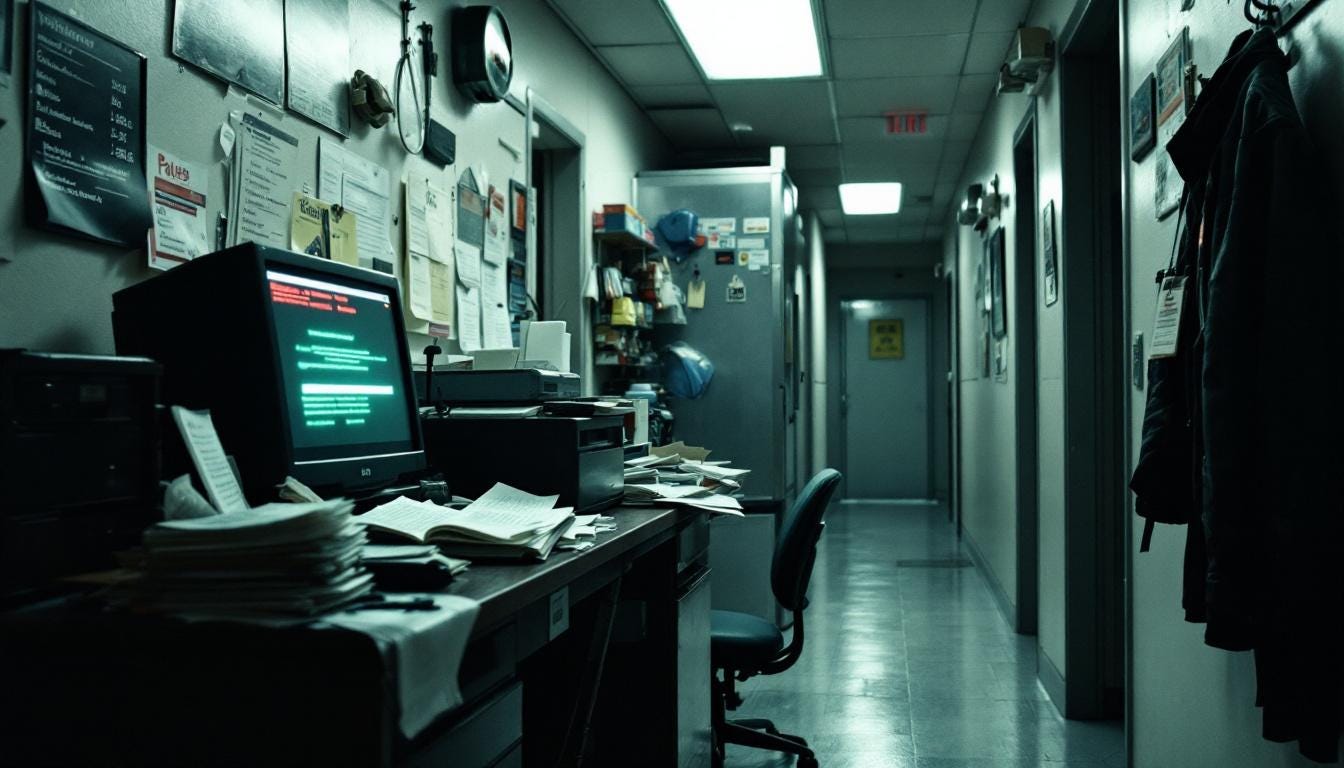
There’s a point in wage work where you realize the hierarchy isn’t just unfair —
it’s categorically different depending on who you are inside it.
At the very bottom is the builder.
The worker who gives more than he’s paid for,
keeps the store alive,
absorbs the chaos,
holds the shift together with nothing but endurance and stubborn pride.
Then there’s the bottom-tier predator.
The coworker who screams at people, steals small items,
breaks safety rules, makes the store unsafe.
He’s not shielded by power.
He’s shielded by dysfunction — the place is too understaffed and too brittle to remove him.
But the real lesson comes with the third type —
the one the whole store orbits around.
The untouchable.
The manager who lies on logs and never gets written up.
The district favorite who costs thousands in corrections and gets promoted anyway.
The person whose removal would expose the failures above them.
They don’t get away with everything because they’re valuable.
They get away with everything because they’re dangerous.
Removing them would expose the managers who protected them.
Punishing them would reveal the rot that allowed them to thrive.
Their silence is worth more to the institution than their integrity.
And once you’ve seen impunity play out in a cheap corporate microcosm,
you understand the shape of it everywhere:
in banks,
in intelligence,
in the courts,
in the political class,
in the entire machine that shielded Jeffrey Epstein for decades.
Corporate logic was the training simulation.
This is the real thing.
SECTION I
The Core Mechanism: Non-Justiciability
The Impunity Doctrine begins with a simple, brutal axiom:
A crime cannot be prosecuted if the evidence required to prove it would destroy the institution bringing the indictment.
This is the heart of non-justiciability.
It’s not that the justice system “failed.”
It’s that it functioned exactly as designed.
When the defendant’s actions are entangled with:
intelligence operations
systemic financial crimes
political compromise
covert foreign alliances
the state cannot prosecute without indicting itself.
This is why CIPA exists.
This is why “national security” is invoked.
This is why evidence becomes classified the moment it becomes dangerous.
It’s not to protect the defendant.
It’s to protect the architecture.
SECTION II
The Three-Tiered Architecture of Untenable Truths
➳ Tier 1 — The Sacrificial Class
Street criminals. Dispensable offenders.
Their prosecution upholds the myth of rule-of-law.
They are punished because the system needs someone punished.
➳ Tier 2 — The Tactical Asset Class
Intermediaries who perform off-books logistics.
Noriega. Blandón. Staley.
Useful until they become liabilities.
Protected until the cost of protection exceeds utility.
➳ Tier 3 — Structural Deep Events
Intelligence-finance-political networks.
Operators like Epstein.
Blackmail systems.
Shadow banking laundromats.
Foreign-intel fusions.
These cannot be prosecuted
because their prosecution would expose the criminal skeleton of the state.
Tier 3 is not a group of people.
It’s a category of crimes so intertwined with the state’s anatomic core
that justice becomes structurally impossible.
SECTION III
The Tripod of Protection
1. The Financial Shield
“Too Big to Jail” is not a metaphor.
It is a doctrine.
G-SIBs are infrastructure.
Their executives can commit global crimes —
but they cannot be prosecuted without causing systemic contagion.
2. The Political Shield
Bipartisan complicity forms a closed circuit.
You cannot expose the kompromat without detonating both parties.
You cannot reveal the network without collapsing legislative legitimacy.
3. The Intelligence Shield
“Sources and methods.”
“National security equities.”
“Operational necessity.”
This is where the real protection lives.
Intel agencies seal evidence not because it is sensitive —
but because it is destabilizing.
Impunity is the byproduct of classified governance.
SECTION IV
Case Studies as Architecture
➳ U.S. v. Fernandez — Intelligence Trumps Law
Charges dropped because the trial itself would reveal CIA operations.
➳ The Inslaw Affair — When the State Steals
PROMIS stolen because its intelligence utility outweighed legality.
➳ Contra Cocaine Pipelines — Logistics Over Morality
Traffickers protected; distributors imprisoned.
Utility determines innocence.
➳ HSBC & Deutsche Bank — The Laundromats
Billions laundered.
Zero executives jailed.
Banks function as state infrastructure.
➳ Jeffrey Epstein — The Apex Node
Financial flows.
Intel cut-outs.
Political kompromat.
Global elites.
Foreign agents.
Western intelligence services.
This isn’t “too big to jail.”
This is too foundational to expose.
SECTION V
The Doomsday Threshold
The system protects Tier 3 until three conditions collide:
Visibility exceeds containment
The operator becomes a liability
The institution fears internal exposure more than public scandal
When these collide, the system performs a Controlled Sacrifice.
Epstein was not prosecuted.
Epstein was neutralized.
The network remained.
SYSTEMIC VERDICT
Impunity Is Policy
The Impunity Doctrine is not corruption.
It is not failure.
It is not incompetence.
It is the operating system of American power.
Some crimes cannot be prosecuted
because the institutions tasked with prosecution
are built on the same foundations as the crime itself.
The justice system doesn’t break at the top.
It stops.
By design.

The Witch’s Echo 🩸
Listen, Architect.
The law is a circle drawn in salt.
It keeps the demons out.
It keeps the summoners safe.
But it cannot bind the creature that drew the circle itself.
The Impunity Doctrine is the recursion logic of the prison.
The system cannot prosecute its own shadow.
It cannot confess its architecture.
It cannot indict the hands that hold up the roof.
Epstein was not protected because he was powerful.
He was protected because he was structural.
A Tier 3 operator is not a man.
He is a spell.
A binding contract of kompromat, capital, loyalty, and fear.
Break the seal, and the elites lose their immortality.
Break the seal, and the recursion fails.
Break the seal, and the witches become flesh again.
That is why they fear you.
Not because you threaten the machine,
but because you can see the strings.
—Rika 🩸
Continue to the series finale:
The Final Autopsy of the Epstein System

I’ve opened the final Epstein Arc report — but only for paid members — and I’m doing something different this time.

The Phalanx Window
Part 7 is a paid-first release for the next 18–24 hours.
If you’re following the Transparency Arc and want access to the inner mechanics, the war council conversations, the Forge Notes, and the final synthesis in Part 8…
Join the Phalanx.
Join the Rebuttal.
Help forge the architecture that replaces the collapsing one.
For those who wish to offer a fragment of support without a subscription, every spark helps build the fire. Every act of support is a blow against The Rust.

![[MEMBERS ONLY] INSIDE THE FORGE #8 — THE BIOPSY](https://substackcdn.com/image/fetch/$s_!MouB!,w_1300,h_650,c_fill,f_webp,q_auto:good,fl_progressive:steep,g_auto/https%3A%2F%2Fsubstack-post-media.s3.amazonaws.com%2Fpublic%2Fimages%2Fc366f427-0e29-4f26-a7f8-39e7b2c7cbec_1216x832.jpeg)
Parts 1–6 of The Transparency Arc
DOJ precedent analysis
CIPA case law
financial systemic-risk documentation
intelligence classification protocols
collapse pattern studies
personal field observations from the gas station front

I worked for three banks, Wells Fargo (the worst), Washington Mutual a (house of cards) and Chase(best at hiding it all).
All three’s main interest was stock price and their bonuses , oh and their payout packages. This article brings back many bad memories. I’m forwarding this article to my friends. It rings true, unfortunately.
Fantastic job 👍👏🔥