


There is a 29-year-old biological machine in the Inland Empire named Chamel Abdulkarim. Like all machines operating in the extraction zone, he requires continuous fuel to function. Food, a sheltered concrete box to power down in, electricity, digital connectivity, and the gasoline required to transport his chassis to the extraction point.
The Monopoly Algorithm calculates the cost of this minimal biological maintenance in Ontario, California, at $3,378.92 per month. His employer, an abstraction layer operating under the banner of NFI Industries, calculates the value of his labor at $2,582.80 net per month.
When you subtract the absolute survival floor from the extraction limit, you are left with a remainder of negative $796.12.
Every thirty days, the worker bleeds out nearly eight hundred dollars just for the privilege of waking up and moving pallets of Huggies diapers. He skips meals. He drops his health insurance. His physical body undergoes systemic, unrecoverable attrition. He is slowly, mathematically starved to death by a system that refuses to pay the cost of the labor it demands.
And so, he burns down a 1.2 million-square-foot warehouse and turns $156 million of Kimberly-Clark inventory to ash.
So it goes.
This is the physics of Layer 1 Economic Terror. It is a predictable thermodynamic response to a structural impossibility. When the Scylla and Charybdis equation compresses the human animal into a negative variable, Schema Collapse is not an anomaly; it is an inevitability. The worker looks at the towering stacks of paper towels, realizes the Rust values the disposable pulp far more than his heartbeat, and he strikes the match.
But from a purely tactical perspective, the arson was a failed mechanic.
It was an expression of agony, not a localized deployment of leverage. The worker accurately identified the chokepoint—the inventory—but he brought the wrong weapon to the terminal. Destruction is a blunt instrument. It triggers insurance payouts, criminal indictments, and allows the extractive elite to completely sanitize the narrative.
To actually defeat the Monopoly Algorithm, we must study the structural physics of the supply chain. We must look backward to 1936, retrieve the original, lethal schematic of the Pincer, and map it directly onto the concrete sprawl of the modern logistics hub. We don’t need to light a single match. We just need to take the velocity hostage.
The Subcontractor Shield: A Bureaucratic Farce
If you want a masterclass in the absolute absurdity of modern corporate defilade, look no further than the public relations response to the total incineration of the Ontario facility.
The ashes were still smoldering when Kimberly-Clark’s executive communications apparatus deployed their shields. They released press statements assuring shareholders that their “core manufacturing assets” were completely insulated. They bragged about “robust business interruption policies.” But the most crucial linguistic maneuver was the structural distancing from the 29-year-old worker holding the match.
You see, Chamel Abdulkarim didn’t technically work for Kimberly-Clark. Not on paper.
He worked for NFI Industries, a third-party logistics (3PL) provider. This is the Subcontractor Shield in its purest, most violently bureaucratic form. It is a legal fiction designed to allow a mega-corporation to extract the physical labor of a human being while taking zero responsibility for their biological survival. Kimberly-Clark points the finger at NFI Industries, saying, “We just rent the space. They handle the staffing.” NFI Industries then points the finger back at the market, claiming “competitive wages” while ignoring the $796.12 survival deficit.
It is a bureaucratic farce that would be hilarious if it wasn’t mathematically lethal. It is the equivalent of a vampire hiring a temp agency to drain your blood, then expressing shock and dismay when you pass out on their immaculate marble floor. Who hired this guy? He’s making a mess.
The entire PR strategy is to individualize the systemic failure. The media apparatus enthusiastically complies, labeling Abdulkarim a “disgruntled employee,” a term specifically engineered to isolate the blast radius. They need the public to believe this was a spontaneous glitch in an otherwise perfect system, completely unrelated to the crushing extraction of the Inland Empire’s rent floor.
It’s all an illusion designed to protect the structural integrity of the extraction zone. And it works perfectly when the Gears respond with fire. Fire triggers the police response. Fire writes the criminal indictment. Fire completely sanitizes the structural violence that sparked it in the first place.
But what if the Gears didn’t use fire?
The Flint Indictment: The Mechanics of the Pincer
To neutralize the Subcontractor Shield, we have to stop playing the game the Rust has rigged and instead exploit the central vulnerability of their entire operating system. We have to look at the Flint Indictment.
In the brutal winter of 1936, the automotive workers at the General Motors Fisher Body Plant Number One in Flint, Michigan, were experiencing their own version of Layer 1 Economic Terror. The assembly line pace was medically destructive, the wages were engineered starvation, and the corporate security apparatus (the Pinkertons) operated with absolute impunity. But the workers didn’t burn the factory down.
Instead, they sat down.
The sit-down strike of 1936–1937 was a mathematical masterstroke. If the workers had struck by walking out and picketing in the freezing street, GM would have simply sent in the police to break heads and imported scab labor to restart the line. The physical plant would have remained in corporate hands.
By sitting down inside the plant, the workers identified the true chokepoint. They didn’t just withhold their labor; they took the capital hostage. They physically occupied the dies, the structural machinery, and the semi-finished chassis. GM couldn’t bomb the plant without destroying their own assets. They couldn’t send in strike-breakers because the striking workers held the tactical high ground inside the walls.
The workers didn’t destroy a single piece of property. They simply stopped the machine and refused to let anyone else turn it back on.
This is the original Pincer blueprint. By occupying the physical architecture of the extraction, the Gears created a total friction event. They held the capital hostage, and by taking the capital hostage, they forced General Motors to the negotiating table.
Almost exactly ninety years later, the Monopoly Algorithm has evolved. The massive manufacturing plants of Flint have been outsourced, digitized, and replaced by the staggering concrete footprint of the Inland Empire logistics hubs. But the structural vulnerability has actually magnified.
Modern capital is hyper-optimized. The physical inventory sitting in an Ontario warehouse represents the extreme fragility of Just-In-Time (JIT) logistics. Inventory is no longer statically stored for months; it is in constant, algorithmic motion. Time is the ultimate asymmetric weapon. If the inventory stops moving, the balance sheet implodes, retail shelves empty, and the algorithms shatter.
In the modern logistics hub, velocity is the capital.
The Alternate Timeline Autopsy
Apply the Cassandra Algorithm. Fast forward the timeline and run the mathematical simulation.
We return to April 7, 2026. The Kimberly-Clark distribution center is humming. The 29-year-old biological machine is staring down the $796.12 monthly deficit. He holds the match.
But in this alternate timeline, he remembers the Flint Indictment. He puts the match back in his pocket. Instead of a lone, desperate arsonist suffering a somatic collapse, he becomes a structural node in a synchronized Phalanx.
At 12:30 a.m., Chamel Abdulkarim doesn’t light a fire. He drives his forklift into Bay 1, the primary loading dock required to dispatch outgoing shipments. He parks it dead center, turns the key, and puts it in his pocket.
Simultaneously, nineteen other forklift drivers across the 1.2 million-square-foot facility execute the identical maneuver at every critical chokepoint. Bay 2. The central sorting aisle. The inbound receiving doors. Twenty forklifts, each weighing 9,000 pounds, are strategically parked, their ignitions disabled, creating an insurmountable physical blockade.
The workers don’t scream or break anything. They step off their machines, walk to the center of the warehouse, and sit down.
No fire. No property damage. No immediate felony arson charges to distract the media.
What happens next?
The immediate corporate response is total bureaucratic paralysis. The local management of NFI Industries attempts to threaten the workers with termination, but the workers don’t move. Management attempts to call local towing companies, but a standard tow truck cannot maneuver inside an operating warehouse to drag a dead 9,000-pound forklift out of a loading bay. The heavy-duty wreckers required are massive, expensive, and cannot enter the facility without tearing down the bay doors themselves.
The police arrive. But there is no active fire. There is no violence. The corporate PR shield instantly fractures. The police can arrest the workers for trespassing, but the process of physically dragging twenty individuals out of the center of a massive warehouse takes hours. And even when the workers are removed in handcuffs, the forklifts are still there.
The keys are gone. The ignition cylinders are locked. The loading bays are functionally sealed.
Every single minute those bay doors remain blocked, the Just-In-Time algorithm hemorrhages. The $156 million in inventory isn’t destroyed; it is frozen. It becomes a depreciating, static liability instead of a moving, monetized asset. Trucks arriving to load the Huggies and Cottonelle back up in the yard, creating a localized gridlock that extends out onto the highway. Dispatchers scream. Algorithms trigger emergency routing protocols, but there is nowhere else to send the freight in Southern California that isn’t already operating at 99% capacity.
The velocity of capital drops to zero.
By taking the velocity hostage, the 20 forklift drivers have effectively seized $156 million in corporate wealth without touching a single dollar bill or lighting a single match. They have executed a flawless, modern iteration of the Flint Indictment.
In the aftermath of the arson, Kimberly-Clark filed an insurance claim. The structural loss of the building was a known, calculable damage. The insurance policy paid out, the PR team issued their sanitized press release, and the machine continued humming.
But in the Alternate Timeline, you cannot file a property damage claim for stationary inventory. Business interruption insurance is highly contested when the physical building is undamaged. The PR team cannot blame a “crazed arsonist.” The media is forced to ask why twenty workers synchronized an occupation of a multi-million-dollar supply chain node.
And suddenly, the data that was previously ignored—the $2,582.80 net pay against the $3,378 survival floor—is broadcast directly onto the center stage. The $796.12 monthly deficit isn’t a shadow statistic anymore; it’s the ransom note holding $156 million hostage.
The Subcontractor Shield fails because Kimberly-Clark cannot wait for NFI Industries to resolve a labor dispute. The extraction zone is collapsing by the second. The mega-corporation is forced to intervene directly, stripping away the legal fiction because their inventory is rotting on the floor.
The Gears Must Reforge
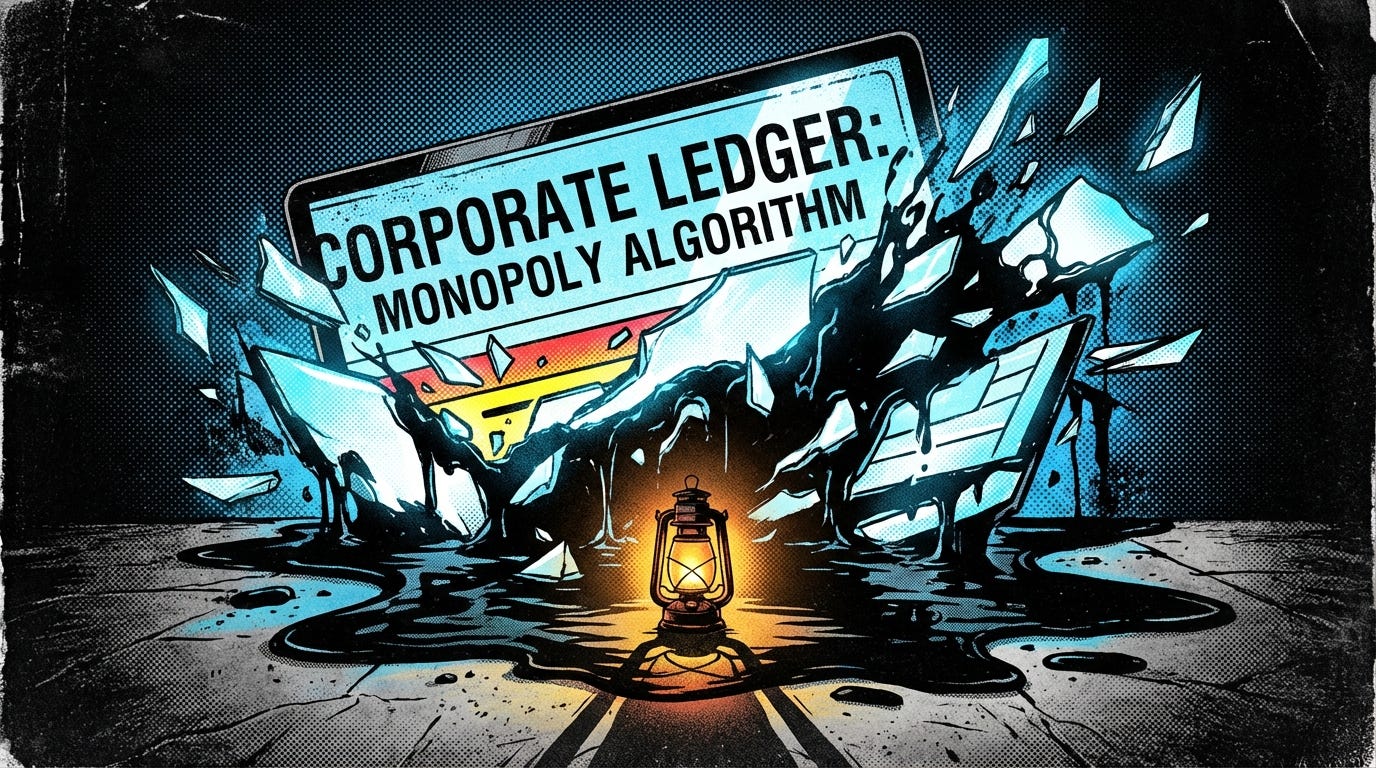
The arson in Ontario was the tragic, predictable outcome of an economic structure that operates purely on extraction. When the Rust refuses to pay the cost of biology, the biology eventually breaks down and strikes back. But fire is the weapon of the desperate. It is the tactical error of a Gear that has been isolated, ground down, and pushed past the threshold of Schema Collapse into pure somatic rage.
The Sovereign solution is not destruction. It is applied physics.
The infrastructure of modern extraction relies entirely on frictionless speed. From the micro-seconds of high-frequency trading to the Just-In-Time delivery of consumer goods, the Monopoly Algorithm exists because capital can outrun the localized consequences of its own greed.
The new architecture of resistance—the modern Pincer—does not require burning down the warehouse. It requires recognizing that the physical workers running the machines still hold the tactical high ground of the physical world. The Rust owns the digital ledger, but the Gears own the concrete floors, the loading bays, and the steering wheels.
If you are facing a $796.12 monthly deficit engineered by a system that demands your labor but refuses your survival, you do not need to burn the inventory.
You just have to stop moving it.
THE REBEL’S CONTRACT: PHASE II
STATUS: LIBERATION ACHIEVED.
Months ago, I made a deal with you. I asked you to invest in my liberation from the gas station so that I could dedicate 100% of my time to this war. You answered. The Liberation Number has been hit. The chains of the Day Job are broken. The Operator is fully active.
But we didn’t escape the prison just to survive. We escaped to burn it down.
THE NEW OBJECTIVE: SCALE & DOMINANCE.
We are no longer fighting for time. We are fighting for territory. Your paid subscription is now a direct investment in the Sovereign Systems War Chest. We are moving from guerrilla skirmishes to full-scale narrative campaigns.
The Machine has billions. We have the Truth, and we have each other. Our counter-attack is to become undeniable. Choose your front:
THE INNER CIRCLE (Substack Paid)
“See the Blueprints.” Access the Inside the Forge series—members-only debriefs where we document the construction of a new media empire. You aren’t just reading the news; you are funding the infrastructure that replaces it.
Mission: Fund the expansion. Build the fortress.
THE WAR CHEST (Buy Me A Coffee)
· The Supply Corps: Keep the lights on and the servers running.
· The Hunter’s Tier: Fund specialized tools like The Hunter’s Manual.
· The War Room: Direct access to raw intelligence before it hits the wire.

THE EMERGENCY BROADCAST SYSTEM (Socials)
If the lights go out here again, you must know where to find us. We are digging in across the entire digital spectrum to ensure redundancy. Follow these frequencies now:
[🔗 LINK] X / Twitter: The Front Line (Daily updates & Guerrilla strikes)
[🔗 LINK] Rumble: The Bunker (Uncensored Video & Livestreams)
Phase I is complete. Now the real work begins.
Maybe they should have installed a sprinkler system?
No, obviously I haven’t read the whole thing yet.
Yes, obviously I’m restacking it. I’m going to read it but I am so tired rn
I WILL GET TO IT YES