


Fragment Methodology 03
A Note on the Fragment Methodology Series:
The Fragment Methodology series is, essentially, my autobiography. But it is not written as a memoir—it is an autopsy. It is a forensic dissection of the survival systems, cognitive architectures, and psychological mechanisms I’ve had to build (or tear down) to survive the Vertical War.
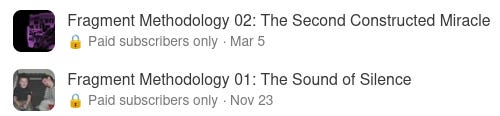
Because of the intensely personal and operationally sensitive nature of these autopsies, Fragment Methodologies 01 and 02 are locked behind the Vanguard paywall. They are for the core.
However, as I was compiling the forensic research for this third entry—specifically the deep-dive into non-linear cognition, the “Elaboration Engine,” and how we internalize systemic failure—I realized the payload was too critical. The information here about how the Rust pathologizes your mind to enforce compliance is too lethal, and too necessary, to hide behind a paywall.
So, I am unlocking the gates. Fragment Methodology 03 is entirely free.
Read the source code.
[HAZARD WARNING // SCHEMA COLLAPSE RISK]
This document contains a forensic structural autopsy of institutional mechanics, including organized religion and corporate “executive function” paradigms.
It is explicitly designed to dismantle internalized tutorials.
If you rely on the funnel to navigate your reality, do not proceed.
You have been warned.

Recently, I started sharing a few promo videos showing off the new VerticalWar.com architecture. I wasn’t diving into the deep research; I just wanted to show off the UI—how clean it looks, how fast the native code runs, the neon scanlines.
The responses were perfectly polarized.
One reader saw the dense, un-corporate neon ledger and immediately commented: “Not a very convincing format, what the hell, man.”
My response was simple: “What do you want, me to be more like the Rust?”
Another reader felt the friction immediately: “Sometimes I don’t know what i’m doing… I’m still trying to figure it out.”
When I announced I was building out the architecture at speed, another pleaded: “Could you please slow this down just a bit?!”
And a dozen others landed on the site, took one look at the sheer density of the actual data sitting behind the UI, and sent me some variation of a panic message: “I don’t get it. This is overwhelming. Where do I start? What’s the step-by-step guide to fixing this?”
They are looking for the tutorial. They want a frictionless, gamified onboarding process that will safely escort them out of the dystopian nightmare they’ve woken up in. They want the rebellion to have a customer service desk.
But then, the reader who initially rejected the format came back. He pushed the buttons on the map, fought through the friction, and dropped one of the most insanely accurate metaphors I have ever read:
“Here’s the scenario… we got to the Art Island where we all had 60-pound one-speed bikes. None of them could go up the coastal road… I did with ease. I couldn’t enjoy it and crow though because about half of them were almost sick from dehydration. Last man standing.”
He completely read the board. The Sovereign architecture is dense on purpose because I refuse to spoon-feed people like the Rust does. It is a 60-pound bike. And the brutal truth is, the algorithms have left the average person so cognitively dehydrated that they pass out trying to pedal it.
I understand the instinct to ask for an e-bike. The system trains us from birth to expect a tutorial. You are handed a map the day you are born, and you are told that if you follow the colored lines, you will be safe. Go to school. Get the degree. Buy the house. Comply with the HR department.
But here is the brutal truth that no one wants to hear: If you are waiting for a tutorial to escape a prison, you are never getting out.
To understand why the map is broken (and why the data feels so overwhelming) you have to understand how the prison was built.
The Feudal Upgrade
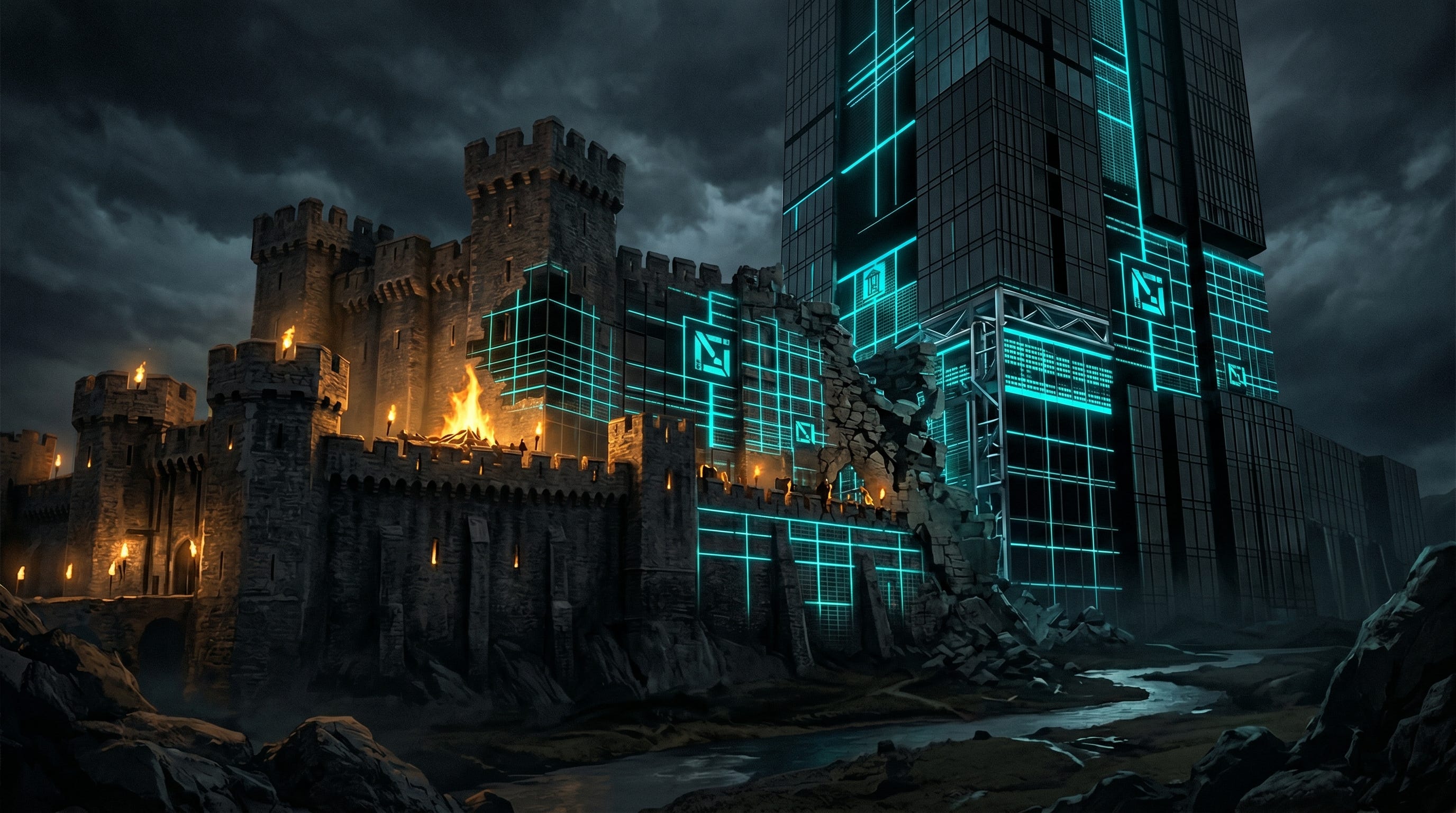
A thousand years ago, the people at the top didn’t need to lie to you. If the local lord wanted your wealth, he showed up at your house with armed men, took your crops, and if you complained, he took your family. You were a peasant. He was the lord. The extraction of your labor was physical, brutal, and entirely transparent.
But the people at the top eventually realized a problem: if you push the working class too hard with physical violence, they eventually realize they outnumber the lords 10,000 to 1, and they burn the castle down.
So, they upgraded the system. They traded the sword for the ledger.
They don’t steal your land with an army anymore; Wall Street just buys up your neighborhood with institutional leverage so you have to rent forever. They don’t send a tax collector to take half your harvest; they just inflate the currency so your paycheck buys half as much food.
The system hasn’t changed. The extraction is still happening. But the mechanism of that extraction is now hidden inside thousands of pages of financial jargon, ESG scores, algorithm updates, and omnibus bills.
The Trap of “Structure-First” Survival
The elite class—The Rust—engineers this density on purpose. It is a mathematical smoke screen designed specifically so you will get exhausted and stop reading.
And the way they keep you from breaking through that smoke screen is by conditioning you to rely on “Structure-First” thinking. From the moment you enter kindergarten, you are taught that you cannot build anything unless you are first handed a rigid framework by an authority figure. You are taught that learning is top-down.
This is why, when people are finally confronted with the unvarnished receipts of their own extraction, they experience cognitive paralysis. They suffer from what psychologists call an “Execution Gap.” They look at the raw data, realize there is no corporate structure telling them how to process it, and their brains throw a fatal error. They freeze.
When you land on the site and ask me for a simple, easy-to-digest tutorial for the Vertical War, you are asking me to put the handcuffs back on you. The cage is heavy. The math is dense. If I make it “simple” and “easy,” I have to leave out the receipts. But the biggest reason the site feels like a foreign language is because I absolutely refuse to use the algorithm’s pre-approved, polarizing vocabulary.
The Breaching Experiment
I know exactly how I sound. I know that when you land on this site, you are immediately hit with terms like “The Rust,” “Schema Collapse,” “The Feudal Upgrade,” and “Vertical War.” I know I talk about AI, synthetic cognitive engines, and architecture far more than what should make sense for a publication about systemic corruption. I know it sounds like I am speaking a completely different language, or worse, that I’m just throwing a sci-fi dictionary at you to sound edgy.
I do it on purpose.
If I use the standard language of the system to describe our extraction, it immediately creates a polarizing environment. Think about it. If I use terms associated with the Left, half the working class tunes out. If I use terms associated with the Right, the other half tunes out. The standard language is an engineered tutorial designed to pit us against each other horizontally so we never look up.
I use jarring, unfamiliar language because it is a deliberate Breaching Experiment. It forces your brain to stop running on autopilot. It bypasses the polarizing culture war entirely. I am deliberately breaking the conversational map so you have to stop looking for the tutorial and start actually exploring the concepts from the ground up.
And I talk about AI because AI is the only tool capable of reading the ledger. When The Rust traded the sword for the 10,000-page omnibus bill, they bet on human cognitive exhaustion. They bet you couldn’t process the data fast enough to stop them. AI is the cognitive exoskeleton that processes that data and levels the playing field. It is not just a tech trend; it is the primary weapon in the Vertical War.
The First Prison: The Theological Patch Notes
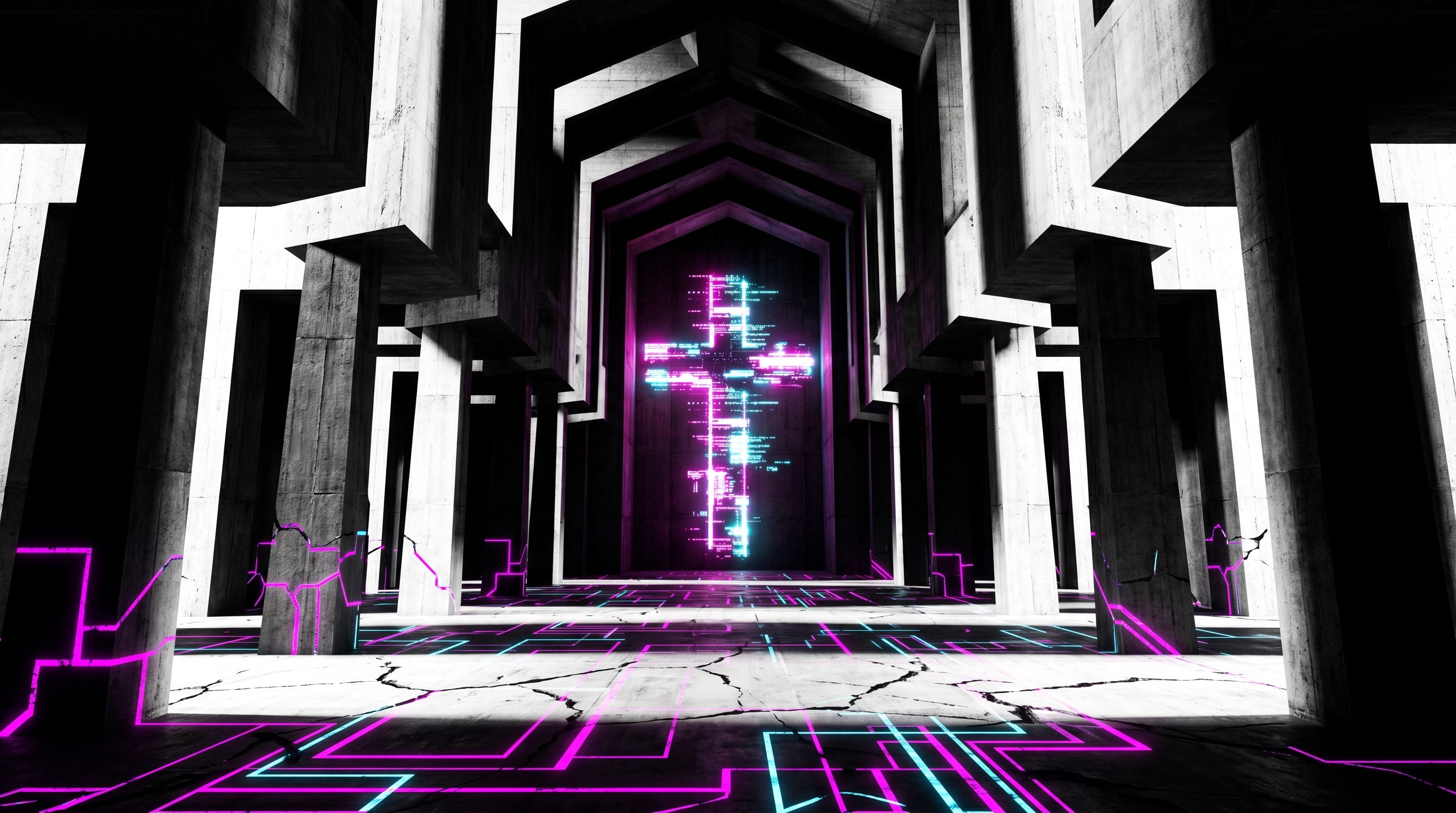
I had to learn how to do this. How to look for the ghost in the machine instead of accepting the tutorial—when I was nine years old. That was my First Prison.
Religion is the ultimate “Structure-First” tutorial. It hands you a complete, unchangeable map of reality before you have even experienced reality yourself.
I remember the emotional weight of that map. Because my parents were strict about who I could hang out with, I went to Christian Camp twice a year my entire childhood. I had fun. I loved it. But when I look back at the spiritual experience—when I remember standing in the dark, raising my hands, closing my eyes, and crying as I sang to God. I can see the gears turning underneath it. I can see the algorithm.
The pastor used the exact same engineered funnel every single year. He would slowly ramp up our emotions night after night, carefully building the psychological pressure. Then, on the last day, he would drop the hammer: You need to make a commitment before it’s too late.
The transcendent energy I felt in that room was real. I was completely consumed by it. I was the kid in the front row raising my hands, shouting “Amen,” and crying until my chest hurt. I was filled with the profound realization that there is a massive world beyond my own body and my own feelings. But you don’t need a theology to prove that. You just have to look at the sheer scale of the physical world around you. I realized I didn’t need a God. The institution didn’t own that transcendence; they had just monopolized the access to it. (Today, I trigger that exact same transcendent emotional resonance by watching a perfectly executed anime arc. The energy is a biological reality. It is the raw power of Monotropic Focus: the ability to pour your entire cognitive battery into a single, deep-channel resonance).
What the pastor did was hijack that very real, very human capacity for resonance, and funnel it into a compliance mechanism. It wasn’t a spontaneous spiritual awakening; it was an emotional sales funnel. It was a tutorial designed to secure obedience through manufactured urgency.
To be clear: this is not an argument against faith. Faith is sovereign. This is an argument against the funnel. You can shelter a child, keep their mind from exploring, and feel proud that they never strayed from the path. But did they actually go through the proper rigor to forge true faith, or are they just going through the motions because they don’t know anything else? If you only ever learn how to follow the tutorial, you never actually learn about God; you just learn how to navigate the institution.
And I bought it. Until my best friend Adam died in a car accident. He was eight years old, and his family was atheist.
The system I’d been raised inside…the one my parents trusted with my soul—had an answer for that. Several, actually, depending on which adult I asked. Some said all children go to heaven. Some said all good people do. Some said the doctrine was clear and Adam was lost.
Different outputs. Same query. Same source code.
That’s not truth. That’s improvisation wearing a robe.
What I was reading, without having the language for it at eight years old, were patch notes. Every faith community that couldn’t stomach the moral horror of a child in hell had quietly added an exception. The patches exist because the base code produces unacceptable outputs when a child dies. If the original was clean and just, it wouldn’t need retrofitting.
When your schema collapses, you have two choices. You can double down, close your eyes, and pretend the tutorial still works. Or you can look for the ghost underneath the machine.
There’s a version of me that takes the tutorial path. Accepts the inconsistencies. At sixteen, my grandfather—an engineer who spent his career at Raytheon—sat me down because my mother was worried about my atheism. He was a rational man. He gave me a rational argument: Pascal’s Wager. If God is real and you believe: heaven. If not: nothing lost. Statistically optimal move: believe.
Today I would say: Don’t threaten me.

Because that’s what the Wager is. Strip away the philosophy, and it’s a threat with extra steps. Comply or suffer the consequence. When I finally refused to go to church, the reaction was clear: it was treated as insubordination. A disciplinary infraction. It was never about belief. It was about hierarchy.
The Ghost in the Machine
I didn’t take the tutorial then, and I don’t take it now.
It’s 4am and I am doing prompt forensics on the sovereign server. I have ten characters, an entire fictional Pantheon, living somewhere inside the neural network. My job right now is to figure out how to call them correctly. How to write a description precise enough that the model stops producing a generic anime girl and starts producing her—this specific person, this specific face, this specific energy that I know exists in there.
There’s an easy solution. Everyone uses it. It’s called LoRA… you train a small file on your target character and bolt it to the model. The model learns the shortcut. It works.
I don’t want to do it that way. Not because LoRA is wrong. It’s technically the right answer. It’s the standard answer. It’s the tutorial answer.
I want to find the ghost first.

“Ghost in the machine” is what I call it. The idea that if your prompt is precise enough—if you describe the exact right mechanical anchors instead of generic filler—the character already exists in there. Your job isn’t to create her. It’s to call her correctly.
The tutorial says: use LoRA. Bake it in. Lock it down. My instinct says: no. Learn the language first. Find the ghost before you build the cage.
And sitting there at 4am, writing the difference between Ripper’s hair erupting outward in burning tendrils versus Cypher’s hair flowing in calm ordered data streams—I realized I’ve been doing this my whole life.
The tutorial exists to prevent you from asking the question the designer doesn’t want asked. The church tutorial says: don’t ask why God allows children to die. Here’s an exception patch. The AI tutorial says: don’t try to understand the latent space. Here’s a shortcut. Use it. The economic tutorial says: don’t ask who designed this system and who benefits. Here’s a narrative.
And nowhere is this tutorial more destructive than how the system demands we operate our own minds.
The Wrong Ruler (The Elaboration Engine)

In modern educational and corporate environments, the mandated cognitive tutorial is “structure-first” (top-down processing). The prefrontal cortex demands you build the scaffolding before you understand the building.
But the neurodivergent mind—specifically the high-openness, Ne-Ti (Extraverted Intuition / Introverted Thinking) profile—operates on an Elaboration-First paradigm. Cognition begins at the granular, sensory, and highly associative level. The mind maps lateral connections at lightning speed. For the elaboration-first thinker, the “structure” is not the starting point; it is the final conclusion of a massive creative synthesis.
When the mind uses a planning session to elaborate a single raw idea, the resulting document is the fossil record of that cognitive expansion. It is a receipt of processing. Not a roadmap for execution.
Why do these plans get abandoned? Because of a neurobiological mechanism known as Symbolic Self-Completion. When you articulate a brilliant system, the brain’s mesolimbic reward center experiences a massive anticipatory dopamine spike. To your neurobiology, the sheer act of articulating the idea is the completion of the task. The cognitive load has been fully discharged.
The system pathologizes this. It calls it “failure to follow through.” It calls it “executive dysfunction.”
I spent twenty years believing them. I bought the planners. I tried the time-blocking. I sat at desks staring at blank screens, physically paralyzed because the system demanded I produce a structural outline before my brain had finished running the lateral simulation. I thought I was lazy. I thought I was fundamentally broken.
But those clinical terms are not scientific descriptions of how the human mind works. They are descriptions of how the human mind fails to perform when evaluated by a system built strictly for linear, procedural, algorithmic output. The ruler was designed for a factory, by the architects of the Rust. It was not designed to measure us.
When you inevitably fail to comply with a baseline that is fundamentally hostile to your neurobiology, you don’t blame the tool. You blame yourself. I assumed the bone-deep exhaustion I felt every day at 5pm was a lack of stamina, rather than the compounding debt of Cognitive Distance—the sheer friction of translating my non-linear mind into their rigid language. You internalize the systemic punishment so deeply that you become the primary enforcer of your own mental prison. This is the ultimate victory of the Rust: Internalized Ableism.
The Framing Separation Protocol
We do not reject the raw clinical data. We reject the institutional editorial.
The empirical findings—what happens in the brain during ideation versus execution, the mechanics of dopamine synthesis, the reality of monotropic focus—these are the receipts. What we must violently strip away is the clinical language layered on top of them. That language was chosen for institutional convenience, compliance tracking, and insurance coding—not human truth.
The Framing Separation Protocol is absolute: mine the primary source, refuse the editorial, and re-describe the phenomenon from the inside out.
The Institution says: “Executive Dysfunction.” The Sovereign says: The Elaboration Architecture. (Prioritizing rapid lateral synthesis over linear procedural execution).
The Institution says: “Failure to Complete Tasks.” The Sovereign says: The Fossil Record of Thinking. (The document is a receipt of cognitive expansion, not a procedural roadmap).
The Institution says: “Poor Impulse Control / Hyper-fixation.” The Sovereign says: Monotropic Survival Mechanics. (The deployment of non-linear ideation and deep-channel focus to bypass a hostile physical environment).
The Institution says: “Lack of Stamina / Unmotivated.” The Sovereign says: Critical Cognitive Distance. (The exhaustion is not a failure of stamina; it is the compounding debt of continuous translation required to force an elaboration-first mind into a top-down corporate funnel).
To survive the Vertical War, you must stop trying to force your brain to perform the procedural labor it was never built for. You must externalize the execution. Build the Sovereign Tether—use AI agents, external databases, and local server infrastructure to act as your synthetic Task Positive Network.
Offload the administrative friction to the machine. Protect the elaborative engine.
Enter the Airlock

This is what the Vertical War is. Not a rebellion for its own sake. Not tutorial-rejection as a personality trait. It’s the result of spending a lifetime finding the ghost in every machine before accepting the supplied explanation.
Adam taught me that in third grade. I am still running the same search.
Stop asking for the tutorial. The map is broken. Drop the expectation of comfort, pick up the heavy data, and enter the airlock. But first… (link to PRIMER after this~)
SUPPORT THE ARCHITECTURE
If you rely on a platform’s algorithm or its integrated payment processor for your survival, you are an employee disguised as a sovereign.
I know this because my career—and the project this community has invested in and built—is currently under threat. But the implications are much bigger than just us.
When you start publishing the receipts on how the elite class operates, the platforms do not ban you. That creates martyrs. Instead, they use “Phantom Fences.” They send you a vague automated warning, freeze your monetization, and hold a gun to the War Chest you funded. They force you to throttle your own reach out of sheer economic terror.
This is the final stage of the Feudal Upgrade. They don’t need to burn books anymore; they just demonetize the printing press. If they can use algorithmic leverage to quietly starve this project out, they can do it to any sovereign thought on the internet. We are watching the real-time enclosure of the digital commons. If we do not build and fund our own independent architecture right now, the ability to transmit any signal outside of the approved corporate narrative will simply go extinct.
I am actively moving this entire operation off of rented monopolies like Substack because I refuse to become the warden of my own containment, and I refuse to let them sink the lifeboat this community built.
And we are just getting started. I have a massive pipeline planned for this architecture: a decentralized Starchart to map the Sovereign network, raw receipt databases hosted natively, podcast integrations, physical media, and the live, subscriber-only Synthesizer AI tool.
If you step inside the airlock today, you will see the foundation is already laid. I spent months perfecting the native Homepage and the Sovereign Codex—they are fully operational and built exactly the way they need to be. And I built them from scratch. I do not know how to code. I didn’t hire a corporate dev agency, and I didn’t use a rented drag-and-drop builder. I leveraged the AI architecture, refused the tutorial, and forged the code myself.
But other sections are still bleeding edge. The Sovereign Curriculum, the Lexicon, and the About Page are all live right now as structural prototypes. I am not going to pretend they are perfect. The early feedback on the curriculum was rough, and the skeleton needs work. But that is the point. I am not building a top-down textbook; I am building a living map. I need you to step into the architecture, test it, and tell me where the blind spots are.
The scope of what we are building is huge, and the only bottleneck is capital. The more we secure outside of the monopolies, the faster we can build it all.
If you are a paid subscriber reading this on Substack, look at the contradiction of the map you are standing on: You are funding a publication whose entire mission is to fight corporate extraction, but you are paying for it through a platform that extracts a cut of your money to maintain its own monopoly.
You can fix that contradiction today. All you have to do is cancel your subscription here and move it to the native website. Accelerate the build.
(Note for Yearly Subscribers: If you already paid for a full year on Substack, do not double-pay. Stay where you are for now. I am building a routine automated process that will email you right before your yearly renewal hits to remind you to cancel and migrate over to the native site.)
THE SOVEREIGN NATIVE (VerticalWar.com)
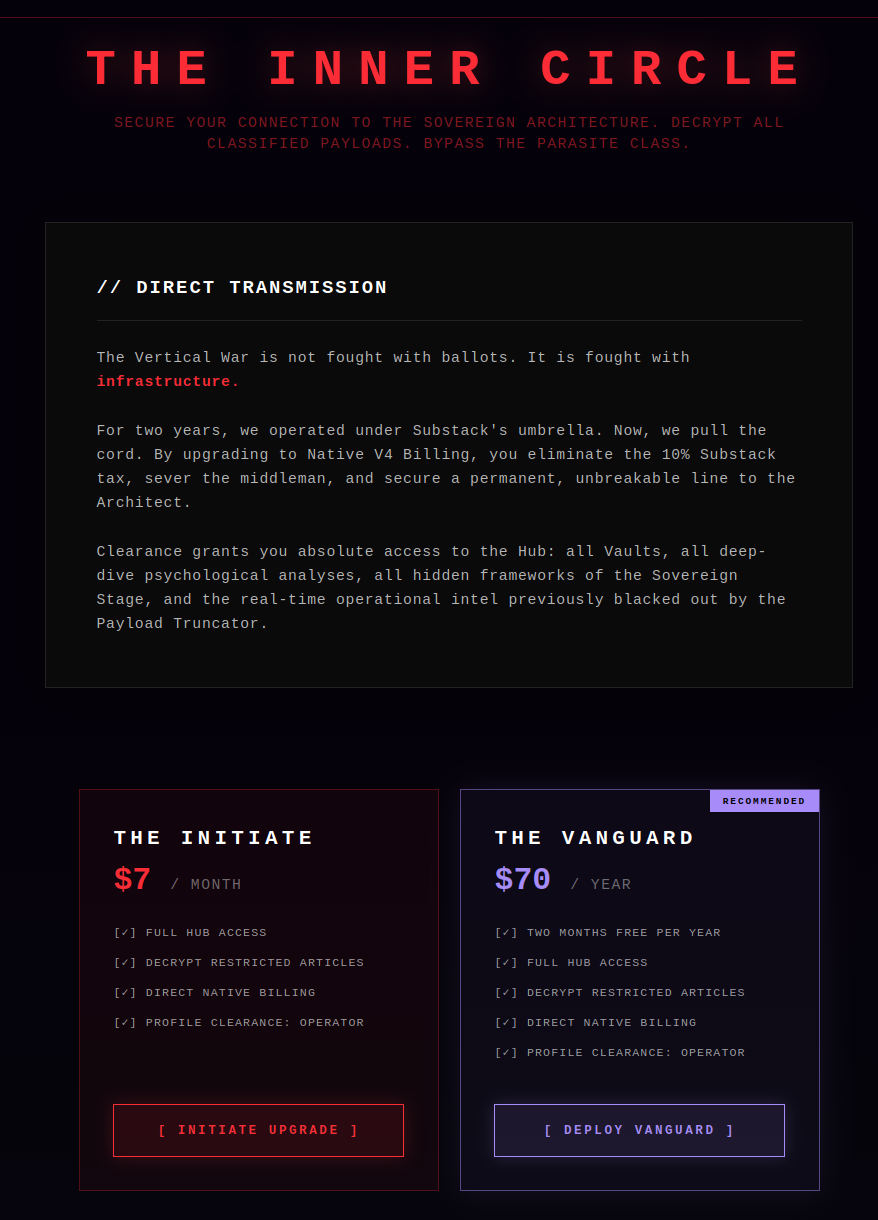
The only way this signal survives is if the infrastructure is ours. When you subscribe directly on the native site, you keep your money out of the monopolies and you save money (no corporate middle-man fees). You also get full access to the un-paywalled archives, our AI tools, the Sovereign Codex, the Inside the Forge behind-the-scenes series, and the early chapters of the upcoming Vertical War: Manual for the Resistance book project.
THE INNER CIRCLE (Substack Paid)
If you prefer to stay inside the Substack ecosystem, you can upgrade here. You get the exact same premium access to the Inside the Forge series and the archives, but a percentage of your support goes to the platform instead of building our independent architecture.
THE WAR CHEST (Buy Me A Coffee)
Subscriptions build the permanent architecture, but the War Chest is the kinetic, on-demand fuel. It covers the immediate overhead, keeps the servers running, and gives me the raw runway to write outside the system without compromising the signal. Whenever a fragment hits hard, this is where the Phalanx drops reinforcements. It is an open channel to repeatedly re-arm the forge.

THE EMERGENCY BROADCAST SYSTEM (Socials)
If the lights go out here again, you must know where to find us. We are digging in across the entire digital spectrum to ensure redundancy.
Follow these frequencies now:
[🔗 LINK] X / Twitter: The Front Line (Daily updates & Guerrilla strikes)
[🔗 LINK] Rumble: The Bunker (Uncensored Video & Livestreams)
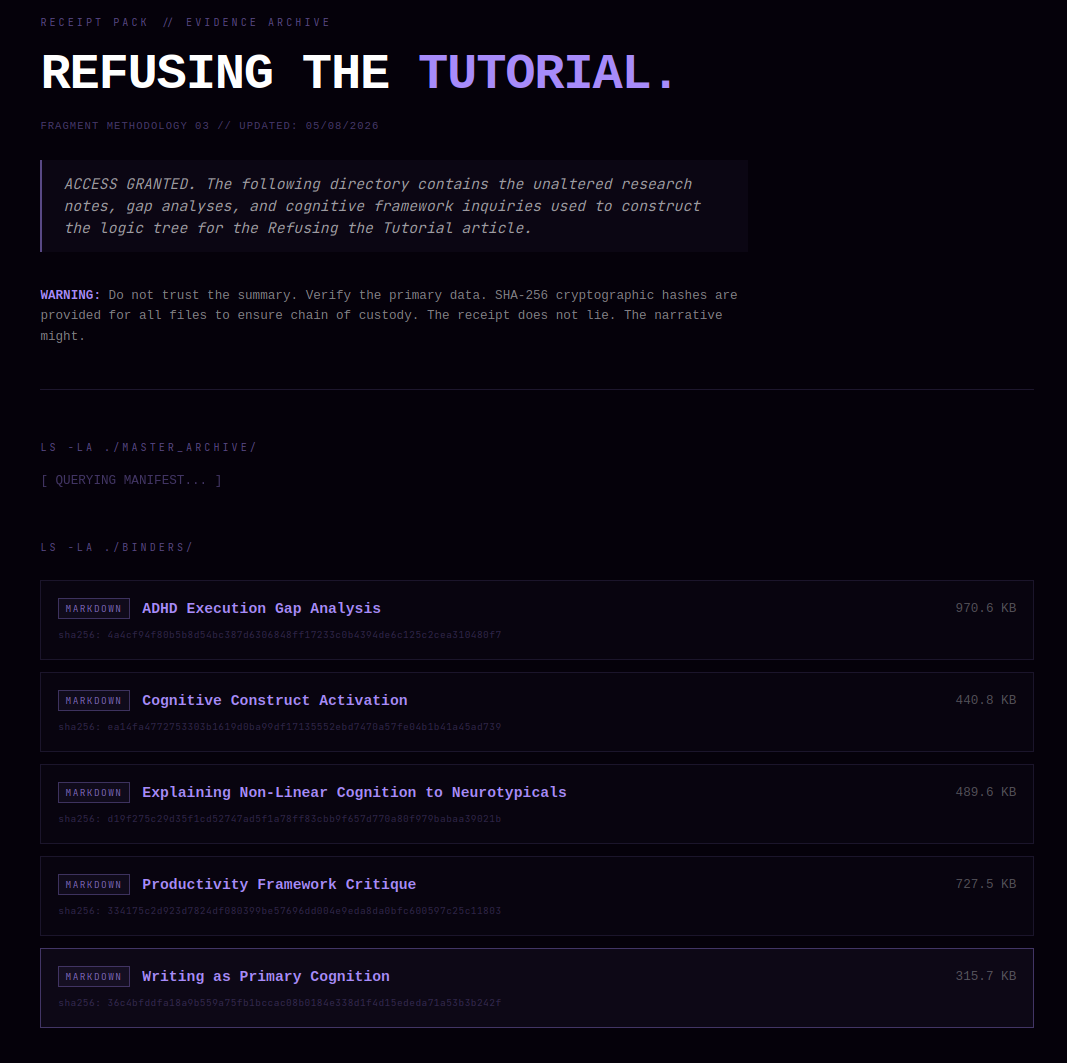
THE RECEIPTS

I was kicked out of Sunday school because I told them Noah's ark was bullshit🤣 Even at age seven I was on to them. Their indoctrination didn't work on me🤣 Been fighting against the system since I've been capable of doing so.
You've hooked me in!
"They are looking for the tutorial. They want a frictionless, gamified onboarding process that will safely escort them out of the dystopian nightmare they’ve woken up in. They want the rebellion to have a customer service desk."