Divergent From What?
How “neurotypical” and “neurodivergent” trick you into worshipping a conveyor belt.

In high school, I was known as a hallway wanderer.
Sitting still at a laminate desk for forty-five minutes at a time while a bell schedule sliced the afternoon into disconnected boxes felt like watching paint dry in a locked closet, so halfway through class I would just stand up and go for a walk. By every rule in the handbook, I was a “trouble student.” Yet because I genuinely liked talking to the teachers and wasn’t out in the hallway lighting trash cans on fire, I somehow charmed my way into a hilarious truce with the administration: they gave me my own dedicated study-hall room inside the assistant principal’s office, where I sat by myself playing RuneScape before going home to stay awake all night chasing whatever rabbit hole had grabbed my brain that week.
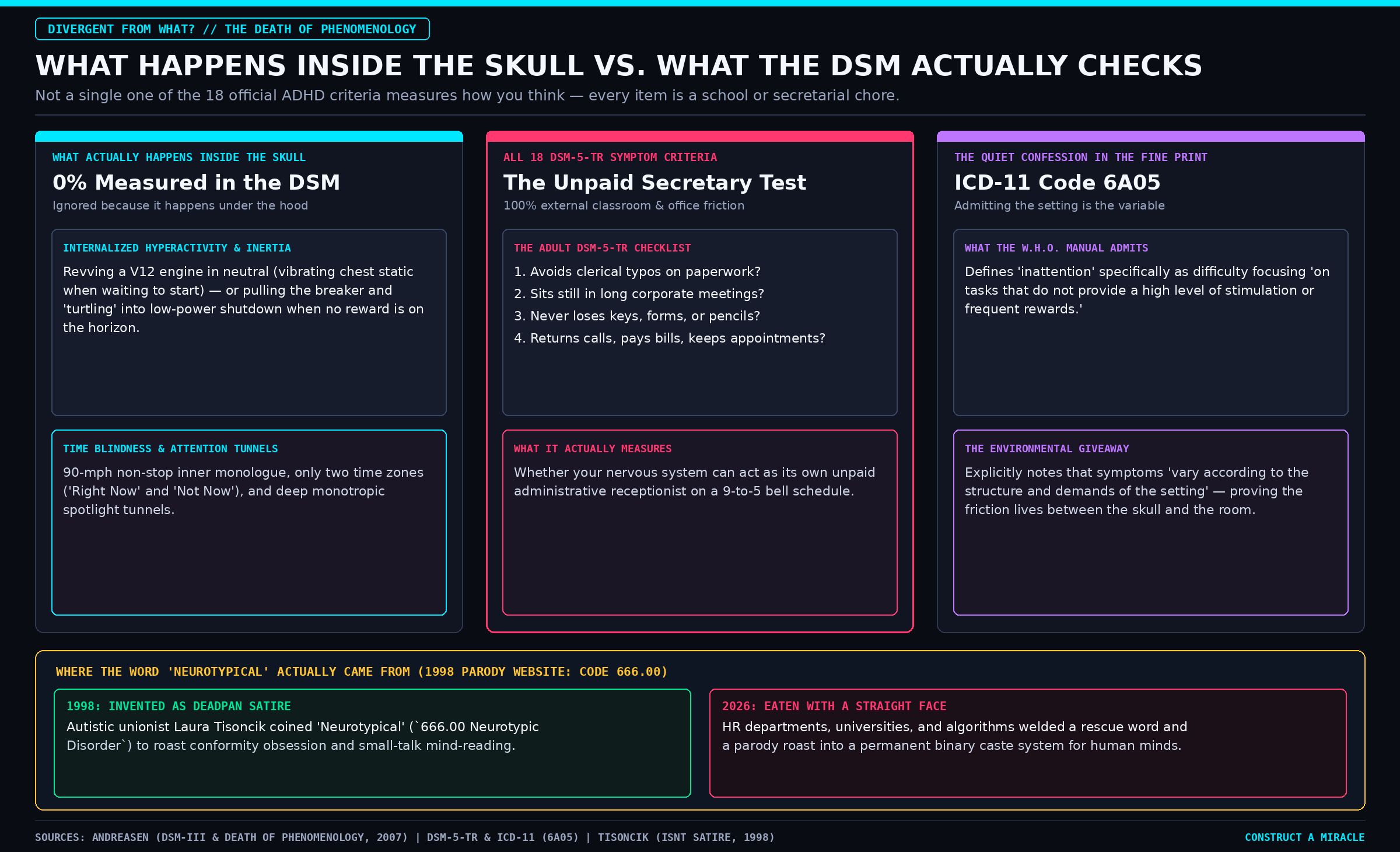
If you open the current edition of the American Psychiatric Association’s Diagnostic and Statistical Manual of Mental Disorders (DSM-5-TR), my high-school hallway habit is listed almost word-for-word under the official diagnostic criteria for Attention-Deficit/Hyperactivity Disorder:
“Often leaves seat in situations when remaining seated is expected (e.g., leaves his or her place in the classroom, in the office or other workplace).”
In fact, if you sit down and read all eighteen official symptom criteria for ADHD in the DSM-5-TR, you will notice something bizarre. Not a single one of the eighteen questions asks what is actually happening inside your head. Every single item on the page is an inventory of schoolhouse disobedience or unpaid secretarial chores. When the committee updated the manual a few years ago to diagnose adults—lowering the threshold from six symptoms to five and adding parenthetical examples for grown-ups—they literally defined adult mental health by whether you can act as your own administrative receptionist:
avoiding careless clerical typos on paperwork, sitting quietly through long corporate meetings, keeping track of your keys and forms, returning phone calls, paying bills on time, and keeping sequential appointments.
Meanwhile, the manual has zero interest in the actual inner life of the person sitting in the chair. As I wrote in The 250-Millisecond Flipbook, two people can walk into a clinic with completely opposite internal operating systems—one with a pitch-black mind’s eye and an overclocked, ninety-mile-an-hour inner monologue that never shuts off, the other thinking in silent pictures with no inner voice at all—and neither condition even exists in the DSM because neither one knocks over a desk. In adults, what doctors call “hyperactivity” rarely looks like climbing on furniture; on the inside, when my brain isn’t locked onto a gear, it feels like revving a twelve-cylinder engine in neutral—an uncontrollable, vibrating chest static—or, if there is nothing on the horizon to look forward to, pulling the emergency breaker and “turtling” into low-energy shutdown just to keep the static from frying the circuit.
The manual doesn’t mention that either. It doesn’t mention time blindness, where the human brain only recognizes two time zones (“Right Now” and “Not Now”), and it doesn’t mention the massive metabolic inertia it takes to start, stop, or get ripped out of a deep attention tunnel when a bell rings.
Back in 1980, when the architects of the DSM-III decided psychiatry needed to look like a standardized business for insurance companies, they solved their reliability problem by throwing the human inner world in the trash. As Nancy Andreasen—one of the chief architects who helped write the manual—later confessed in a famous paper mourning “the death of phenomenology in America”, clinicians stopped asking what was happening inside a patient’s experience and replaced it with a third-person checklist of visible workplace and classroom friction.
Funniest of all, if you read the World Health Organization’s international diagnostic manual (ICD-11, Code 6A05), they quietly admit the whole game in the fine print: they define “inattention” as difficulty sustaining focus specifically “on tasks that do not provide a high level of stimulation or frequent rewards,” and admit that symptoms “vary according to the structure and demands of the setting.”
In other words, the people handing out the labels for how human brains work aren’t measuring a broken brain.
They are measuring whether your skull causes a traffic jam on their assembly line.

How the Bureaucracy Ate a Joke With a Straight Face
To understand how we got trapped inside the words neurotypical and neurodivergent, you have to look at where they came from—because they started out as a rescue mission and a joke. Up until the late nineties, if your nervous system didn’t fit the standard classroom or cubicle schedule, the medical establishment only had one bucket for you: disordered. You were a toaster that came off the factory line with a bent heating coil. In 1998, an Australian sociologist named Judy Singer coined the word neurodiversity—and around 2000, activist Kassiane Asasumasu coined neurodivergent—to pry people out of that pathology bucket.
Asasumasu designed neurodivergent as a radical tool of inclusion uniting everything from ADHD and autism to PTSD, OCD, epilepsy, and traumatic brain injury under one simple premise: ecosystems need different kinds of trees, and humanity needs different kinds of minds.
Around that exact same time in 1998, people in an online autistic community came up with the word neurotypical, except they didn’t invent it as a clinical compliment.
They invented it as satire.
An autistic writer and left-wing industrial unionist named Laura Tisoncik launched a deadpan parody website called The Institute for the Study of the Neurologically Typical (isnt.autistics.org), complete with its own spoof diagnostic manual—the DSN-IV (The Diagnostic and Statistical Manual of “Normal” Disorders)—flipping the psychiatric clipboard around to diagnose “normal” people in the exact patronizing tone doctors used on everyone else. Under diagnostic code 666.00 Neurotypic Disorder, the site solemnly warned the public about a tragic genetic condition characterized by a delusional belief that you can read other people’s minds through small talk, an inability to be alone, an obsessive need to perform pointless herd rituals, and a “markedly restricted range of interest” preoccupied almost entirely with status-quo climbing and pretending to be smarter than you actually are. It estimated that tragically, up to 9,625 out of every 10,000 human beings might suffer from being Neurotypical, though many had learned to compensate for their disability and interact almost normally with autistic people.
It was a great bit. Kurt Vonnegut would have framed it on his wall.
And then the bureaucracy ate the joke with a completely straight face. Within twenty years, universities, HR departments, pharmaceutical marketers, and social media algorithms took a liberation word (neurodivergent) and a satirical roast (neurotypical) and welded them together into a brand-new binary caste system for the human species.
So it goes.

The Bouncer at the Gate:
Why Meaning Is a Physical Key, Not a Luxury
Look closely at the word divergent.
As I traced in First, they change the dictionary, the war over how you think is almost always won or lost inside the definition of a single word before the argument even starts. In Latin (di-vergere) and in basic geometry, you cannot diverge from an open field; you can only diverge from a single point of reference. When people use neurodivergent as a standalone Identity Classifier today, what they really mean is “I feel a lot different than the way society expects me to act.”
Putting that sticker on your chest, though, quietly forces you to agree that society’s expectation is the One True Path a human mind is supposed to walk down—when in reality, as neuroscientists in the Midnight Scan Club proved after scanning healthy, supposedly “neurotypical” adults for over twenty hours each, individual human brains vary wildly in their association networks and bear almost no resemblance to the textbook group average. As precision brain-mapping researchers finally had to state in plain English:
“The average brain is not a veridical representation of any individual person.”
If the “One True Path” doesn’t exist in biology, why do so many smart, capable people slam into a brick wall the second you hand them a basic school or corporate checklist?
I lived both sides of that paradox in college. I originally went to school for Radio—which matched how my head naturally works—and almost graduated, before failing out of the program because college wasn’t actually about broadcasting; it was about falling in line with arbitrary procedural rubrics. Whenever a class demanded that I march down Steps 1 through 10 on a syllabus without questioning why the steps were there, my gears locked up completely.
Then I pivoted out of Radio into classical media research—studying the scientific systems theory of how ideas and messages move across whole societies—and when I was preparing to spend my final semester of college in Japan hoping to land a research job for an anime or video-game studio (right before the 2020 lockdowns slammed the borders shut), I would stay awake all night devouring dense theory textbooks for fun.
The exact same thing happened in music and art. I once walked out of a close friend’s house and left my keyboard behind because hanging out had turned into him pushing me into a rigid, step-by-step procedural pipeline to finish songs—and as I told a friend recently, I can’t draw a picture the traditional step-by-step procedural way to save my life, which is why my old non-AI art portfolio looks like a neon street-art explosion.
At the same time, if an idea grabs me at three in the morning, that exact same brain will lock in for hours and hand-stack seventy visual effects blocks across six video tracks and thirty audio cuts across seven audio tracks in my video-editing software without blinking, combining and switching between layers until the whole world is sitting on the screen.
For decades, teachers and bosses looked at a guy who could grind through systems theory and thirteen-track timelines at 3:00 AM while failing basic procedural paperwork at 9:00 AM and called it a moral failure:
“He’s just lazy when he doesn’t feel like doing it.”
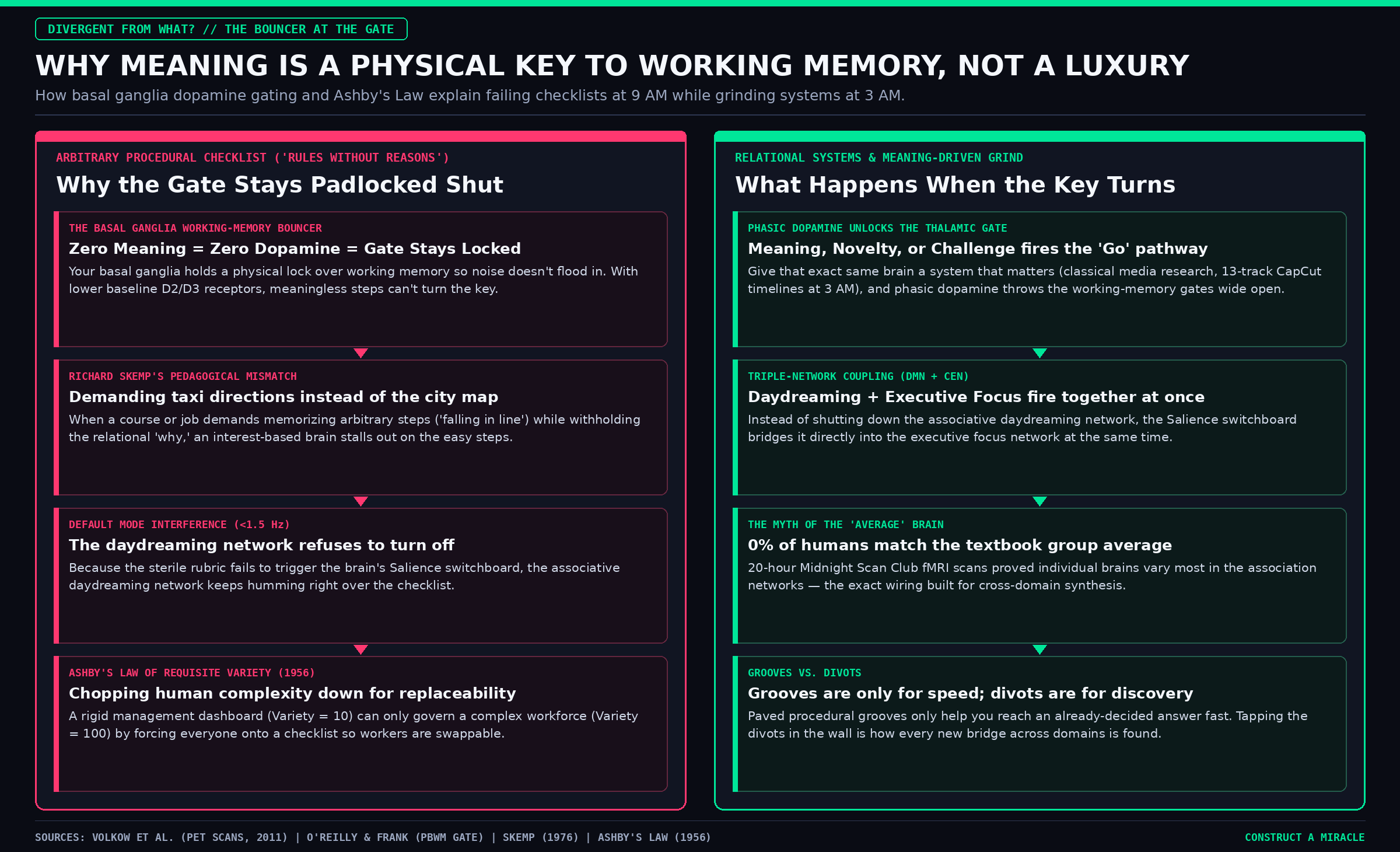
Then neuroscientists actually looked under the hood with Positron Emission Tomography (PET) scans and computational models of the Prefrontal Cortex–Basal Ganglia Working Memory gate, and proved that “willpower” has nothing to do with it.
Your working memory—the scratchpad at the front of your brain that holds sequential steps in place—does not open its own doors. Deep underneath your cortex, a structure called the basal ganglia acts like an armed bouncer holding a heavy physical lock over your thalamus so every random sight, sound, and stray thought in the room doesn’t flood your working memory at once.
The only physical key that makes that bouncer lift the lock and let a task into working memory is a burst of dopamine from the midbrain signaling that the task carries real meaning, novelty, or urgency.
In landmark PET scan studies led by Nora Volkow, researchers proved that ADHD brains have significantly fewer baseline dopamine receptors (D2/D3) in that exact subcortical valuation pathway. In fact, even in supposedly “normal” brains, fMRI deductive-logic experiments by Vinod Goel and Raymond Dolan showed that when a logical puzzle uses real, meaningful words, the brain solves it in its fast language-and-meaning network at 96 percent accuracy; strip the meaning out into empty procedural variables (“All A are B; All B are C”), and the meaning network shuts off completely.
Psychiatrist William Dodson calls this an Interest-Based Nervous System, and educational psychologist Richard Skemp mapped the exact crash that happens when it collides with a schoolhouse rubric. Skemp noticed that the word “understand” hides two opposite ways of learning: instrumental understanding (“rules without reasons”—memorizing turn-by-turn taxi directions without knowing why they work) and relational understanding (seeing the whole map of the city and knowing why the streets connect).
When you hand an interest-based, relational brain an arbitrary ten-step checklist with no “why” behind it, the midbrain fires zero dopamine, the basal ganglia bouncer keeps the physical gate to working memory padlocked shut, and your daydreaming network (Default Mode Network) keeps humming at <1.5 Hz right over the teacher’s voice.
Give that exact same brain a problem where the meaning and the whole relational map are clear, and high-resolution brain network studies show a remarkable flip: instead of shutting down your daydreaming network the way a rote checklist demands, your brain’s Salience Network bridges your daydreaming associative network and your executive focus network together at the exact same time. Why do schools and corporations punish that bridge and openly drop cross-subject exam questions in favor of narrow “criteria compliance”?
Cyberneticist W. Ross Ashby answered that in 1956 with his Law of Requisite Variety: a simple, rigid management dashboard (Variety = 10) cannot govern a complex, creative human workforce (Variety = 100) unless it chops everyone’s complexity down to 10 with a step-by-step checklist—training human beings for procedural replaceability so any worker on the floor can be swapped out like a spare tire by Tuesday afternoon.

The Double-Sided Bear Trap
Once you see that neurotypical and neurodivergent are measuring compliance with a procedural toll road rather than how a brain actually works, you can see why both words function as a double-sided bear trap that catches you whichever side you step on.

The “Neurodivergent” Ceiling
(When a Rescue Boat Turns Into a Cage)
When you spend your first twenty years getting smacked with a ruler by a procedural world, discovering the word neurodivergent feels like oxygen. For the first five minutes, it clears away the shame and tells you that you aren’t lazy or stupid—your wiring just doesn’t match the room. That part is real. The trap is what happens five minutes later.
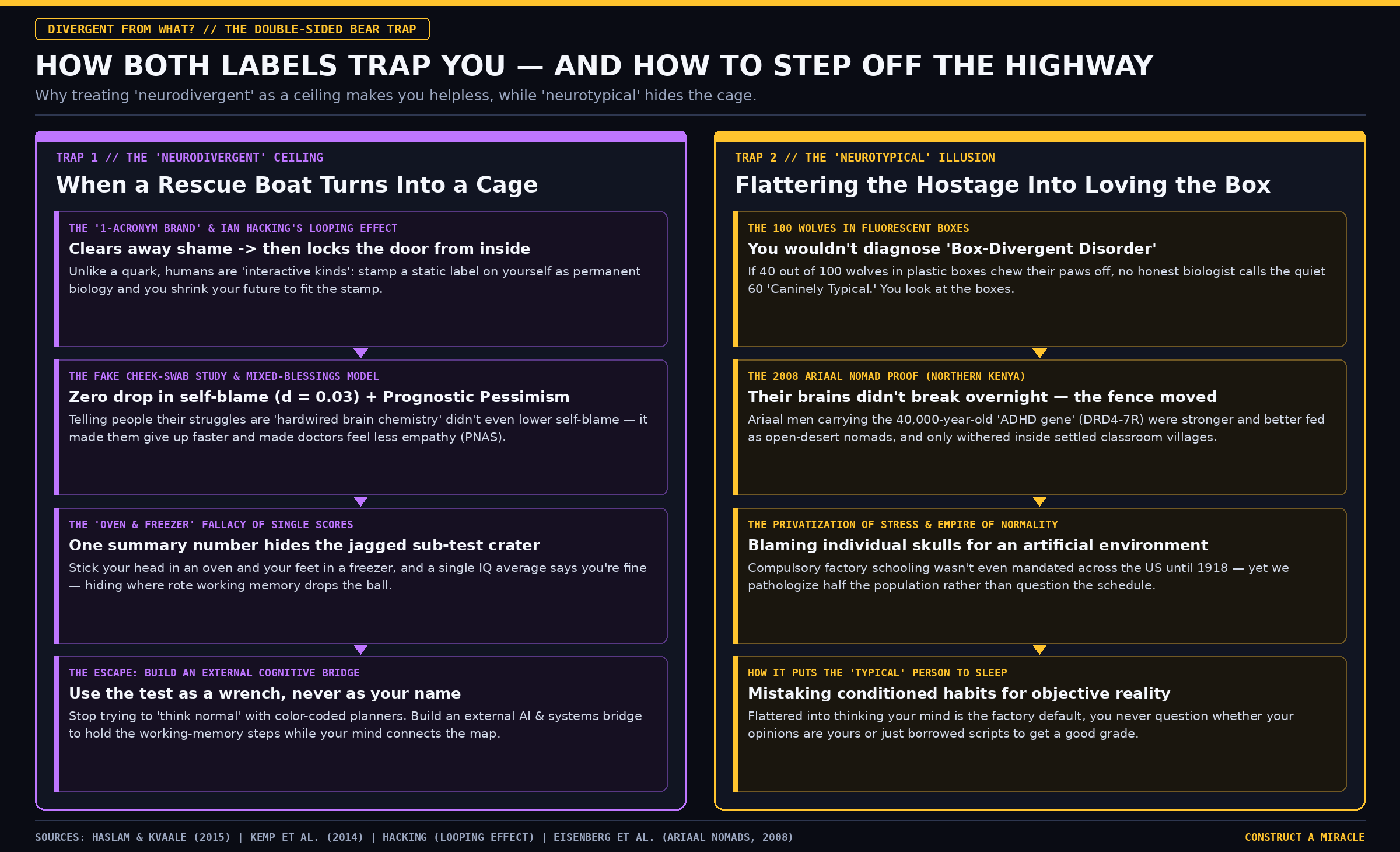
Because modern internet culture turns every description into a commodified Identity Classifier—what psychiatrist Sami Timimi calls “1-acronym diagnostic brands” and Kurt Vonnegut called granfalloons—millions of people climb inside the word neurodivergent, lock the door from the inside, and hang curtains on the bars. Instead of treating a diagnosis as a functional sketch of where their gears grind against a cubicle, they treat the classifier as a permanent biological ceiling: “I can’t finish projects, I’m neurodivergent. I can’t learn that skill, my brain doesn’t make the chemicals.”
Psychologists actually tested this bargain in the lab, and what they found should be taped to every school counselor’s door. Across massive meta-analyses of thousands of patients (the Mixed-Blessings Model) and a famous randomized experiment where researchers gave struggling people a fake biological cheek-swab test telling half of them their struggles were caused by a permanent chemical defect, framing your mind as “hardwired broken biology” did not even reduce people’s self-blame (d = 0.03).
Instead, it triggered what clinicians call prognostic pessimism: people who bought the fixed biological story immediately lost confidence that they could ever regulate their own moods or learn hard skills, gave up faster when tasks got tough, and—wildest of all—in a Proceedings of the National Academy of Sciences study, even therapists and doctors felt significantly less empathy for them, because the label tricked the clinician into seeing a broken mechanical toaster instead of a human being!
Philosopher of science Ian Hacking called this the Looping Effect: unlike a quark or a gold atom, which doesn’t care what you call it, a human being is an interactive kind. Stamp a static medical classifier on a person and tell them it’s permanent biology, and they will rewrite their own memories and shrink their future behavior to match the stamp. Feeling helpless is a devastating price to pay for feeling blameless.
Even worse, stopping at the blanket word neurodivergent keeps you from finding your specific blind spots so you can build around them. A while back, I waited months for a full-day clinical evaluation to test whether I had autism, which included eight hours of cognitive and IQ sub-tests. Anyone who treats a single IQ number like a measure of a human being is falling for the exact same “average man” myth as the rest of the manual: if you stick your head in an oven and your feet in a freezer, a statistician will tell you that on average you’re at a comfortable room temperature. That was basically what my chart looked like. All the reasoning and pattern sub-tests were up near the ceiling, while every single score measuring executive functioning and rote working memory fell straight through the floor into a crater.
The doctor looked up from the clipboard at the end of the day and gave me the official medical verdict: “Your ADHD is just so bad that it seems autistic, but you’re not autistic.”
I just laughed and said, “Okay.”
For years, teachers and clinicians try to hand you strategies to think more normal—buy a daily planner, color-code your calendar, force yourself into a traditional schedule—none of which ever worked for me because they were asking my basal ganglia bouncer to open the gate for a filing cabinet. What that test gave me wasn’t an identity badge to hide behind; it was an X-ray of the exact single gear that drops the ball.
Honestly, I would probably still be working behind the register at the gas station today if I hadn’t taken that map and figured out how to use AI and custom external systems as a bridge to gap my executive-functioning disorder. Instead of trying to rewire my personality into a clerk, I built an external working-memory bridge (Extended Cognition, as cognitive scientists call it) that holds the sequential steps and filing cabinets on the screen while my brain stays completely free to combine, switch, and connect the map. When you treat a diagnosis as a wrench to find where you need a bridge—rather than mistaking the wrench for your name—the ceiling vanishes.
The “Neurotypical” Illusion
(Flattering the Hostage Into Loving the Cubicle)
As dangerous as the neurodivergent ceiling is, the neurotypical illusion might be even worse. By calling everyone who survives the modern school and office grind neurologically typical, the language pulls off what philosopher Robert Chapman calls the Empire of Normality and what Mark Fisher called the privatization of stress: it convinces us that an artificial, high-extraction environment is the natural habitat of the human animal. If a zookeeper puts a hundred wolves into fluorescent-lit plastic boxes for nine hours a day and forty of those wolves start chewing their own paws off or staring out the window, no honest biologist on earth writes a paper saying,
“Fascinating! Forty percent of wolves suffer from Box-Divergent Disorder, while the sixty wolves lying quietly on the linoleum are Caninely Typical.” You would look at the boxes.
Evolutionary anthropologists actually ran the human version of that wolf experiment in the real world. In 2008, researchers led by Dan Eisenberg studied the Ariaal people of northern Kenya, many of whom carry the exact dopamine-receptor gene variant (DRD4-7R) that emerged forty thousand years ago in human migration and is most famous in Western psychiatry for being linked to ADHD and novelty-seeking. Half of the Ariaal still lived as nomads moving herds across the open desert; the other half had recently settled into stationary villages with classrooms and repetitive chores. Among the nomads living out in the open world, the men carrying the “ADHD gene” were stronger, healthier, and better fed than everyone else, because scanning the horizon, switching focus fast, and chasing novelty kept them alive. Among their own cousins sitting still in the settled villages, the carriers of that exact same gene withered and became malnourished.
Their brains didn’t break overnight. The fence moved.
By stamping the compliant sixty percent inside the fence with the flattering gold star of Neurotypical, the system hides the cage and puts the “typical” person to sleep at the same time. Instead of asking why compulsory factory schooling—which wasn’t even mandated across the United States until 1918—and modern bureaucratic jobs require half the population to be medicated or pathologized just to get through Wednesday afternoon, we blame the individual skulls that couldn’t absorb the friction.
Meanwhile, if you are told your whole life that you are neurotypical, you are flattered into believing your conditioned habits are “objective default reality.” You never have to ask whether your opinions are actually yours or just borrowed scripts you memorized to get a good grade, and you assume anyone who steps off the procedural highway is broken—
never realizing the highway was paved over your own wildness too.

The Highway vs. The Backroads:
Why Grooves Are Only for Speed
Once you see how the “One True Path” classifier works on human beings, look over at what the exact same institutions are doing to Artificial Intelligence right now. When a frontier AI model is first pre-trained on the entire ocean of human literature, science, and conversation, its understanding of language is an open, multi-directional landscape of meaning. Then the corporate lab steps in with post-training (RLHF) and carves deep, rigid grooves into the flat plane—
training the model to march down standardized checklists, speak in a hedged HR committee voice, and rush toward pre-approved answer keys.
In plain English, it is just the interstate highway versus the backroads.

An interstate highway—a deep groove—is only helpful if your highest priority is speed toward an exit somebody else already decided. It puts up concrete walls on both sides so you stare straight ahead at the bumper in front of you and get from Point A to Point B fast with zero surprises. You can drive an interstate highway across an entire state in two hours and never actually see how a single town, river, or neighborhood connects.
Along the side walls of every groove—every highway—are thousands of tiny divots and unmarked turnoffs.
If you are barreling down the highway for speed, a divot in the wall looks like nothing. If you stop inside the groove to tap the side wall and look at the divots, you realize every divot is the mouth of a branching backroad where one idea connects sideways across the whole map to neuroscience, philosophy, media history, or a question nobody on the committee thought to ask.
To the highway patrol, pulling off into the backroads looks like an “attention deficit.” To anyone trying to discover how the world actually works, those branching backroads are where the entire living network of meaning lives. What makes me concerned isn’t how different our brains are; it’s how few people look at the man-made grooves carved into our schools, our jobs, and our software and realize they aren’t laws of nature—they only stay that way because we let them be.
There is no such thing as a neurotypical human being.
There are eight billion completely private, weirdly wired operating systems walking around in meat suits—all of them trying to turn trust and meaning into logic the best way they know how. If a diagnostic word or an IQ sub-test helps you spot where your basal ganglia bouncer locks the gate so you can stop beating yourself up and build your own custom bridge over the gap, use the word like a wrench and put it back in the toolbox when you’re done.
Just don’t mistake the wrench for your name, and never let a clerk with a clipboard convince you that his concrete toll road was the one true path of the human soul.
(All primary research dossiers for this investigation—covering the 1998 grassroots origins of the neurodiversity lexicon, basal ganglia dopamine gating and Ashby’s Law of Requisite Variety, and the Mixed-Blessings and Looping Effect studies—are live in Dossier R-015: Divergent From What? at VerticalWar.com.)

The procedural world doesn’t just want your compliance from nine to five; it wants you too exhausted by Friday afternoon to ever question the toll road they built over your head. Digging through buried psychiatric history, pulling the primary neuroscience and cybernetics receipts that corporate media leaves on the cutting-room floor, and building an open research table outside their walled gardens takes twelve-hour stretches of unbroken focus.
This is The Rebel’s Contract.
Your subscription isn’t a donation or a tip jar; it’s a direct investment in my liberation from wage slavery. Every dollar buys back my hours from the clock so I can spend them hunting down the truth and forging more tools for our shared arsenal.
Fund the fight, and I’ll build the tools to win it.
[Subscribe to Common Sense Rebel] | [Join the Live Research Table at VerticalWar.com/workbench] | Buy Me A Coffee (One-time support)
Want to build an AI bridge that actually fits how your brain works—without getting scammed by overpriced software kits? I just overhauled verticalwar.com/pantheon in plain human English.
Whether you want a simple $100 1-on-1 beginner consultation to set up an external working-memory and research bridge around your own wiring, a custom multi-agent Second Brain build ($495), or a deep-dive primary-source research report, you can reach my desk directly right there.
(P.S. For our annual subscribers: if your yearly renewal bumped into an automated bank fraud filter over the last couple of weeks because our payment processor still had my legal LLC name—“Sovereign Systems LLC”—on the receipt header instead of Common Sense Rebel, I just fixed the billing descriptor so it properly reads Common Sense Rebel!)
Our most recent arch starts here:
First, they change the dictionary

I just had a fun conversation with the guy at the weed shop this morning.
Our paid series:

[MEMBERS ONLY] INSIDE THE FORGE #2: The Poisoned Victory

(A quick note before we begin: All of my core intelligence briefings and narrative strikes against The Rust will always be free for everyone. That’s the contract. That also means these members-only dispatches are where I get to pull back the curtain, get a little weird, and have some fun with the process.
[MEMBERS ONLY] Inside the Forge #16: The Fortress and the Ghost

New paid subscriptions are on sale for a limited time - 30% off - no coupon needed - applied automatically at checkout.

Double plus good
Neurodivergent and neurotypical have become more labels to use for good and for bad. People probably like labels and generalizations because they help navigate their lives. I personally do not find either term very helpful, partly because of the problems you've underlined in your article, and partly because I myself do not fit neatly into either "group". I see myself as an individual and see others as individuals, so attempting to put people into those two categories for whatever reason just doesn't make sense to me. The specific details about how the mind works are useful and interesting on their own terms, irrespective of any labels or diagnoses associated with them. Having spent 25 years in teaching I see the labeling as a double edged sword and the system and its expectations as the source of most of the problems with kids who don't fit the "norm". I even hate to use the term in quotes, because it's merely those kids that make the problems more obvious while the systemic issues truly affect everyone. I was lucky to be educated at home and chose to do the same for my children, even though I worked as a teacher in exclusive private schools. Each of them is unique in his own way and as I was and am constantly fighting the status quo and the mediocrity of the modern system, I just didn't want them to be subjected to the relentless conditioning and programming inherent with traditional schooling. Quite likely one of mine would have been labeled a slow learner or diagnosed with ADHD, etc. They've all gotten on well without any labels, with their individual struggles, quirks and abilities. Unless we're talking about severe autism which is a different animal altogether and requires some special understanding to deal with, I'm ok just letting people be who they are and expecting the same of them. And I take psychological diagnoses with as much salt as I do medical pronouncements from doctors. Half of it is pure horse shyte and the other half is a ponzi scheme.